











Popular
What is the significance of the time-leaping ability that the protagonist, Makoto, discovers?
How does Makoto's relationship with her friends, particularly Chiaki and Kousuke, evolve throughout the film?
What role does the mysterious character of Chiaki play in Makoto's journey?
What are the consequences of Makoto's repeated time leaps on her life and the lives of those around her?
How does the film depict the theme of nostalgia through Makoto's experiences?
Should I watch it?
Ask Your Own Question

What is the plot?
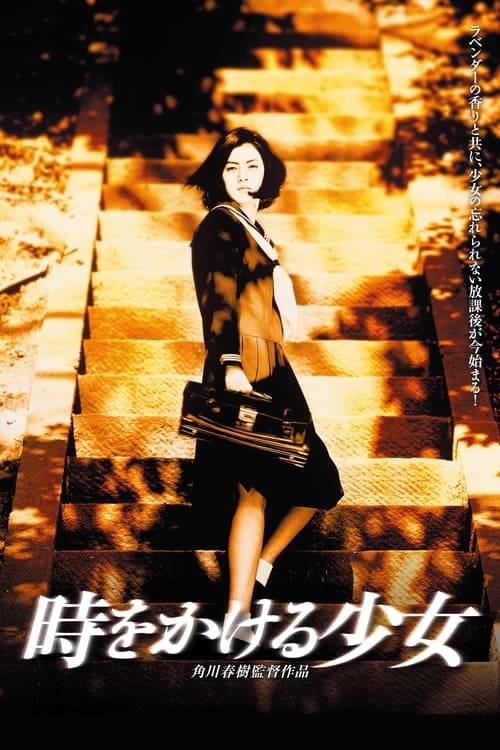
In The Girl Who Leapt Through Time as the 2006 film tells it, summer begins quietly at Kuranose High School in Tokyo, where seventeen-year-old Makoto Konno drifts through second-year high school life with no grand ambitions, no urgent plans for the future, and only the easy companionship of her two close friends, Chiaki Mamiya and Kosuke Tsuda. The days feel loose and unremarkable: classes, sports, lazy conversations, and the small humiliations of being a teenager who is more comfortable reacting to life than directing it. Makoto is the kind of girl who can spend an afternoon tossing a ball with the boys, complain about homework, and then worry about dinner or a test, all without ever imagining that time itself is about to become something she can bend.
The first break in that ordinary rhythm comes on a day that starts badly and gets worse. Makoto notices the proverb on the classroom blackboard, "Time waits for no one," and almost immediately stumbles onto a strange, walnut-shaped object in the science room area, the thing that triggers everything that follows. Soon afterward, while rushing to meet her aunt, she rides her defective bicycle toward a railroad crossing, loses control as the brakes fail, and is hurled directly into the path of an oncoming train. For a horrifying instant it seems she is about to die, the metal train filling her vision and the world snapping into danger, but then the impossible happens: she jolts backward through time and finds herself returned to the moment before the accident, alive, breathless, and staring at the same crossing as if reality has blinked and reset itself.
Terrified and confused, Makoto runs to her aunt, Kazuko Yoshiyama, who works as an art restorer at the Tokyo National Museum and knows more about this sort of thing than Makoto can possibly understand at first. Kazuko listens to the story and calmly tells her that what happened is called a time leap, an ability that has happened before and, in Kazuko's explanation, often appears in adolescent girls. Makoto is stunned to learn that this is not a dream or a fluke but a real phenomenon with rules, limits, and consequences. The revelation reframes the bicycle accident: she has not merely survived a crash, she has slipped outside ordinary time and returned to an earlier point in the day.
At first, Makoto responds the way a teenager naturally would if handed a miraculous power: she tests it, then immediately starts using it for selfish convenience. If she is late, she leaps. If she embarrasses herself, she leaps. If she gets a bad result, misses a cue, or wants to redo a moment that felt awkward, she leaps again. The film turns these repetitions into a buoyant comic rhythm. She can relive a karaoke session, improve a quiz score, escape small disasters at home, and make her days feel smoother and more enjoyable simply by rewinding the clock and trying again. For a while, her life becomes absurdly rosy, as though the universe has handed her a private cheat code and she intends to use it on every minor inconvenience.
One of the earliest and most important scenes after the revelation is Kazuko's explanation that time-leaping is not limitless. Makoto learns that the power is finite and that every leap consumes one of the chances she has been given. This warning does not stop her immediately, because the temptation to control her environment is too strong. She keeps using leaps to avoid embarrassment, improve test scores, and relive pleasant moments, but the film quietly begins to tighten around her. The more she rewinds events, the more the world around her starts to show the strain of being manipulated.
Chiaki and Kosuke remain close to her throughout this early part of the story, but their roles begin to shift as Makoto's power intersects with their feelings and futures. Makoto becomes especially focused on preventing an awkward love confession and smoothing out social complications, and at one point she even plays matchmaker between Kosuke and a classmate, Kaho Fujitsu, while continuing to use leaps to manage the social chaos she is trying to avoid. She treats the power like a tool for tidying up her daily life, but the film steadily reveals that every small correction creates other distortions she cannot fully predict.
The tension rises as Makoto discovers that her leaps are not just convenient, they are disappearing. She begins to understand that the number of times she can time leap is limited, and every use brings her closer to the end of that hidden reserve. She tests the boundaries, then starts conserving what remains, but by then the pattern of her life has already changed. Actions that once felt inconsequential now matter, because the power that allowed her to undo mistakes is running out. The emotional center of the film shifts from fantasy to consequence: if she can no longer reset everything, then each choice starts to stick.
Meanwhile, Chiaki becomes stranger and more central, and the film quietly layers clues that he is not simply another carefree classmate. He is observant in ways the others are not, and his interest in Makoto carries a tension she cannot name yet. What seemed at first like playful everyday banter begins to feel charged with something unspoken. Makoto, still largely thinking in terms of school days and easy afternoons, does not yet understand that Chiaki's presence in her life is tied to something much larger than a normal teenage friendship.
That larger truth breaks open at the climax. Makoto has already nearly exhausted her time leaps when Chiaki becomes suspicious that she is using the power. She panics, trying to prevent him from learning too much, because the one thing she has begun to realize is that knowledge about time leaping changes everything. Then the story surges toward its decisive moment: a bicycle hurtles toward the railway crossing again, chaos erupts, and the scene feels like a terrible echo of the day everything began. Kosuke and Kaho are thrown upward in the commotion, the danger of the moment making the familiar setting suddenly violent and unstable.
As Makoto cries out "Stop!!," time itself freezes. The image is dramatic and hushed at once: suspended motion, breath caught in the air, and then Chiaki appears inside the halted moment to finally speak the truth. He confesses that he is from the future. His name, his behavior, his emotional distance, and his strange familiarity with time all snap into place. He tells Makoto that he time-leaped back into her era because he wanted to see a painting that exists only in this season, in this time, and nowhere else. This revelation is the film's most important twist: Chiaki was never only a classmate, and his interest in the present has always been bound to a future beyond Makoto's reach.
The confession reorders everything Makoto thought she knew about him. His quiet presence around her, his drifting conversations, and his subtle sadness now read differently. He is not simply leaving school someday like everyone else; he is a traveler temporarily stranded in her time, attached to a mission that gives his whole stay a bittersweet urgency. He also tells her that he can never see her again now that someone from the past knows about time leaping, and then he disappears from the frozen moment, leaving Makoto with the full emotional force of his confession and the knowledge that some doors close the instant they are opened.
The film does not linger on sentimentality; instead, it drives straight into Makoto's final realization. She discovers that she has regained the power for one more time leap. This last leap is not another opportunity for convenience. It is her one remaining chance to choose what kind of person she wants to be after having treated time like a disposable toy. She understands, at last, the value of what Kazuko and Chiaki have been trying to teach her: time is not something to waste because a repeated moment is never the same moment twice. The film's core idea, the meaning of "irreplaceable time," becomes emotionally real rather than abstract.
Makoto uses that final leap to return to the day and place where she first met Chiaki. The scene is charged with a different kind of energy from the earlier comic repetitions. She is no longer leaping to fix a quiz, avoid embarrassment, or redo a casual afternoon. She is returning to the origin of something that mattered, trying to preserve the connection she almost lost through carelessness and fear. This time, she acts honestly. She speaks from the heart instead of stumbling around the truth. The film frames this return as both a correction and an acceptance: Makoto cannot keep Chiaki with her forever, but she can at least choose not to let their bond vanish without being acknowledged.
What follows is the emotional resolution rather than a tragic ending. There are no deaths in this film's central story, no fatal confrontation, and no body count to tally. The conflict is about loss of possibility, the pain of separation, and the way time forces people to choose what they value before it slips away. Chiaki's future origin means he belongs to another timeline, and Makoto's repeated leaps have already changed the emotional shape of their relationship beyond repair in ordinary terms. Yet the ending does not collapse into despair. Instead, it leaves Makoto with a transformed understanding of herself: she is no longer the girl who drifts through summer afternoons without direction, because she has now faced the reality that some moments cannot be repeated, only lived well the first time.
In the last movement of the film, Makoto carries forward the lesson she has learned. Chiaki's disappearance from her immediate life does not erase the meaning of what happened, and the ending holds onto the possibility that they may meet again in the future. The final tone is wistful but hopeful, built on the idea that loving someone across time is painful precisely because every moment is singular and cannot be recovered once it passes. Makoto stands at the threshold of adulthood with a clearer sense of what matters, and the story closes on that delicate balance between regret and promise, with the memory of Chiaki, the echo of the frozen "Stop!!," and the understanding that some time is truly irreplaceable.
More Movies Like This
Browse All Movies →








What is the ending?
In the ending of "The Girl Who Leapt Through Time," the protagonist, Makoto, realizes the consequences of her time-leaping and the impact it has on her relationships. She ultimately decides to let go of her ability to leap through time, accepting the natural flow of life and the importance of cherishing moments with her friends. The film concludes with her saying goodbye to her friend Chiaki, who has been a significant part of her journey, as he prepares to leave for the past.
As the film approaches its conclusion, the atmosphere is charged with a sense of urgency and emotional weight. Makoto, having experienced the thrill and pitfalls of her time-leaping ability, finds herself at a crossroads.
Scene 1: The realization dawns on Makoto that her repeated leaps have not only altered her own life but have also affected those around her, particularly her close friend Chiaki. She reflects on the moments she has taken for granted, the laughter shared, and the bonds formed. The weight of her choices begins to settle heavily on her heart.
Scene 2: In a poignant moment, Makoto confronts Chiaki, who has been a steadfast presence throughout her adventures. She senses a change in him, a bittersweet farewell that looms on the horizon. Chiaki reveals that he must return to the past, a decision that fills Makoto with dread. She realizes that her time-leaping has created a rift between them, and she struggles with the thought of losing him.
Scene 3: As the day of Chiaki's departure approaches, Makoto grapples with her emotions. She recalls the moments they shared, the laughter, the support, and the unspoken feelings that lingered between them. The weight of her ability to leap through time becomes a burden, as she understands that some moments are meant to be lived, not altered.
Scene 4: In a climactic moment, Makoto makes the difficult decision to let go of her time-leaping ability. She understands that life is about embracing the present and cherishing the people around her. With a heavy heart, she bids farewell to Chiaki, acknowledging the importance of their friendship and the memories they created together.
Scene 5: As Chiaki prepares to leave, he gives Makoto a final, heartfelt smile, a gesture filled with understanding and acceptance. The moment is bittersweet, encapsulating the essence of their relationship. Makoto watches him go, feeling a mix of sadness and gratitude for the time they shared.
Scene 6: The film concludes with Makoto standing alone, reflecting on her journey. She has learned the value of time, the significance of relationships, and the beauty of living in the moment. The final scenes depict her embracing her life as it unfolds, ready to face the future without the crutch of time-leaping.
In the end, Makoto chooses to live authentically, while Chiaki returns to his own timeline, leaving behind a legacy of friendship and love that will resonate with her forever. The film closes on a note of hope, emphasizing the importance of connection and the acceptance of life's natural course.
Is there a post-credit scene?
The movie "The Girl Who Leapt Through Time," produced in 1997, does not have a post-credit scene. The film concludes with a poignant ending that encapsulates the themes of time, choice, and the bittersweet nature of growing up. After the main events unfold, the story leaves viewers with a sense of closure regarding the protagonist's journey, focusing on her acceptance of the past and the future. The absence of a post-credit scene aligns with the film's reflective tone, allowing the audience to ponder the implications of the narrative without additional content.
What is the significance of the time-leaping ability that the protagonist, Makoto, discovers?
Makoto's time-leaping ability serves as a means for her to navigate the complexities of adolescence, allowing her to correct mistakes and avoid unpleasant situations. Each leap reveals her growing understanding of the consequences of her actions, highlighting her emotional journey and the weight of her choices.
How does Makoto's relationship with her friends, particularly Chiaki and Kousuke, evolve throughout the film?
Initially, Makoto shares a carefree friendship with Chiaki and Kousuke, but as she begins to use her time-leaping ability, the dynamics shift. Chiaki's feelings for Makoto become more apparent, leading to tension as she inadvertently alters their interactions. The evolution of these relationships underscores themes of love, regret, and the impact of time on friendships.
What role does the mysterious character of Chiaki play in Makoto's journey?
Chiaki serves as both a friend and a catalyst for Makoto's growth. His knowledge of time travel and his own emotional struggles provide a contrast to Makoto's carefree nature. As the story unfolds, Chiaki's feelings for Makoto and his own sacrifices become pivotal, ultimately influencing her understanding of love and the importance of cherishing moments.
What are the consequences of Makoto's repeated time leaps on her life and the lives of those around her?
Each time Makoto leaps, she alters events in ways that seem beneficial at first but often lead to unforeseen complications. Her attempts to avoid negative outcomes create a ripple effect, impacting her relationships and the emotional states of her friends. This cycle of cause and effect emphasizes the interconnectedness of their lives and the importance of facing challenges rather than escaping them.
How does the film depict the theme of nostalgia through Makoto's experiences?
Nostalgia is woven throughout Makoto's time-leaping adventures as she revisits moments from her past, often idealizing them. Her longing to relive joyful experiences contrasts with the reality of her present, leading to a poignant exploration of memory and the bittersweet nature of growing up. This theme is particularly highlighted in her interactions with Chiaki, as they both grapple with their pasts and the inevitability of change.
Is this family friendly?
The movie "The Girl Who Leapt Through Time," produced in 1997, is generally considered family-friendly, but it does contain some themes and scenes that may be sensitive for younger viewers or those who are particularly sensitive. Here are a few aspects to consider:
-
Loss and Grief: The film touches on themes of loss, particularly related to the protagonist's relationships and the consequences of her actions. This may evoke feelings of sadness or discomfort.
-
Emotional Turmoil: The main character experiences a range of emotions, including confusion, regret, and anxiety, which may resonate deeply with some viewers.
-
Consequences of Actions: The protagonist's ability to leap through time leads to unintended consequences that can be distressing, as she grapples with the impact of her choices on herself and others.
-
Mature Themes: While not graphic, the film does explore themes of growing up, relationships, and the complexities of life, which may be more suitable for older children and teens.
-
Mild Frustration and Conflict: There are moments of conflict and frustration between characters that may be upsetting for sensitive viewers, as they navigate their relationships and misunderstandings.
Overall, while the film is suitable for a family audience, parents may want to consider these elements when deciding if it is appropriate for younger children.








