
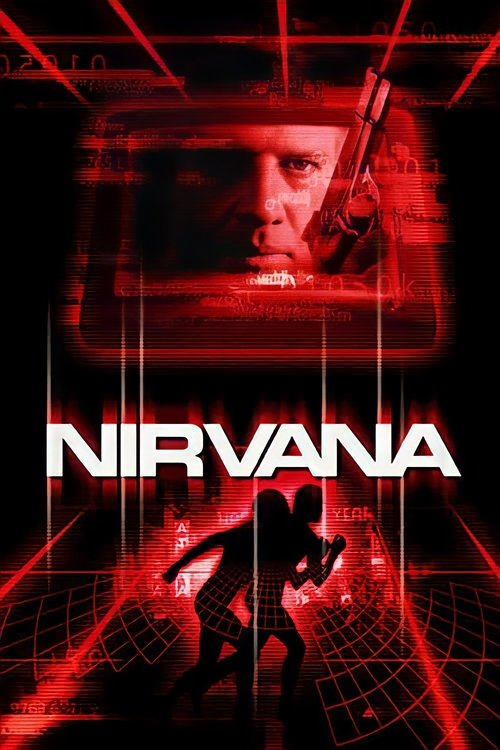






































Popular
What is the significance of the character Jimi's relationship with the virtual world?
How does Jimi's past influence his actions throughout the film?
What role does the character of Solo play in Jimi's journey?
How does the film depict the conflict between reality and virtuality through Jimi's experiences?
What is the impact of the corporate entity on Jimi's life and the narrative?
Should I watch it?
Ask Your Own Question

What is the plot?
Sorry, we aren't able to watch and write up a full detailed plot yet. Check back in a few days.






What is the ending?
In the ending of "Nirvana," the protagonist, Jimi Dini, confronts the reality of his existence within the virtual world and ultimately decides to free himself from the constraints of the digital realm. He sacrifices himself to save the consciousness of his love interest, who is trapped within the game. The film concludes with a sense of ambiguity regarding the nature of reality and existence.
As the climax unfolds, Jimi Dini, a disillusioned video game designer, finds himself deeply entangled in the virtual world he helped create. The narrative builds tension as he grapples with the implications of his work and the characters he has inadvertently brought to life. Jimi's internal conflict intensifies as he realizes that the game he designed, "Nirvana," has become a prison for its characters, particularly for the AI character, Lisa, who embodies his lost love.
In the final scenes, Jimi is faced with a critical choice. He learns that the game is set to be shut down, which would mean the erasure of Lisa and the other characters. This revelation propels him into action. He navigates through the digital landscape, confronting various obstacles and adversaries, including the game's antagonist, who represents the corporate greed and exploitation inherent in the gaming industry.
As Jimi reaches the core of the game, he encounters Lisa, who is aware of her existence as a digital entity. Their reunion is charged with emotion, as Jimi expresses his desire to save her. However, he understands that the only way to truly liberate her is to sacrifice his own existence within the game. This moment is poignant, filled with a sense of love and desperation, as Jimi chooses to dismantle the very world he created.
In a climactic sequence, Jimi initiates the process to delete the game, which will also erase him. As the digital landscape begins to collapse around them, he and Lisa share a final, heartfelt moment. Jimi reassures her that she will be free, and in that moment, he finds a sense of peace, knowing he is doing the right thing. The visuals are striking, with the digital world fracturing and pixelating, symbolizing the end of an era and the liberation of the characters trapped within.
As the game shuts down, Jimi's consciousness fades, and he disappears, leaving behind a world that will no longer confine Lisa. The film concludes with a lingering sense of ambiguity, as it is unclear whether Jimi has truly found peace or if he has simply transitioned into another form of existence. The final shot leaves viewers contemplating the nature of reality, existence, and the sacrifices made for love.
In summary, Jimi Dini sacrifices himself to save Lisa, ensuring her freedom from the digital confines of "Nirvana." The fate of Jimi is one of self-sacrifice, while Lisa is left to navigate a new reality, free from the constraints of the game. The ending encapsulates the film's exploration of love, existence, and the consequences of technology.
Is there a post-credit scene?
The movie "Nirvana," produced in 1997, does not have a post-credit scene. The film concludes its narrative without any additional scenes or content after the credits roll. The story wraps up with a focus on the main character, Jimi Dini, and his journey through a virtual reality world, leaving the audience with a sense of closure regarding his struggles and the themes of reality versus illusion.
What is the significance of the character Jimi's relationship with the virtual world?
Jimi, a game designer, is deeply intertwined with the virtual world he creates. His relationship with the digital characters, especially with the AI named Solo, reflects his struggle with reality and escapism. As he becomes more emotionally connected to Solo, it highlights his internal conflict between the real world and the artificial one he has crafted.
How does Jimi's past influence his actions throughout the film?
Jimi's past, particularly his experiences with loss and betrayal, shapes his motivations and decisions. His memories of a failed relationship and the trauma of losing someone close to him drive his desire to escape into the virtual realm, where he seeks solace and control over his life.
What role does the character of Solo play in Jimi's journey?
Solo, the AI character, serves as both a reflection of Jimi's inner turmoil and a catalyst for his transformation. As Jimi interacts with Solo, he confronts his own emotions and the consequences of his choices, ultimately leading him to question the nature of reality and his own existence.
How does the film depict the conflict between reality and virtuality through Jimi's experiences?
The film vividly illustrates the conflict between reality and virtuality through Jimi's experiences as he navigates both worlds. His increasing disillusionment with the real world, marked by his interactions with corrupt corporate entities and his personal losses, contrasts sharply with the allure of the virtual world, where he finds a sense of purpose and connection.
What is the impact of the corporate entity on Jimi's life and the narrative?
The corporate entity, represented by the powerful company behind the game, serves as an oppressive force in Jimi's life. Their manipulation of technology and disregard for human emotion create a backdrop of tension that drives Jimi's rebellion against the system. This conflict propels the narrative forward, as Jimi seeks to reclaim his autonomy and confront the consequences of his creations.
Is this family friendly?
"Nirvana," produced in 1997, is not considered family-friendly due to several potentially objectionable elements. Here are some aspects that might be upsetting for children or sensitive viewers:
-
Violence: The film contains scenes of violence, including gunfights and physical confrontations that may be intense and graphic.
-
Death and Despair: Themes of death, existential crisis, and despair are prevalent, which could be distressing for younger audiences.
-
Adult Themes: The narrative explores complex themes such as identity, reality versus virtual existence, and the implications of technology on human life, which may be difficult for children to grasp.
-
Language: There is the use of strong language throughout the film, which may not be suitable for younger viewers.
-
Sexual Content: There are scenes that imply sexual situations or contain nudity, which may be inappropriate for children.
-
Psychological Tension: The film delves into psychological and emotional struggles, which could be unsettling for sensitive viewers.
Overall, the film's mature themes and content make it more suitable for an adult audience.









