
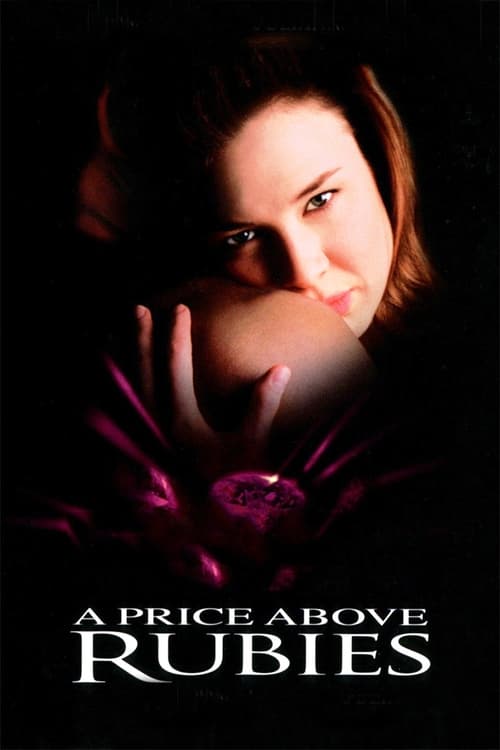



















Popular
What motivates Sonia to pursue a life outside her traditional Jewish community?
How does Sonia's relationship with her husband, Mendel, evolve throughout the film?
What role does the character of the artist, played by Chris Sarandon, play in Sonia's journey?
How does Sonia's family react to her choices throughout the film?
What are the key moments that lead Sonia to confront her identity and make pivotal decisions?
Should I watch it?
Ask Your Own Question

What is the plot?
Sonia Horowitz begins A Price Above Rubies in the cramped, emotionally starved center of her life: a Hasidic marriage in Brooklyn, New York, where she is expected to be a dutiful wife, a proper mother, and nothing more. She has just given birth to her first child, a son, and instead of bringing fulfillment, motherhood only sharpens the sense that she is disappearing inside a life designed by other people. Mendel Horowitz, her husband, is sincere and devout, a man who spends himself on prayer, study, and religious discipline, but his holiness leaves no room for tenderness. He is not cruel in a loud or theatrical way; his neglect is quieter than that, a spiritual absence that makes Sonia feel like a shadow in her own home. She wants intimacy, beauty, and a life that feels alive, but Mendel answers need with restraint, and desire with piety.
The film's opening establishes this ache with painful clarity. Sonia is young, beautiful, intelligent, and visibly restless, and the world around her keeps trying to shrink her into obedience. Her parents had once discouraged her from entering the jewelry trade, steering her instead toward marriage with a scholar, the kind of respectable future her community praises. Now she is living that future, and it feels like a locked room. The move to Borough Park, Brooklyn, closer to Mendel's yeshiva and family, only intensifies the pressure. Instead of finding support, Sonia finds herself watched more closely, judged more harshly, and more tightly enclosed by the customs of the community. The baby gives her a role, but not a self.
Into this sealed world comes Sender, Mendel's brother. He is a jeweler, worldly compared with Mendel, and far quicker than anyone else to notice that Sonia is not merely unhappy but starving for a different existence. Where Mendel sees duty, Sender sees appetite, intelligence, and latent talent. He is the first person who truly recognizes the eye she has for jewelry, the instinct she has for spotting what others overlook. He brings her into his business, and at first this seems like rescue. He gives her work as a buyer, sending her out to look for undervalued pieces, to gather jewels that others dismiss, and to bring them back for sale. It is a small opening in the wall of her life, but to Sonia it feels vast. Work gives her mobility. Money gives her leverage. Beauty gives her something to believe in.
The jewelry business becomes the first real bridge between Sonia's confined domestic life and a wider world. She moves through shops, back rooms, and hidden dealings with increasing confidence, and the camera treats these spaces like a secret ecosystem of value and desire. Jewelry in this film is never just ornament. It is memory, labor, inheritance, and hidden worth. It is what is buried beneath ordinary surfaces, waiting to be seen by an eye that knows how to look. Sonia's talent is not decorative; it is visionary. She can tell what something could become. That gift matters, because for the first time she is not merely being looked at by others. She is looking, choosing, judging.
As she becomes more at ease in this new world, the film introduces Ramon, a Puerto Rican jewelry maker and artist whose presence is immediately different from the men around Sonia. Ramon lives in a creative space where skill and imagination matter more than social rank. He respects her eye. He listens. He does not speak to her like a child or a duty. Their connection starts professionally, but it deepens quickly because he sees in her a woman who has been denied her own life for too long. He encourages her judgment and values her taste. In his presence, Sonia is not merely Mendel's wife or Sender's responsibility. She becomes a collaborator, a mind, a sensibility, a person.
The film is careful to make this connection feel both liberating and dangerous. Sonia is not simply falling in love with a man; she is falling toward possibility itself. Ramon represents a life in which creativity, sensuality, and choice are not sins to be buried. Their scenes are filled with warmth and mutual recognition, and the tension comes from the fact that Sonia is reaching for something that her world is determined to forbid. Every time she steps further into Ramon's orbit, the line between self-discovery and exile grows thinner.
That line is crossed through Sender, whose role in Sonia's life darkens. What began as assistance and recognition curdles into control. Sender becomes sexually involved with Sonia, and the affair is one of the film's most damaging betrayals because it is wrapped in intimacy, dependency, and family power. He gives her access to work, but he also uses that access to claim her. He is not a liberator; he is another form of confinement, only dressed in sophistication and seduction rather than religious law. Sonia is drawn to him partly because he sees her, but that seeing is possessive. He wants her desire and her gratitude on his terms.
The affair between Sonia and Sender worsens the central conflict rather than resolving it. It does not free her from Mendel's world; it makes her more vulnerable inside it. Sender becomes jealous, controlling, and increasingly dangerous once he senses that Sonia's emotional center is moving elsewhere. That elsewhere is Ramon. Sonia's bond with Ramon is not just romantic or sexual; it is the first relationship in the film that feels rooted in respect. She gravitates toward him because he gives her what her marriage never has: acknowledgment without domination.
The spiritual dimension of the film deepens Sonia's struggle. She is shown in haunting, intimate moments of inward dialogue with her deceased younger brother, and she also encounters a mysterious older woman who offers wisdom from beyond ordinary social rules. These elements give Sonia's inner life an almost mystical texture. She is not simply rebelling against a marriage. She is searching for meaning, and the film frames that search as something both emotional and spiritual. Her pain is not treated as selfishness in any simple sense, even though the community around her will later call it that. It is treated as a soul's refusal to keep shrinking.
Mendel, meanwhile, remains locked inside his own understanding of righteousness. He believes he is doing what God asks of him. His neglect is not born of malice but of zeal, and that makes the tragedy sharper. When Sonia's dissatisfaction becomes impossible to ignore, he tries to solve it through the structures he trusts most. He takes her first to his rebbe, then to a Jewish psychologist, hoping that religious authority and formal counsel will heal what he cannot understand on his own. But these interventions only reveal how far apart he and Sonia truly are. The counsel is male, institutional, and abstract. Sonia's suffering is embodied, urgent, and specific.
The rebbe scene becomes one of the film's quiet turning points. Sonia's raw honesty and visible pain seem to penetrate the old man in a way that sermons and rules cannot. In response, he goes home and tells his own wife how much he loves and appreciates her, a small but revealing act that suggests Sonia's suffering has exposed a truth larger than her marriage. The rebbe's change is a mirror held up to Mendel. It implies that devotion without gratitude is incomplete, and that holiness is no excuse for emotional neglect. But this insight comes too late to repair what has already broken.
The film steadily increases the pressure around Sonia. The community's gaze becomes more judgmental. Rachel, Mendel's sister, speaks for the social order when she condemns Sonia as selfish and disloyal, making clear that the issue is not just one marriage but the stability of the entire Orthodox world around her. Sonia is expected to sacrifice her own hunger for the sake of family, faith, and communal appearance. When she stops doing that, the punishment comes fast and hard.
The central betrayal unfolds when Sender discovers Sonia's connection with Ramon. Jealous and enraged, he decides not merely to confront her but to destroy her standing with Mendel and the family. He tells what he knows, and the private fractures in Sonia's life become public catastrophe. The film's cruelty in this stretch comes from how efficiently the community closes ranks. Mendel changes the locks on the door. Sonia is shut out of her own home. She is cut off from her child. Her mother disowns her. Rachel refuses to hand over her son. The social machinery of punishment moves with chilling speed, turning a personal crisis into full banishment.
There are no major deaths in the film's present action. No one is killed on screen, and no central character dies as part of the storyline. The film's deepest losses are social, emotional, and spiritual: motherhood severed, marriage undone, belonging revoked. The younger brother Sonia speaks with is part of her inner life and backstory, not a death event in the film's timeline. What "dies" here is the life she was told to accept.
Sonia is left devastated, but not broken into silence. Her exclusion forces the final transformation. Rather than crawling back to Mendel in submission, she turns more fully toward her own sense of value. The jewelry motif comes into focus with its strongest symbolic force in the story's closing movement. One of the film's key images is a gold ring with a missing ruby, an object that embodies incompleteness, hidden worth, and the possibility of restoration. The missing stone is not just a gem; it is the shape of Sonia's own life, a center that has been absent for too long.
The climax gathers around this object and the emotional reckonings it represents. Eventually, Sonia has the ring back in her possession, and the film uses that return to echo her own recovery of self. She is no longer merely a woman acted upon by husband, brother-in-law, or community. She has become someone who can recognize value, name loss, and choose what to do with what remains. Ramon, for his part, is left with the possibility of a future that Sonia helps make visible through her taste and conviction. She does not stay with him in a conventional romantic ending; the film makes clear that she is not simply exchanging one man for another. The transformation is deeper and more painful than that. It is about stepping out of a life defined by obligation and into one shaped by agency, even if the path forward is uncertain.
In the final reconciliation between Sonia and Mendel, the film chooses not hatred but sorrowful clarity. Mendel comes to her. He asks after their son. He apologizes for forgetting her birthday, though he knows, and she knows, that the birthday is not really the issue. It is a small domestic detail loaded with all the years of neglect behind it. Sonia asks him if he misses her. He shakes his head. Then he asks the same of her, and she shakes her head too. The exchange is devastating because it is honest. Neither of them pretends anymore. They laugh, briefly and almost tenderly, at the truth of their mutual emotional emptiness. Mendel then gives her a ruby as a token of regret and invites her to visit their son. It is not a restoration of marriage, but it is a recognition of damage and a gesture toward human decency. Sonia answers with, "God bless you," and the line lands not as submission but as release.
The final image of the film completes the symbolic arc. The ruby that Mendel gives Sonia is fitted into the ring, restoring the missing piece. The gesture closes the visual metaphor on a note of wholeness achieved through loss, not through reconciliation to the old order. Sonia has been excommunicated from one life, but she has not vanished. She has found a new life in the ashes, one grounded in work, self-knowledge, and a refusal to be reduced again. The ending is bittersweet rather than triumphant. She does not get back her family. She does not return to Mendel. She does not have a simple romantic future with Ramon. What she does have is the one thing the film has fought over from the start: a self that cannot be entirely taken away.
By the last scene, Sonia is no longer the silent wife in a narrow Brooklyn home. She is a woman who has seen the cost of freedom, paid it, and emerged changed. The story ends not with a tidy rescue, but with the hard-earned recognition that a life can be wrong for a person even when it is holy to everyone around her. Sonia's final blessing to Mendel closes the film with pain, grace, and distance, leaving behind the image of the completed ring as the truest summary of what she has become: not repaired back into obedience, but made whole on her own terms.








What is the ending?
In the ending of "A Price Above Rubies," Sonia, after a tumultuous journey of self-discovery and conflict, ultimately chooses to embrace her own identity and desires. She confronts her husband, Mendel, and decides to leave him, seeking a life that is true to herself. The film concludes with Sonia finding a sense of freedom and purpose, symbolized by her decision to pursue her passion for jewelry making.
Expanded Ending Narrative:
As the film approaches its climax, Sonia finds herself at a crossroads. The tension between her and Mendel has reached a boiling point. In a pivotal scene, Sonia stands in their modest home, the weight of her choices heavy in the air. Mendel, who has been struggling to understand Sonia's need for independence, confronts her about her recent behavior and the distance that has grown between them. His voice is filled with a mix of frustration and concern, reflecting his deep love for her but also his inability to grasp her yearning for freedom.
Sonia, her emotions swirling, feels both anger and sadness. She has been suffocated by the expectations of her Orthodox Jewish community and the confines of her marriage. In a moment of clarity, she expresses her feelings to Mendel, revealing her desire to pursue her passion for jewelry making, a craft that has become a symbol of her individuality. The room is charged with tension as she speaks, her voice trembling yet resolute. Mendel listens, his expression a mixture of hurt and understanding, as he realizes that Sonia's dreams cannot be contained.
In the following scene, Sonia visits the bustling streets of New York City, a stark contrast to the quiet life she has known. The vibrant colors and sounds of the city invigorate her spirit. She meets with a jeweler who recognizes her talent and offers her a chance to showcase her work. This moment is pivotal for Sonia; it represents not just an opportunity but a step toward reclaiming her identity. The camera captures her excitement, her eyes sparkling with hope as she envisions a future where she can be both an artist and a woman of her own making.
As the film nears its conclusion, Sonia returns home to confront Mendel one last time. The atmosphere is heavy with unspoken words. She tells him that she cannot continue living a life that feels inauthentic to her. Mendel, heartbroken, pleads with her to reconsider, but Sonia stands firm. The emotional weight of their shared history hangs in the air, but Sonia's resolve is unshakeable. She understands that to truly love Mendel, she must first love herself.
In the final scenes, Sonia walks away from their home, a symbolic act of liberation. The camera follows her as she strides confidently down the street, the city alive around her. She is no longer just a wife or a daughter; she is Sonia, an artist ready to embrace her future. The film closes with a shot of her working on her jewelry, her hands deftly crafting pieces that reflect her inner strength and creativity. The final image is one of empowerment, as Sonia finds her place in the world, a testament to her journey of self-discovery.
Mendel, left behind, is shown grappling with the loss of his wife. His character arc concludes with a sense of sorrow but also a newfound understanding of the importance of individual dreams and aspirations. The film leaves viewers with a poignant reminder of the complexities of love, identity, and the pursuit of happiness.
Is there a post-credit scene?
The movie "A Price Above Rubies," produced in 1998, does not have a post-credit scene. The film concludes with its final scenes, focusing on the resolution of the main character's journey and her relationships. After the credits roll, there are no additional scenes or content that follow. The story wraps up with a sense of closure regarding the protagonist's struggles and choices, leaving the audience to reflect on the themes of love, identity, and personal freedom.
What motivates Sonia to pursue a life outside her traditional Jewish community?
Sonia, played by Judy Reyes, feels stifled by the expectations of her Orthodox Jewish community and her role as a wife. Her desire for independence and self-fulfillment drives her to explore her own identity, leading her to seek a life that allows her to express her individuality and passions.
How does Sonia's relationship with her husband, Mendel, evolve throughout the film?
Sonia's relationship with Mendel, portrayed by Steven Schub, begins with a sense of love and commitment, but as Sonia's yearning for freedom grows, tensions arise. Mendel struggles to understand her need for independence, leading to conflicts that highlight the strain between traditional values and personal desires.
What role does the character of the artist, played by Chris Sarandon, play in Sonia's journey?
The artist, who becomes a significant figure in Sonia's life, represents the allure of a different lifestyle and the possibility of artistic expression. His influence encourages Sonia to embrace her creativity and question the constraints of her community, ultimately pushing her towards a path of self-discovery.
How does Sonia's family react to her choices throughout the film?
Sonia's family, particularly her mother and sister, exhibit a mix of concern and disappointment regarding her choices. They embody the traditional values of their community and struggle to accept Sonia's desire for autonomy, leading to emotional confrontations that highlight the generational and cultural divides.
What are the key moments that lead Sonia to confront her identity and make pivotal decisions?
Key moments include Sonia's interactions with the artist, her experiences at art shows, and her growing dissatisfaction with her domestic life. These experiences culminate in a series of emotional confrontations with her family and husband, ultimately forcing her to confront her identity and make choices that reflect her true self.
Is this family friendly?
"A Price Above Rubies" is a drama that explores complex themes and relationships, which may not be suitable for younger audiences or sensitive viewers. Here are some potentially objectionable or upsetting aspects:
-
Intense Emotional Conflict: The film delves into the struggles of the protagonist, which includes feelings of isolation, frustration, and the search for identity. These emotional scenes can be heavy and may be difficult for children to process.
-
Marital Strain: There are scenes depicting tension and conflict between the main character and her husband, which may include arguments and emotional distress.
-
Sexual Content: The film contains scenes that involve sexual themes and suggestive situations, which may not be appropriate for younger viewers.
-
Cultural and Religious Tensions: The story is set within a Jewish community, and there are moments that highlight cultural expectations and pressures, which may be confusing or upsetting for some viewers.
-
Depictions of Grief and Loss: The film touches on themes of loss and the impact it has on relationships, which can be emotionally challenging.
-
Violence and Threats: There are instances of implied violence and threats that may be unsettling, particularly for younger audiences.
Overall, while the film offers a rich narrative and character development, its themes and content may not be suitable for children or those sensitive to emotional and relational turmoil.








