












Popular
What specific events lead to the climax of the film?
What motivates the main character, a single mother, to reconnect with her estranged family?
How does the relationship between the mother and her children evolve throughout the film?
What role does the grandmother play in the family dynamics?
How does the film depict the theme of forgiveness among family members?
Should I watch it?
Ask Your Own Question

What is the plot?
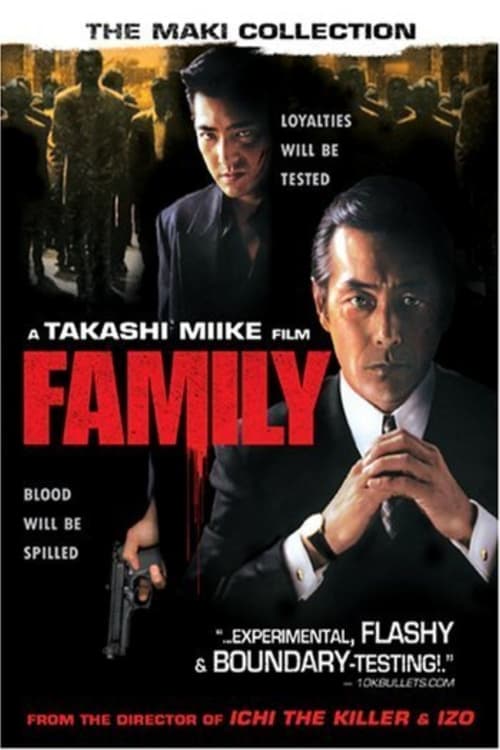
The film opens in a cramped debtor's home with a single act of brutality that poisons everything that follows: Iwaida Nishikawi, a yakuza enforcer from the Nishiwaki Group, arrives to collect a debt, finds no money, and instead violates Haruko while her husband and their young son Takashi crouch hidden in a closet, forced to hear and witness the violation in terrified silence. The scene is ugly and intimate, lit by the dull, suffocating interior of the house, and the moment becomes the family's origin wound; Haruko survives, but the shame, terror, and helplessness harden into a legacy that hangs over the children for decades.
After the assault, the story lingers on the shattered household. Haruko's husband, broken and humiliated, begins drinking in daylight, and one afternoon he stumbles into the street and picks a fight with a group of thugs. He is no longer a father or husband in any meaningful sense, only a man trying and failing to turn grief into anger. The thugs beat him to death in the street, sealing the family's collapse in an act of casual public violence. The death is not a grand revenge murder but a filthy, humiliating end, and it leaves Takashi and his older brother Hideshi to absorb the consequences. Hideshi eventually tracks down the men responsible, and in a rage that seems inherited from the world around him, he kills one of them by stomping on his skull. That retaliation is not healing; it only confirms that violence has become the family's language.
Thirty years pass. The film jumps forward to a colder, more institutional world where the old sins have not disappeared but merely aged into power. Iwaida Nishikawi is now an aging yakuza boss in Kyoto, riding in a lift with three bodyguards around him, still protected by the same kind of muscle that once allowed him to terrorize others. The lift becomes a metal box of fate, a place where past and present collapse together. A hired killer steps in and starts shooting. One by one, the three men guarding Iwaida are killed before they can stop him, and then the killer turns to Iwaida himself. In the middle of the attack, Iwaida notices a scar on the killer's left cheek and realizes who he is. The assassin is Takeshi, and the recognition lands like a final curse: the man who has come to execute him is connected to the family he destroyed long ago. Iwaida is shot dead in the lift, and the murder is both a revenge killing and the beginning of a deeper revelation.
The killing is recorded on camera, and the footage becomes the crucial clue that names the killer. The scar on Takeshi's cheek is clear enough to identify him as "Lightning Takeshi," transforming him from an anonymous hit man into a known target. That image turns the manhunt into a story of pursuit, concealment, and family fracture. Takashi and Hideshi set out to find Takeshi, but their search is not simply vengeance; it is tangled up with protection, guilt, and the need to understand why this assassin has suddenly become the center of their lives. Takeshi, meanwhile, is hiding with nurse Rie Ishibashi, who becomes an uneasy refuge and a witness to the aftermath of the shooting. The film uses this hiding place as a counterpoint to the lift: one is a sealed chamber of death, the other a fragile shelter where a wounded man tries to disappear.
As the brothers close in, the story reveals its central twist. Takeshi is not merely a hit man who happened to kill the wrong boss. He is their brother. The man Takashi and Hideshi are chasing is part of the same shattered family created by Iwaida's violence decades earlier. That revelation recasts the entire film. What had seemed like a gangster revenge thriller becomes a story about blood ties poisoned by crime, about sons split apart by secrecy and circumstance, and about a family trying to survive the consequences of one man's cruelty. The brothers' pursuit of Takeshi is no longer straightforward retaliation; it becomes an attempt to locate, protect, and reclaim him from the spiral of retribution that has already begun.
The plot darkens further when Kenmoshi escalates the conflict. To force Takashi into submission and make him hand over his brother, Kenmoshi abducts Takashi's wife Mariko and rapes her. This is another act of coercive brutality, echoing the opening violation of Haruko and showing that the same logic of possession and humiliation still governs the criminal underworld. Mariko's captivity becomes both leverage and message: surrender Takeshi, or your wife will continue to suffer. The film makes the emotional pressure unmistakable. Takashi is no longer just trying to find his brother; he is being cornered by the threat to his own household, forced into a choice between family loyalty and immediate rescue.
Meanwhile, the truth behind Iwaida's death becomes even more sinister. Hideshi discovers that Takeshi did not act alone out of personal vengeance; he had been secretly sent by their yakuza boss to eliminate Iwaida. That revelation widens the conspiracy and shows that the assassination is part of an internal criminal power struggle. The boss has used Takeshi as an instrument, turning the family's buried wound into a weapon against Iwaida. What begins as revenge is therefore also manipulation. The brothers' attempt to understand the killing leads them into a larger web where the old crime against Haruko, the murder of the father, the execution of Iwaida, and Mariko's abduction all connect through hidden orders and long-held blackmail.
The final movement of the story pushes toward confrontation rather than resolution. Takeshi remains on the run, protected for the moment by Rie Ishibashi, while Takashi and Hideshi continue searching for him. Their effort is driven by conflicting motives: they want to protect their brother from the people who want him dead, but they also want to reckon with what he has done and what was done to them. The emotional terrain is a field of grief and obligation. Takashi still carries the memory of hiding in the closet as a child while his mother was violated; Hideshi still bears the memory of seeing his father beaten to death and answering with more violence. Now both men are forced to look at the brother who emerged from that same wounded history as a killer. The film's tension comes from that collision of roles: victim, avenger, brother, target.
The ending is bleak rather than neatly cathartic. The available plot information shows the revenge chain fully set in motion, but not fully closed. Iwaida is dead, his bodyguard detail wiped out in the lift; Takeshi's identity is known through the scar captured on camera; Takashi and Hideshi have uncovered the family connection; Mariko has been violated to exert pressure on Takashi; and the search for Takeshi continues as he hides with Rie Ishibashi. The final sense is of a family still being pulled apart by crimes that began decades earlier and have never stopped reproducing themselves. The film does not offer a clean moral restoration. Instead, it leaves the audience in the wreckage of inherited violence: a mother traumatized, a father dead, one brother turned killer, another hardened by retaliation, and another family member used as a hostage in a war that began before the children even understood it.
By the time the story reaches its end, every major thread points back to that first room, that first assault, and that first hidden child in the closet. The deaths have not balanced the original wrong; they have only multiplied it. Iwaida's murder feels like the payment of a debt, but the film insists the real debt is impossible to repay. The final image of the story is not peace but pursuit, not closure but the knowledge that everyone involved has been marked by the same act of violation and the same machinery of revenge.








What is the ending?
In the ending of the movie "Family," the main character, a father named John, confronts the consequences of his actions and the impact they have had on his family. The film concludes with a sense of resolution as John seeks to mend his relationships and find a way forward.
As the final scenes unfold, John is seen grappling with the emotional fallout of his choices. He has a heartfelt conversation with his estranged wife, where they both express their pain and the longing for reconciliation. Their dialogue is filled with tension, but also a glimmer of hope as they acknowledge the love that still exists between them, despite the turmoil.
In a pivotal moment, John reaches out to his children, attempting to reconnect and rebuild the trust that has been shattered. The children, initially hesitant, begin to open up, revealing their own struggles and feelings of abandonment. This emotional exchange serves as a turning point for the family, highlighting the importance of communication and understanding in healing.
The film closes with a scene of the family together, sharing a quiet moment that signifies a new beginning. While the road ahead is uncertain, there is a sense of unity and a commitment to work through their issues together.
As the film approaches its conclusion, the atmosphere is thick with tension and unresolved emotions. John, the father, stands alone in his dimly lit living room, the weight of his decisions pressing heavily on his shoulders. The camera captures the lines of worry etched on his face, reflecting the turmoil within. He knows he must confront the reality of his fractured family.
In the next scene, John takes a deep breath and decides to reach out to his estranged wife, Sarah. He finds her in the kitchen, preparing dinner, the familiar sounds of clattering pots and pans filling the air. The moment is charged; Sarah looks up, her expression a mix of surprise and guardedness. John's heart races as he approaches her, the tension palpable. He begins to speak, his voice trembling slightly as he apologizes for the pain he has caused. Sarah listens, her eyes glistening with unshed tears, revealing the hurt that still lingers beneath her stoic exterior.
Their conversation unfolds slowly, each word heavy with meaning. John expresses his regret, his desire to make amends, and the love he still feels for her. Sarah, initially defensive, begins to soften as she shares her own feelings of betrayal and loneliness. The dialogue is raw and honest, showcasing the complexity of their relationship. As they talk, the camera shifts between close-ups of their faces, capturing the flicker of hope that begins to emerge amidst the sorrow.
The scene transitions to the children's room, where John's two kids, Emily and Jake, are sitting on their beds, their expressions a mix of confusion and anger. John enters hesitantly, unsure of how to bridge the gap that has formed between them. He sits down, his heart pounding, and begins to speak. He tells them how much he misses them and how deeply he regrets the choices that led to their estrangement. The children listen, their faces a canvas of mixed emotions--hurt, anger, and a flicker of longing for their father's presence.
Emily, the older sibling, finally breaks the silence. Her voice is shaky as she expresses her feelings of abandonment and betrayal. Jake, still young and innocent, looks between his father and sister, trying to understand the gravity of the situation. John's heart aches as he realizes the depth of their pain. He reassures them that he is committed to being a better father, to being present in their lives. The emotional weight of the moment hangs in the air, and slowly, the children begin to open up, sharing their own struggles and fears.
As the family begins to communicate, the atmosphere shifts. The camera captures the small gestures of connection--a tentative touch, a shared laugh, the way they lean into each other. It's a slow process, but the seeds of healing are being planted. The scene is interspersed with flashbacks of happier times, reminding the audience of the love that once bound them together.
The film culminates in a poignant scene where the family gathers in the living room, a space that once felt cold and distant. They sit together on the couch, the tension replaced by a tentative warmth. John suggests they play a game, something they used to enjoy as a family. The children exchange glances, hesitant but intrigued. As they begin to play, laughter fills the room, a sound that had been absent for far too long.
The final moments of the film are filled with a sense of cautious optimism. The camera pulls back, capturing the family in a tight embrace, their faces illuminated by the soft glow of the evening light. While the future remains uncertain, there is a palpable sense of unity and a commitment to face whatever challenges lie ahead together.
As the credits roll, the audience is left with the image of a family beginning to heal, a testament to the power of love, communication, and the resilience of familial bonds. Each character, having faced their demons, is now on a path toward reconciliation, embodying the film's central message about the importance of family and the possibility of redemption.
Is there a post-credit scene?
The movie "Family," produced in 2001, does not have a post-credit scene. The film concludes its narrative without any additional scenes or content after the credits roll. The story wraps up with a focus on the emotional resolutions of the characters, leaving the audience with a sense of closure regarding the themes of family and connection explored throughout the film.
What specific events lead to the climax of the film?
The climax is reached when a family gathering forces long-buried tensions to surface. A confrontation occurs between the mother and her estranged relatives, revealing past grievances and misunderstandings. This moment of conflict ultimately leads to a cathartic resolution, where the characters must confront their feelings and decide whether to move forward together.
What motivates the main character, a single mother, to reconnect with her estranged family?
The main character, a single mother, is driven by a deep sense of loneliness and the desire for her children to have a connection with their extended family. As she struggles with her own challenges, the thought of her children growing up without a support system pushes her to reach out to her estranged relatives.
How does the relationship between the mother and her children evolve throughout the film?
Initially, the relationship is strained, as the mother is overwhelmed by her responsibilities and struggles to balance work and parenting. However, as the story progresses and she reconnects with her family, she begins to open up emotionally, allowing her children to see her vulnerabilities. This leads to a deeper bond as they navigate their challenges together.
What role does the grandmother play in the family dynamics?
The grandmother serves as a pivotal figure in the family dynamics, representing tradition and the importance of familial ties. Her presence brings both comfort and tension, as she often challenges the mother's decisions while also providing wisdom and support. This duality helps to bridge the gap between the mother and her children.
How does the film depict the theme of forgiveness among family members?
Forgiveness is depicted through various interactions, particularly between the mother and her estranged family members. Key scenes show characters reflecting on past mistakes and expressing regret, culminating in heartfelt apologies. These moments are charged with emotion, illustrating the difficulty yet necessity of forgiveness in healing familial relationships.
Is this family friendly?
The movie "Family," produced in 2001, is not particularly family-friendly and contains several elements that may be objectionable or upsetting for children or sensitive viewers. Here are some aspects to consider:
-
Themes of Abandonment: The film explores complex family dynamics, including feelings of abandonment and emotional distress, which may be difficult for younger audiences to process.
-
Emotional Turmoil: Characters experience significant emotional struggles, including grief and conflict, which can be intense and may resonate deeply with sensitive viewers.
-
Dramatic Tension: There are scenes that involve high emotional stakes and confrontations that could be distressing, particularly for younger viewers who may not fully understand the underlying issues.
-
Mature Language: The dialogue includes mature language that may not be suitable for children.
-
Difficult Relationships: The portrayal of strained family relationships and the impact of personal choices can be heavy and may evoke strong emotions.
These elements contribute to a narrative that is more suited for mature audiences, as it delves into serious themes that may not be appropriate for children.








