
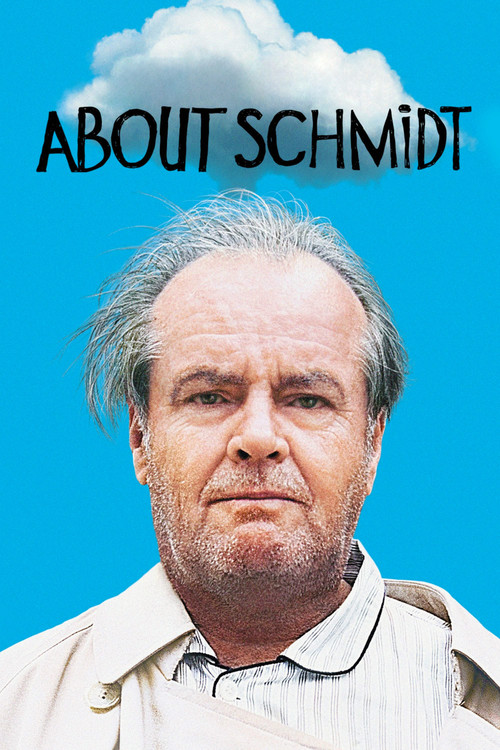














Popular
Should I watch it?
Ask Your Own Question

What is the plot?
Sorry, we aren't able to watch and write up a full detailed plot yet. Check back in a few days.









What is the ending?
In the ending of "About Schmidt," Warren Schmidt attends his daughter's wedding, where he feels a mix of pride and sadness. He reflects on his life and the choices he has made. The film concludes with him feeling a sense of acceptance, as he realizes that life continues despite his personal losses.
As the film approaches its conclusion, we find Warren Schmidt, played by Jack Nicholson, preparing to attend the wedding of his daughter, Jeannie. The scene opens with Schmidt in his modest hotel room, a stark contrast to the grand event he is about to attend. He is dressed in a suit, but his demeanor is one of uncertainty and introspection. He gazes out the window, lost in thought, reflecting on the life he has led and the relationships he has struggled to maintain.
The wedding takes place in a large, beautifully decorated venue, filled with family and friends. Schmidt arrives, and as he enters, he is immediately struck by the vibrant atmosphere. The sounds of laughter and music fill the air, but Schmidt feels out of place, a solitary figure amidst the celebration. He watches as Jeannie, radiant in her wedding dress, interacts with her new husband, a man Schmidt has never fully approved of.
As the ceremony unfolds, Schmidt's internal conflict becomes palpable. He is proud of his daughter but also grapples with feelings of loss and regret. He recalls moments from their past, particularly the strained relationship they shared, and he feels a deep sense of longing for the connection that was never fully realized. The camera captures his expressions, revealing a man who is both happy for his daughter and mournful for the life he has lived.
During the reception, Schmidt is seated at a table with other guests, but he remains somewhat detached. He observes the festivities, the dancing, and the joy surrounding him, yet he feels a profound sense of isolation. As he watches Jeannie dance with her husband, he is reminded of the fleeting nature of life and the inevitability of change.
In a poignant moment, Schmidt stands up to give a toast. He stumbles through his words, expressing his love for Jeannie and his hopes for her future. His speech is heartfelt but tinged with sadness, as he acknowledges the challenges they faced as a family. The guests listen attentively, and for a brief moment, Schmidt feels a connection to those around him.
As the evening progresses, Schmidt finds himself outside, looking up at the stars. He reflects on his life, the choices he made, and the relationships he has lost. The weight of his past hangs heavy on him, but there is also a sense of acceptance. He realizes that life will go on, and while he may not have the perfect relationship with his daughter, he can still support her in her new journey.
The film concludes with Schmidt driving away from the wedding, a solitary figure once again. He looks out the window, a mixture of emotions playing across his face. The final shot captures him in silence, contemplating the future, embodying the themes of loss, acceptance, and the passage of time.
In the end, Warren Schmidt has come to terms with his life, recognizing that while he may not have achieved everything he wanted, he still has the capacity to love and support his daughter as she embarks on her new life. Jeannie, now married, is ready to start her own family, while Schmidt, having faced his own vulnerabilities, finds a sense of peace in the acceptance of his circumstances. The film closes on a note of bittersweet reflection, leaving the audience with a sense of the complexities of family and the enduring nature of love.
Is there a post-credit scene?
The movie "About Schmidt," produced in 2002, does not have a post-credit scene. The film concludes with a poignant moment as Warren Schmidt, played by Jack Nicholson, reflects on his life and the choices he has made. After the credits roll, there are no additional scenes or content that follow. The film ends on a note that encapsulates Schmidt's journey of self-discovery and the emotional weight of his experiences, leaving the audience to ponder his reflections without any further narrative developments.
What motivates Warren Schmidt to go on a road trip?
Warren Schmidt, played by Jack Nicholson, is motivated to go on a road trip after he retires from his job as an actuary. Feeling lost and disconnected after the death of his wife, Helen, he seeks to find meaning in his life and reconnect with his estranged daughter, Jeannie, who is about to marry a man he disapproves of.
How does Warren Schmidt feel about his daughter Jeannie's fiancé?
Warren Schmidt is deeply disapproving of Jeannie's fiancé, a man named Randall. He perceives Randall as immature and unworthy of his daughter, which causes him significant emotional turmoil as he grapples with the idea of losing his daughter to someone he believes is not a good match.
What role does the character of Roberta play in Warren's journey?
Roberta, played by Kathy Bates, is a woman Warren meets during his road trip. She represents a stark contrast to his late wife, Helen. Roberta's boldness and openness challenge Warren's reserved nature, and their interactions force him to confront his own feelings of loneliness and the possibility of new connections.
How does Warren Schmidt cope with the loss of his wife?
Warren Schmidt copes with the loss of his wife, Helen, by reflecting on their life together through a series of letters he writes to a Tanzanian boy named Ndugu, whom he sponsors. These letters reveal his deep sense of loss, regret, and his struggle to find purpose in a life that feels empty without her.
What is the significance of the RV in Warren's journey?
The RV symbolizes Warren's journey of self-discovery and his desire for freedom. As he travels across the country, the RV becomes a physical representation of his emotional state--clunky, isolating, and filled with memories. It serves as a mobile home for his introspection and the various encounters that shape his understanding of life after retirement.
Is this family friendly?
"About Schmidt" is a film that explores themes of loss, loneliness, and the search for meaning in life, which may not be suitable for younger audiences or sensitive viewers. Here are some potentially objectionable or upsetting aspects:
-
Death and Grief: The film opens with the death of the main character's wife, which is a central theme throughout the story. The portrayal of grief and the emotional turmoil that follows can be heavy and may be distressing for some viewers.
-
Nudity and Sexual Content: There are scenes that include nudity, particularly in a context that may be considered inappropriate for children. This includes a scene involving a nude woman in a calendar.
-
Language: The film contains strong language and profanity, which may not be suitable for younger audiences.
-
Existential Themes: The film delves into deep existential questions and the struggles of aging, which may be difficult for children to understand and could evoke feelings of sadness or discomfort.
-
Family Dynamics: There are tense and uncomfortable interactions between family members, particularly between Schmidt and his daughter, which may resonate with viewers who have experienced similar familial conflicts.
-
Depression and Isolation: The protagonist experiences feelings of depression and isolation, which are depicted in a raw and honest manner, potentially affecting sensitive viewers.
Overall, while "About Schmidt" offers poignant insights into life and relationships, its themes and content may not be appropriate for children or those who are particularly sensitive to such subjects.







