
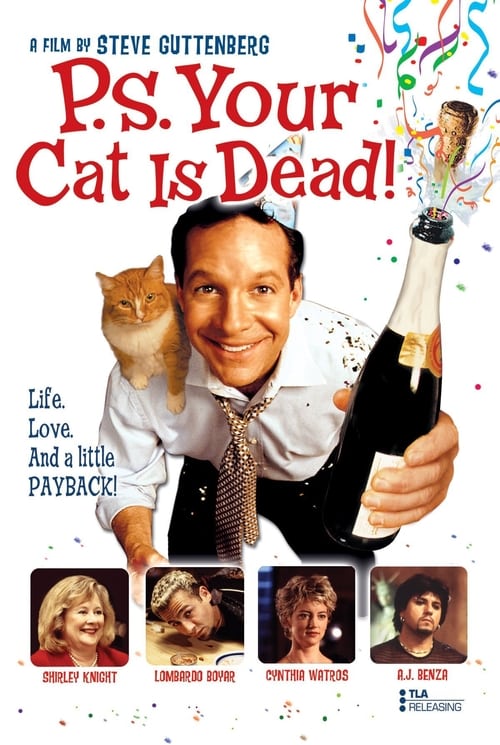








Popular
What happens to the main character, Steve, at the beginning of the movie?
How does Steve's relationship with his cat influence his actions throughout the film?
What role does the character of the burglar play in Steve's journey?
How does the character of the girlfriend, who left Steve, impact his emotional state throughout the film?
What is the significance of the ending scene involving Steve and the burglar?
Should I watch it?
Ask Your Own Question

What is the plot?
Sorry, we aren't able to watch and write up a full detailed plot yet. Check back in a few days.







What is the ending?
In the ending of "P.S. Your Cat is Dead!", the protagonist, a struggling actor named Steve, confronts the chaos in his life, including his failed relationships and the loss of his cat. After a series of comedic and dramatic events, he finds a sense of resolution and acceptance, ultimately deciding to move forward despite the challenges he faces.
As the film approaches its conclusion, Steve is in his apartment, grappling with the aftermath of a tumultuous day. He has dealt with the unexpected arrival of his ex-girlfriend, the theft of his cat, and the presence of a burglar named Joe, who has become an unlikely companion. The tension in the apartment is palpable as Steve navigates his feelings of anger, betrayal, and confusion.
In a pivotal scene, Steve and Joe engage in a heartfelt conversation that reveals their vulnerabilities. Joe, who initially appears as a mere antagonist, shares his own struggles, and the two men find common ground in their shared experiences of loss and disappointment. This moment of connection allows Steve to reflect on his own life choices and the importance of human connection, even in the most unexpected circumstances.
As the night progresses, Steve's ex-girlfriend, who has been a source of emotional turmoil for him, re-enters the scene. Their interaction is charged with unresolved feelings, but Steve ultimately realizes that he must let go of the past to move forward. He acknowledges the pain of their relationship but also understands that clinging to it will not bring him happiness.
In the final moments of the film, Steve makes a decision to embrace his future. He takes a step towards healing by accepting the loss of his cat and the chaos of his life. The film closes with a sense of hope, as Steve looks out into the world, ready to face whatever comes next, having learned valuable lessons about resilience and the importance of connection.
The fate of the main characters is as follows: Steve, having faced his demons, is poised to start anew, while Joe, who has shown a more human side, leaves with a sense of understanding. The ex-girlfriend, while still a part of Steve's past, represents a chapter that he is ready to close. The film ends on a note of acceptance, highlighting the complexities of life and relationships.
Is there a post-credit scene?
The movie "P.S. Your Cat is Dead!" does not have a post-credit scene. The film concludes without any additional content after the credits roll. The story wraps up with the main character, a struggling actor named Steve, having gone through a series of chaotic and emotional events, including dealing with the death of his cat, the arrival of an unexpected visitor, and his attempts to navigate personal relationships. The ending focuses on Steve's realization and acceptance of his circumstances, leaving the audience with a sense of closure rather than an additional scene to follow.
What happens to the main character, Steve, at the beginning of the movie?
At the beginning of the movie, Steve, a struggling actor, is dealing with the aftermath of a breakup with his girlfriend, who has left him. He is emotionally distraught and feels a deep sense of loneliness. The scene is set in his cramped New York City apartment, where he is surrounded by remnants of his former life, including his beloved cat, who has recently died. This loss amplifies his feelings of despair and isolation.
How does Steve's relationship with his cat influence his actions throughout the film?
Steve's relationship with his cat serves as a poignant reflection of his emotional state. The cat's death symbolizes his feelings of abandonment and loss, which drive him to act out in various ways throughout the film. He often reminisces about the cat, and its absence exacerbates his loneliness, leading him to make impulsive decisions, such as attempting to rob a burglar who breaks into his apartment.
What role does the character of the burglar play in Steve's journey?
The burglar, who breaks into Steve's apartment, becomes a catalyst for Steve's transformation. Initially, Steve confronts him with aggression, but as the situation unfolds, they engage in a dialogue that reveals deeper layers of both characters. The burglar, who is also struggling with his own issues, challenges Steve's perspective on life, forcing him to confront his own failures and insecurities. This interaction ultimately leads to a moment of self-reflection for Steve.
How does the character of the girlfriend, who left Steve, impact his emotional state throughout the film?
Steve's ex-girlfriend looms large in his mind throughout the film, representing his feelings of rejection and inadequacy. Her departure is a constant source of pain for him, and he often reflects on their relationship, questioning what went wrong. This emotional turmoil drives many of his actions, as he grapples with feelings of worthlessness and the desire to prove himself, both to her and to himself.
What is the significance of the ending scene involving Steve and the burglar?
In the ending scene, after a series of chaotic events, Steve and the burglar reach a moment of understanding. This scene is significant as it encapsulates Steve's journey from despair to a semblance of hope. The burglar's unexpected kindness and their shared vulnerabilities allow Steve to see beyond his own pain. This moment of connection signifies a turning point for Steve, suggesting that despite his struggles, there is potential for growth and healing.
Is this family friendly?
"P.S. Your Cat is Dead!" is not considered family-friendly and contains several elements that may be objectionable or upsetting for children or sensitive viewers.
-
Strong Language: The film features frequent use of profanity, which may be inappropriate for younger audiences.
-
Violence: There are scenes that depict physical altercations and aggressive behavior, which could be distressing.
-
Themes of Death: The title itself suggests themes surrounding death, and the emotional weight of loss is explored throughout the film.
-
Substance Abuse: Characters engage in drinking and drug use, which may not be suitable for children.
-
Adult Situations: The film includes mature themes related to relationships and sexuality that may be uncomfortable for younger viewers.
These aspects contribute to the film's overall tone, which is more suited for an adult audience.








