








Popular
What is the significance of the character Marie's ghostly presence in Julien's life?
How does Julien's profession as a clockmaker influence the narrative?
What role does the setting play in the development of Julien and Marie's relationship?
How does Julien's emotional state evolve throughout the film in relation to Marie?
What is the significance of the recurring motif of time in the film?
Should I watch it?
Ask Your Own Question

What is the plot?
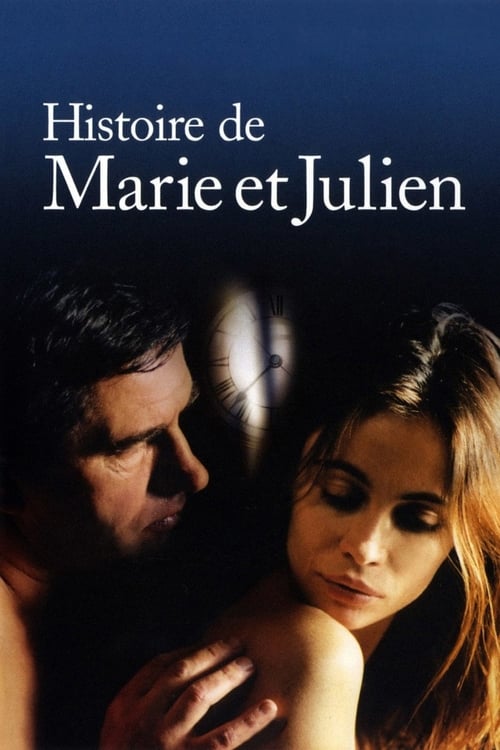
The Story of Marie and Julien: Complete Plot Narrative
Julien Muller exists in solitude within his large, half-empty house that serves as both his residence and clock repair workshop. He is a man of gentle habits--carefully repairing intricate timepieces, speaking softly to his tuxedo cat Nevermore, assuring the animal that no one lives upstairs anymore. This reference to the upper floors hints at abandonment, at a woman who once occupied those rooms before leaving with another man, taking with her only the clothes and possessions she couldn't carry away. Julien is described as having destructive impulses despite his meticulous work with clocks, and these impulses have led him down a dark path: he has decided to blackmail Madame X, a wealthy and attractive woman who traffics in stolen antiques, dealing specifically in counterfeit Chinese silks. What drives a man so gentle with his cat and so caring with his clocks to engage in such a sordid act remains unclear even to Madame X herself, who recognizes that Julien is not the "blackmailing type". Perhaps it is laziness, a desire for easy money without the effort of his meticulous craft.
The blackmail scheme begins simply enough. Julien has discovered Madame X's secret--her involvement in the trafficking or counterfeiting of antique goods--and he uses this knowledge as leverage. He demands payment in exchange for his silence, for the documents and items he has hidden away that prove her fraud. Initially, his demands seem reasonable, but when Madame X fails to obey his rules, Julien's patience wears thin and he arbitrarily escalates his demands tenfold. The money exchanges happen through an intermediary: Marie, a woman from Julien's past, has mysteriously reappeared in his life after vanishing without trace a year earlier. She becomes his accomplice in the blackmail scheme, collecting the payments and items from Madame X, though she seems far from critical of the crime. In fact, she helps willingly, as if drawn into Julien's orbit by forces neither of them fully understands.
The reunion with Marie is the true catalyst for everything that follows. A year ago, fate had brought them together, but then she vanished inexplicably. Now she has returned just as mysteriously, and when Julien encounters her, they rekindle their relationship with an intensity that borders on desperate. Their connection is passionate and physical. They engage in elaborate role-playing scenarios, finishing each other's erotic stories, co-creating fantasies about forests and desire. Marie moves into Julien's house, and for a time, their reunion seems like a second chance at love. Yet from the beginning, something is profoundly wrong. Marie fluctuates between moments of passionate devotion and periods of icy, aloof numbness. She seems incapable of normal physical feeling. When scratched, she does not bleed--a fact she carefully hides from Julien. She speaks in a distant, otherworldly manner, as if she comes from a place where time has no value, where nothing grows or builds upon the passage of moments.
Marie becomes increasingly obsessed with the attic room in Julien's house. She spends hours alone there, compulsively decorating and rearranging its contents with meticulous precision. She seems driven by forces she cannot explain, as if following instructions from somewhere deep within her psyche. Julien grows frustrated watching her disappear into that room day after day, losing herself in work whose purpose remains mysterious even to her. When he finally demands to see what she has created, Marie can offer no explanation. The room is arranged with such specific intention, yet she claims not to know what it is for. Julien's concern deepens into something darker--he begins to wonder if Marie is mad.
His suspicions seem confirmed when he contacts Marie's old employer, hoping for insight into her behavior. The employer suggests he speak with Delphine, Marie's former friend. When Julien reaches Delphine, the story that emerges is troubling: Marie's relationship with a man named Simon drove her to madness, and that relationship ended their friendship. The implication hangs in the air--that Marie's current strangeness might be a continuation of a psychological break that began with Simon. Desperate for answers, Julien decides to visit the apartment where Marie and Simon once lived together. A letting agent shows him through the space, and when they reach a particular room, Julien stops cold. He recognizes it immediately. It is identical--in every detail--to the room Marie has been preparing in his attic.
The truth crashes down upon him like a physical blow. The letting agent explains that this is where a woman hanged herself, attempting to frame her boyfriend in revenge after a terrible argument. The woman was Marie. She had killed herself in this room, months or perhaps a year earlier, trying to destroy Simon through her own death. And now, impossibly, she has returned to Julien's house and recreated that room of death in his attic, as if compelled by forces beyond her control to repeat her final act.
Julien returns home in a state of shock and confusion. Marie silently leads him to the attic, to the room she has prepared with such care. There, she confesses her intention: she feels compelled to hang herself again, to ritualistically repeat the act that claimed her life. Julien's response is immediate and desperate. He carries her downstairs, away from the noose, away from the machinery of her self-destruction. They make love, and for a moment, it seems as though physical intimacy might anchor her to life, might convince her that she has reasons to remain in this world.
But the supernatural forces at work in this story are far more complex than simple possession or madness. Marie leaves Julien to meet with someone else--a woman named Adrienne, who appears to her in the darkness. Adrienne is also a ghost, also a revenant trapped between worlds. She had committed suicide as well, driven by a terrible relationship with someone she loved. The two dead women meet in a space that may or may not be real, in a conversation that may or may not be happening. Adrienne tells Marie something crucial: she knows that Marie no longer wants to die. They discuss their situation with a kind of resigned acceptance, acknowledging that they do not understand the rules governing their existence, the laws that keep them bound to this world of the living.
Meanwhile, the blackmail plot continues its own dark trajectory. The documents proving Madame X's fraud are exchanged for money. Marie collects the payments. The scheme that began with Julien's destructive impulses reaches some kind of resolution, though Julien's commitment to it wavers as his focus shifts entirely to the supernatural mystery unfolding in his own home. Madame X, for her part, knows Marie only as "l'autre personne"--the other person. She does not understand who this woman is or why she appears in her life collecting blackmail payments. But Adrienne, Madame X's dead sister, knows the truth. She tells Madame X that Marie is "like me"--a revenant, a ghost, someone caught between worlds.
The film's narrative becomes increasingly dreamlike and uncertain. Marie and Julien examine a photograph together, and Marie speculates about the two women in the image: "one is dead, the other alive". The boundary between reality and dream, between the living and the dead, becomes impossible to determine. Marie begins to chant in a foreign language, her voice taking on an otherworldly quality. She seems to be channeling forces from beyond, speaking words in tongues that Julien cannot understand. The "forbidden sign" that Adrienne showed her in dreams--a specific gesture made with the hands--becomes a symbol of the ghostly rules that govern their existence.
The climax approaches with terrible inevitability. Julien, having learned the truth about Marie, having understood that the woman he loves is dead and trapped in a liminal space between worlds, makes a decision born of desperation and love. If Marie cannot cross over, if she is doomed to return to this corrupt world she hoped to escape, then perhaps he can join her. Perhaps death is the only place where they can truly be together. He prepares a noose in the kitchen, ready to follow Marie into whatever comes next.
But Marie, in a moment of clarity and love, interrupts him. She pulls down the noose before he can place it around his neck. Julien, thwarted in his attempt at hanging, runs to the kitchen in a final act of desperation. He takes a knife and attempts to slit his wrist, to bleed out and join her in death. Marie stops him, grabbing the knife from his hands. In the struggle, both are cut--her wrist, his palm--and the blood that flows seems to carry a kind of magic, a supernatural significance that transcends normal physics.
Marie looks at Julien with an intensity that seems to pierce through all the confusion and madness of their relationship. She speaks words that sound like a vow, like a binding spell: "Now I am yours. You are mine. Where I must go you will accompany me. For what I must do you will help me. Don't fail me, or you will lose the very memory of me." These words are not a threat but a declaration of absolute connection, a statement that their fates are now intertwined, that they will face whatever comes next together.
The film ends not with death but with a strange kind of tenderness. Julien does not die. Marie does not hang herself again. Instead, they remain together in a state that transcends the normal categories of life and death. The questions that have haunted the narrative--Is Marie alive or dead? Is Julien dreaming? What are the rules of their supernatural existence?--remain unanswered. The film suggests that these questions no longer matter. What matters is that they have found each other, that they have chosen to remain together, that they have created a love story that exists outside the normal boundaries of human experience.
The house remains half-empty. The clocks continue to tick. Nevermore, the tuxedo cat, watches from the shadows, having long ago revealed Julien's secrets to Marie by leading her to the hidden documents. The blackmail scheme has run its course. Madame X and her dead sister Adrienne have reached some kind of understanding about their own supernatural existence. And Julien and Marie, the clockmaker and the ghost, the man and the revenant, have transcended the ordinary world to create something entirely their own--a dark, tender, supernatural love story that defies death itself.


What is the ending?
In the ending of "The Story of Marie and Julien," Marie's ghostly presence becomes increasingly intertwined with Julien's life. As Julien grapples with his feelings for Marie, he ultimately decides to confront the reality of her death. The film concludes with a haunting sense of loss and unresolved emotions, leaving Julien to navigate his grief and the memories of Marie.
As the final scenes unfold, Julien is seen in his apartment, surrounded by the remnants of his life with Marie. The atmosphere is heavy with a sense of longing and melancholy. He reflects on their time together, the moments of joy and the shadows of tragedy that have marked their relationship. The camera lingers on Julien's face, capturing the depth of his sorrow and the weight of his memories.
In a poignant moment, Julien visits the place where Marie's body was found, a location that holds both beauty and despair. He stands alone, grappling with the reality of her absence. The wind rustles through the trees, echoing the emptiness he feels inside. Julien's internal struggle is palpable as he confronts the truth of Marie's death, realizing that he must let go of the past to move forward.
The film closes with Julien returning to his apartment, where he finds a small token left behind by Marie. It serves as a bittersweet reminder of their love and the life they could have shared. As he holds it in his hands, tears well in his eyes, symbolizing both his grief and the enduring connection he feels to Marie, even in her absence.
In the final moments, Julien is left alone, a solitary figure in a world that feels both familiar and foreign without Marie. The screen fades to black, leaving the audience with a lingering sense of loss and the complexities of love and memory.
The fate of Julien is one of profound sorrow and introspection. He is left to navigate his grief, carrying the weight of his memories of Marie. The film concludes without a clear resolution, emphasizing the enduring impact of love and loss on the human experience. Marie, as a ghostly presence, remains a part of Julien's life, symbolizing the inescapable nature of memory and the emotional scars that linger long after a loved one is gone.
Is there a post-credit scene?
The Story of Marie and Julien, directed by Jacques Rivette, does not feature a post-credit scene. The film concludes with a focus on the complex relationship between the two main characters, Marie and Julien, leaving the audience with a sense of ambiguity and reflection on their intertwined fates. The ending emphasizes the themes of love, loss, and the supernatural elements that permeate their story, without any additional scenes or content after the credits.
What is the significance of the character Marie's ghostly presence in Julien's life?
Marie, portrayed as a ghost, represents Julien's unresolved feelings and the haunting nature of love and loss. Her presence is both comforting and unsettling, reflecting Julien's internal struggle with his past and his inability to move on.
How does Julien's profession as a clockmaker influence the narrative?
Julien's work as a clockmaker symbolizes his desire for control and order in his life. The meticulous nature of his craft parallels his attempts to manage his emotions and the chaotic relationship with Marie, whose ghostly existence disrupts the flow of time.
What role does the setting play in the development of Julien and Marie's relationship?
The film is set in a dimly lit, atmospheric Paris, which enhances the sense of isolation and melancholy surrounding Julien. The settings, including his workshop and the hauntingly beautiful locations they visit, serve as a backdrop for their complex relationship, emphasizing themes of longing and the supernatural.
How does Julien's emotional state evolve throughout the film in relation to Marie?
Initially, Julien is depicted as a lonely and reclusive figure, deeply affected by Marie's death. As the story progresses, his emotional state shifts from despair to a conflicted yearning for connection, ultimately leading him to confront his feelings about love, loss, and the possibility of moving forward.
What is the significance of the recurring motif of time in the film?
Time is a central motif in 'The Story of Marie and Julien,' represented through Julien's clockmaking and the ghostly nature of Marie. The manipulation of time reflects Julien's struggle with his memories of Marie and his desire to reclaim moments from the past, highlighting the tension between nostalgia and the present.
Is this family friendly?
"The Story of Marie and Julien," directed by Jacques Rivette, is not considered family-friendly due to its mature themes and content. Here are some potentially objectionable or upsetting aspects that may affect children or sensitive viewers:
-
Themes of Death and Loss: The film explores heavy themes surrounding death, which may be distressing for younger audiences or those sensitive to such topics.
-
Psychological Tension: The narrative delves into psychological complexities and emotional turmoil, which can create a tense atmosphere that might be unsettling.
-
Isolation and Loneliness: The characters experience profound feelings of isolation and loneliness, which could resonate negatively with sensitive viewers.
-
Supernatural Elements: The presence of ghostly apparitions and the exploration of the supernatural may be frightening for some children.
-
Intense Emotional Scenes: There are moments of intense emotional conflict and despair that could be difficult for younger viewers to process.
Overall, the film's exploration of complex adult themes and emotional depth makes it more suitable for mature audiences.







