





Popular
What is the significance of Erik's relationship with his father in the story?
How does Erik's fascination with insects reflect his character development?
What role does the character of the teacher play in Erik's journey?
How does Erik's perception of the world change throughout the film?
What is the impact of Erik's encounters with other children in the film?
Should I watch it?
Ask Your Own Question

What is the plot?
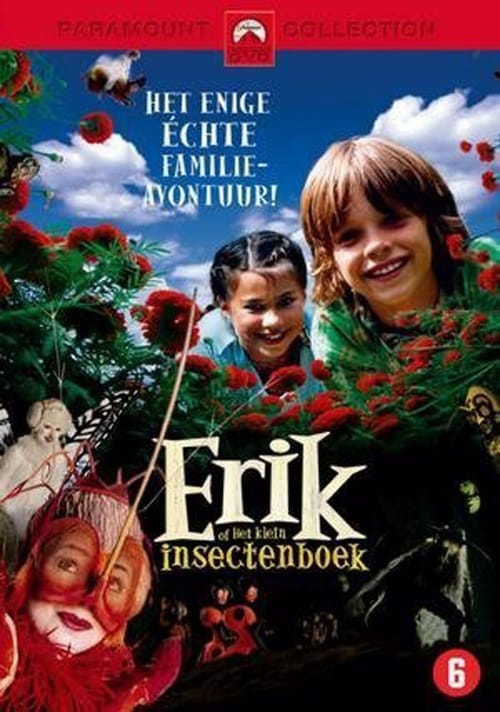
Erik Pinksterblom opens the film as a shy ten-year-old Dutch schoolboy who would rather drift off thinking about his secret crush, Rosalie, than face the dreaded classroom presentation on insects. He lies in bed with that familiar knot of dread in his stomach, staring at the ceiling and trying to avoid the fact that tomorrow he must stand in front of his class and speak. Around him, the world feels too large and too difficult, and the fear is not really about insects at all: it is about being seen, being judged, and failing in public. His father is already dead, and that absence hangs over Erik like a quiet ache; his grandfather has helped raise him since the loss, and the old man's gentle patience is one of the few steady things in Erik's life. That grandfather, a kind nature lover with a country estate full of curiosities, tries to rescue the moment by steering Erik toward the subject of insects, telling him that they are fascinating if he only gives them a chance. Erik does not feel fascinated. He feels trapped.
The grandfather's estate becomes the story's first true threshold, a place of wood, grass, old papers, and careful observation, where the real world and the strange world are separated by only the thinnest veil. In the quiet of that estate, Erik is given a book on insects and guided toward noticing details he has never wanted to notice before. The film's opening mood is one of reluctant learning: Erik is not a natural scientist, he is a daydreamer, and the adults around him understand that the lesson is as much about courage as it is about entomology. He is still thinking about Rosalie, still fretting over school, when the magical side of the story begins to take hold. The transition is gentle but unmistakable: the ordinary bedroom, the grandfather's house, the insect book, and the old image connected to the insect world all begin to feel like parts of the same hidden mechanism. Erik reads, dozes, and slips away.
When Erik enters the insect world, the change in scale is immediate and astonishing. He becomes tiny, and the meadow around him swells into a giant, threatening landscape. Leaves become walls, grass becomes a forest, and every puddle and stem feels like terrain to be crossed with caution. The insects he meets are not mindless creatures but talking, self-aware social beings with customs, vanity, and prejudices that look embarrassingly human. Erik's first major encounter is with an aristocratic wasp family, whose polished manners and inherited superiority establish the film's social satire at once. They occupy a palatial, overdecorated world and judge everyone around them according to rank, appearance, and utility. Their contempt for bees is immediate and loud, and the snobbishness in their voices makes the wasps feel less like animals than like a caricature of old wealth and status obsession.
Erik's own presence in their world is an offense and an amusement at the same time. He is a two-legged outsider who knows things about insects from a book, and that knowledge makes him useful but also suspicious. He tries to speak carefully, but even his innocent remarks can land badly. One of the story's sharpest little detonations comes when he recites or alludes to the "busy bee," a phrase meant as harmless schoolbook language but taken by the wasps as an insult because it praises labor and practicality, the very qualities they scorn. The moment reveals how easily language crosses into offense when it lands in the wrong culture. The wasps' reaction turns tense and ugly, and Erik is forced to learn that in this miniature society, as in his own, class pride and social codes can turn a simple sentence into a conflict.
As Erik moves deeper through the meadow, he encounters a whole range of insect lives, each with its own logic. The insects ask him questions because he is strange to them, and he asks questions because everything around him is unfamiliar despite the facts he has memorized from his book. The film plays these scenes with a mix of wonder and discomfort: Erik is fascinated, but he is also constantly aware that he is vulnerable. He is tiny in body but not in mind, and the strange advantage of the story is that his knowledge gives him a kind of social power. He can interpret behavior that others take for granted. He can identify species, habits, and habits of thought. That knowledge does not make him safe, but it helps him survive. He is repeatedly reminded that being clever on paper is not the same as being brave in person, and the insect world keeps pressing him toward that lesson.
The wasp family's hostility is only one face of the insect society's deeper hypocrisy. Erik discovers that insects, like humans, are governed by status, ritual, and inherited assumptions. The bees, for example, are linked to work and service, while the wasps define themselves in opposition to such labor. Different species occupy different symbolic places in this tiny civilization, and the film uses these differences to expose the pettiness of prejudice. Erik learns that even among creatures who are physically small, there can be enormous pride. That realization begins to reframe his own life. His fear of school, his embarrassment around Rosalie, and his sense of inadequacy no longer feel isolated; they are part of a larger pattern of people and creatures all trying to protect their sense of self.
Among the many figures Erik meets are memorable personalities such as his grandfather's insect-world counterparts and other beings from the meadow society, including the vigilant, argumentative, and strangely dignified ones who populate the field's hidden corners. In the film's cast of voices and faces, figures like Rosalie, the teacher, Erik's mother, his grandfather, the wasp-like aristocrats, the homely laborers, and the more comic or earthy characters all anchor the fantasy in recognizable human emotion. The real-world names matter because the insect world keeps reflecting them back in distorted form. Rosalie, whom Erik loves from a distance, remains a silent pressure on his imagination; she is the reason he wants to seem better than he feels. The teacher, whose looming demand for a speech makes Erik sick with nerves, stands as the worldly counterpart to the insect society's judges and gatekeepers. Even Erik's family is split between absence and support: his father's death has left a wound, while his grandfather and mother represent care, continuity, and the possibility of growth.
The film's most important revelation is not a single shocking twist but a gradual understanding of what Erik really needs. He thinks he needs to learn insects well enough to survive a school presentation. In fact, he needs to learn how to stand in front of others without collapsing into fear. The magical journey is a kind of training ground, and every encounter in the insect world pushes him closer to that truth. When he is mocked, questioned, or challenged, he must answer. When he is treated as an intruder, he must decide whether to flee or speak back. When the insect society's assumptions become absurd or unfair, he must resist them. He is not simply collecting facts. He is being shaped by conflict.
The story's tension grows as Erik makes his way through the tiny society's social web, encountering not only the proud wasps but also the more practical, comic, and earthy inhabitants of the meadow. He sees how different insects live, work, hide, and defend themselves. In some versions of the source material and the wider plot tradition, the miniature world includes a snail-shell dwelling that symbolizes shelter and domesticity, another sign that this is a society built around the same anxieties and comforts as the human one. Erik is invited into spaces that are both hospitable and strange, and each one teaches him that survival depends on adaptation. The film repeatedly returns to the idea that what appears tiny is not trivial. The smallest creatures carry the same dramas of vanity, fear, generosity, and resentment that humans do.
One of the film's cleverest emotional turns is that Erik's greatest ally in this process is knowledge, but knowledge only works once it is connected to feeling. He can recite what insects do, yet he still has to learn what to do when he is afraid. He can identify a species, but he must also learn to read a room. He can explain behavior, but he still has to speak honestly about himself. The insect world therefore becomes a mirror in which Erik sees not just bugs, but the shape of his own cowardice and his own longing. He begins to understand that his silence about Rosalie is part of the same fear that makes him dread the classroom. To change one, he must change the other.
The film does not rely on lethal danger, and there are no major deaths in the story's plot. The stakes are emotional, social, and personal rather than fatal. That absence of death actually intensifies the film's tenderness: the conflict is about whether Erik can grow into himself, not whether anyone can survive a slaughter. Even so, the confrontations feel real. Erik is humiliated by the wasps' arrogance, shaken by the insect world's skepticism, and pushed to the edge by his own uncertainty. In these scenes, his worst enemy is his own hesitation. Every time he is forced to answer a question or defend a statement, the film measures how much courage he has gained and how much he still lacks.
As the night in the insect world continues, the magical experience becomes more than a dreamlike excursion. It becomes a test of identity. Erik's understanding of insects is no longer abstract; it has been earned in conversation, embarrassment, and surprise. He sees the insect community not as a collection of specimens but as a living society full of contradiction. Some are proud, some are helpful, some are suspicious, some are ridiculous, and all are guided by the same impulses that shape human families and classes. This realization is one of the story's key revelations: the boundary between human and insect is less about size than about behavior. Vanity, hierarchy, exclusion, and courage exist on both sides of the scale.
The climax arrives as Erik reaches the point where the adventure can no longer remain an escape. He must choose what the experience means. The insect world has taught him enough, but knowledge alone is not the ending. He must bring that learning back into the human world and act on it. The final stretch of the film therefore turns from wonder toward resolve. Erik gathers himself. The fear that opened the story has not vanished, but it has been challenged and reshaped. He is no longer just the boy in bed, staring at the ceiling and wishing the problem would disappear. He is the boy who has faced alien judgment and found that he can answer back.
The return to the real world is the story's emotional release. Erik wakes or comes back from the magical night changed, and the film makes clear that the journey was not a dream in the trivial sense but an inner transformation made visible through fantasy. He goes back to his everyday life with a new steadiness. The looming school presentation is still waiting, but it no longer has the same power over him. He has seen social hierarchy stripped down to absurd miniature form, and that knowledge weakens its hold on him in the human world. He now understands that authority can be silly, that pride can be empty, and that speaking with conviction matters more than pretending not to care.
By the final scenes, Erik has gained the courage to approach school differently and to face his life more honestly. He is no longer merely avoiding his speech or hiding behind fantasy. The film ends on the note that the experience has given him a new confidence to act, to speak, and to return to the everyday world with his eyes open. His grandfather's guidance, once just gentle encouragement, has become part of Erik's own strength. The loss of his father remains part of him, but it no longer defines his helplessness. Rosalie remains the object of his shy affection, yet the barrier between feeling and action has begun to break. The closing effect is one of quiet triumph: Erik does not conquer the world, but he learns how to stand in it.
The final scene and resolution leave the sense that the insect adventure has done what the grandfather hoped it would do from the start. It has taught Erik not only about insects but about himself. He returns to the real world ready to speak, to endure attention, and to stop hiding behind fear. The story ends with transformation rather than spectacle, with courage rather than victory over a villain, and with the promise that the shy boy who began the film can now face both school and life with a little more backbone, a little more honesty, and a little less trembling.





What is the ending?
In the ending of "Erik or the Small Book of Insects," Erik confronts his fears and insecurities, leading to a moment of self-discovery. He ultimately finds a sense of acceptance and understanding of himself and his place in the world. The film concludes with Erik embracing his individuality, symbolized by his connection to the insects he has studied throughout the story.
As the film approaches its conclusion, we find Erik in a quiet, reflective state, sitting alone in his room surrounded by the small book of insects that has been a constant presence throughout his journey. The room is dimly lit, with shadows dancing across the walls, creating an atmosphere of introspection. Erik's face is a mixture of determination and vulnerability as he contemplates the lessons he has learned.
In the next scene, Erik steps outside into a sunlit garden, where he is greeted by the vibrant colors of flowers and the gentle hum of insects buzzing around him. This moment signifies a shift in Erik's perception; he is no longer the timid boy who felt out of place. Instead, he walks with a newfound confidence, observing the insects with a sense of wonder and appreciation. The camera captures close-ups of the insects, emphasizing their beauty and complexity, paralleling Erik's own journey of self-acceptance.
As Erik interacts with the insects, he begins to understand that, like them, he has his own unique qualities that make him special. He kneels down to examine a butterfly, its delicate wings fluttering in the breeze. This moment is pivotal, as Erik realizes that embracing his individuality is not something to fear but rather something to celebrate. The emotional weight of this realization is palpable, and the audience can feel Erik's transformation as he smiles, a genuine expression of joy lighting up his face.
In the final scenes, Erik returns home, where he is met by his family. There is a sense of warmth and acceptance in their interactions, suggesting that Erik's journey has not only changed him but has also positively impacted those around him. His parents, who had previously struggled to understand him, now look at him with pride and admiration. Erik shares his newfound passion for insects with them, explaining their significance and beauty, which fosters a deeper connection between him and his family.
The film concludes with Erik standing in front of a large window, looking out at the world beyond. The sunlight streams in, illuminating his face, symbolizing hope and the promise of new beginnings. The camera slowly pans out, capturing Erik's silhouette against the backdrop of a vibrant landscape filled with life. This final image encapsulates the essence of Erik's journey: a boy who has learned to embrace his uniqueness and find his place in a world that can often feel overwhelming.
In summary, Erik's fate is one of self-acceptance and growth, while his family also experiences a transformation in their understanding of him. The ending reinforces the themes of individuality, connection, and the beauty of embracing one's true self.
Is there a post-credit scene?
The movie "Erik or the Small Book of Insects," produced in 2004, does not feature a post-credit scene. The film concludes its narrative without any additional scenes or content after the credits roll. The story wraps up with a focus on Erik's journey and his relationship with the world of insects, leaving the audience with a sense of closure regarding his character development and the themes explored throughout the film.
What is the significance of Erik's relationship with his father in the story?
Erik's relationship with his father is central to the narrative, showcasing a complex dynamic filled with tension and longing. Erik seeks his father's approval and understanding, which he struggles to attain. This relationship drives Erik's internal conflict, as he grapples with feelings of inadequacy and the desire to connect with his father, who is often emotionally distant.
How does Erik's fascination with insects reflect his character development?
Erik's fascination with insects serves as a metaphor for his own feelings of isolation and his quest for identity. Throughout the film, his detailed observations of insects reveal his sensitivity and curiosity about the world around him. This interest becomes a coping mechanism for Erik, allowing him to escape from his troubled home life and explore themes of transformation and growth.
What role does the character of the teacher play in Erik's journey?
The teacher in the film acts as a mentor figure for Erik, providing him with guidance and encouragement. This character recognizes Erik's unique talents and interests, particularly in his studies of insects, and helps him to cultivate his passion. The teacher's support contrasts with Erik's home life, highlighting the importance of positive influences in Erik's development and self-acceptance.
How does Erik's perception of the world change throughout the film?
As the film progresses, Erik's perception of the world evolves significantly. Initially, he views it through a lens of fear and confusion, largely influenced by his strained family dynamics. However, through his exploration of nature and his interactions with supportive characters, Erik begins to see beauty and complexity in the world around him. This shift is marked by moments of discovery and connection, leading to a more hopeful outlook.
What is the impact of Erik's encounters with other children in the film?
Erik's encounters with other children are pivotal in illustrating his struggles with social acceptance and belonging. These interactions often highlight his feelings of alienation, as he finds it difficult to relate to his peers. However, there are moments of connection that provide Erik with glimpses of friendship and understanding, ultimately contributing to his character growth and his journey towards finding his place in the world.
Is this family friendly?
"Erik or the Small Book of Insects" is generally considered family-friendly, but it does contain some elements that may be unsettling for younger viewers or sensitive individuals.
-
Themes of Isolation: The protagonist, Erik, experiences feelings of loneliness and alienation, which may resonate deeply and evoke sadness.
-
Insect Imagery: The film features various insects, some of which may be depicted in a way that could be unsettling for those with a fear of bugs or who find them disturbing.
-
Existential Themes: The narrative explores complex themes of identity and existence, which might be challenging for younger audiences to fully grasp.
-
Emotional Struggles: Erik's internal conflicts and emotional struggles are portrayed with depth, which could be intense for sensitive viewers.
-
Surreal Elements: The film includes surreal and dreamlike sequences that may be confusing or unsettling for some children.
Overall, while the film is suitable for a family audience, these aspects may require parental guidance for younger viewers.








