








Popular
What is the significance of the keymaker in the car chase scene?
How does Neo's relationship with Trinity affect the car chase?
What role do the Merovingian and his henchmen play in the car chase?
How does the car chase illustrate Neo's abilities as 'The One'?
What emotional stakes are present for Morpheus during the car chase?
Should I watch it?
Ask Your Own Question

What is the plot?
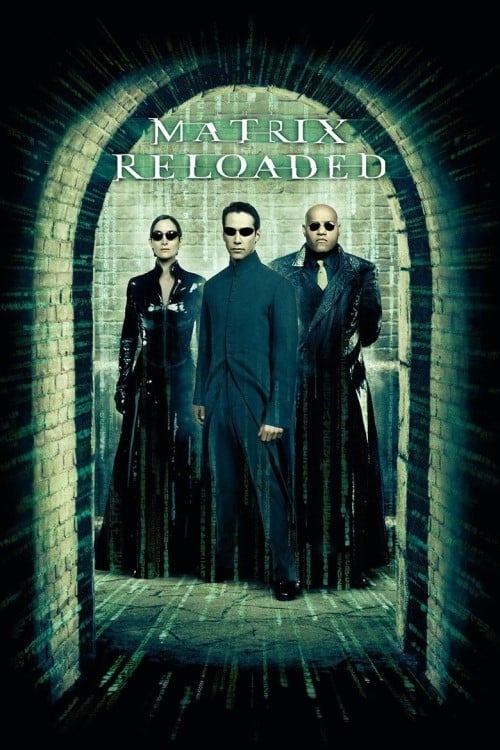
The film opens in crisis, with Zion bracing for annihilation as word spreads that a massive Sentinel force is tunneling toward the city and will arrive in 72 hours. In the dim, crowded war room, the human resistance feels the clock start to grind down on them, and every conversation is shadowed by the certainty that this is not a drill but the opening move of an extinction event.
Morpheus takes charge of the spiritual side of the response, hearing an emergency message from Captain Niobe of the Logos and pressing for a meeting that keeps at least one ship outside Zion so contact with the Oracle can continue. Commander Lock, hard-eyed and practical, orders all ships to return home and prepare for the defense, refusing to gamble on prophecy while the machines are literally boring toward the city beneath their feet. That split sets the movie's rhythm: one half is military panic in Zion, the other is a hunt through the Matrix for answers that may matter even more than bullets.
Neo lives at the center of that fracture. He is no longer just the savior of the first film; he is now a man in love with Trinity, but also a man haunted by visions of her death. The dream leaves him visibly unsettled, and that private fear keeps pushing him forward even when Morpheus speaks of destiny and the Oracle speaks in riddles. Neo is the One, but the film keeps stressing that being the One does not mean being certain, and it certainly does not mean being safe.
The Oracle directs the trio toward the next step in the chain of hidden power: the Keymaker, the only path to the Source. In one of the film's biggest revelations, she is no divine prophet at all but an exiled computer program, a piece of the Matrix itself who has her own purpose and her own way of steering events. She tells Neo that the Keymaker is held by the Merovingian, and that to reach the Source Neo must first pass through this French program's territory. The truth lands like a trapdoor opening beneath the story: the Oracle has always been part of the system, not outside it, and now she is deliberately guiding Neo deeper into its machinery.
Neo, Morpheus, and Trinity move into the Matrix with urgency and stealth, but the world they enter is already alive with surveillance and betrayal. Their target is the Merovingian, a powerful exile who runs his own corner of the simulation like a dark palace of privilege and cruelty. He refuses to surrender the Keymaker, and the meeting turns into a confrontation packed with menace, arrogance, and sudden violence. Neo is forced into action against the Merovingian's guards, while the Keymaker becomes the object everyone is trying to seize before the others can use him.
The Keymaker himself is one of the film's most important figures, a quiet, nervous old man who carries the literal means to open almost any door. His power is simple but enormous: with the right key, he can take someone anywhere in the Matrix, and that makes him indispensable and doomed. Every faction wants him--Neo's group needs him to reach the Source, the Merovingian wants to keep him locked away, and the Agents want him terminated because his existence threatens the control structure of the system. The film makes him feel both fragile and central, like a living hinge in a vast hidden machine.
The escape from the Merovingian's domain explodes into the freeway chase, the movie's most elaborate and breathless set piece. Morpheus, Trinity, and the Keymaker are pursued at once by the ghostlike Twins, by Agents, and by ordinary police, all of them converging on a moving battlefield of concrete barriers, overpasses, semis, motorcycles, and roaring engines. The sequence becomes an urban storm of metal and motion: guns spit, tires scream, cars smash into one another, and every lane seems to become a dead end one second before it is needed. The Keymaker is treated like cargo, but the chase makes clear he is a lifeline.
Trinity drives with ferocious control, threading impossible gaps through traffic while Morpheus fights on and around the vehicles with katana and pistol, trying to keep their pursuers from closing in. The Twins are especially relentless, their ghostly nature making them feel less like men than like a curse riding in an SUV. Morpheus eventually battles them directly and destroys their car, apparently killing them in the blast, though their non-corporeal forms suggest they may survive in some altered state. Whether dead or merely dispersed, they are removed from the chase by force, and the road opens just enough for the heroes to keep moving.
The chase is also a rotating chain of rescues and losses. Morpheus repeatedly fights to keep hold of the Keymaker, Trinity leaps between vehicles with terrifying precision, and the freeway becomes a labyrinth where every crash creates a new threat and every escape route immediately becomes another ambush. An agent attacks Morpheus on a truck, and the battle edges toward catastrophe as the vehicles themselves begin to collapse into one another. Niobe joins the chaos by entering the Matrix to help, and her intervention becomes crucial when she catches Morpheus as he falls from the truck, saving him from a deadly plunge. The whole sequence keeps tightening until it feels less like a chase than like the system itself trying to crush the resistance beneath its wheels.
Eventually Neo arrives in time to alter the outcome, snatching Morpheus and the Keymaker from the air and ending the freeway disaster in a burst of impossible timing. It is one of the movie's cleanest demonstrations of Neo's mythic role: he does not merely survive the system, he bends it at the exact moment it threatens to win. The immediate objective is achieved, but the cost is that the larger war is still waiting, untouched, in Zion.
While these battles rage in the Matrix, Zion's crisis worsens. The city prepares for the machine assault with grim discipline, but the resistance's planning is undermined by secrets and sabotage. The EMP strategy, intended as Zion's best defense, depends on coordinated timing and trust. That trust is shattered when Smith, now operating through Bane's body, triggers the EMP prematurely and ruins the plan. The betrayal lands as a brutal twist because it turns one of Zion's own assets into the reason its defenses fail. Bane, in effect, is lost to Smith's control by the end of the film, and the human crew is left with the horrifying realization that the enemy can cross the boundary between worlds in ways they did not expect.
Neo's route to the truth continues beyond the freeway and beyond the Keymaker. He reaches the Architect, and the film's entire philosophy snaps into place around that encounter. The Architect reveals that the Matrix is not a one-time prison but a repeating design, a controlled cycle that anticipates its own anomalies. Neo is told that he is not the first One; he is the sixth iteration. The prophecy, the rebellion, the sense of freedom--all of it is exposed as part of a system that allows a chosen anomaly to emerge, then offers a structured choice that keeps the machine order intact.
This is the film's most devastating revelation. Neo has believed that he is breaking the system from the outside, but the Architect explains that his existence has always been included in the system's architecture. The "One" is not a random miracle; he is a managed event, a predictable pressure valve. The idea that the war might be solved by simple victory is shattered. The Matrix is not a prison with one lock to pick; it is a machine built to absorb resistance and recirculate it.
At the same time, the Oracle's instructions and Neo's vision of Trinity dying collide with the Architect's choice. Neo is forced into a decision that shapes the ending: the machine order wants him to choose the larger system, but Trinity is in danger, and the emotional core of the story finally outweighs the abstract logic of prophecy. The narrative does not soften this choice. It sharpens it until everything becomes personal. Neo chooses Trinity, refusing to let the system define love as expendable collateral.
That choice does not end the war, but it does reveal who Neo is beneath the myth. He is not merely fulfilling a function; he is making a human decision in defiance of the machine logic that created him. The film does not present the outcome as triumphant in any simple sense. Instead, it treats the choice as a break in the pattern, an interruption that may matter more than the system can yet understand.
The aftermath comes fast and violent. Neo, Trinity, and Morpheus return toward their ship just as the machine threat escalates, and the final stretch of the film shifts back into survival mode. The Sentinels attack their vessel, turning the last act into a desperate naval-and-biological struggle in cramped corridors and flickering emergency light. The ship becomes a place of panic, alarms, and metal-on-metal dread, the perfect closing chamber for a story that has been narrowing toward catastrophe from the beginning.
Then comes the film's most shocking twist. Neo, now outside the Matrix, discovers that his power has not stopped at the edge of the simulation. He reaches out and disables the attacking machines in the real world, affecting Sentinels directly with a force that looks like an extension of the same will he uses inside the Matrix. The moment is stunning because it breaks the film's core boundary. Everything the audience has assumed about what counts as real suddenly becomes unstable. Neo slumps into a coma from the effort, showing that whatever this new power is, it is dangerous and beyond his control.
The ship barely survives long enough for rescue. Another vessel retrieves the survivors, and the final image settles into a grim, unresolved aftermath: Neo lies unconscious in the hospital room aboard the ship, and beside him is Bane's body, now associated with Smith's corruption. The scene is quiet, but the quiet is poisonous. Smith's threat has crossed into the next stage, Neo is in a coma, and the machine army is still advancing on Zion. The war is not over; it is closer to the city than ever.
The ending leaves the story on a knife edge. Zion has not been saved, the Matrix has not been broken, the prophecy has been exposed as part of a cycle, and Neo's new ability has only deepened the mystery around him. The final feeling is not closure but escalation: the machines are still coming, Smith is still present in human form through Bane, and Neo has crossed a threshold that no one, not even the Oracle or the Architect, fully understands.
More Movies Like This
Browse All Movies →


What is the ending?
In the car chase sequence of The Matrix Reloaded, Neo, Trinity, and Morpheus are pursued by agents and a group of sentinels. They engage in a high-speed chase through the city, showcasing incredible stunts and combat. The chase culminates in a dramatic confrontation, where Neo demonstrates his growing powers, ultimately leading to a tense escape.
As the chase unfolds, Neo, Trinity, and Morpheus are in a sleek, black vehicle, racing through the streets of a futuristic city. The atmosphere is charged with urgency and tension as they are pursued by Agent Smith and other agents, who are determined to capture them. The sound of screeching tires and gunfire fills the air, creating a chaotic backdrop to their desperate flight.
The scene begins with Morpheus driving the car, his expression focused and determined. He navigates through traffic with precision, while Trinity sits in the passenger seat, ready to engage in combat. Neo, in the back seat, is acutely aware of the danger they face, his mind racing as he contemplates their next move. The stakes are high, and the trio knows that their survival depends on their ability to work together.
As they speed through the city, Agent Smith and his cohorts appear, seamlessly blending into the chaos of the chase. The agents are relentless, using their superhuman abilities to leap from car to car, attempting to reach Neo and his allies. The tension escalates as Morpheus swerves to avoid obstacles, while Trinity prepares to fire at their pursuers. The choreography of the chase is a blend of high-octane action and intricate martial arts, showcasing the characters' skills and the stakes of their mission.
In a pivotal moment, Neo realizes that he can manipulate the Matrix in ways that go beyond his previous experiences. He taps into his powers, deflecting bullets and using his abilities to protect his friends. This moment of realization is both empowering and terrifying for him, as he grapples with the implications of his growing strength.
The chase reaches a climax when they are cornered, and Neo must make a choice. He decides to confront Agent Smith directly, showcasing his newfound confidence and abilities. The confrontation is intense, filled with a mix of physical combat and philosophical undertones, as Neo faces the embodiment of the system he is fighting against.
Ultimately, the chase ends with a narrow escape. Neo, Trinity, and Morpheus manage to evade their pursuers, but not without significant consequences. The emotional weight of the chase lingers as they regroup, reflecting on the dangers they face and the choices they must make moving forward. Each character is left with a sense of urgency and determination, knowing that their fight against the Matrix is far from over.
In summary, the car chase in The Matrix Reloaded serves as a critical moment for the characters, highlighting their strengths, vulnerabilities, and the ever-present threat of the Matrix. Neo's evolution as the One is underscored by his actions during the chase, while Trinity and Morpheus remain steadfast allies, each contributing to the fight against their adversaries. The fate of each character is intertwined with the larger narrative, setting the stage for the challenges that lie ahead.
Is there a post-credit scene?
In "The Matrix Reloaded," there is no post-credit scene. The film concludes with a dramatic climax, leaving viewers with a sense of anticipation for the next installment, "The Matrix Revolutions." The focus remains on the unfolding narrative and the characters' journeys, particularly Neo's struggle against the machines and his quest for understanding his role as "The One." The absence of a post-credit scene aligns with the film's thematic emphasis on choice, destiny, and the ongoing battle between humans and machines.
What is the significance of the keymaker in the car chase scene?
The keymaker is crucial in the car chase scene as he holds the keys to accessing the Source, which is vital for Neo and his allies to confront the Architect. His presence drives the urgency of the chase, as the agents are determined to capture him to prevent Neo from reaching his goal.
How does Neo's relationship with Trinity affect the car chase?
During the car chase, Neo's relationship with Trinity is highlighted through their teamwork and mutual trust. Their emotional connection fuels their determination to protect each other, especially when they face overwhelming odds against the agents. This bond adds tension and stakes to the chase.
What role do the Merovingian and his henchmen play in the car chase?
The Merovingian, a powerful figure in the Matrix, orchestrates the events leading to the car chase. His henchmen, including the Twins, are sent to retrieve the keymaker, creating a formidable obstacle for Neo and his team. Their supernatural abilities and relentless pursuit heighten the danger during the chase.
How does the car chase illustrate Neo's abilities as 'The One'?
The car chase showcases Neo's growing powers as 'The One.' He demonstrates superhuman reflexes and combat skills, particularly when he deflects bullets and engages in hand-to-hand combat with agents. This scene emphasizes his evolution and the weight of his destiny as he fights to protect his allies.
What emotional stakes are present for Morpheus during the car chase?
Morpheus experiences intense emotional stakes during the car chase, as he is deeply committed to the mission and the safety of the keymaker. His leadership is tested as he navigates the chaos, and his determination to protect Neo and Trinity reflects his unwavering belief in their cause and the prophecy.
Is this family friendly?
The car chase scene in The Matrix Reloaded is intense and features several elements that may not be suitable for children or sensitive viewers. Here are some potentially objectionable aspects:
-
Violence: The scene includes high-speed car chases, gunfire, and collisions, which can be quite intense and may be distressing for younger viewers.
-
Gunplay: Characters engage in shootouts, with bullets flying and vehicles being shot at, which can create a sense of danger and urgency.
-
Destruction: The chase leads to significant destruction of property, including cars and city infrastructure, which may be unsettling.
-
Tension and Fear: The characters are in life-threatening situations, which can evoke feelings of fear and anxiety.
-
Mature Themes: The underlying themes of conflict between freedom and control may be complex for younger audiences to grasp.
Overall, while the scene is action-packed and visually impressive, it contains elements that may not be appropriate for all viewers.









