
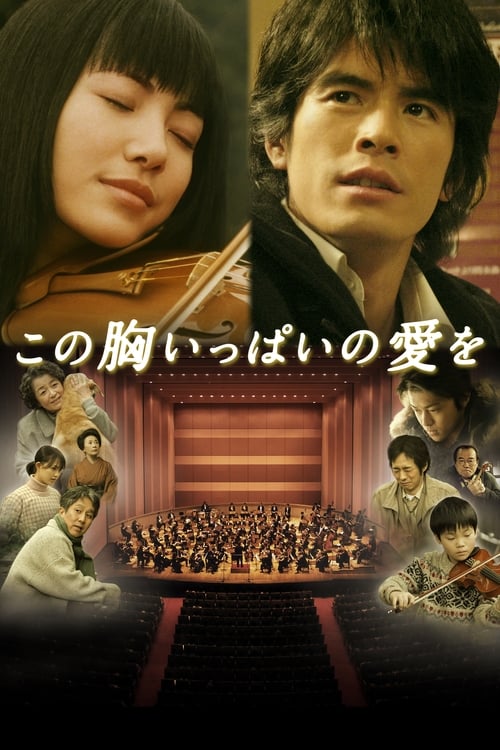










Popular
How does Mia's relationship with her childhood friend evolve throughout the film?
What is the main conflict faced by the protagonist in A Heartful of Love?
What role does Mia's family play in her decision-making process?
What pivotal moment leads Mia to finally pursue her artistic dreams?
How does the setting influence the characters' development in A Heartful of Love?
Should I watch it?
Ask Your Own Question

What is the plot?
Hiroshi Suzutani is thirty years old when A Heartful of Love opens, a polished advertising executive whose adult life has grown remote from the small, tidal world of his childhood. On business in Moji, Kyushu, he returns to the port town where he once lived as a boy, and the trip immediately feels uncanny, as if the streets themselves are preserving his past in amber. The narrow lanes, the old harbor air, and his grandmother's former inn all look exactly as he remembers them, unchanged by the decades he has spent away. That eerie familiarity is the first sign that this is not going to be a normal homecoming, because Moji does not greet him as a visitor; it swallows him whole and sends him backward through time. He stands outside the inn, still trying to orient himself, when he sees a ten-year-old boy and freezes. The child is him. The shock lands like a physical blow. The adult Hiroshi stares at his own younger self, Hiro, and for a few stunned seconds the film lets the impossible hang in the air: one man, two ages, one moment of life split open.
Before Hiroshi can make sense of what he is seeing, Nunokawa appears and draws him into the same impossible reality. The two men, both displaced and disoriented, slowly realize they have been thrown roughly twenty years into the past, back to 1986. The discovery does not come with any grand explanation or clean logic; it arrives through confusion, then panic, then cautious testing of the world around them until the truth becomes undeniable. They are not dreaming, not hallucinating, and not merely remembering. They are physically present in a past that still exists around them, and because no one around them seems to notice the paradox, they are forced to accept the only workable fact: for now, they are stuck there. Time itself becomes the central pressure of the story. Hiroshi has been given, or cursed with, a second chance to walk the streets of his childhood while his childhood self is still alive and running through them.
He takes refuge at the inn once owned by his grandmother, and this choice quietly gives the film one of its most haunting domestic arrangements: the thirty-year-old Hiroshi rooms with his ten-year-old self. The house becomes a place where memory is no longer abstract but embodied. Each room holds two versions of the same life, and the adult Hiroshi watches the child Hiro from close range, gradually seeing the boy's loneliness, intelligence, and guarded sensitivity in ways he could never have understood in the original timeline. Hiro is at first wary of this strange older man who seems to know too much, who can finish half-formed thoughts and recognize feelings the child has never spoken aloud. The tension between them is palpable. Hiroshi has to suppress the instinct to reveal the truth, while Hiro's suspicion keeps every scene charged with the risk of discovery. But over time the distance between them narrows. The adult's kindness and the child's tentative curiosity create a fragile bond, and that bond deepens into trust as Hiroshi proves that he is not there to control the boy's life but to protect it.
Nunokawa takes a different path. Where Hiroshi is pulled toward tenderness and memory, Nunokawa moves back toward criminal instinct and survival. In the past, he falls into his old rhythms, returning to his criminal roots as if the years have only scrubbed the surface of an identity that was always waiting underneath. Yet his plot is not just about crime or habit; it is about origin. He has come to this point in time carrying a wound he does not yet understand fully, and the film slowly reveals that his own existence is tied to a family tragedy that haunts him from before he was born. The adult Hiroshi's return is framed by regret over Kazumi, the young woman he cherished long ago, while Nunokawa's return is framed by the absence of a mother he never truly knew. Their parallel journeys give the story a double heartbeat: one man trying to save love, the other trying to rewrite blood.
The key to the mystery comes through a professor who becomes the story's intellectual guide and moral witness. He explains that he once encountered an old blind woman who literally faded away before his eyes after she corrected a situation she had regretted for decades. That revelation transforms the time-travel premise from an accident into a pattern. The past is not fixed only by force; it can be altered by resolving the emotional knots that keep people trapped in it. The professor's account gives Hiroshi and Nunokawa a direction. If they can identify and repair the unresolved pain at the center of their lives, they may be able to return to 2006. The idea sounds simple when spoken, but in practice it means confronting fear, guilt, and the possibility that helping someone may require changing their future in ways that are painful, irreversible, or morally unbearable.
For Hiroshi, that unresolved knot is Kazumi. He knows, with the terrible certainty of a man who has already lived through the consequences, that Kazumi is destined to die soon from a mysterious illness unless something drastic changes. The story turns toward her with growing urgency. Hiroshi does not merely want to preserve a memory; he wants to keep a life from ending. Yet the only path forward is horrifying in its own way. Kazumi may need a risky operation that could save her life, but the procedure likely leaves her crippled. The choice is brutal: save her body at the cost of mobility, or allow the illness to take everything. Hiroshi's future knowledge gives him power, but that power is poisoned, because he can see the consequences before anyone else can. Every conversation with Kazumi carries the pressure of this hidden knowledge. His words to her are careful, protective, and increasingly desperate. He wants to persuade her toward survival without crushing her spirit, but he also cannot bear the thought of watching her vanish.
The emotional center of those scenes lies in the contrast between what is spoken and what is withheld. Hiroshi looks at Kazumi with the expression of someone standing at the edge of a disaster only he can see. When he speaks, his voice has the strained tenderness of a man trying to save someone without revealing the full horror of why he is afraid. The film lets that fear seep into the spaces between lines. Kazumi, sensing the intensity but not the reason for it, is drawn into a relationship shaped by care, urgency, and the terrible asymmetry of time. Hiroshi is not simply reliving a youthful crush; he is trying to rewrite the outcome of a life he already knows he once failed to protect.
Meanwhile Nunokawa confronts a different kind of tragic inheritance. He seeks out his pregnant mother and learns the truth that has defined him from the shadow side of life: his mother's death in childbirth is directly tied to his own existence, and the abusive father who remains after her death will become part of the structure of the life he has known. The revelation strips away whatever illusion he still had that the past can be gently adjusted. His own birth is entangled with death, and the person he has become exists because of a catastrophe that destroyed the woman who brought him into the world. He decides to try to change that outcome by convincing her to abort him before the pregnancy reaches its fatal end. It is an act born from grief and self-loathing as much as compassion. If he can prevent the birth, he can spare his mother the death that defined him, but he will also erase himself. The film presses hard on the contradiction: saving a mother may mean sacrificing the son who cannot bear to let her die again.
As these separate strands tighten, the film's emotional and temporal tension increases. Hiroshi's scenes with younger Hiro are especially poignant because the boy is, in effect, learning to trust his own future. The adult man becomes a protector, mentor, and witness, subtly shaping the child's understanding of himself. The household at the grandmother's inn becomes an intimate chamber of doubled identity. Every shared meal, every quiet exchange, every moment of observation has the strange feeling of a memory being written while it is still being lived. The adult Hiroshi sees not only what the child is now, but what the child will become, and that knowledge gives the ordinary gestures of care an almost sacred weight. At the same time, the danger of interference hangs over everything. If Hiroshi alters the wrong detail, he may not just save Kazumi or return home; he may erase the very conditions that allowed his life to unfold.
The narrative drives forward toward its climax through those converging moral dilemmas. Hiroshi presses Kazumi toward the operation, knowing that every second matters and that the future he remembers will not occur unless the past is forced to change. His pursuit of her survival becomes a race against the disease that will otherwise claim her. Nunokawa, moving on his own track, confronts his mother with the impossible truth of his identity and the fate awaiting her. He has to speak as a son to the woman who should not yet know him, and the emotional violence of that encounter is sharpened by what he is asking her to do. In both cases, the characters are trying to force compassion into the shape of destiny. They are not merely trying to survive the past; they are trying to persuade the past to love them differently.
The film's revelations continue to pile up as the characters near the moment of decision. The professor's earlier story about the blind woman now resonates as more than a curious anecdote; it becomes a demonstration that emotional resolution can trigger literal disappearance, as if once a burden is lifted, the past no longer needs to hold the person who carried it. That possibility gives Hiroshi and Nunokawa hope, but also dread. Returning to 2006 may require not just action, but acceptance. They must complete the unresolved business that binds them to 1986, and doing so may mean changing the lives of others in ways that cannot be undone.
The climax emerges from the collision of these two great acts of love and self-erasure. Hiroshi's effort to save Kazumi reaches its decisive point when the choice about the operation can no longer be avoided. The film treats this not as a simple medical decision but as an emotional trial. The operation is dangerous and may leave her crippled, but refusing it means certain death from the illness. Hiroshi must confront the limits of his power: he can no longer dream of preserving both her life and the body she expects to keep. The tragedy of that moment lies in its cruelty. Love does not offer a pure victory; it offers only survival at a cost. Kazumi's fate becomes the measure of whether Hiroshi can accept a painful future in order to prevent total loss. His determination to save her reveals the depth of what he has felt all along, and his inability to shield her from pain reveals the brutality of time travel's ethics.
Nunokawa's climax is even more wrenching. His attempt to confront his mother and alter his own birth forces him to stare directly into the contradiction at the center of his being. He wants to prevent her from dying in childbirth, but doing so requires negating his own existence. That is not just a plot twist; it is a spiritual collapse and rebirth at once. The film places him in the unbearable position of asking the woman who would one day die for him to choose not to bear him at all. His abusive father looms over the situation as the embodiment of what the future has made of their family, a future he hopes to stop before it begins. The confrontation carries the bitterness of inherited violence and the possibility, however slim, of breaking the chain.
The outcome of these efforts is shaped by the film's larger time-travel logic. Once the unresolved events are corrected, the characters are no longer held in 1986. The mechanism that first displaced them now releases them, just as the professor's blind woman vanished after fixing her own past. Hiroshi and Nunokawa's return to the present is the emotional proof that the story's premise has worked: the past has been altered enough to let go of them. What happens in 1986 does not remain a sealed pocket of memory; it ripples forward into the future, changing what can still happen. The film's final movement is therefore less about spectacle than consequence. The characters do not simply win or lose. They pay, and what they gain is the right to continue living in a world made slightly different by their sacrifice.
The ending completes the emotional circle by showing that the characters' hard choices have not been meaningless. Hiroshi's effort to save Kazumi gives their relationship a new shape, one rooted not in nostalgia but in active devotion. The pain of the operation and its possible crippling aftermath underscore the seriousness of what he has chosen: he is willing to accept an altered life for her if it means she survives. Nunokawa's effort to confront his mother's fate resolves the family trauma that has haunted his existence, even though the cost may be the erasure of the life he knew. His story, like Hiroshi's, is one of painful mercy. Both men are forced to understand that love is not the same as preservation. Sometimes love means changing the future into something less neat and more painful, but still alive.
The final scene closes the loop on the film's central emotional question: can the past be repaired without destroying the people who remember it? The answer is yes, but not cleanly. The world of 2006 is no longer exactly the same, and the lives shaped by 1986 now carry the scars of what was changed. Hiroshi has returned with the knowledge of what it means to cherish Kazumi beyond memory, and Nunokawa returns with the knowledge that his own existence was born from a tragedy that can now be faced rather than merely endured. The haunting image left behind is of a past no longer frozen in regret. Instead, it becomes something the characters have touched, wounded, and finally released. Hiroshi's bond with his younger self, the professor's lesson about forgotten regrets, Kazumi's perilous fate, and Nunokawa's confrontation with his mother all come together in a resolution built on acceptance rather than triumph. The film ends not with an illusion of perfect happiness, but with the quieter, more painful gift of second chances earned through loss.
More Movies Like This
Browse All Movies →






What is the ending?
In the ending of "A Heartful of Love," the main characters come to terms with their feelings and the choices they have made throughout the film. The protagonist, after a series of emotional confrontations and realizations, finds a sense of closure and acceptance in their relationships. The film concludes with a poignant moment that encapsulates the themes of love, sacrifice, and personal growth.
As the final scenes unfold, we see the protagonist standing at a crossroads, both literally and metaphorically. They reflect on their journey, the love they have experienced, and the lessons learned. The film closes with a sense of hope, suggesting that while love can be complicated and painful, it also has the power to heal and transform.
Now, let's delve into the ending in a more detailed, chronological narrative.
The final act begins with the protagonist, Alex, sitting alone in a quiet café, the soft hum of conversations around them fading into the background. The weight of their decisions hangs heavily in the air. Alex's eyes are filled with a mix of regret and determination as they replay the events that led them here. The camera captures the flickering candle on the table, symbolizing the fragile nature of love and hope.
In the next scene, we transition to a park where Alex's love interest, Mia, is seen walking with a friend. Mia's expression is contemplative, her brow furrowed as she grapples with her own feelings of loss and longing. The vibrant colors of the park contrast with the somber mood, highlighting the internal conflict she faces. As she sits on a bench, she pulls out a small, worn photograph of the two of them, a bittersweet reminder of their shared moments.
The narrative shifts back to Alex, who receives a text from Mia, asking to meet. The tension builds as Alex prepares for this encounter, their heart racing with anticipation and fear. The scene cuts to a dimly lit street where they agree to meet, the atmosphere thick with unspoken words and unresolved emotions.
When they finally come face to face, the air is charged with a mix of hope and uncertainty. Mia's eyes glisten with unshed tears as she speaks, her voice trembling. "I thought we lost each other," she admits, vulnerability etched across her features. Alex, equally emotional, responds, "I was afraid to let you in, but I can't imagine my life without you."
In this pivotal moment, they both acknowledge their fears and the mistakes that have driven them apart. The dialogue is raw and honest, filled with pauses that allow the weight of their words to sink in. As they embrace, the camera captures the warmth of their connection, a stark contrast to the coldness they felt in their separation.
The scene transitions to a montage of their journey together, interspersed with moments of laughter, joy, and the challenges they faced. This visual storytelling reinforces the depth of their bond and the significance of their reconciliation. The music swells, evoking a sense of nostalgia and hope.
As the film nears its conclusion, we see Alex and Mia walking hand in hand through the park, their silhouettes framed against the setting sun. The golden light bathes them in warmth, symbolizing a new beginning. They share a quiet moment, exchanging glances filled with understanding and love, suggesting that they are ready to face whatever comes next together.
The final scene fades to black, leaving the audience with a lingering sense of optimism. The fate of Alex and Mia is one of renewed love and commitment, while the other characters, who have also faced their own struggles, find their paths leading toward healing and self-discovery. The film closes with a message that love, despite its complexities, is worth fighting for, and that personal growth often comes through the trials of the heart.
Is there a post-credit scene?
In the movie "A Heartful of Love," produced in 2005, there is no post-credit scene. The film concludes its narrative without any additional scenes after the credits roll. The story wraps up the emotional arcs of the characters, leaving the audience with a sense of closure regarding their journeys and relationships. The focus remains on the themes of love, connection, and personal growth that are explored throughout the film.
How does Mia's relationship with her childhood friend evolve throughout the film?
Mia's relationship with her childhood friend, Alex, evolves from a deep-rooted friendship into a romantic connection. Initially, they share a bond filled with playful banter and mutual support, but as Mia pursues her artistic dreams, their relationship is tested by misunderstandings and the fear of losing their friendship. Ultimately, they confront their feelings, leading to a heartfelt reconciliation.
What is the main conflict faced by the protagonist in A Heartful of Love?
The main conflict faced by the protagonist, a young woman named Mia, revolves around her struggle to balance her aspirations of becoming a successful artist with her family's expectations and the pressures of a traditional lifestyle. As she navigates her passion for art, she also grapples with her feelings for a childhood friend, which complicates her journey.
What role does Mia's family play in her decision-making process?
Mia's family plays a significant role in her decision-making process, often representing the traditional values that clash with her desire for independence. Her parents, particularly her mother, pressure her to follow a conventional path, which creates internal conflict for Mia as she seeks to assert her identity and pursue her passion for art.
What pivotal moment leads Mia to finally pursue her artistic dreams?
A pivotal moment that leads Mia to finally pursue her artistic dreams occurs when she attends an art exhibition featuring a renowned artist who inspires her. This experience reignites her passion and determination, prompting her to confront her fears and take a leap of faith in her artistic career, despite her family's disapproval.
How does the setting influence the characters' development in A Heartful of Love?
The setting, a vibrant city filled with art and culture, significantly influences the characters' development. It serves as a backdrop for Mia's artistic journey, providing her with inspiration and opportunities. The contrast between the bustling city life and her family's traditional home highlights the tension between her aspirations and her roots, shaping her character growth throughout the film.
Is this family friendly?
"A Heartful of Love," produced in 2005, is generally considered family-friendly, but it does contain some themes and scenes that may be sensitive for children or those who are particularly sensitive.
-
Emotional Struggles: The film explores themes of love, loss, and personal growth, which may evoke strong emotions. Characters experience heartbreak and disappointment, which could be upsetting for younger viewers.
-
Family Conflict: There are scenes depicting familial disagreements and tensions that may be difficult for children to understand or process.
-
Romantic Relationships: The film includes romantic elements that may involve misunderstandings and emotional turmoil, which could be confusing for younger audiences.
-
Life Challenges: Characters face various life challenges that may include themes of sacrifice and resilience, which could be heavy for sensitive viewers.
Overall, while the film promotes positive messages about love and connection, the emotional depth and complexity of the characters' experiences may require parental guidance for younger viewers.








