
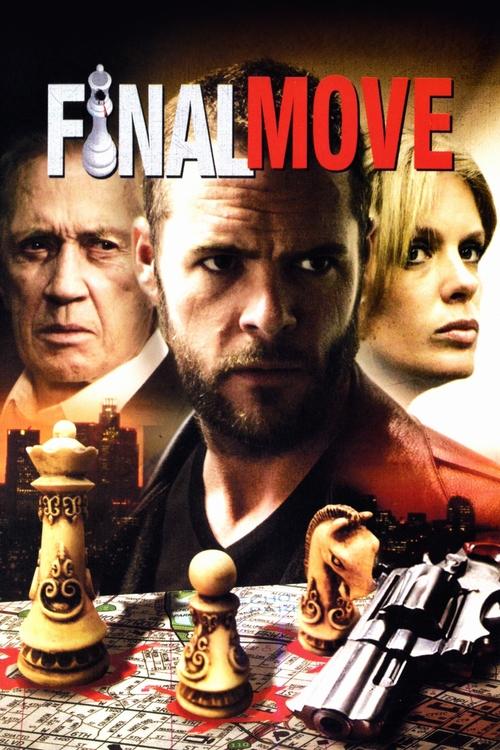















Popular
What is the significance of the chess game in Final Move?
How does the character of Detective John McKenzie evolve throughout the film?
What motivates the serial killer in Final Move?
How does the relationship between McKenzie and his partner develop in the film?
What role does the character of the victim play in the narrative of Final Move?
Should I watch it?
Ask Your Own Question

What is the plot?
Final Move opens in the grim aftermath of a case that should be over: Thomas Page, the so-called Chess Piece Killer, has already been captured, sentenced, and executed, yet Los Angeles is immediately shaken by fresh murders that copy his ritualized style. The city feels as if it has been reset onto the same board, and the police are forced into the unbearable possibility that either they put the wrong man to death or someone is deliberately reenacting Page's crimes.
The first murders are all about pattern and implication. At the scenes, detectives find chess-related clues and evidence that point back to the dead killer, including the signature chess pieces left with victims and the carefully arranged logic of the killings. The victims are not random; according to the plot summaries, Page had targeted people he believed escaped justice through corruption or technicalities, and the new murders continue that same disturbing moral logic. The police realize that whoever is killing now understands the original case intimately, because the scenes do not merely imitate Thomas Page's style--they recreate his method with enough precision to reopen every doubt the original investigation buried.
That doubt drags Dan Marlowe back into the nightmare. Dan Marlowe, played by Matt Schulze, is a former detective whose mind was shattered by the first Chess Piece Killer case and who is now recovering in a psychiatric center or asylum. He is not merely traumatized; he is psychologically wounded by the conviction that his last case ended in catastrophe, and the news that the murders have resumed after Page's execution cuts straight through whatever fragile stability he has managed to build. Detective Roman Krieg, Marlowe's former partner and now the active investigator on the case, comes to him because the new murder looks too much like the old one to ignore. Krieg is the practical cop in the story, the man still functioning in the world of procedure, but even he can see that this case is now bigger than ordinary homicide. He needs Marlowe's instincts, and he needs them fast.
Marlowe's return is complicated immediately by the fact that he is not just an ex-cop but a psychic one. His gift lets him experience flashes in which he can see a murder as it is being committed, and that ability is both the reason he becomes useful again and the reason he might finally break for good. The investigation depends on those visions, because the killer is operating with enough confidence and precision that ordinary evidence alone is not enough. Marlowe's psychic insight becomes the one thing that can cut through the fog of the case, but every time he uses it, he risks plunging back into the same insanity that sent him into treatment in the first place. That tension hangs over every scene he enters: his mind is a weapon, but it is also a wound that never fully closes.
As Marlowe is pulled back into the hunt, FBI agent Iris Quarrie reenters the case as well. She worked the earlier investigation alongside Krieg, and now she joins the effort to stop the new killings before the city is flooded with more bodies. In the available summaries, Iris is described simply as a key participant from the first case, but a later source reveals the film's central twist: Iris Quarrie is not only involved in the investigation, she is secretly the serial killer herself. That revelation reframes everything that comes before and after it. What initially appears to be a damaged but cooperative federal presence is in fact a predator exploiting her position, her access, and her knowledge of the original murders to keep the game alive.
Before that truth is exposed, though, the story plays itself as a desperate race against time. The police have to decide whether the dead Thomas Page really was the Chess Piece Killer or whether the execution itself was an error that allowed the real murderer to survive in secret. The possibility that an innocent man may have been executed is not a side issue; it is the emotional fault line of the whole story. Every clue now has two meanings. If the new murders are a copycat's work, the police are chasing a mimic. If they are not, then the execution was not justice but a mistake that only gave the murderer a new advantage: the cover of death.
The domestic side of the story intensifies that pressure. Amy Marlowe, Dan's wife, resents the life that the job has taken from her husband and wants him to stay away from the case. Her resistance is not petty; it is the voice of someone who has already watched the work destroy his sanity once and does not want to see it happen again. The case is pulling Dan not only toward danger but away from the family he is trying to protect. That danger becomes personal because the summaries specifically note that Dan and his family become targets as the game turns deadlier. The investigation is no longer about anonymous victims on a chessboard of streets and intersections. It is about whether Marlowe can keep his wife and family alive while returning to the same darkness that nearly consumed him.
The city itself is repeatedly treated like a giant chessboard. That metaphor is not decorative; it is the logic of the killings. The murderer places victims as if they are pieces, uses locations as squares, and arranges the city into a structure only someone with intimate knowledge of the original game could design. One source even states directly that the placement of the victims corresponds to a board-like map of Los Angeles, with the city functioning as one huge chessboard. This means every murder is both a death and a move. The killer is not simply eliminating people; he is advancing a strategy, forcing the police into a position where every response feels like an answer to an opponent who is already thinking several moves ahead.
Dan's visions become the key to cracking that strategy. He sees murders in flashes that arrive like psychic wounds, sudden and invasive, as if his mind is being used as a surveillance device by the killer's own depravity. The visual style implied by the plot summaries is harsh and immediate: Marlowe is not calmly deducing from clues but being battered by horrific glimpses that collapse distance between witness and victim. That makes him more valuable to Krieg and Quarrie, but it also makes him vulnerable to manipulation. If the killer knows Dan can see the murders, then every psychic flash becomes a way to torment him, bait him, and force him closer to collapse.
As the investigation deepens, the story's hidden architecture starts to emerge. The most important twist is that the murder spree is not just imitating Thomas Page; it is being driven by someone who understands the previous case from the inside, someone with a personal motive tied directly to Marlowe. Iris Quarrie's secret identity as the true killer gives the film its emotional core: she is angry that Marlowe rejected her and chose Amy instead, and her murders are a deliberate attempt to drive him insane with guilt and grief. That motive transforms the entire plot from a procedural mystery into a profoundly personal revenge scheme. The chess theme ceases to be just a serial killer's signature and becomes a language of obsession, rejection, and punishment.
The revelation also reorders the meaning of the earlier case. Thomas Page had been a serial killer who specifically targeted people he believed had escaped justice, and he had been captured after Marlowe had a vision of one of the murders that exposed the masked killer's face. That history matters because it means Marlowe's psychic gift was part of the original downfall of the "Chess Piece Killer," and now the same gift is being tested again, but in a case built on deception layered over the earlier crimes. If Page was the original monster, Iris is the imitator who knows just how to exploit the mythology around him. If Page was not the whole truth, then the execution has turned the city into a theater of mistaken certainty.
The pressure mounts as the police try to stay ahead of the next murder. They know another killing is coming, and the fear is not abstract--it is structural, built into the way the city map, the clues, and Marlowe's visions all point toward a larger plan. Krieg and Quarrie push the investigation forward while Marlowe pushes inward, trying to survive the visions long enough to understand what they mean. He is trapped between two kinds of collapse: the external collapse of the case, which seems to be spiraling into more death, and the internal collapse of his own mind, which is still damaged enough that every new psychic shock threatens to undo his recovery.
The film's confrontations are all defined by that dual pressure. Krieg's confrontations are with the facts, the crime scenes, and the urgency of preventing another death. Marlowe's confrontations are with his own trauma, his visions, and the possibility that his sanity is the price of solving the case. Amy's confrontations are with Dan's refusal to stay safe and with the terrifying reality that his return to the work may bring the killer to their door. The whole story becomes a tightening spiral in which each person is forced into a different corner of the same board.
The available sources do not provide a fully detailed, scene-by-scene death count with every victim named, but they do make clear that the killing continues after Thomas Page's execution and that the murders are part of an ongoing sequence of brutal deaths. They also establish that the killer specifically targets the family and that the danger extends beyond the police to Marlowe's own home. Because the plot summaries do not enumerate each victim, the exact count and order of every death cannot be confirmed from the materials provided, but the narrative certainty is that each murder is another move in the same deadly chess game. Every death belongs either to the dead killer's legacy or to the current killer's revenge, and the police are forced to interpret each scene as evidence of a larger design rather than an isolated crime.
The climax centers on the collapse of the false front that Iris Quarrie has maintained. As the investigation reaches its breaking point, the true pattern becomes impossible to hide: she has been using her knowledge of the first case to create the copycat murders, and she has done so not out of ideology but out of rage at Marlowe. She is not simply covering for Thomas Page; she is weaponizing the case against Dan, turning the city's renewed fear into a personal campaign of psychological destruction. That twist turns every earlier alliance into an act of deceit. Her cooperation with Krieg and the FBI becomes a performance designed to keep suspicion away from herself while she continues moving the pieces into place.
What happens in the final confrontation is not fully detailed in the available summaries, but the structure of the story makes the outcome legible. Marlowe's psychic ability, which has tormented him throughout the film, is the very thing that lets him close in on the truth before the killer can fully complete the game. The last stretch is built around the realization that the dead Thomas Page was not the whole answer and that the surviving threat is far closer to Dan than anyone imagined. The police race to prevent the next murder while Marlowe tries to keep his mind intact long enough to identify the real chess player before the board is cleared by blood.
The final scene does not come with the neatness of a standard procedural victory, at least not in the material available here; instead, the important resolution is the revelation that the killer the police thought they were chasing was someone already inside the case. That means the movie's ending is less about an elegant arrest than about the destruction of a lie. Iris Quarrie's secret is exposed, the revenge motive behind the murders is uncovered, and Marlowe is forced to confront the fact that the case was never only about Thomas Page or about the execution that may have been wrongful. It is about obsession, rejection, and the way grief can be turned into a private executioner's code.
What remains is Dan Marlowe standing in the wreckage of the game, still psychologically scarred, still carrying the burden of his visions, and now knowing that the case reached into his intimate life because the real killer wanted his pain to be personal. Roman Krieg and the police have to absorb the truth that the murders were never random copycat chaos, but the work of a hidden participant who knew the previous investigation too well. Amy's fear is justified: Dan's return to the case does drag danger to the family threshold, and the film closes with that emotional damage intact. The board is cleared only in the sense that the killer's mask is removed; the human cost remains.
In the end, Final Move leaves its central question hanging like a blade over the whole story: if the dead Thomas Page was not the only killer, then justice was compromised from the start, and if Iris Quarrie was the murderer all along, then the police were hunting inside their own reflection the entire time. The final resolution is not comfort but exposure. Dan Marlowe survives long enough to see the truth, but the truth is that the game was always deadlier than anyone understood, and the final move is not merely a capture on the board--it is the revelation that the real enemy has been moving in plain sight while everyone else was looking at the wrong king.


What is the ending?
In the ending of "Final Move," the protagonist, a skilled chess player named David, confronts the antagonist, a mysterious killer who has been targeting chess players. The climax unfolds in a tense showdown where David must outsmart the killer to save his loved ones. Ultimately, David manages to turn the tables on the killer, leading to a dramatic conclusion where justice is served.
As the film reaches its climax, the tension escalates. David, having been drawn into a deadly game orchestrated by the killer, finds himself in a high-stakes situation. The killer, who has been methodically eliminating chess players, has now set his sights on David and his girlfriend, Sarah. The atmosphere is thick with suspense as David realizes that the killer is not just playing a game of chess but is also playing with their lives.
In a dimly lit warehouse, David confronts the killer, who is revealed to be a former chess prodigy turned psychopath. The killer taunts David, challenging him to a final game of wits. The stakes are clear: if David loses, Sarah will pay the ultimate price. The scene is charged with emotion as David's desperation to protect Sarah fuels his determination. He recalls the lessons learned from his mentor, which guide him in this life-or-death situation.
As the game unfolds, the camera alternates between close-ups of David's focused expression and the killer's sinister grin. Each move on the chessboard mirrors the escalating tension between the two men. David's internal struggle is palpable; he is not just fighting for his life but also for the love of Sarah, who is held captive nearby. The audience can feel the weight of his fear and resolve as he contemplates each move, knowing that one wrong decision could lead to disaster.
In a pivotal moment, David makes a bold move that surprises the killer. This unexpected strategy shifts the momentum of the game, showcasing David's growth as a player and a person. The killer, caught off guard, begins to unravel, revealing his own vulnerabilities. The scene is electric, filled with the sounds of the ticking clock and the quiet gasps of anticipation from the onlookers.
As the game reaches its climax, David executes a brilliant checkmate, outsmarting the killer. The killer, realizing he has been defeated, becomes enraged. In a final act of desperation, he lunges at David, but David, fueled by adrenaline and the need to protect Sarah, manages to subdue him. The struggle is intense, and the physicality of the scene underscores the stakes involved.
In the aftermath, the police arrive just in time to apprehend the killer, who is now defeated and restrained. David, breathless and shaken, rushes to Sarah, who has been watching the entire ordeal unfold. Their reunion is emotional, filled with relief and gratitude. David's victory is not just over the killer but also over his own fears and insecurities.
As the film concludes, the camera pans out, showing David and Sarah embracing, surrounded by the chaos of the warehouse. The final shot lingers on David's face, reflecting a mix of triumph and the heavy burden of what he has just endured. The fate of the main characters is clear: David emerges as a hero, having saved Sarah and defeated the killer, while the killer faces justice for his crimes. The film closes on a note of hope, suggesting that even in the darkest of times, love and courage can prevail.
Is there a post-credit scene?
The movie "Final Move," produced in 2006, does not have a post-credit scene. The film concludes its narrative without any additional scenes or content after the credits roll. The story wraps up with the resolution of the main plot, focusing on the intense psychological and strategic battle between the characters, particularly revolving around the themes of deception and survival. As the credits begin to roll, the audience is left with the finality of the characters' fates, without any further revelations or cliffhangers.
What is the significance of the chess game in Final Move?
The chess game in Final Move serves as a metaphor for the strategic and psychological battles between the characters, particularly between the protagonist, a detective, and the antagonist, a serial killer. The killer uses chess moves to taunt the detective, creating a tense cat-and-mouse dynamic that reflects their intellectual duel.
How does the character of Detective John McKenzie evolve throughout the film?
Detective John McKenzie starts as a dedicated but somewhat conventional cop, focused on solving the case. As the story progresses, he becomes increasingly obsessed with the killer's mind games, leading to moments of doubt and vulnerability. His emotional state shifts from confidence to desperation as he realizes the personal stakes involved.
What motivates the serial killer in Final Move?
The serial killer is motivated by a desire for recognition and control. He sees his murders as a form of art and a way to challenge the intelligence of law enforcement, particularly Detective McKenzie. His actions are driven by a need to prove his superiority and to engage in a deadly game that elevates his own sense of power.
How does the relationship between McKenzie and his partner develop in the film?
The relationship between McKenzie and his partner, Detective Sarah, begins with a strong professional bond built on trust and teamwork. However, as the case intensifies and the killer's games escalate, tensions rise. Sarah becomes increasingly concerned for McKenzie's well-being, leading to moments of conflict as she tries to pull him back from the brink of obsession.
What role does the character of the victim play in the narrative of Final Move?
The victim in Final Move is crucial to the narrative as they serve as the catalyst for the unfolding events. Their backstory and connection to the killer reveal deeper layers of the plot, highlighting the personal stakes involved for McKenzie. The victim's fate drives the urgency of the investigation and adds emotional weight to McKenzie's journey.
Is this family friendly?
"Final Move," produced in 2006, is not considered family-friendly due to its themes and content. Here are some potentially objectionable or upsetting aspects that may affect children or sensitive viewers:
-
Violence: The film contains scenes of physical confrontations and threats, which may be intense and unsettling for younger audiences.
-
Murder and Death: The plot revolves around a series of murders, and there are graphic depictions of death that could be disturbing.
-
Psychological Tension: The film features a high level of suspense and psychological manipulation, which may create anxiety or fear in sensitive viewers.
-
Adult Themes: There are themes of betrayal, revenge, and moral ambiguity that may not be suitable for children.
-
Language: The dialogue includes strong language that may not be appropriate for younger audiences.
These elements contribute to a darker tone that may not be suitable for family viewing.






