














Popular
What motivates the main character, Soledad, to isolate herself from others?
How does Soledad's relationship with her father influence her actions throughout the film?
What role does the character of the neighbor play in Soledad's journey?
How does Soledad's environment reflect her internal struggles?
What significant event prompts Soledad to reconsider her life choices?
Should I watch it?
Ask Your Own Question

What is the plot?
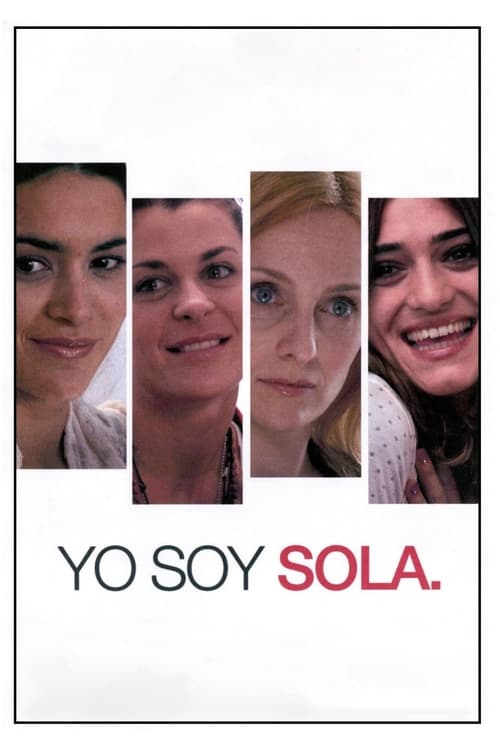
Yo soy sola follows four women in Buenos Aires, each caught in a different version of adult loneliness, desire, and self-invention, and the film moves between their lives like a set of parallel emotional confessions rather than a single conventional plot. Vera is the one who seems to be moving upward, Lina is the one who is always looking outward for love, Mara Bestelli is the one who makes a secret irreversible choice, and Inés is the one who reduces life to one goal: marriage. From the beginning, the film's tension comes not from a mystery to be solved but from the quiet instability of each woman's inner world, each of them trying to fill a lack she cannot clearly name.
The opening establishes Vera first as a rising journalist who should, on paper, be satisfied. She is working, advancing, and presumably doing everything the ambitious way, yet she remains deeply discontented. Her problem is not failure but emptiness: she wants to be the best, but the film makes clear that she does not even know what "the best" means anymore. That uncertainty hangs over her scenes and gives them a restless energy, as if she is always arriving late to her own life. She moves through Buenos Aires with the taut posture of someone professionally successful and personally stranded, and the city around her feels like a place of constant motion that still cannot deliver purpose.
Lina's world is almost the inverse. Where Vera is all ambition and no peace, Lina is all longing and ritual. She lives among incense and saints, surrounded by the language of devotion, superstition, and private prayer, but her faith is not calm or reverent. It is desperate. She is obsessed with finding love, and her imagination is so charged by romantic hunger that she even projects that longing onto a television character. The result is both comic and poignant: she treats desire as something that can be summoned by signs, symbols, and sacred objects, as though love might arrive if she can only arrange the universe correctly. Her scenes carry a devotional intensity, with the smell of incense and the presence of saints turning her home into a shrine to the relationship she does not have.
Mara Bestelli's story introduces the film's clearest act of secrecy. She makes the decision to be artificially inseminated without telling her partner, who lives abroad. That choice changes everything, because it is not just a private reproductive decision but a hidden act that reshapes the meaning of the relationship itself. Her story carries the quiet force of a detonated secret: there is no explosion in the moment she does it, but the emotional aftershock is built into the premise. The film presents the act as decisive, even radical, because it bypasses the usual idea of shared planning and mutual consent. Mara wants motherhood enough to cross a line in silence, and the silence becomes its own form of conflict. Her story is defined by absence, distance, and the gap between her life in Buenos Aires and the partner who remains somewhere abroad, outside the immediate frame of the decision she has already made.
Inés, by contrast, is introduced with blunt simplicity: her only goal in life is to marry, no matter why. That makes her the most apparently transparent of the four women and also the most haunting, because the film suggests that a person can reduce existence to a single social destination and still remain profoundly unsure of herself. Her fixation on marriage is not presented as romantic fulfillment but as a kind of existential placeholder, a way of giving life a shape when no deeper purpose feels secure. She becomes the film's portrait of someone who has confused the institution with the answer. Around her, Buenos Aires feels less like a modern city than a maze of expectations, social scripts, and invisible judgments, all of which she seems determined to obey.
The film's structure does not build toward a conventional thriller-style climax, and there are no murders, fatal accidents, or deaths identified in the available plot material. There are no documented killings, and no character is described as dying in the course of the story. Instead, the tension rises through revelation of character, through the slow accumulation of each woman's private crisis. The audience comes to understand that the real stakes are emotional and existential: who each woman is trying to become, what she is willing to conceal, and how much of her life is built on longing rather than truth.
As the four stories progress in overlapping rhythms, the film keeps returning to the fact that these women are not isolated examples but "four moments" in adult female life. That framing matters, because it turns each storyline into a variation on a shared condition. Vera's dissatisfaction is one version of the problem, Lina's spiritualized search for love is another, Mara's secret reproductive act is another, and Inés's marriage fixation is another. The film's movement is therefore linear in feeling but mosaic in structure: each new scene deepens the sense that these women are circling the same emotional absence from different angles.
Vera's arc continues to sharpen her contradiction. She is a journalist, which suggests observation, language, and public intelligence, yet she cannot quite observe her own need clearly enough to name it. The recurring idea that she wants to be "the best" lands like a painful joke: she is achieving in the external world while remaining unable to define the internal prize. This makes her scenes feel tense even when nothing overtly dramatic is happening. Every conversation and professional moment becomes a small test she seems unable to pass, because the film's real question is not whether she succeeds, but what success would even mean to her if she did. Her life has motion without direction, and that restless movement gives her storyline an aching, suspended quality.
Lina's scenes build differently, with more visible eccentricity and emotional vulnerability. Her house, filled with incense and saints, is not simply decorative; it reflects her mind. She speaks, prays, waits, imagines, and reimagines the possibility of love until longing takes on the texture of belief. Her attraction to a television character reveals how mediated and fantasized her desire has become. Love is no longer a person or a relationship; it is an image, a projection, a sign that appears on a screen and absorbs the intensity she has nowhere else to place. The film treats this gently, but it does not soften the loneliness underneath. Lina's ritual life is a defense against the terrifying possibility that no love will arrive at all.
Mara Bestelli's plotline, meanwhile, becomes the film's most quietly consequential secret. The artificial insemination is not described as a spur-of-the-moment whim but as a deliberate act carried out behind her partner's back. Because he lives abroad, the distance itself becomes part of the moral and emotional burden. What is normally a shared decision is transformed into a private one, and the film's emotional charge comes from the knowledge that the relationship has been altered before the partner can even react. The revelation is less a twist than a destabilization: the audience understands that Mara's future is now divided between what she has chosen and what she has chosen not to tell. That division gives her storyline a tense, inward momentum, as if the secret itself is already changing her body and her future before anyone else has spoken a word about it.
Inés remains the most socially straightforward and yet the most vulnerable to self-deception. Her obsession with marriage strips away complexity in favor of an endpoint, but the film does not present that endpoint as liberation. Instead, it frames her fixation as a desperate attempt to pin identity to a recognized role. If Vera wants excellence, Lina wants love, and Mara wants motherhood, Inés wants the ceremony, the status, the category. She wants to become a wife because the title promises containment and certainty. But the film's portrait of her suggests that certainty may be the very thing she lacks. Her scenes carry an undercurrent of futility, as though she is running toward a finish line that may not transform anything at all.
The film's complete ending is not documented in the available source material with scene-by-scene precision, and there is no verified final confrontation, final betrayal, or final reconciliation detailed in the summaries gathered. What is clear is that the film closes as a portrait of unresolved lives rather than a solved narrative puzzle. The emotional resolution lies in recognition: these women are not moving toward one grand shared revelation, but inhabiting different forms of the same adult disquiet. The title itself, "Yo soy sola," becomes the final emotional statement, not because the women are physically alone at the end, but because each is ultimately confronted with the loneliness of her own desire.
So the film ends without a tidy transformation. Vera remains trapped between professional ascent and personal dissatisfaction, still chasing an undefined greatness. Lina remains amid incense, saints, and television fantasies, still searching for the love that she hopes will give her life meaning. Mara remains marked by the secret of her artificial insemination, a choice that has already altered the terms of her relationship with the man abroad, whether she has confessed it or not. Inés remains fixed on marriage, still believing that the right social outcome will somehow solve the deeper lack inside her. The final effect is not catharsis but a lingering ache: four women, four different strategies for surviving adulthood, and no simple answer for any of them.




What is the ending?
In the ending of "Yo soy sola," the protagonist, a young woman named Valeria, confronts her loneliness and the choices she has made in her life. After a series of emotional struggles and revelations, she ultimately decides to embrace her solitude and find strength within herself. The film concludes with Valeria walking away from her past, symbolizing her acceptance of her identity and the journey ahead.
As the film approaches its conclusion, we find Valeria in a state of deep reflection. The scenes unfold in a dimly lit room, where she sits alone, surrounded by remnants of her past relationships. The camera captures her pensive expression, highlighting the weight of her solitude. She recalls moments of joy and pain, each memory flickering like a candle in the dark, illuminating her internal conflict.
In the next scene, Valeria steps outside into the bustling streets, the sounds of life contrasting sharply with her inner turmoil. She walks with purpose, her footsteps echoing against the pavement, symbolizing her determination to confront her reality. As she navigates through the crowd, we see flashes of her interactions with friends and family, each encounter tinged with a sense of longing and unfulfilled connection.
Valeria's journey leads her to a park, where she finds a quiet bench. Here, she reflects on her relationships, particularly with her estranged mother and her friends who have drifted away. The camera lingers on her face, capturing the tears that well up in her eyes as she grapples with feelings of abandonment and regret. Yet, amidst the sorrow, there is a flicker of resolve. She understands that her loneliness is not a curse but a space for self-discovery.
In a pivotal moment, Valeria pulls out a small notebook filled with her thoughts and dreams. She begins to write, her pen moving swiftly across the pages as she pours out her heart. This act of writing becomes a cathartic release, allowing her to articulate her feelings and aspirations. The scene is interspersed with flashbacks of her past, illustrating the contrast between her former self and the woman she is becoming.
As the sun begins to set, casting a warm glow over the park, Valeria stands up, a newfound strength radiating from her. She takes a deep breath, inhaling the crisp air, and smiles softly to herself. This moment signifies her acceptance of solitude as a part of her identity, rather than something to be feared.
The final scene shows Valeria walking away from the park, her silhouette framed against the vibrant colors of the sunset. She moves forward with a sense of purpose, leaving behind the shadows of her past. The film closes with a lingering shot of her figure disappearing into the horizon, symbolizing her journey towards self-acceptance and the promise of new beginnings.
In this ending, Valeria's fate is one of empowerment. She learns to embrace her solitude, transforming it into a source of strength. The other characters, while not present in the final moments, are left behind in her journey, representing the relationships that shaped her but ultimately could not define her. The film concludes on a note of hope, suggesting that solitude can lead to profound self-discovery and personal growth.
Is there a post-credit scene?
The movie "Yo soy sola," produced in 2008, does not feature a post-credit scene. The film concludes its narrative without any additional scenes or content after the credits roll. The story wraps up with a focus on the main character's journey and emotional resolution, leaving the audience with a sense of closure regarding her experiences and personal growth throughout the film.
What motivates the main character, Soledad, to isolate herself from others?
Soledad, the protagonist, is driven by a deep sense of loss and emotional pain stemming from her past experiences. Her isolation is a coping mechanism to shield herself from further heartbreak, particularly after the death of her mother and the subsequent abandonment by her father. This emotional turmoil manifests in her reluctance to form new relationships, as she fears the vulnerability that comes with opening up to others.
How does Soledad's relationship with her father influence her actions throughout the film?
Soledad's relationship with her father is strained and filled with unresolved issues. His abandonment during her childhood leaves a lasting impact on her psyche, leading her to believe that love is transient and unreliable. This belief fuels her desire to remain solitary, as she equates closeness with potential pain. Throughout the film, flashbacks reveal her longing for paternal affection, which complicates her emotional state and decisions.
What role does the character of the neighbor play in Soledad's journey?
The neighbor, a kind and persistent man, serves as a catalyst for Soledad's gradual transformation. His attempts to connect with her challenge her self-imposed isolation. Initially, she rebuffs his advances, but his unwavering support and understanding slowly chip away at her defenses. His presence introduces the possibility of companionship and healing, forcing Soledad to confront her fears and reconsider her stance on relationships.
How does Soledad's environment reflect her internal struggles?
Soledad's environment is stark and desolate, mirroring her emotional state. The empty spaces of her home, filled with shadows and silence, symbolize her loneliness and the void left by her loved ones. The contrast between her bleak surroundings and the vibrant life outside serves as a constant reminder of what she has lost and what she is missing. This setting amplifies her internal conflict, as she grapples with the desire for connection against her instinct to retreat.
What significant event prompts Soledad to reconsider her life choices?
A pivotal moment occurs when Soledad receives a letter from her estranged father, expressing a desire to reconnect. This unexpected communication forces her to confront her past and the unresolved feelings she harbors towards him. The letter acts as a mirror, reflecting her own fears of abandonment and the possibility of forgiveness. It serves as a turning point, prompting her to reevaluate her choices and consider the implications of remaining isolated.
Is this family friendly?
"Yo soy sola," produced in 2008, is a film that delves into themes of loneliness, identity, and personal struggle. While it is a poignant exploration of these themes, it does contain elements that may not be suitable for children or sensitive viewers.
Potentially objectionable or upsetting aspects include:
-
Emotional Distress: The protagonist experiences significant emotional turmoil, which may be intense for younger audiences or those sensitive to themes of isolation and despair.
-
Family Conflict: There are scenes depicting strained family relationships, which may resonate negatively with viewers who have experienced similar issues.
-
Mental Health Themes: The film touches on mental health struggles, including feelings of depression and anxiety, which could be distressing for some viewers.
-
Loneliness and Isolation: The pervasive theme of loneliness is explored in depth, which might evoke strong feelings of sadness or discomfort.
-
Mature Themes: The film addresses adult themes related to personal identity and self-acceptance, which may be complex for younger viewers to fully understand.
Overall, while the film offers valuable insights into personal growth and resilience, its emotional weight and mature themes may make it less suitable for a family-friendly viewing experience.








