



Popular
What are the main struggles of the protagonist, Yozo Oba, throughout the film?
How does Yozo's relationship with his mother influence his character development?
What role do the women in Yozo's life play in his emotional journey?
How does the theme of identity crisis manifest in Yozo's character?
What is the significance of the diary that Yozo keeps throughout the film?
Should I watch it?
Ask Your Own Question

What is the plot?
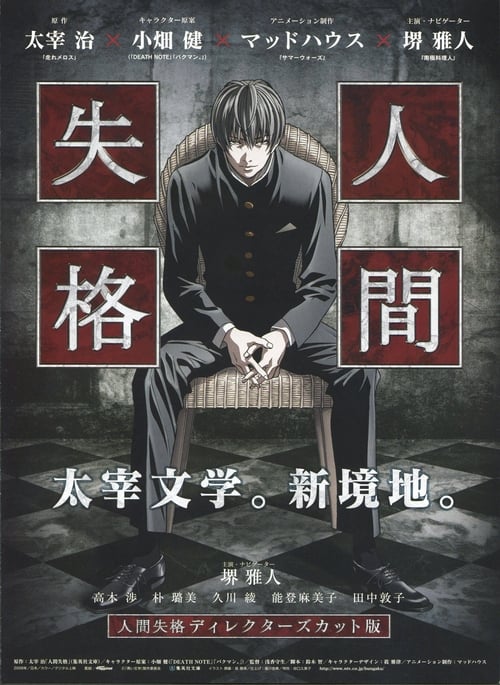
Ōba Yōzō begins his life in a grand northern Japanese household already feeling like an intruder in his own skin, a young man of privilege who has learned that survival depends on performance rather than honesty. Around everyone at home, and later at school, he puts on a buoyant, joking mask, making himself the class clown so that no one will notice the terror underneath. That false cheer is not mere habit; it is the foundation of his entire existence, the only way he knows how to move through a world he experiences as opaque, hostile, and unreachable.
The director's cut opens with the sense that this life is already being remembered as a tragic case file, and the framing deepens the feeling that what follows is not a series of ordinary events but the slow dissection of a broken man. Yōzō's family background is important from the start: he is not a destitute outcast but the son of a wealthy, socially respectable family, which makes his alienation even more paradoxical and humiliating. He has every outward advantage, yet he cannot inhabit any human relationship without feeling like a fraud. His smile is a shield, and his silence is a wound.
At school, the first crack in that shield appears when his classmate Takeichi sees through him. Takeichi recognizes that Yōzō's joking is not natural sociability but a carefully maintained disguise, and the discovery terrifies Yōzō because it means someone has looked past the mask and seen the frightened emptiness beneath it. Instead of rejecting Takeichi, Yōzō gravitates toward him, as though being unmasked by one perceptive peer is less dangerous than continuing to pretend in front of everyone else. This friendship becomes one of the few genuine connections in his life, but even that bond is fragile, because Yōzō does not know how to be sincere without feeling exposed.
A major turning point arrives when Yōzō encounters a Van Gogh painting. The image strikes him with the force of revelation, as if the painter has given form to the same inner torment that Yōzō has never been able to name. He turns to art not as career or hobby but as emergency confession. He produces a self-portrait so unsettling, so steeped in self-loathing, that he shows it only to Takeichi. That act says everything about his state: he wants to be understood, but only by someone who has already proven capable of seeing through him. The portrait becomes a visual equivalent of his mind, a face that is at once recognizably human and spiritually ruined.
From there, his life begins to tilt harder into self-destruction. He drifts toward alcohol, which offers brief anesthetic relief, and toward women, which offers a different kind of escape: temporary belonging, the illusion of being wanted, and the hope that intimacy might silence the voice in his head telling him he is irredeemably false. Instead, each connection only sharpens his guilt and dissociation. He moves from one room to another, one emotional dependency to the next, in urban interiors that feel increasingly claustrophobic. The film's recurring spaces--bars, private rooms, brothels, apartments, and domestic interiors--become less like settings than traps, places where he can hide for a while but never heal.
One of the most devastating passages involves Yōzō becoming involved with a married woman, Tsuneko. The relationship is emotionally unstable from the beginning, shaped less by romance than by mutual desperation and the desire to flee ordinary life. In a gesture that seals his fate, Yōzō spends the night with her and then, the following morning, attempts a double suicide with her. The suicide scene is the story's most violent outward rupture: the water, the shoreline, and the lethal promise of escape become the physical expression of the death he has long rehearsed inside himself. But the attempt goes wrong. Yōzō survives, while Tsuneko dies by drowning.
Tsuneko's death is the film's first unequivocal fatal consequence, and it lands on Yōzō like a sentence he can never appeal. He is not redeemed by survival; he is condemned by it. The fact that he lives when she does not transforms his body into evidence of guilt. The water does not cleanse him. It marks him. Whatever fragile hope he may have had of disappearing peacefully is destroyed, because now his continued existence is inseparable from her death. From this point on, the movie's emotional momentum changes: Yōzō is no longer merely a man failing to connect; he is a man carrying an unerasable death inside him.
The guilt does not stay abstract. It manifests in his behavior, his habits, and his body. He becomes increasingly unstable and obsessive, and one of the most vivid signs of collapse is his compulsive handwashing, a physical ritual that externalizes his need to scrub away moral contamination he knows cannot be removed. He keeps moving, keeps seeking out drink, keeps seeking companionship, yet the internal pressure only rises. The world around him increasingly interprets his instability as weakness, shamelessness, or moral failure, which only deepens his sense that he does not belong anywhere.
Horiki enters this phase as one of the crucial figures in Yōzō's downward spiral. He is the man who can speak to Yōzō in the language of vice, exhaustion, and social disillusionment, and he functions as a catalyst for further collapse rather than rescue. Horiki's presence reinforces the idea that Yōzō's life is becoming a grim network of dependencies, each person offering a temporary form of shelter while also pushing him closer to ruin. Through Horiki, Yōzō learns that society expects him to return home and accept the obligations of family and status, especially as his father's condition worsens. That expectation does not restore him; it only increases the sense that he is trapped inside a role he has already failed to inhabit.
As the story continues, Yōzō's sense of identity becomes more fractured. He is still capable of performing the outward gestures of normality, but those gestures have become hollow reflexes. He is no longer masking a secret self so much as dissolving into a series of emergency disguises. The film emphasizes this through his shifting domestic arrangements and intimate entanglements: he is with one woman, then another; he is drinking, then hiding; he is trying to survive, then trying to vanish. The emotional temperature remains high because every scene carries the possibility that his next attachment will become another disaster.
The major twist that reshapes the second half comes when Yōzō's life appears, for a moment, to stabilize. He is now living with Yoshiko, the young woman who saves him after he collapses in a drunken stupor in the city. Her arrival functions as a rescue scene, but the film quickly undercuts any hope that she represents lasting salvation. Yoshiko becomes his wife, and for a time he seems almost happy: he is married, relatively successful as a mangaka, and able to enjoy an outwardly ordinary domestic existence. The scene is deceptive because it looks like recovery while actually concealing a fresh layer of dependency and exploitation.
Horiki returns and reveals the first blow of this section: Yōzō's father is dead. The news detonates whatever remaining emotional structure Yōzō has left. The father's death is not merely family information; it is the collapse of one of the last anchors tying him to the world of obligation, inheritance, and social identity. His reaction is violent and destabilized, as though even the fact of his father's death cannot be absorbed through ordinary grief but only through panic and disintegration. The confrontation is not a physical battle but a psychic one: the son who never knew how to live as himself now faces the final severing of family authority, and the result is chaos.
While Horiki goes downstairs to get help, he unintentionally stumbles upon a devastating secret. He discovers Yoshiko having sex with Yōzō's publisher. The revelation is brutal not because it is merely adulterous but because it exposes the true cost of Yōzō's apparent professional success. Yoshiko is selling her body so that Yōzō's manga can continue to be published. Her fidelity has been sacrificed to keep his work alive, and the marriage that seemed like shelter is revealed as a system of coercion and degradation. The publisher is not a benefactor but a participant in an arrangement that turns intimacy into commerce and shame into fuel for art.
This revelation changes the emotional meaning of every recent scene. Yōzō's "success" is no longer his own. His domestic peace is built on humiliation he did not choose to see. Yoshiko, whom he regarded as his "rescuer," is in fact caught in a desperate transaction that preserves his public image while eroding her dignity. The film does not present this as a simple betrayal; it presents it as another symptom of a world in which love and exploitation cannot easily be separated. Yōzō's life is once again revealed to be sustained by falsehood.
That evening, his instability reaches another peak. He attempts suicide again and fails. The scene pushes him toward the edge but does not let him fall away cleanly. He wakes in a hospital, physically alive but morally and emotionally more exhausted than ever. There, he overhears one of his father's servants speaking desprectively about him. The servant's contempt lands with cruel simplicity: even in the aftermath of a suicide attempt, even in vulnerability, Yōzō is still seen through the same dismissive social lens that has always surrounded him. Human compassion is unavailable; judgment remains easy.
For a moment, Yoshiko and her prostitute friend defend him. This is one of the story's rare instances of direct protection, but even that protection is fragile and fleeting. Yōzō does not stay long enough to hear the full extent of their defense, which means the emotional rescue never fully reaches him. He remains severed from whatever consolation might have been offered. The scene underscores the tragedy at the center of the film: help may exist, but Yōzō cannot remain present long enough to receive it. He is always already slipping away.
At this point, the film drives toward its final movement, and the atmosphere becomes less like domestic drama and more like existential aftermath. Yōzō eventually finds himself at the medicine shop he and Mayumi visited years before. That location carries the weight of memory, making the present moment feel haunted by earlier losses and earlier versions of himself. The past does not arrive as flashback alone; it inhabits the setting. The medicine shop becomes a symbolic threshold where his earlier life, his failed attempts at connection, and the accumulation of grief seem to converge.
There, a woman's voice says that she has been waiting for him. The line is eerie and intimate, sounding like promise, temptation, or final summons. It is one of the film's most haunting moments because it can be heard as both comfort and death sentence. Yōzō, exhausted beyond resistance, appears to step into that invitation and commit suicide again, this time successfully. The story does not treat the act as a sudden shock but as the logical endpoint of a life defined by alienation, shame, dependency, and repeated failed attempts to disappear. The final image closes on him sitting face to face with his id, a visual and psychological confrontation that completes the film's tragic logic.
By the end, Yōzō's life has been stripped down to the most unbearable truth: he cannot reconcile the self he performs with the self he experiences, and every attempt at closeness becomes another mechanism of self-destruction. Takeichi sees through him, but cannot save him; Tsuneko dies in the double-suicide attempt; Yoshiko appears as rescuer but is revealed to be trapped in exploitation; Horiki acts as catalyst and witness; the father's death removes the final external authority; and the final suicide at the medicine shop resolves nothing except the long accumulation of despair. The movie ends not with healing, but with the completion of a descent that has been visible from the opening mask: a man who could never become human in the way others demanded, and who finally disappears into the darkness he has been circling all along.
More Movies Like This
Browse All Movies →




What is the ending?
In the ending of "Ningen Shikkaku: Director's Cut-ban," the protagonist, Yozo Oba, confronts his deep-seated feelings of alienation and despair. After a series of tumultuous events, he finds himself in a state of emotional collapse. The film concludes with Yozo's acceptance of his own identity, albeit in a tragic manner, as he contemplates his existence and the relationships he has failed to maintain.
As the film draws to a close, Yozo is seen in a dimly lit room, surrounded by the remnants of his life. He reflects on his past, the people he has hurt, and the connections he has lost. His internal struggle culminates in a moment of clarity, where he acknowledges his inability to connect with others. The final scenes depict him in a state of resignation, suggesting a bleak acceptance of his fate.
The ending of "Ningen Shikkaku: Director's Cut-ban" unfolds with a palpable tension that has been building throughout the film. The scene opens in a small, cluttered room where Yozo Oba sits alone, the shadows of the evening creeping in through the window. The atmosphere is heavy, filled with the remnants of his chaotic life. Yozo, a man who has long felt disconnected from the world around him, is now at a crossroads.
As he gazes at the scattered papers and empty bottles that litter the floor, his mind races with memories of his past. The camera lingers on his face, capturing the turmoil within him. He recalls the moments of intimacy he shared with his friends, particularly with his love interest, the vibrant and caring Akiko. Yet, these memories are tinged with regret, as he realizes how he has pushed them all away, unable to bridge the gap between his inner self and the facade he presents to the world.
In a poignant flashback, we see Yozo's interactions with his friends, filled with laughter and warmth, juxtaposed against the cold reality of his current isolation. The contrast is stark, emphasizing his profound sense of loss. He remembers Akiko's gentle encouragement, her attempts to understand him, and how he ultimately rejected her support, choosing instead to retreat further into his own despair.
The film then shifts back to the present, where Yozo's emotional state deteriorates. He begins to write in his journal, a desperate attempt to articulate his feelings. The words flow from him, revealing his inner turmoil and the deep-seated belief that he is unworthy of love and connection. The act of writing becomes a cathartic release, yet it also serves as a reminder of his failures.
As the night deepens, Yozo's thoughts spiral into darkness. He contemplates the idea of disappearing entirely, feeling that he has become a mere shadow of a person. The camera captures the flickering candlelight, casting eerie shadows that dance across the walls, mirroring his fractured psyche. In this moment, he confronts the reality of his existence: he is a man who has lost his way, unable to find solace in the world around him.
In the final scenes, Yozo makes a fateful decision. He steps outside into the cold night air, the city lights twinkling in the distance. The world feels both vast and suffocating, a reflection of his internal struggle. He walks aimlessly, lost in thought, as the weight of his choices bears down on him. The film closes with a haunting image of Yozo standing alone, a solitary figure against the backdrop of a bustling city, embodying the essence of his alienation.
As the credits roll, the fate of the main characters is left ambiguous. Yozo's journey is one of profound introspection, and while he reaches a moment of acceptance, it is clear that his path is fraught with uncertainty. The film leaves viewers with a lingering sense of melancholy, a reminder of the complexities of human connection and the struggles of those who feel like outsiders in their own lives.
Is there a post-credit scene?
In the 2009 film "Ningen Shikkaku: Director's Cut-ban," there is no post-credit scene. The film concludes without any additional content after the credits roll. The narrative wraps up with a focus on the protagonist, Yozo Oba, and his struggles with alienation and identity, leaving the audience to reflect on the themes presented throughout the film. The absence of a post-credit scene emphasizes the weight of Yozo's emotional journey and the unresolved nature of his character's fate.
What are the main struggles of the protagonist, Yozo Oba, throughout the film?
Yozo Oba, the protagonist, grapples with profound feelings of alienation and disconnection from society. He struggles to form genuine relationships, often resorting to a facade of humor and charm to mask his inner turmoil. His inability to connect with others leads him to a deep sense of despair, which is exacerbated by his self-destructive behaviors, including substance abuse and a reliance on women for validation.
How does Yozo's relationship with his mother influence his character development?
Yozo's relationship with his mother is fraught with emotional neglect and misunderstanding. She is depicted as a distant figure, which contributes to Yozo's feelings of inadequacy and isolation. This lack of maternal support shapes his worldview, leading him to seek affection and approval from others, often in unhealthy ways. The absence of a nurturing bond leaves him feeling unworthy and lost.
What role do the women in Yozo's life play in his emotional journey?
The women in Yozo's life, including his love interests and acquaintances, serve as both a source of comfort and further alienation. He often idealizes them, projecting his desires onto them, yet his relationships are ultimately superficial. These interactions highlight his inability to form meaningful connections, as he oscillates between longing for intimacy and pushing people away due to his fear of vulnerability.
How does the theme of identity crisis manifest in Yozo's character?
Yozo's identity crisis is central to his character arc. He frequently questions his own existence and purpose, feeling like a 'non-human' or 'empty shell.' This crisis is visually represented through his erratic behavior and the masks he wears in social situations, symbolizing his struggle to find a true self amidst the chaos of his emotions and societal expectations.
What is the significance of the diary that Yozo keeps throughout the film?
The diary serves as a crucial outlet for Yozo's thoughts and feelings, providing insight into his internal struggles. It becomes a confessional space where he articulates his despair, loneliness, and longing for connection. The act of writing allows him to confront his emotions, yet it also highlights his isolation, as the diary remains a private refuge that he cannot share with others.
Is this family friendly?
"Ningen Shikkaku: Director's Cut-ban" is not considered family-friendly due to its mature themes and content. Here are some potentially objectionable or upsetting aspects that may affect children or sensitive viewers:
-
Mental Health Struggles: The film delves deeply into themes of depression, alienation, and existential crisis, which may be distressing for some viewers.
-
Self-Harm: There are scenes that depict self-destructive behavior, which can be triggering for individuals who have experienced similar issues.
-
Substance Abuse: The protagonist engages in drug use, which is portrayed in a raw and unfiltered manner.
-
Sexual Content: The film includes explicit sexual situations and discussions that may not be appropriate for younger audiences.
-
Violence and Aggression: There are moments of emotional and physical violence that contribute to the overall dark tone of the film.
-
Isolation and Loneliness: The pervasive sense of isolation experienced by the main character can evoke strong feelings of sadness and discomfort.
These elements contribute to the film's heavy atmosphere and may not be suitable for children or those sensitive to such topics.







