
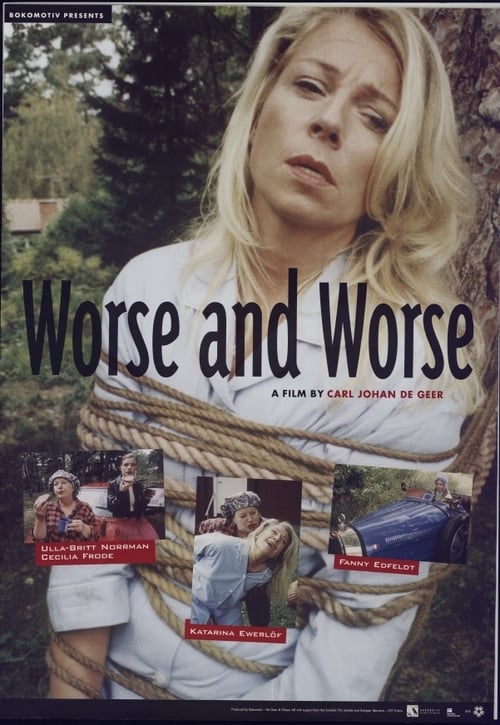




Popular
How does Jack's relationship with his girlfriend evolve throughout the film?
What are the main conflicts faced by the protagonist in Worse and Worse?
What role does Jack's best friend play in the story?
What are some of the comedic situations Jack finds himself in while trying to write?
How does the setting influence Jack's creative process in the film?
Should I watch it?
Ask Your Own Question

What is the plot?
Sorry, we aren't able to watch and write up a full detailed plot yet. Check back in a few days.








What is the ending?
In the ending of "Worse and Worse," the main character, a struggling writer named Jack, faces the consequences of his choices. After a series of escalating conflicts and personal failures, he ultimately finds himself alone, reflecting on his life and the relationships he has damaged. The film concludes with Jack making a decision to change his life, but it remains ambiguous whether he will follow through.
As the final act unfolds, the scene opens with Jack sitting in his dimly lit apartment, surrounded by crumpled papers and empty coffee cups. The weight of his failures hangs heavily in the air, and the silence is punctuated only by the ticking of a clock. Jack's face is etched with despair, his eyes reflecting a mix of regret and determination. He picks up a pen, hesitating as he stares at a blank page, the remnants of his once vibrant creativity now stifled by self-doubt.
In the next scene, we see Jack's estranged girlfriend, Sarah, standing outside his apartment building. She is visibly upset, her expression a blend of anger and sadness. She has come to confront Jack about their relationship, which has deteriorated due to his obsession with writing and neglect of their bond. As she knocks on the door, Jack's heart races; he knows he must face the consequences of his actions. When he finally opens the door, the tension is palpable. Sarah's voice trembles as she expresses her disappointment, and Jack struggles to find the right words to apologize.
The conversation escalates, with Sarah revealing how Jack's fixation on his writing has pushed her away. Jack, feeling cornered, tries to defend his passion, but the more he speaks, the more he realizes how much he has lost. The emotional weight of their exchange culminates in a moment of silence, where both characters are left to confront the reality of their situation. Jack's eyes well up with tears as he acknowledges his mistakes, and Sarah, though hurt, softens slightly, sensing his vulnerability.
As the scene shifts, we see Jack alone again, this time at a local bar. He sits at the counter, nursing a drink, surrounded by laughter and chatter that feels distant to him. The bartender, an older man with a knowing smile, engages Jack in conversation, offering him a moment of clarity. Jack reflects on his life choices, the friendships he has neglected, and the dreams he has chased at the expense of those he loves. The bartender's words resonate with him, igniting a flicker of hope amidst his despair.
In the final scene, Jack returns to his apartment, where the remnants of his writing chaos still linger. He takes a deep breath, feeling a renewed sense of purpose. He sits down at his desk, the blank page before him no longer a source of fear but a canvas for possibility. As he begins to write, the camera pans out, capturing the transformation in his demeanor. The film ends on an ambiguous note, leaving viewers to ponder whether Jack will truly change or if he will continue down the path of self-destruction.
Throughout this conclusion, the fates of the main characters are intertwined with Jack's journey. Sarah, though hurt, represents the possibility of redemption and forgiveness, while Jack's internal struggle highlights the conflict between ambition and personal relationships. The film closes with a sense of uncertainty, reflecting the complexities of life and the choices that define us.
Is there a post-credit scene?
In the movie "Worse and Worse," produced in 2004, there is indeed a post-credit scene that adds a humorous twist to the film's conclusion. After the credits roll, the screen fades back in to reveal the main character, who has been through a series of increasingly absurd and unfortunate events throughout the film.
In this scene, he is seen sitting in a therapist's office, looking disheveled and exhausted. The therapist, a quirky character with an overly enthusiastic demeanor, is trying to help him process his chaotic experiences. As the character recounts his misadventures, the therapist takes notes, nodding vigorously, but then suddenly interrupts with an outlandish suggestion that involves a bizarre self-help technique involving rubber chickens and interpretive dance.
The main character, initially bewildered, slowly starts to crack a smile, realizing the absurdity of his situation. The scene ends with him reluctantly agreeing to try the technique, leading to a comedic moment where he awkwardly attempts to dance with a rubber chicken, leaving the audience with a light-hearted and absurdly funny impression, perfectly encapsulating the film's overall tone. This post-credit scene serves as a reminder of the film's comedic essence and the protagonist's journey through chaos and laughter.
How does Jack's relationship with his girlfriend evolve throughout the film?
Jack's relationship with his girlfriend, Lisa, begins with a sense of hope and support, as she encourages him to pursue his writing. However, as Jack's procrastination and obsession with his work intensify, Lisa becomes frustrated and feels neglected. Their interactions shift from affectionate and understanding to confrontational and strained, highlighting Jack's internal battle and the impact of his creative struggles on their relationship. Ultimately, Lisa's patience wears thin, leading to a pivotal moment where she questions whether she can continue to support Jack.
What are the main conflicts faced by the protagonist in Worse and Worse?
The protagonist, a struggling writer named Jack, faces multiple conflicts throughout the film. He grapples with his inability to finish his novel, which leads to a deep sense of frustration and self-doubt. Additionally, Jack's relationships with his girlfriend, who is growing increasingly impatient with his lack of progress, and his best friend, who is more successful, create tension. Jack's internal struggle is compounded by his encounters with a series of bizarre and comical situations that further derail his focus.
What role does Jack's best friend play in the story?
Jack's best friend, Tom, serves as both a source of inspiration and a point of contention for Jack. Tom is a successful author, which amplifies Jack's insecurities and feelings of inadequacy. Throughout the film, Tom tries to motivate Jack, offering advice and encouragement, but his success also serves as a painful reminder of Jack's own failures. Their friendship is tested as Jack's jealousy and frustration grow, leading to moments of tension and ultimately forcing Jack to confront his own shortcomings.
What are some of the comedic situations Jack finds himself in while trying to write?
Jack encounters a series of increasingly absurd and comedic situations that serve as distractions from his writing. These include a chaotic encounter with a group of eccentric neighbors who mistakenly believe he is a famous author, a disastrous attempt to attend a writing workshop that devolves into chaos, and a series of mishaps involving his computer that lead to lost work and heightened frustration. Each situation escalates the comedic tone of the film while also reflecting Jack's internal struggle and inability to focus.
How does the setting influence Jack's creative process in the film?
The setting plays a crucial role in Jack's creative process, as it reflects his mental state. The film primarily takes place in Jack's cluttered apartment, filled with unfinished manuscripts and distractions. This chaotic environment mirrors Jack's own disarray and inability to concentrate. Additionally, scenes set in coffee shops and writing retreats highlight the contrast between Jack's aspirations and his reality, emphasizing how external environments can either inspire or hinder creativity. The settings become a character in their own right, influencing Jack's journey throughout the film.
Is this family friendly?
"Worse and Worse," produced in 2004, is a dark comedy that explores themes of family dysfunction and personal crises. While it contains humorous elements, it also delves into more serious and potentially objectionable content.
-
Family Conflict: The film portrays intense arguments and conflicts among family members, which may be distressing for younger viewers or sensitive individuals.
-
Substance Abuse: There are scenes that depict characters engaging in drinking and drug use, which could be inappropriate for children.
-
Mental Health Issues: The film addresses themes of depression and anxiety, showcasing characters struggling with their mental health, which might be upsetting for some viewers.
-
Dark Humor: The humor in the film often leans towards the macabre or uncomfortable, which may not be suitable for all audiences.
-
Emotional Turmoil: Characters experience significant emotional distress, including feelings of failure and despair, which could resonate negatively with sensitive viewers.
Overall, while the film has comedic elements, its exploration of darker themes and situations may not be considered family-friendly.