






















Popular
What is the significance of the Singing Buttocks Bomb in the story?
How does Shin-chan's family react to the chaos caused by the Singing Buttocks Bomb?
What role does Kazama play in the plot of the movie?
How does Dr. Kuro's motivation for creating the Singing Buttocks Bomb unfold in the film?
What comedic elements are present in the interactions between Shin-chan and the other characters during the chaos?
Should I watch it?
Ask Your Own Question

What is the plot?
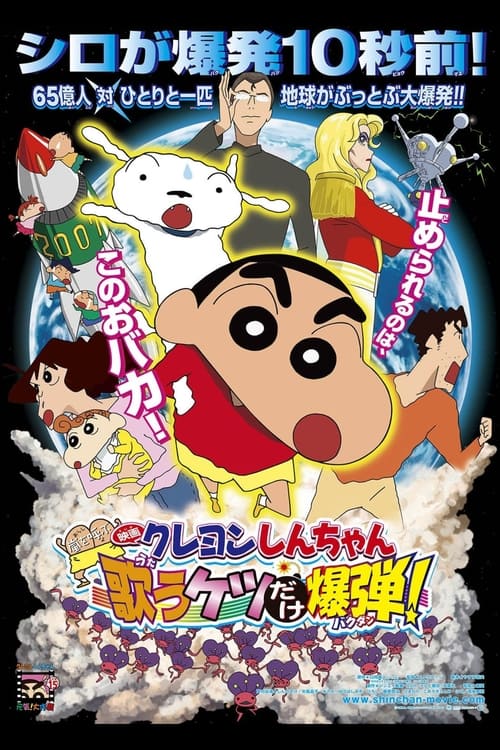
The story opens with the Nohara family on a summer vacation in Okinawa, where the mood is light, noisy, and carefree until a ridiculous accident turns the trip into a planetary emergency. Shin-chan's pet dog Shiro becomes the unlucky host of an alien bomb when the device somehow sticks to his rear end on the beach, and the family's holiday instantly stops being a holiday. The bomb is not a small threat or a comic prop--it is powerful enough to destroy the entire Earth, and once that fact becomes clear, everyone's panic sharpens into desperate motion.
At first, the disaster feels almost too absurd to believe. Shiro is still just Shiro: white fur, tiny legs, and the innocent expression of a dog who does not understand why every adult suddenly wants him so badly. The Nohara family tries to stay together and protect him, with Hiroshi Nohara and Misae Nohara doing what they can to keep the children safe while also trying to make sense of the madness. But the bomb's presence on Shiro's body is real, and the family's confusion is quickly overtaken by fear when UNTI, the Unidentified Nature Team Inspection, detects the incident and launches its own recovery operation.
UNTI's intervention changes everything. The organization is presented as an official, cosmic-monitoring force, and its members understand immediately that this is no ordinary explosive. They identify the bomb as something that cannot simply be cut away or removed by force, and the implication is chilling: if the device stays where it is, the only safe answer may be to send Shiro far away from Earth. That revelation turns the family's struggle from a simple rescue into a moral nightmare. The adults are no longer just protecting a pet; they are trying to stop a catastrophe without sacrificing the dog who has become the living vessel of that catastrophe.
Shin-chan reacts in the only way he knows how: with childish chaos, stubbornness, and a strange sort of heroism. He clings to Shiro, refuses to let anyone take him away, and begins treating the crisis as both a family problem and a personal mission. His bond with Shiro becomes the emotional center of the story. The dog has always been more than a pet, and now that loyalty is tested under impossible pressure. The Noharas move through Okinawa trying to keep Shiro close, but the danger follows them everywhere because the bomb stays attached, and every step they take only draws more attention from the people hunting it.
Then a second faction enters the conflict: the mysterious female terrorist group known as the Hinageshi Opera Company. Their arrival transforms the crisis into a three-way struggle, with the family, UNTI, and Hinageshi each pursuing the bomb for different reasons. They are not simply random villains; they are strategic and theatrical, using the chaos to interfere with UNTI's recovery efforts and seize the advantage for themselves. Their motives remain opaque, but their role is clear--they complicate every attempt to control the situation, and their interference repeatedly prevents any clean solution. Each time UNTI pushes forward, Hinageshi disrupts the plan. Each time the Noharas think they might escape, a new conflict erupts around them.
As the conflict escalates, the movie's tension shifts between frantic action and emotional urgency. Okinawa, initially a picturesque vacation setting, becomes a place of chase scenes, panic, and impossible choices. Beaches, roads, and operational zones all become battlegrounds. The comedy of Shiro with a bomb attached to his rear end never disappears entirely, but it is shadowed by the seriousness of what is at stake. Shin-chan's childish antics sit beside the horrifying truth that the device could end civilization, creating a constant swing between absurdity and dread.
The most devastating revelation comes when Shin-chan learns the full truth: the bomb is not only world-ending, it cannot be removed from Shiro by any normal means. That detail removes every easy solution. The family cannot cut it off, the authorities cannot safely dismantle it, and the terrorists cannot simply steal it and run. The bomb's bond to Shiro is effectively permanent, which means that every group's strategy collapses into one question: who gets to control Shiro, and where will he be sent? The answer soon becomes horrifyingly obvious. UNTI concludes that the only viable way to prevent Earth's destruction is to launch Shiro and the bomb into outer space so it can detonate away from the planet.
That decision tears the story's emotional core wide open. For the Noharas, especially Shin-chan, the idea of sending Shiro away is unbearable. It is not just a tactical sacrifice; it feels like abandoning a family member to die alone in the void. Shin-chan's refusal to accept that outcome gives the film its momentum. He keeps pushing back against the adults, against the agencies, and against the logic of the mission itself. Every scene of argument and pursuit builds toward the same question: can a family save their dog without letting the Earth be destroyed?
UNTI eventually gains the upper hand and captures Shiro. This is the story's darkest turn, because it means the official plan is now in motion. The organization prepares a rocket launch meant to send Shiro and the bomb into outer space, and the machinery of the climax begins to close around the characters. The atmosphere becomes urgent and mechanical, all whirring equipment, stern commands, and countdown energy. The launch site becomes the story's final arena, the place where the conflict can no longer be avoided or delayed. For the family, this is no longer about stopping a kidnapping; it is about stopping a launch that will decide Shiro's fate forever.
Shin-chan refuses to let that happen. In one of the film's defining acts of defiance, he climbs aboard the rocket himself to save Shiro. This is the moment when his childish love becomes outright bravery. He is not a strategist, and he does not have the authority to stop the launch, but he has something stronger in the emotional logic of the story: he will not leave Shiro behind. The rocket becomes a symbol of irreversible loss, and Shin-chan's decision to board it is the story's boldest act of resistance. The Noharas' ordinary family bond is pushed into the realm of cosmic sacrifice.
The launch happens, and for a brief instant it seems the worst outcome is inevitable. Shiro is in space, the bomb is still attached, and the plan to detonate it away from Earth appears to be moving exactly as UNTI intended. But the climax does not resolve the way anyone expects. In a sudden, bizarre, almost miraculous twist, the bomb mysteriously falls off Shiro's bottom at the last possible moment. That tiny detail--so absurd in shape, so enormous in consequence--changes everything. The device is no longer attached, meaning the intended explosion will not take place on the dog and will not trigger the catastrophic chain of events that threatened the planet.
Shin-chan and Shiro narrowly escape from the rocket that has already been launched. The escape is frantic and relieved all at once, a release of tension after so much fear. The movie does not linger on a triumphant victory so much as on survival. Earth is saved not by military precision or scientific genius but by a last-second, almost slapstick twist of fate. The family's emotional victory is that Shiro lives, Shin-chan returns, and the world does not end. The bomb's departure resolves the crisis in the most improbable way possible, preserving both the joke and the heart of the story.
No character deaths are identified in the available plot information, and the film's ending confirms that the disaster is avoided without any listed fatalities. That absence matters because the story repeatedly threatens total destruction, yet ultimately chooses survival over tragedy. When the dust settles, the Nohara family is back together, the crisis is over, and peace returns to them. The final feeling is not one of grandeur but of exhausted relief: a family vacation has been transformed into a brush with planetary annihilation, and somehow, through love, chaos, and a completely absurd miracle, Shiro is still Shiro, Shin-chan is still Shin-chan, and the world is still intact.
More Movies Like This
Browse All Movies →


What is the ending?
In the ending of "Crayon Shin-chan: Invoke a Storm! The Singing Buttocks Bomb," Shin-chan and his friends manage to thwart the evil plans of the villain, who intended to use the Singing Buttocks Bomb to take over the world. They work together, using their unique skills and teamwork, to save the day. Ultimately, the bomb is neutralized, and peace is restored. The characters return to their normal lives, with Shin-chan continuing to be his mischievous self, bringing laughter and joy to those around him.
As the climax of "Crayon Shin-chan: Invoke a Storm! The Singing Buttocks Bomb" unfolds, the scene shifts to a chaotic showdown at the villain's lair. The atmosphere is tense, filled with the sounds of alarms blaring and the frantic movements of the henchmen. Shin-chan, along with Kazama, Nene, Masao, and Bo-chan, stands at the entrance, their faces a mix of determination and fear. They know they must act quickly to stop the Singing Buttocks Bomb from being activated.
The group sneaks inside, navigating through a series of traps and obstacles. Each character showcases their strengths: Kazama's intelligence, Nene's resourcefulness, Masao's bravery, and Bo-chan's unwavering loyalty. As they move deeper into the lair, they encounter the villain, who is flamboyant and over-the-top, reveling in his plan to unleash chaos upon the world with his bomb. His confidence is palpable, and he underestimates the children, believing they are no match for his grand scheme.
In a pivotal moment, the villain activates the bomb, and the countdown begins. Panic ensues as the children scramble to find a way to stop it. Shin-chan, in his typical fashion, uses humor to lighten the mood, cracking jokes even in the face of danger. This moment of levity helps to rally his friends, reminding them of their bond and the importance of working together.
As the countdown ticks down, the children devise a plan. They split up, each taking on different tasks to disable the bomb. Kazama uses his quick thinking to decipher the bomb's mechanism, while Nene distracts the villain with her charm. Masao and Bo-chan work together to create a diversion, drawing the henchmen away from the bomb's control panel.
In a heart-pounding sequence, Shin-chan confronts the villain directly. With a mix of bravado and silliness, he challenges the villain, buying time for his friends to complete their tasks. The villain, caught off guard by Shin-chan's antics, becomes increasingly frustrated, leading to a comedic exchange that lightens the tension.
Finally, as the countdown reaches its final seconds, Kazama successfully disarms the bomb just in time. The explosion is averted, and the villain's plans are foiled. The children celebrate their victory, embracing each other in relief and joy. The villain, realizing he has been defeated, is left in a state of disbelief, while his henchmen scatter in fear.
In the aftermath, the children return to their neighborhood, where they are greeted as heroes. Shin-chan, ever the jokester, makes light of the situation, recounting their adventure with exaggerated flair. His friends laugh, grateful for the bond they share and the adventure they experienced together.
As the film concludes, each character reflects on their growth throughout the ordeal. Shin-chan remains his mischievous self, but there is a newfound appreciation for teamwork and friendship among the group. The final scene shows them playing together, a testament to their enduring camaraderie and the joy they bring to each other's lives. The screen fades to black, leaving the audience with a sense of warmth and laughter, characteristic of the beloved series.
Is there a post-credit scene?
In "Crayon Shin-chan: Invoke a Storm! The Singing Buttocks Bomb," there is indeed a post-credit scene that adds a humorous touch to the film's conclusion. After the main credits roll, the scene opens with Shin-chan and his friends, who are still buzzing from their recent adventure. They are gathered in a playful setting, where Shin-chan is attempting to demonstrate the infamous "Singing Buttocks Bomb" technique that played a significant role in their escapades.
As Shin-chan enthusiastically prepares to showcase his skills, he strikes a comical pose, his face filled with determination and mischief. However, as he begins to perform, his antics quickly spiral into chaos. His friends, including Kazama, Nene, and Masao, watch with a mix of amusement and disbelief, their expressions shifting from excitement to concern as Shin-chan's performance becomes increasingly exaggerated and ridiculous.
The scene culminates in a slapstick moment where Shin-chan accidentally causes a minor disaster, leading to a burst of laughter from his friends. The lightheartedness of the moment encapsulates the film's overall tone, leaving the audience with a sense of joy and the familiar charm of Shin-chan's antics. This playful post-credit scene reinforces the film's themes of friendship and fun, ensuring that viewers leave with a smile.
What is the significance of the Singing Buttocks Bomb in the story?
The Singing Buttocks Bomb is a central plot device in the movie, created by the villainous Dr. Kuro. It is a bomb that, when activated, causes uncontrollable laughter and chaos, as it emits a song that compels people to dance and laugh uncontrollably. This absurdity serves as both a comedic element and a serious threat, as it can disrupt society and lead to widespread pandemonium.
How does Shin-chan's family react to the chaos caused by the Singing Buttocks Bomb?
Shin-chan's family, particularly his mother, Misae, is initially frustrated by Shin-chan's antics and the chaos surrounding them. However, as the situation escalates, they become more involved in the efforts to stop Dr. Kuro and the bomb. Misae's protective instincts for her family kick in, showcasing her determination to keep her loved ones safe amidst the absurdity.
What role does Kazama play in the plot of the movie?
Kazama, one of Shin-chan's friends, plays a crucial role as the voice of reason among the group. He is often seen trying to maintain order and focus on the mission to stop Dr. Kuro. His character embodies a mix of bravery and intelligence, as he devises plans to counter the effects of the Singing Buttocks Bomb, showcasing his growth and leadership throughout the chaos.
How does Dr. Kuro's motivation for creating the Singing Buttocks Bomb unfold in the film?
Dr. Kuro's motivation stems from a desire for revenge against society, feeling misunderstood and ridiculed. His backstory reveals a tragic past that fuels his obsession with creating the Singing Buttocks Bomb. As the plot progresses, his character oscillates between being a comical villain and a more serious threat, highlighting his emotional turmoil and the consequences of his actions.
What comedic elements are present in the interactions between Shin-chan and the other characters during the chaos?
The interactions between Shin-chan and his friends, especially during the chaos caused by the Singing Buttocks Bomb, are filled with slapstick humor and absurdity. Shin-chan's mischievous nature leads to hilarious misunderstandings and antics, such as his attempts to dance while trying to avoid the bomb's effects. The exaggerated reactions of his friends, particularly Nene and Kazama, add to the comedic tension, creating a blend of laughter and chaos that defines the film's tone.
Is this family friendly?
"Crayon Shin-chan: Invoke a Storm! The Singing Buttocks Bomb" is generally considered a family-friendly film, but it does contain some elements that may be objectionable or upsetting for children or sensitive viewers. Here are a few aspects to consider:
-
Toilet Humor: The film heavily features toilet humor, including jokes and situations revolving around buttocks and flatulence, which may not be suitable for all audiences.
-
Silly Violence: There are scenes of exaggerated, cartoonish violence that may be unsettling for some viewers, though it is presented in a comedic context.
-
Mature Themes: Some themes may touch on adult concepts or social commentary that could be confusing or inappropriate for younger children.
-
Emotional Moments: Certain scenes may evoke feelings of sadness or concern, particularly when characters face challenges or conflicts.
-
Silly Scenarios: The absurdity of the plot and characters' actions may be overwhelming or nonsensical for some viewers, leading to confusion.
Overall, while the film is designed for a younger audience, parents may want to preview it to determine its appropriateness for their children based on these elements.







