











Popular
What motivates the king's actions throughout the film?
How does the absence of a heart affect the king's relationships with his subjects?
What role does the queen play in the king's life and decisions?
How does the king's quest for a heart manifest in the story?
What pivotal moment leads to the king's realization about his lack of a heart?
Should I watch it?
Ask Your Own Question

What is the plot?
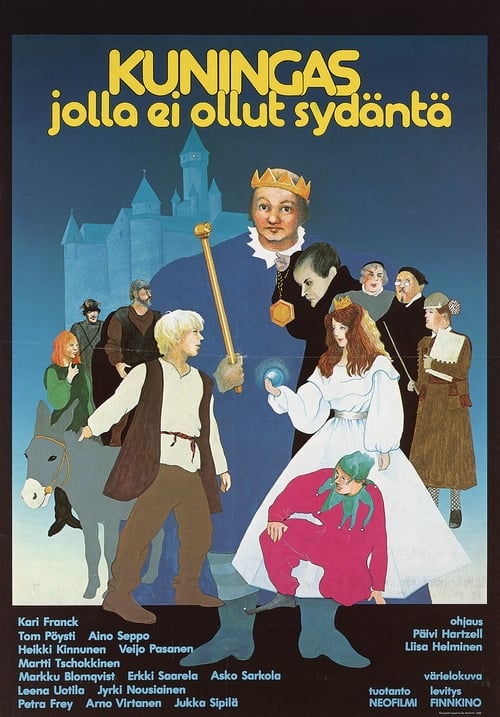
Kuningas jolla ei ollut sydäntä begins in a kingdom that looks almost impossibly whole: the castle gleams, the fields are prosperous, and the king and queen live in open happiness with their young daughter. The mood is warm and storybook-like, but the film immediately plants the seed of its tragedy. The queen dies suddenly in an accident, and the king, overwhelmed by grief, cannot bear the force of feeling that her death unleashes in him. Rather than endure it, he chooses a brutal solution: he has his heart removed, severing himself from emotion in the most literal way possible. From that moment on, the kingdom changes with him. What had once been a place of joy becomes a rigid, hyper-organized realm governed by efficiency, logic, and control, a society in which feeling is treated as a weakness and tenderness is replaced by administration.
The king's transformation is not only personal but political. He turns his private sorrow into a state ideology, and the court reshapes itself around his coldness. Ministers and bureaucrats come to embody this new order, including the prime minister and the timetable minister, whose very presence suggests that life in the kingdom is now measured, scheduled, and regulated rather than lived. The castle, once a home, becomes a machine of rule. People move through its spaces with obedience rather than affection, and the visual world of the film reflects that emotional frost: straight lines, formal rituals, controlled gestures, and a sense that every human impulse has to be filed away or suppressed.
At the center of the story, though, is the king's daughter, the princess, who grows up inside this system but never fully belongs to it. As she matures, she becomes the living reminder of what the kingdom has lost. Where the king demands reason, she reaches for play; where the court values order, she values joy; where the kingdom insists on restraint, she insists on life. Her challenge is not initially open rebellion. It begins in small, stubborn acts of resistance--her refusal to accept that feeling is shameful, her attempts to remind her father of warmth, her persistence in treating the world as something that can be loved rather than merely managed. She is not naïve, but she refuses to become numb.
The film broadens its world through a second storyline that runs alongside the royal tragedy: the adventure of a foreign prince and his strange, Robin Hood-like entourage. This thread adds movement, comedy, and a more chaotic energy to the otherwise austere atmosphere of the court. The prince and his companions travel through the kingdom's margins and hidden places, and their route eventually intersects with the royal conflict. Their story brings in a more playful kind of threat and possibility, one that contrasts sharply with the king's bureaucratic regime. Instead of order, they bring improvisation. Instead of control, they bring motion. Instead of silence, they bring noise, confusion, and human unpredictability.
The queen's death remains the core wound of the narrative, and the film carefully makes clear that this tragedy is not something the king causes directly; it is fate, accident, and devastating loss. Yet the emotional consequences are his responsibility. His choice to remove his heart becomes the defining revelation of the story: he is not naturally heartless, but has tried to amputate grief instead of grieving. The symbolism is stark and unforgettable. He believes he is protecting himself from pain, but what he actually does is cut himself off from the very faculty that would allow him to love, to mourn properly, and to remain human. The kingdom suffers because its ruler refuses sorrow.
As the princess grows older, the tension between father and daughter deepens. She does not merely notice the coldness around her; she actively challenges it. She tries to get her father to see that the world cannot be reduced to efficiency. She tries to restore memory, affection, and playfulness to a man who has made a philosophy out of denial. Their confrontations are emotional rather than violent, but they carry real dramatic force because each one exposes how far the king has gone. He answers her with cold logic, administrative discipline, and emotional refusal. She answers him with feeling, persistence, and the unbearable truth that he has become a stranger to himself.
The king's courtly world grows more absurd as it becomes more rational. The irony is that the more the kingdom tries to eliminate disorder, the more it feels spiritually broken. Rules pile up, systems multiply, and the machinery of governance becomes a substitute for empathy. The timetable minister and the prime minister stand as symbols of this new regime, figures whose function is to keep life moving according to plan even when the plan has cost the kingdom its soul. The film uses them to show how emotional suppression spreads outward: what begins as grief becomes policy, and what begins as policy becomes an entire culture of deadened feeling.
The parallel prince storyline eventually reinforces the same central conflict through contrast. His band operates on impulse and camaraderie rather than protocol, and their movements carry the energy of a folk tale that refuses to sit still. Their adventures echo the larger film's concern with freedom versus control, but they do so in a lighter key. This matters because the movie does not present the return of emotion as a simple solemn cure. It also includes laughter, mischief, confusion, and the messy vitality of people who do not behave according to royal plans. The prince and his companions widen the emotional register of the film until the king's world can no longer contain it.
The jester, Hovinarri, becomes the crucial figure in the story's emotional turn. On the surface, he appears to be the comic character, the fool, the one least likely to matter in a kingdom obsessed with seriousness. But that is exactly why he becomes essential. He sees what the others cannot or will not say. His role is not merely to entertain but to break through the king's defensive shell. Where the princess speaks as a daughter, the jester speaks as a truth-teller disguised as nonsense. He carries the power of foolishness to expose the folly of trying to live without feeling.
The confrontation between king and jester is the turning point. It is not a duel of swords but a collision of worldviews. The king, by now so thoroughly committed to his own hard logic, confronts someone who refuses to respect the terms of that logic. The jester's apparent absurdity is exactly what gives him leverage: he can move where solemnity cannot. He can slip past the king's defenses and strike at the truth the king has buried. Through this encounter, the film makes its central revelation emotionally unavoidable. The king has not become stronger by removing his heart. He has become smaller, colder, and increasingly unable to recognize the suffering he has caused in himself and in others.
The princess and the jester together complete the pressure that the kingdom can no longer withstand. She brings familial love and moral insistence; he brings wit, inversion, and emotional honesty. Their combined effect is to force the king toward self-recognition. The film's climax is built on this slow collapse of his defenses. He is confronted not with punishment but with understanding, and that may be even harder for him to bear. He has to face the fact that his heartless rationalism is not wisdom but an evasion of grief, and that by trying to rule without pain he has also ruled without joy, tenderness, or genuine life.
The final confrontation does not end in destruction. Instead, it ends in transformation. The king finally understands that the kingdom he built in the name of reason is spiritually barren, and that the emotions he tried to erase are not enemies but the source of humanity itself. The princess and the jester have done what no decree, no bureaucratic structure, and no forced discipline could accomplish: they have reached the part of him that still remembers love. The film treats this as a moral and emotional victory rather than a political overthrow. There is no revenge, no violent reckoning, no tragic sacrifice to pay for his mistake. The resolution is reconciliation.
In the ending, the king regains awareness of the value of joy and feeling. The emotional balance of the film returns not because the world becomes perfect, but because he stops trying to amputate sorrow from life. The story closes on a note of restored humanity: the princess is no longer speaking into a void, and the king is no longer sealed away inside his self-made coldness. The jester's truth has opened a path back toward connection, and the kingdom, though changed by loss, is no longer condemned to be governed as a machine. The final scenes return the film to the possibility of warmth, implying that the deepest order is not logic without feeling, but the hard and necessary union of both.
More Movies Like This
Browse All Movies →
What is the ending?
In the ending of "Kuningas jolla ei ollut sydäntä," the king, who has been on a quest for love and redemption, ultimately sacrifices his own desires for the sake of his people. He realizes that true leadership comes from the heart, and in a poignant moment, he chooses to give up his own life to save his kingdom from impending doom. The film concludes with a sense of bittersweet resolution, as the kingdom mourns the loss of their king but also finds hope in the legacy of his selflessness.
As the final scenes unfold, the atmosphere is heavy with tension and impending tragedy. The king stands at the edge of a cliff overlooking his kingdom, the wind whipping through his hair as he contemplates the weight of his decisions. He has been grappling with the emptiness of his heart, a metaphor for his inability to connect with his subjects and the love he has long sought. The camera captures the turmoil in his eyes, reflecting his internal struggle between duty and desire.
In the next scene, the kingdom is in chaos, threatened by an external force that seeks to overthrow the king. The people, once loyal, are now filled with fear and uncertainty. The king gathers his advisors, a group of weary but determined individuals who have stood by him through thick and thin. They discuss strategies, but the king knows deep down that their efforts may not be enough. His heart, still encased in the metaphorical armor he has worn throughout his reign, feels heavy with the burden of leadership.
As the conflict escalates, the king makes a fateful decision. He realizes that to truly protect his kingdom, he must confront the enemy head-on. In a climactic battle scene, the king leads his troops into the fray, his determination shining through despite the odds stacked against them. The visuals are striking, with the clash of swords and the cries of warriors echoing in the air. The king fights valiantly, embodying the spirit of a true leader, but it becomes clear that the battle is not just for his kingdom but also for his own redemption.
In a moment of desperation, the king faces the enemy leader, a figure shrouded in darkness and malice. Their confrontation is intense, filled with raw emotion as the king fights not only for his people but also to reclaim his own heart. In a final act of bravery, he sacrifices himself, allowing his people to escape the clutches of despair. The scene is heart-wrenching, as the camera lingers on his face, a mixture of pain and peace as he embraces his fate.
The aftermath of the battle is somber. The kingdom mourns the loss of their king, the streets lined with grieving citizens who once looked to him for guidance. Yet, amidst the sorrow, there is a flicker of hope. The king's sacrifice has united the people, igniting a sense of resilience and determination to carry on his legacy. The final shots of the film show the kingdom beginning to rebuild, the sun rising over the horizon, symbolizing a new dawn.
As the credits roll, the audience is left with the poignant reminder of the king's journey. His fate, though tragic, serves as a powerful testament to the themes of love, sacrifice, and the true essence of leadership. The characters who stood by him, the advisors and the citizens, are now tasked with honoring his memory and ensuring that his heart, once lost, continues to beat within the spirit of the kingdom he loved so dearly.
Is there a post-credit scene?
The movie "Kuningas jolla ei ollut sydäntä," produced in 1982, does not feature a post-credit scene. The film concludes its narrative without any additional scenes after the credits roll, focusing instead on the resolution of its central themes and character arcs. The ending leaves the audience with a sense of closure regarding the fate of the characters and the overarching story, emphasizing the emotional weight of the journey rather than teasing future developments.
What motivates the king's actions throughout the film?
The king, who lacks a heart, is driven by a desire for power and control, often leading him to make ruthless decisions that alienate those around him. His internal struggle with his emotional void creates a complex character who seeks validation through dominance.
How does the absence of a heart affect the king's relationships with his subjects?
The king's lack of empathy and emotional connection leads to strained relationships with his subjects. They fear him, and his inability to understand their needs results in rebellion and discontent, highlighting the consequences of his emotional detachment.
What role does the queen play in the king's life and decisions?
The queen serves as a foil to the king, embodying compassion and emotional depth. Her attempts to reach out to him and instill a sense of humanity create tension, as she represents the love and connection he is missing, ultimately influencing his journey.
How does the king's quest for a heart manifest in the story?
The king's quest for a heart symbolizes his longing for emotional fulfillment. He embarks on a journey that leads him to confront various challenges and characters that reflect his inner turmoil, ultimately pushing him to reconsider his values and desires.
What pivotal moment leads to the king's realization about his lack of a heart?
A pivotal moment occurs when the king witnesses the suffering of his subjects firsthand during a crisis. This experience forces him to confront the consequences of his actions and the emptiness of his rule, leading to a moment of introspection about his identity and desires.
Is this family friendly?
"Kuningas jolla ei ollut sydäntä," or "The King Who Had No Heart," is a fantasy film that contains several elements that may be considered objectionable or upsetting for children or sensitive viewers.
-
Dark Themes: The film explores themes of loss, betrayal, and the absence of love, which may be emotionally heavy for younger audiences.
-
Violence: There are scenes that depict conflict and struggle, including battles and confrontations that may be intense or frightening.
-
Emotional Distress: Characters experience significant emotional turmoil, including sadness and despair, which could be distressing for sensitive viewers.
-
Supernatural Elements: The presence of magical and fantastical creatures may be unsettling for some children, depending on their sensitivity to such themes.
-
Moral Ambiguity: The characters often face moral dilemmas that may be complex and difficult for younger viewers to understand.
These aspects may require parental guidance to help contextualize the film's themes and scenes for younger audiences.









