















Popular
What motivates Hauke Haien to build the new dike?
How does Hauke's relationship with his father influence his actions?
What role does the supernatural element of the white horse play in the story?
How does the community react to Hauke's plans for the dike?
What is the significance of Hauke's relationship with his wife, Elke?
Should I watch it?
Ask Your Own Question

What is the plot?
Sorry, we aren't able to watch and write up a full detailed plot yet. Check back in a few days.


What is the ending?
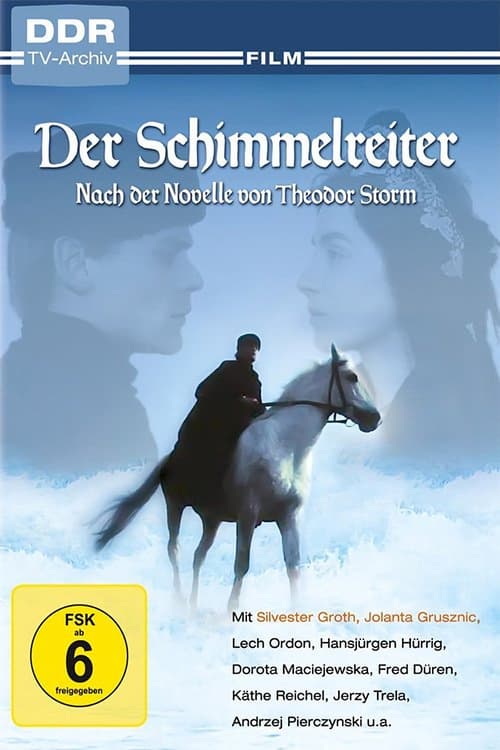
In the ending of "Der Schimmelreiter," the protagonist, Hauke Haien, faces the consequences of his ambitious plans to build a new dike. Despite his efforts, a storm surge overwhelms the dike, leading to disaster. Hauke's horse, a white stallion, is seen as a symbol of his fate. In the end, Hauke sacrifices himself to save the village, but he is ultimately lost to the sea.
Expanding on the ending in a chronological and narrative fashion:
As the film approaches its climax, the tension builds in the small coastal village where Hauke Haien has been tirelessly working on his ambitious dike project. The villagers, initially skeptical of Hauke's vision, have come to see the importance of his work, but they remain divided in their support. Hauke, portrayed as a man driven by a deep sense of duty and a desire to protect his community, is increasingly isolated in his determination.
The scene shifts to a darkening sky as ominous clouds gather on the horizon. The villagers, now aware of the impending storm, rush to secure their homes and livestock. Hauke, however, remains focused on the dike, believing that his construction will withstand the storm. His internal conflict is palpable; he is torn between his ambition and the fear of failure. He recalls the warnings of the old villagers who had once told tales of the dangers of the sea.
As the storm hits, the wind howls and rain lashes down, creating a chaotic atmosphere. The villagers gather at the dike, their faces a mix of fear and determination. Hauke stands resolute, urging them to trust in his work. The dike, however, begins to show signs of weakness. Cracks form, and water starts to seep through, igniting panic among the villagers.
In a pivotal moment, Hauke's beloved white horse appears, symbolizing both his strength and his vulnerability. Hauke rides the horse along the dike, trying to rally the villagers and maintain their faith in his vision. But as the storm intensifies, the dike begins to crumble under the relentless pressure of the waves. Hauke's desperation grows; he realizes that his dream of a perfect dike may lead to catastrophe.
As the water breaches the dike, chaos ensues. Villagers scream and scramble to save themselves and their families. Hauke, in a moment of clarity, understands that he must act decisively. He makes the heart-wrenching decision to stay behind, determined to hold the dike together as long as he can. He shouts to the villagers to flee to safety, urging them to abandon their homes for their lives.
In the final moments, Hauke's horse, the embodiment of his spirit, is swept away by the rising tide. Hauke, now fully aware of the futility of his struggle against nature, is engulfed by the waves. The camera captures his face, a mixture of resolve and despair, as he disappears into the depths of the sea. The villagers, witnessing his sacrifice, are left in shock and grief, realizing the cost of their reliance on Hauke's vision.
The film concludes with a somber tone, as the village is left to grapple with the loss of Hauke Haien. His ambition, while noble, ultimately leads to tragedy, leaving a lasting impact on the community. The final scenes reflect on the themes of human ambition versus nature, the fragility of life, and the sacrifices made for the greater good. The fate of Hauke serves as a poignant reminder of the limits of human control in the face of overwhelming natural forces.
Is there a post-credit scene?
The movie "Der Schimmelreiter," produced in 1985, does not contain a post-credit scene. The film concludes with a powerful and emotional ending that encapsulates the themes of ambition, sacrifice, and the struggle against nature. The narrative wraps up without any additional scenes or content after the credits, focusing instead on the resolution of the main character's journey and the impact of his actions on his community and the landscape around him.
What motivates Hauke Haien to build the new dike?
Hauke Haien is driven by a deep sense of responsibility and a desire to protect his community from the devastating floods that threaten their lives and livelihoods. His personal ambition to prove himself as a capable leader and innovator also fuels his determination to construct a more effective dike.
How does Hauke's relationship with his father influence his actions?
Hauke's relationship with his father is strained, as his father disapproves of his ambitions and the new ideas he brings. This conflict instills in Hauke a desire to prove his worth and to break free from his father's shadow, pushing him to pursue his vision for the dike despite the opposition he faces.
What role does the supernatural element of the white horse play in the story?
The white horse symbolizes both Hauke's ambition and the ominous fate that awaits him. It appears as a harbinger of disaster, representing the consequences of Hauke's hubris and the struggle between man and nature. The horse's presence serves to heighten the tension and foreshadow the tragic events that unfold.
How does the community react to Hauke's plans for the dike?
Initially, the community is skeptical and resistant to Hauke's innovative ideas, preferring traditional methods. As Hauke's determination grows, some begin to support him, but there remains a significant faction that fears change and distrusts his vision, leading to conflict and division within the village.
What is the significance of Hauke's relationship with his wife, Elke?
Hauke's relationship with Elke is complex, as she represents both his emotional anchor and the societal expectations he struggles against. Her support is crucial to his endeavors, yet her fears about the dangers of his ambitions create tension. Their dynamic reflects Hauke's internal conflict between personal desires and communal responsibilities.
Is this family friendly?
"Der Schimmelreiter," produced in 1985, is a film that explores themes of ambition, obsession, and the struggle against nature, which may not be entirely suitable for younger audiences or sensitive viewers. Here are some potentially objectionable or upsetting aspects:
-
Death and Loss: The film deals with themes of mortality, including the death of characters, which may be distressing for children.
-
Natural Disasters: The story involves severe storms and flooding, depicting the destructive power of nature, which could be frightening.
-
Isolation and Despair: The protagonist experiences intense feelings of isolation and desperation, which may be emotionally heavy for younger viewers.
-
Conflict and Tension: There are scenes of conflict between characters, including moments of anger and betrayal, which could be unsettling.
-
Supernatural Elements: The presence of the titular ghostly rider may be frightening for some children, as it introduces a supernatural aspect that can evoke fear.
These elements contribute to a darker tone throughout the film, making it more suitable for older audiences or those who can handle complex emotional themes.







