









Popular
What role does the setting play in the development of the story?
What is the significance of the character Dr. John M. Hargrove in the story?
How does the character of the alien being influence the plot?
How does the relationship between Hargrove and his assistant evolve throughout the film?
What are the key moments that showcase Hargrove's descent into obsession?
Should I watch it?
Ask Your Own Question

What is the plot?
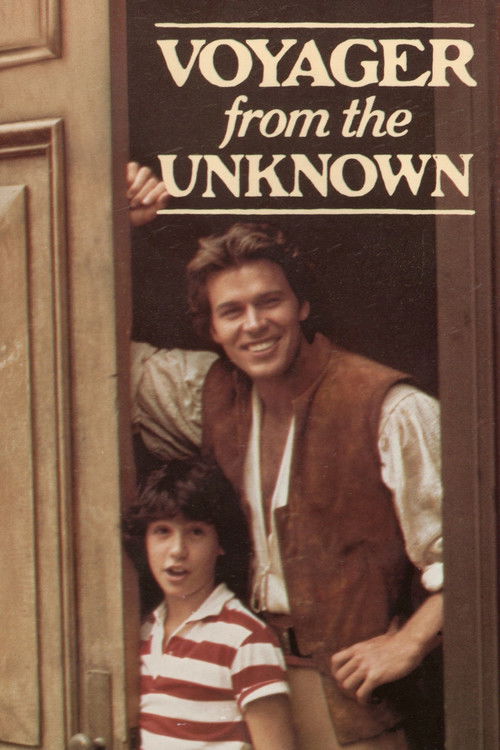
Voyager from the Unknown opens in 1984 in the cramped, lonely bedroom of 11-year-old Jeffrey Jones, an orphan living with his uncle and aunt, where the night is quiet except for the uneasy sense that he does not really belong anywhere. That fragile stillness is shattered when Phineas Bogg, a frantic time traveler, crashes straight through Jeffrey's bedroom window and lands in a heap among shattered glass and splintered wood. In an instant, Jeffrey's ordinary world is invaded by impossible things: Bogg's strange urgency, the weight of his mission, and the mysterious book he carries, the one object that seems to matter more than anything else in his life. Jeffrey stares at the stranger with a mixture of fear and wonder, while Bogg, disoriented but determined, tries to gather himself and explain enough to keep the boy from panicking. The scene has the breathless, accidental energy of fate colliding with childhood, as if Jeffrey's life has been waiting for exactly this rupture.
The interruption becomes chaos almost immediately. Jeffrey's dog lunges at Bogg's book, snapping at it as though it were the most threatening thing in the room, and in the struggle Jeffrey is knocked out the window and falls into the night. Bogg reacts on instinct, diving after him into the void, and the two are swept away together, projected through time before either of them can fully understand what has happened. From that moment forward, the story becomes a race against history itself. Bogg is not merely a runaway stranger; he is a "Traveller," one of the guardians of time, and Jeffrey is now caught in his orbit whether he wants to be or not. The book, the fall, and the leap are all tied together, making the opening feel like the snapping of a trap: one wrong motion, and two lives are pulled out of the present and thrown into the currents of history.
What follows is not a single straight escape but a repeated, dangerous pattern. Bogg and Jeffrey tumble from one historical period to another, each new setting arriving with its own atmosphere, its own urgent local crisis, and its own famous figures from the past. The adventure is always driven by the same tense purpose: Jeffrey must somehow get back to 1984, and Bogg must do it without breaking the timeline. Every arrival demands quick thinking, disguise, and restraint, because the smallest intervention could alter history. That is the hidden law beneath the action, and it gives every scene a brittle edge. They are never simply visitors; they are intruders trying not to leave fingerprints on the past.
As the journey unfolds, the emotional center settles on the strange partnership between the boy and the traveler. Jeffrey begins as an orphan who is used to being overlooked, but now he is the one person who sees Bogg's panic, his confidence, his mistakes, and his strange mixture of bravery and recklessness. Bogg, in turn, becomes a reluctant guide and protector, even when he is clearly improvising half the time. Their dialogue carries the push and pull of two people who have not chosen each other but are nevertheless bound together. Bogg's mission gives the adventure its structure, but Jeffrey gives it vulnerability. He is the reminder that every historical detour has a child's life hanging in the balance.
The book remains the central object of consequence. Its damage is not merely physical; it is symbolic of Bogg's entire position in the universe. The dog's attack on it during the opening struggle is the immediate trigger for catastrophe, and the book's importance implies that the rules of time travel in this world are fragile, bureaucratic, and deeply dependent on the proper handling of tools and records. When Bogg loses control of it, he loses control of the situation itself. That single violent scramble in Jeffrey's bedroom establishes the governing tension of the whole story: history is not just something to visit, but something that can be ruined by a lapse, a bite, a fall, or a moment of fear.
The narrative then moves through its historical encounters as a series of escalating tests. Each period forces Bogg and Jeffrey to navigate unfamiliar customs and personalities while hiding what they are. The comedy of mistaken identity and the pressure of secrecy sit alongside a genuine sense of danger, because the stakes are never abstract. Even when the characters are surrounded by spectacle or by the thrill of meeting famous people from the past, they remain locked in the problem of survival and return. The story's momentum comes from that repetition with variation: arrive, assess, adapt, escape. Every time the pair believes they may have found a stable foothold, the timeline shifts again and sends them somewhere else.
One of the film's key revelations is that this is not random wandering. Bogg belongs to a structured organization, the Travellers, which gives the entire adventure a sense of cosmic responsibility. He is not just using time travel; he is answerable to it. That fact reframes everything that happened in Jeffrey's room. Bogg's appearance was not a rogue accident from nowhere but the consequence of a larger system and a duty he has failed to handle cleanly. The viewer is made to understand that the book he carries is not a prop but a guide, possibly even a map of how history is supposed to unfold. Its importance means that every mishap is potentially catastrophic, not just for Bogg and Jeffrey but for the timeline itself.
As the journey continues, tension builds through the repeated contrast between what the characters want and what history permits. Jeffrey wants home, safety, and the simple return to his own room in 1984. Bogg wants to repair the damage, recover control, and fulfill the obligations of a Traveller. But the past is not a neutral landscape. It is a place full of real people, real dangers, and moments that cannot be disturbed. Each confrontation is therefore double-edged: the outward threat in the scene and the invisible threat of causing a historical rupture. The pair are constantly forced to act as though they are invisible while also surviving intimate, immediate danger.
The emotional pattern of the story deepens because Jeffrey is no longer merely a passenger. Over time he becomes part of the mechanism of survival, learning how to read Bogg, when to trust him, and when to brace for another leap into the unknown. The boy's fear gradually becomes something sturdier: a wary courage shaped by necessity. His orphaned status in the opening makes this especially poignant, because the adventure becomes a strange substitute family dynamic. Bogg is chaotic and flawed, but he is there. He chooses action over abandonment. In a story obsessed with historical continuity, that human bond becomes the most important continuity of all.
The movie does not present a catalog of deaths, and no specific death is identified in the available plot information. That absence matters, because the danger comes instead from destabilization, near misses, and the constant threat of altering or losing history. The opening confrontation is physical and dramatic rather than fatal: the dog attacks the book, Jeffrey falls, and Bogg follows him. The film's violence is of the scrambling, perilous kind, not the body-count kind. What is at stake is not who dies on screen but whether the proper sequence of history survives the travelers' interference.
The revelations accumulate as the adventure goes on. The audience learns that Bogg is part of a temporal order, that the book governs his mission, and that Jeffrey's presence in the story is not an afterthought but a consequence of that first disastrous collision. The narrative keeps suggesting that the pair's travels are meaningful beyond the obvious quest to get home. Each encounter with history becomes a test of whether ordinary people can move through extraordinary times without trying to dominate them. In that sense, the story is constantly about humility: know your place in history, interfere only when necessary, and accept that even the desire to help can become a form of damage.
The ending, as far as the available plot information reveals, does not provide a detailed final showdown or a scene-by-scene resolution from this compilation version. What is clear is the continuing structure of the tale: Bogg and Jeffrey remain in motion through time, seeking a path back to 1984 while preserving the integrity of history around them. The story closes not with a tidy restoration but with the promise and burden of ongoing travel, the same uneasy partnership now hardened by ordeal. The final feeling is one of open-ended momentum: two figures locked in the vast machinery of time, carrying the memory of a shattered window, a bitten book, and a leap into the unknown, still trying to find the way home without breaking the world on the way.
More Movies Like This
Browse All Movies →
What is the ending?
In the ending of "Voyager from the Unknown," the protagonist, Dr. John McKenzie, confronts the consequences of his scientific pursuits. He faces a critical choice that tests his moral compass and ultimately leads to a tragic resolution. The film concludes with a sense of loss and reflection on the nature of human ambition and the unknown.
As the final scenes unfold, Dr. McKenzie stands in the dimly lit laboratory, surrounded by the remnants of his experiments. The atmosphere is thick with tension, and the weight of his decisions hangs heavily in the air. He is haunted by visions of the unknown entities he has encountered, their forms flickering in and out of his consciousness. The emotional turmoil within him is palpable; he grapples with the realization that his quest for knowledge has come at a great cost.
In a pivotal moment, McKenzie is faced with a choice: to continue his experiments and risk unleashing forces beyond his control or to abandon his work and accept the limitations of human understanding. The camera captures the conflict in his eyes, reflecting both determination and fear. He hesitates, the silence of the lab amplifying the gravity of his decision.
As he reaches for the equipment, a sudden surge of energy erupts, causing the lab to tremble. McKenzie is thrown back, and the lights flicker ominously. In this chaotic moment, he realizes that the unknown entities are not just figments of his imagination; they are real and have been drawn to his experiments. The tension escalates as he struggles to regain control, but the forces he has awakened are too powerful.
In a desperate attempt to contain the situation, McKenzie activates a failsafe mechanism, hoping to reverse the effects of his work. The screen fills with blinding light, and the lab is engulfed in a whirlwind of energy. As the chaos subsides, McKenzie is left alone, the lab now eerily silent. He surveys the destruction around him, a mix of relief and sorrow washing over him. The cost of his ambition is evident; he has lost not only his work but also a part of himself.
The film concludes with a haunting image of McKenzie standing amidst the wreckage, a solitary figure against the backdrop of his shattered dreams. The camera slowly pulls away, leaving him in the darkness, a poignant reminder of the dangers of human curiosity and the mysteries that lie beyond our understanding. The fate of Dr. McKenzie is one of isolation and regret, a testament to the film's exploration of the unknown and the consequences of our relentless pursuit of knowledge.
Is there a post-credit scene?
"Voyager from the Unknown," produced in 1984, does not contain a post-credit scene. The film concludes its narrative without any additional scenes or content after the credits roll. The story wraps up with a sense of finality, leaving the audience to reflect on the themes and events that have unfolded throughout the film. The absence of a post-credit scene aligns with the film's focus on its central plot and character arcs, providing a complete experience without further extensions.
What role does the setting play in the development of the story?
The setting of 'Voyager from the Unknown' is crucial to the story's atmosphere and character development. The film transitions between stark laboratory environments and the vastness of space, creating a juxtaposition between human ambition and the infinite unknown. The isolation of space amplifies the characters' emotional states, particularly Hargrove's growing obsession and fear. The eerie silence of the cosmos serves as a backdrop for the unfolding drama, heightening the tension and sense of dread as the characters confront their own limitations.
What is the significance of the character Dr. John M. Hargrove in the story?
Dr. John M. Hargrove serves as the central figure in 'Voyager from the Unknown,' representing the archetype of the ambitious scientist. His relentless pursuit of knowledge drives the narrative, as he embarks on a journey to uncover the mysteries of the universe. Hargrove's internal conflict is palpable; he grapples with the ethical implications of his research and the potential consequences of his discoveries. His character is marked by a blend of curiosity and hubris, which ultimately leads him to confront the unknown.
How does the character of the alien being influence the plot?
The alien being in 'Voyager from the Unknown' acts as a catalyst for the unfolding events. Its presence challenges the characters' understanding of reality and forces them to confront their fears and desires. The alien's interactions with Hargrove reveal his vulnerabilities and the limitations of human knowledge. This being embodies the unknown, pushing the narrative into deeper philosophical territories as it influences Hargrove's decisions and the fates of those around him.
How does the relationship between Hargrove and his assistant evolve throughout the film?
The relationship between Hargrove and his assistant is complex and evolves significantly throughout 'Voyager from the Unknown.' Initially, the assistant admires Hargrove's brilliance and is eager to learn from him. However, as Hargrove becomes increasingly consumed by his quest for knowledge, the assistant begins to question the morality of their work. This shift creates a rift between them, highlighting themes of loyalty, ambition, and the ethical boundaries of scientific exploration. The assistant's growing disillusionment serves as a counterpoint to Hargrove's obsession, ultimately leading to a dramatic confrontation.
What are the key moments that showcase Hargrove's descent into obsession?
Key moments that showcase Hargrove's descent into obsession include his initial discovery of the alien artifact, which ignites his curiosity and ambition. As he delves deeper into his research, scenes depict him neglecting personal relationships and becoming increasingly isolated. His late-night lab sessions, filled with frantic energy and desperation, illustrate his growing fixation. A pivotal moment occurs when he dismisses warnings from his assistant and colleagues, choosing to pursue his experiments at all costs. This culminates in a harrowing encounter with the alien being, where Hargrove's obsession leads to profound consequences, both for himself and those around him.
Is this family friendly?
"Voyager from the Unknown," produced in 1984, is a science fiction film that explores themes of isolation, existentialism, and the unknown. While it is not overtly graphic or violent, there are several aspects that may be considered objectionable or upsetting for children or sensitive viewers.
-
Existential Themes: The film delves into deep philosophical questions about existence and the nature of reality, which may be confusing or unsettling for younger audiences.
-
Isolation and Loneliness: Characters experience profound feelings of isolation and despair, which could evoke strong emotional responses.
-
Mysterious and Eerie Atmosphere: The film features a tense and unsettling atmosphere, with scenes that may be perceived as creepy or frightening, particularly for younger viewers.
-
Unresolved Conflicts: The narrative includes conflicts that are not neatly resolved, which might leave viewers feeling uneasy or anxious.
-
Visual Effects: Some special effects may be disorienting or intense, contributing to a sense of unease.
Overall, while "Voyager from the Unknown" is not explicitly inappropriate, its themes and emotional depth may not be suitable for all children or sensitive individuals.







