














Popular
What role does the character of the journalist play in the story?
What happens to the babies born from the original creature in It's Alive III: Island of the Alive?
How does the character of Dr. Robert Langley evolve throughout the film?
How do the creatures interact with the human characters on the island?
What is the significance of the island setting in the film?
Should I watch it?
Ask Your Own Question

What is the plot?
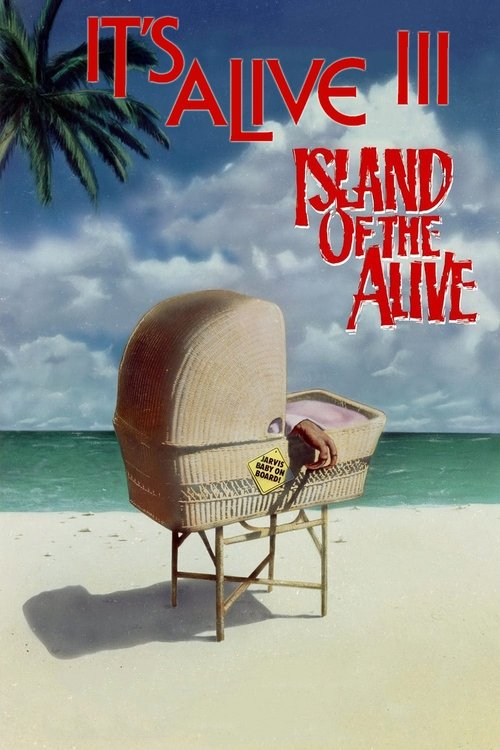
The film opens on a stormy night in a city where a woman goes into labor in the back of a cab, and from the start the world of It's Alive III: Island of the Alive feels hostile, panicked, and already condemned. The cab driver, horrified, rushes to find a police officer to help with the birth and then runs off to locate a public phone and call an ambulance, but while he is away the woman delivers a mutant baby. When the officer sees what has been born, he immediately tries to shoot it, treating the infant as something disposable rather than human, and the baby reacts with shocking ferocity, killing both the officer and its mother. By the next day, the tiny corpse has dragged itself into a Catholic church to die, a bleak image that sets the tone for everything that follows.
From there the story moves into a courtroom, where Stephen Jarvis stands as the public face of the parents fighting to save their mutant children from execution. The legal and political mood is already savage: the government's default answer is to destroy the babies on sight, and the courtroom has become a stage for fear, spectacle, and cruelty. The prosecution tries to humiliate Jarvis by wheeling his mutant son into the courtroom inside a cage, clearly expecting him to recoil and prove that even the boy's own father sees him as a monster. Instead, Jarvis walks toward the cage and speaks to the child, trying to reach him as a father rather than a witness. The room tightens with dread as he places his hands near the cage and insists that the baby is not simply a killer but a frightened living being reacting to the hostility around him.
The baby breaks loose in the courtroom, sending the room into chaos, and for a moment it appears that the state's worst assumptions will be confirmed. But Jarvis keeps talking to his son, and the child calms in his presence. That single act of trust changes the course of the case: the judge accepts the possibility that the babies are intelligent and responsive, and instead of ordering them executed, rules that the captured mutant children will be quarantined on a remote deserted island whose location is kept secret. It is not a triumph so much as an exile, but in this world it counts as mercy. The courtroom scene establishes the film's central contradiction: the children are spared death, yet their survival depends on being hidden away from the human world.
The cost of that decision lands on Stephen Jarvis immediately. He becomes a social outcast, known publicly as the man who fathered a mutant child and defended it in court. His career collapses, and his life shrinks from public visibility into humiliation and isolation. Ellen, the child's mother, is unable or unwilling to stay tied to the case; the stigma drives a wedge between them, and she leaves to build a separate life, wanting nothing to do with the scandal or the boy who has become its symbol. Years pass, and the film checks in on Jarvis five years later, reduced from actor and public figure to a broken man working a lowly job, carrying the emotional wreckage of that court battle with him every day.
Five years after the island sentence, the buried story reopens. Lieutenant Perkins, the returning law-enforcement figure who has stayed connected to the mutant-baby crisis through the series, approaches Jarvis and tells him that Dr. Swenson has assembled an expedition to the island to study how the children have developed. Jarvis is not eager to go; he has already paid dearly for his involvement and has little reason to believe the authorities or researchers are acting out of pure concern. But Perkins persuades him, arguing that Jarvis is one of the few people who truly understands the children and is one of the only people on the expedition who cares about them as living beings rather than specimens. The expedition is also tied, at least in the background, to Cabot, the pharmaceutical executive associated with the earlier mutant-birth crisis, which adds a layer of corporate exploitation and institutional cynicism to the whole mission.
The first expedition to the island is led by Cabot, and it ends in blood. Once the search party reaches the remote island, the supposedly abandoned children reveal that they are anything but helpless. They attack with ferocity, kill the entire expedition, and eat them, turning the government's hidden quarantine into a slaughter zone. Jarvis is the only survivor from that first expedition, and he lives long enough to become part of the island's grim secret: the children have survived, grown, and built a life of their own beyond the reach of society that rejected them.
The second expedition, organized by Dr. Swenson, arrives with the same basic purpose but a different texture. This time there is more explicit scientific curiosity, more of a sense that the adults are trying to "check on" the children after years of silence, but the result is even worse. When the expedition reaches the island, the truth of what the children have become comes into focus with horrifying speed. They are no longer babies at all. They have grown into larger, stronger beings, and the island has become a self-contained colony where they live together, breed among themselves, and communicate telepathically. This is the film's key revelation: the children are not merely surviving, they are evolving into a family, a species, a society. Their apparent dependence on adults has vanished; the adults are now the intruders, and the island belongs to the children.
The attack on the expedition is swift and brutal. The children massacre the visitors, and the film makes clear that the deaths are not accidents or self-defense in any limited sense but the result of the expedition's complete failure to understand what it is entering. Cabot's earlier expedition has already shown how deadly the island is; now Swenson's team discovers that the danger has only increased as the children mature. Lt. Perkins is the one notable exception among the expedition personnel: he survives the slaughter and is left stranded on the island when the rest are killed. The film does not spare the audience from the implication that everyone else on the expedition dies at the children's hands, though the surviving summaries do not provide a full itemized list of every victim by name.
Jarvis is caught in the middle of all this, and the emotional core of the film shifts from public scandal to impossible fatherhood. Among the grown mutants is his own son, now intelligent, commanding, and capable of telepathic communication. The son does not simply attack Jarvis. Instead, he claims him, keeping him alive long enough to understand the truth of the island and the children's new existence. Jarvis is forced to watch as the mutants reveal both their independence and their vulnerability: one of them has given birth to offspring of its own, proving that the mutant line is continuing without any human help. The horror is no longer just that the babies are alive, but that they are reproducing and creating a hidden lineage on the island.
The film's tension deepens as Jarvis realizes that the island is not simply a dumping ground created by the courts. It has become a sealed-off world where the children have been left to develop outside normal human society, and the people who sent them there never intended to reintegrate them. The secrecy surrounding the island now feels like another form of violence. The children are not only hidden from the public; they are trapped in a social experiment shaped by fear, disgust, and control. The expedition, presented as a study, increasingly feels like an act of trespass, and the children's response is framed as both monstrous and understandable depending on how one reads the film's moral logic.
The climax arrives when the island's new order confronts the last remaining adults. Jarvis's son, speaking through telepathic force and intimidation, compels his father to help move the mutants off the island and toward the mainland. The destination is Cape Vale, Florida, and the motive is devastatingly personal: the son is searching for his mother, Ellen. This is the film's emotional twist, the one that recontextualizes the horror as family longing. The creature everyone has feared is not only a survivor or a predator; he is a child who wants his mother. Jarvis, who has spent years ostracized for defending the child's right to exist, is now forced to participate in his son's return to the human world.
The island sequence has the feel of an irreversible collapse. The expedition has been destroyed, Perkins is left behind, and Jarvis is no longer making independent choices in any meaningful sense. He survives, but only because his son permits it. The film turns that survival into a kind of sentence: Jarvis must live with what he has learned and with the knowledge that the children he defended have outgrown the categories that once defined them. The son's telepathic command replaces courtroom law with familial compulsion. The father who once argued that the baby could respond to kindness now learns that the kindness was never enough to restore normality; it only opened the door to a deeper, stranger reality.
The final movement takes the story from island horror to a bleakly tender resolution in Florida. Jarvis's son returns there in search of Ellen, and the ending suggests that mother and child are brought together again after years of separation. One account specifically notes that Ellen and Stephen Jarvis are reunited with the child's offspring, turning the finale into a warped family restoration rather than a simple escape or victory. This is not a conventional happy ending, because the family has not been healed in any ordinary sense. Instead, the film ends by implying that the mutant children have claimed a future, that their lineage will continue, and that the emotional center of the story has shifted from rejection to reluctant acceptance.
The closing note is one of uneasy completion. The courtroom struggle, the island quarantine, the slaughtered expeditions, the telepathic revelation, and the search for Ellen all converge into a final arrangement in which the child is no longer a legal problem but a family reality. Stephen Jarvis survives the ordeal, but not as the same man who entered the courtroom years earlier. He has been stripped of status, career, certainty, and even the ability to define fatherhood in human terms. Ellen's return to the child's orbit closes the emotional circle begun in the opening trial, while the children's independent colony remains somewhere between miracle and nightmare, hidden in the world but no longer contained by it.








What is the ending?
In the ending of "It's Alive III: Island of the Alive," the story culminates with the surviving characters facing the consequences of their actions. The monstrous children, who have been living on a remote island, are revealed to be capable of both violence and compassion. The film concludes with a tense standoff, leading to a tragic resolution for several characters, including the protagonist, as they grapple with the implications of their choices regarding the creatures.
Now, let's delve into the ending in a more detailed, chronological narrative.
As the film approaches its climax, the setting shifts to a remote island where the monstrous children, the offspring of the original creature from the previous films, have been living in isolation. The island is lush and tropical, but it carries an undercurrent of danger, as the children are both innocent and capable of violence. The atmosphere is tense, filled with the sounds of the ocean crashing against the rocks and the rustling of leaves in the wind.
The protagonist, Dr. Robert Lang, is determined to confront the reality of these children. He is filled with a mix of dread and responsibility, knowing that he played a part in their creation. His internal conflict is palpable; he feels a sense of guilt for what has happened and a desire to protect the children from the world that fears them. As he navigates the island, he is haunted by memories of the original creature and the chaos it brought into his life.
Meanwhile, the government agents, led by a ruthless figure, are intent on eliminating the children. They see them as a threat that must be eradicated. The tension escalates as the agents prepare to launch an attack on the island, armed with weapons and a cold resolve. The children, sensing the impending danger, become agitated and defensive, showcasing their primal instincts.
In a pivotal scene, Dr. Lang attempts to communicate with the children, hoping to reason with them and find a peaceful solution. He witnesses their innocence and vulnerability, which contrasts sharply with the violent intentions of the agents. The children, despite their monstrous appearances, display moments of tenderness and curiosity, revealing their complex nature.
As the agents begin their assault, chaos erupts on the island. The children retaliate, using their strength and agility to defend themselves. The scene is chaotic, filled with screams and the sounds of gunfire. Dr. Lang is caught in the middle, torn between his desire to protect the children and the reality of the threat they face. His emotional turmoil is evident as he shouts for both sides to stop, pleading for understanding.
In the climax, a tragic confrontation occurs. One of the children, driven by fear and anger, lashes out, resulting in a devastating outcome. The violence escalates, leading to casualties on both sides. Dr. Lang watches in horror as the situation spirals out of control, realizing that his hopes for a peaceful resolution are slipping away.
As the dust settles, the aftermath is grim. The surviving children are left to mourn their fallen companions, while Dr. Lang is left grappling with the consequences of his actions. The government agents, having lost some of their own, retreat, leaving the island in a state of desolation. The emotional weight of the events hangs heavy in the air, as Dr. Lang reflects on the futility of the violence and the loss of innocence.
In the final moments, Dr. Lang stands on the shore, looking out at the ocean. The waves crash against the rocks, symbolizing the relentless passage of time and the unresolved nature of the conflict. He is left with a profound sense of loss and a haunting question about the future of the children he tried to save. The film ends on a somber note, leaving the audience to ponder the implications of creation, responsibility, and the nature of humanity itself.
Is there a post-credit scene?
It's Alive III: Island of the Alive does not have a post-credit scene. The film concludes with its final moments, focusing on the fate of the mutant children and the implications of their existence. The narrative wraps up without any additional scenes or teasers after the credits, leaving the audience to reflect on the themes of parental responsibility, societal rejection, and the consequences of scientific experimentation.
What role does the character of the journalist play in the story?
The journalist, who is investigating the existence of the creatures, serves as a catalyst for the events that unfold. Her pursuit of the truth leads her to the island, where she confronts the reality of the creatures and their plight, ultimately challenging her own perceptions and biases.
What happens to the babies born from the original creature in It's Alive III: Island of the Alive?
In 'It's Alive III: Island of the Alive', the babies born from the original creature are shown to be living on a remote island. They have grown into fully developed beings, and the film explores their existence and the challenges they face as they are hunted and feared by society.
How does the character of Dr. Robert Langley evolve throughout the film?
Dr. Robert Langley, initially a scientist who created the original creature, becomes increasingly conflicted as he witnesses the consequences of his actions. His motivations shift from a desire to understand and control the creatures to a protective instinct towards them, especially as he grapples with the moral implications of their existence.
How do the creatures interact with the human characters on the island?
The creatures exhibit a range of behaviors, from aggression to curiosity, as they interact with the human characters. These interactions highlight the tension between fear and empathy, as some humans seek to destroy the creatures while others, like Dr. Langley, attempt to understand and protect them.
What is the significance of the island setting in the film?
The island serves as a secluded environment where the creatures can exist away from societal judgment. It becomes a microcosm for exploring themes of isolation, survival, and the consequences of scientific experimentation, as the characters confront their fears and the reality of the creatures' existence.
Is this family friendly?
"It's Alive III: Island of the Alive" is not considered family-friendly due to its themes and content. Here are some potentially objectionable or upsetting aspects that may affect children or sensitive viewers:
-
Violence and Gore: The film contains scenes of violence, including attacks by the mutant babies, which can be graphic and unsettling.
-
Death and Destruction: There are moments depicting death and the consequences of the characters' actions, which may be distressing.
-
Parental Conflict: The emotional turmoil and conflict between parents and their mutant offspring can be intense, exploring themes of rejection and fear.
-
Disturbing Imagery: The appearance of the mutant babies is designed to be unsettling, which may provoke fear or anxiety in younger viewers.
-
Moral Ambiguity: The film raises complex ethical questions about life, creation, and responsibility, which may be difficult for children to understand.
Overall, the film's dark themes and graphic content make it unsuitable for a younger audience or those sensitive to horror elements.








