














Loading additional questions...
Popular
What motivates the main character, Rock, throughout the film?
How does Rock's relationship with his mentor influence his journey?
What challenges does Rock face in his personal life that affect his decisions?
How does Rock's past influence his actions in the present?
What role do secondary characters play in Rock's development?
Should I watch it?
Ask Your Own Question

What is the plot?
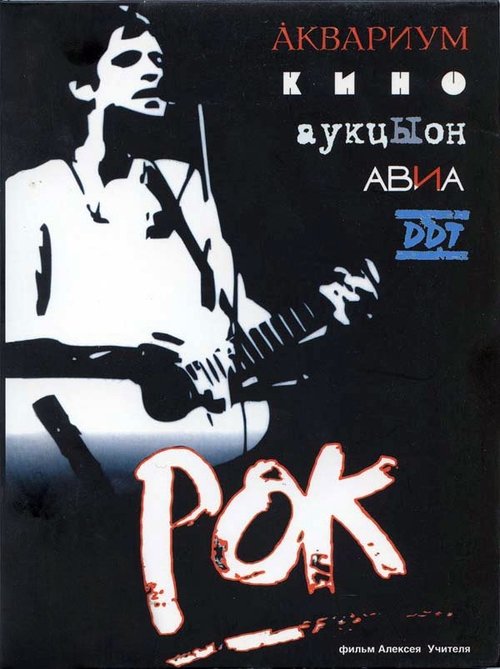
Rock (also listed as Rok or Рок) is a 1988 Soviet documentary directed by Alexey Uchitel about underground rock music in the last years of the Soviet Union, filmed in Leningrad and also in Moscow during January and February 1988. It does not have a fictional plot, named story arc, deaths, or a conventional ending, so a "complete spoiler" in the narrative sense does not really exist.
The film opens not with a single scripted scene but with the atmosphere of a scene: Soviet underground rock exists in a tense, half-legal world, and the documentary drops into that world through interviews and live performance footage. In place of a protagonist, the film gathers famous Soviet rock musicians and lets them speak for themselves, with the camera moving between candid conversation and raw stage energy in Leningrad and Moscow. The result is less a story with turning points than a portrait of a cultural moment, with the pressure of late Perestroika hanging over every image.
As the documentary unfolds, it presents the underground rock community as both defiant and precarious, a scene fighting for recognition inside a Soviet system that has only recently begun to loosen. Performances by bands such as Akvarium, Televizor, Auktyon, DDT, Kino, and Zvuki Mu are intercut with interviews, so the "action" is really the clash between music and control, between private conviction and public exposure. Pyotr Mamonov of Zvuki Mu appears in one of the better-known performance segments, and the footage captures the chaotic charisma of the era rather than a plot twist or revelation in the usual sense. The film's emotional movement comes from hearing musicians describe their work under conditions of uncertainty while the performances themselves feel urgent, improvised, and alive.
The key "revelation" the documentary offers is historical rather than dramatic: underground rock in the Soviet Union is not fringe noise but a real, self-aware artistic movement trying to define itself in the final years of the Soviet system. Because this is a documentary, there are no scripted betrayals, secret identities, murders, or deaths to recount, and no confirmed climactic confrontation that resolves into victory or defeat. Instead, the tension builds through the contrast between what the musicians are making and the world surrounding them, a world that is still constrained even as Perestroika opens small cracks in the surface.
The film ends the way documentaries of this kind often do: not with a dramatic payoff, but with the lingering force of the performances and the sense that what has been shown is larger than the film itself. There is no final showdown, no death scene, no hidden culprit, and no closing resolution beyond the documentary's clear statement that these musicians and their audience are part of a living underground culture. The final impression is of a scene on the verge of wider visibility, with the camera leaving viewers inside the moment rather than outside it, after having documented the sound, faces, and energy of Soviet rock as it fights its way into history.
If a different 1988 film titled Rock was meant, the director, country, or cast would be needed to give the kind of full chronological spoiler requested.
More Movies Like This
Browse All Movies →




What is the ending?
Is there a post-credit scene?
What motivates the main character, Rock, throughout the film?
Rock is driven by a deep desire to prove himself and escape the shadow of his past. He struggles with feelings of inadequacy and seeks validation through his actions, particularly in his relationships and his pursuit of success.
How does Rock's relationship with his mentor influence his journey?
Rock's mentor plays a crucial role in shaping his character. The mentor provides guidance and wisdom, pushing Rock to confront his fears and embrace his potential. This relationship is marked by moments of tension and growth, as Rock learns to balance respect for his mentor with his own aspirations.
What challenges does Rock face in his personal life that affect his decisions?
Rock grapples with personal challenges, including strained family relationships and the pressure to succeed. These challenges create internal conflict, as he often feels torn between his ambitions and the expectations placed upon him by those he loves.
How does Rock's past influence his actions in the present?
Rock's past is a constant presence in his life, shaping his fears and insecurities. Flashbacks reveal key moments that haunt him, driving his determination to overcome obstacles and avoid repeating mistakes. This backstory adds depth to his character and informs his choices throughout the film.
What role do secondary characters play in Rock's development?
Secondary characters serve as mirrors and foils to Rock, highlighting different aspects of his personality. They challenge him, support him, and sometimes betray him, each interaction contributing to his growth. Their diverse perspectives force Rock to confront his own beliefs and ultimately shape his journey.









