





















Popular
Should I watch it?
Ask Your Own Question

What is the plot?
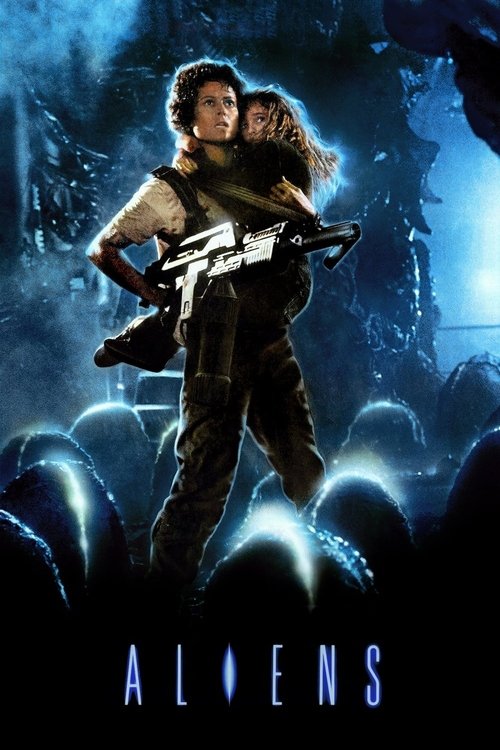
The year is 2179, and the date is June 8. Deep in the void of space, a deep-space salvage crew aboard a vessel orbiting Earth discovers a small escape shuttle drifting silently among the stars. Inside, Ellen Ripley--Lieutenant Ellen Ripley, sole survivor of the Nostromo's doomed voyage--floats in stasis, her body preserved for 57 years after the events that claimed her crew and left her adrift in the cold, endless dark. The salvage team revives her, and Ripley awakens in a sterile medical bay on Gateway Station, her mind fogged with confusion and trauma. She gasps, disoriented, her body trembling as she tries to piece together the nightmare that has haunted her for decades.
She is debriefed by Weyland-Yutani Corporation executives, led by the smooth-talking Carter Burke. He listens with polite skepticism as Ripley recounts the horrors she faced--the derelict ship, the alien eggs, the facehugger, the creature that burst from Kane's chest, the relentless predator that stalked her crew. Burke dismisses her story as the ravings of a traumatized survivor, but Ripley's eyes burn with conviction. She knows what she saw. She knows what is out there.
Burke reveals that a terraforming colony, Hadley's Hope, has been established on LV-426--the very moon where the Nostromo first encountered the alien eggs. Ripley is stunned. She warns Burke that the eggs are still there, that the threat is real, but he brushes her off. "We've lost contact with the colony," he says, his voice calm but calculating. "We need someone who knows what we're dealing with."
Ripley refuses at first, haunted by recurring nightmares of the creature. But Burke presses her, promising that if she goes, the company will destroy the aliens, not capture them. Reluctantly, Ripley agrees. She boards the USS Sulaco, a massive military transport ship, and is introduced to the Colonial Marines assigned to the mission. Corporal Dwayne Hicks, a calm and competent leader, greets her with quiet respect. Private William Hudson, a nervous and talkative marine, jokes about the mission, trying to mask his fear. Private Vasquez, tough and unyielding, watches Ripley with a mix of curiosity and suspicion. Sergeant Apone barks orders, keeping the team in line. And then there is Bishop, an android with a gentle demeanor, assigned to assist the mission. Ripley is immediately hostile toward him, her trust shattered by her previous encounter with the traitorous android Ash aboard the Nostromo.
The Sulaco sets course for LV-426, Ripley's mind racing with dread. She knows what awaits them, but the marines are confident, armed with the latest weaponry and technology. They believe they can handle anything. Ripley knows better.
The dropship descends to the surface of LV-426, landing near the abandoned colony of Hadley's Hope. The marines deploy, their weapons at the ready, Ripley following close behind. The colony is eerily silent, its buildings battle-damaged and deserted. The air is thick with tension as they move through the corridors, their flashlights cutting through the darkness. They find two live alien facehuggers in containment tanks, a chilling reminder of the threat that lurks in the shadows.
As they search the colony, they discover a traumatized young girl hiding in the air ducts. Her name is Rebecca Jorden, but everyone calls her Newt. She is the sole surviving colonist, her eyes wide with fear, her body trembling. Ripley takes her under her wing, a maternal instinct awakening within her. Newt clings to Ripley, her small hand gripping Ripley's jacket as they move through the colony.
The marines locate the signals of the missing colonists beneath the fusion-powered atmosphere processing station. They descend into the station, their flashlights illuminating corridors covered in alien secretions. The air is thick with the stench of decay, the walls slick with a strange, organic substance. They find the colonists cocooned, their bodies serving as incubators for alien embryos. The horror is palpable, the marines' bravado fading as they realize the true extent of the threat.
When the marines kill a newborn alien after it bursts through a colonist's chest, the hive is roused. The aliens ambush the marines, their movements swift and deadly. The marines fight back, their weapons blazing, but the aliens are relentless. Private Gorman, the inexperienced leader, panics, his commands faltering. Ripley takes charge, her instincts honed by her previous encounter. She orders the marines to fall back, to regroup, but the aliens are everywhere.
The marines barricade themselves inside the colony, their numbers dwindling. Ripley discovers Burke's betrayal--Burke had secretly ordered the colonists to investigate the derelict spaceship containing the alien eggs, intending to profit by recovering them for biological weapon research. Ripley confronts Burke, her voice cold with fury. "You sent them to their deaths," she says, her eyes blazing. Burke tries to justify his actions, but Ripley threatens to expose him. Before she can, Bishop interrupts, his voice urgent. "The power plant was damaged during the battle," he says. "It will soon detonate with the force of a 40-megaton thermonuclear weapon."
The marines scramble to evacuate, but the power is suddenly cut. The aliens attack through the ceiling, their movements swift and deadly. Vasquez and Gorman are killed, their bodies torn apart by the creatures. Hudson is subdued, his body limp as the aliens drag him away. Burke tries to escape, but the alien queen catches him, her massive form towering over him. He screams as she impales him, his body lifeless as she drops him to the ground.
Ripley and an injured Hicks reach Bishop in the second dropship, but Ripley refuses to abandon Newt. She arms herself with a pulse rifle and descends alone into the hive in the processing station. The air is thick with the stench of decay, the walls slick with alien secretions. She moves through the corridors, her heart pounding, her breath coming in short gasps. She finds Newt cocooned in the hive, her small body trembling with fear. Ripley frees her, her hands gentle but firm.
As they move through the hive, they encounter the alien queen in her egg chamber. The queen is massive, her body towering over them, her eyes burning with malice. Ripley and Newt flee, their footsteps echoing through the corridors. They reach the dropship, where Bishop and Hicks are waiting. The marines set the colony's nuclear reactor to detonate, the countdown ticking away.
Ripley, Newt, Hicks, and Bishop board the dropship and escape just as the colony is destroyed in a nuclear explosion. The force of the blast consumes the colony, the alien hive, and everything within. The survivors believe they are safe, but the queen alien has stowed away on board the Sulaco, hidden in the dropship's landing gear.
Back on the Sulaco, the group is ambushed by the queen. She tears Bishop in half, his body limp as he falls to the floor. Newt screams, her voice echoing through the ship. Ripley fights back, her pulse rifle blazing, but the queen is too strong. She dons a mechanized exosuit, the power loader, and engages the queen in a climactic battle. The suit's arms clash with the queen's claws, the air filled with the sound of metal and flesh. Ripley manages to grab the queen and expel her through an airlock into space, the creature's body tumbling into the void.
The damaged Bishop keeps Newt safe, his body broken but functional. Ripley, Newt, Hicks, and Bishop enter hypersleep for their return trip to Earth, their bodies weary but alive. The ship drifts through the stars, the survivors hopeful but wary of future threats.
The film ends with Ripley, Newt, Hicks, and Bishop in hypersleep, their journey far from over. The threat of the aliens looms, a shadow that will follow them into the future.



What is the ending?
At the end of the movie "Aliens," Ripley confronts the Alien Queen in a climactic battle, ultimately defeating her and rescuing Newt. They escape the exploding colony on the spaceship Sulaco, and Ripley, Newt, Hicks, and Bishop are the only survivors. Ripley falls into a deep sleep, reflecting on the harrowing events.
As the final act of "Aliens" unfolds, the tension escalates aboard the Sulaco. Ripley, having just witnessed the devastation wrought by the xenomorphs, is determined to save Newt, who has been captured by the Alien Queen. The scene is set in the dark, industrial confines of the colony, where the atmosphere is thick with dread and urgency.
Ripley, clad in a power loader, a mechanical exoskeleton designed for heavy lifting, approaches the Alien Queen's lair. The Queen, a massive, terrifying creature, looms over Newt, who is trapped in a cocoon. Ripley's heart races, her determination fueled by maternal instincts and a fierce desire to protect the young girl. The power loader's mechanical arms clank and whir as Ripley maneuvers it, showcasing her resolve and strength.
The confrontation is intense. Ripley shouts, "Get away from her, you b****!" as she engages the Queen in a fierce battle. The power loader's movements are fluid yet powerful, a stark contrast to the grotesque, fluid motions of the Alien Queen. The two titans clash, Ripley using the loader to grapple with the Queen, who retaliates with ferocity. The scene is a visual spectacle of light and shadow, punctuated by the sounds of metal grinding and the Queen's screeches.
As the fight escalates, Ripley manages to gain the upper hand. She uses the loader to pin the Queen against the wall, and with a swift motion, she ejects her into the airlock. The Queen's screeches echo as she is sucked into the void of space, a moment of triumph for Ripley, who has faced her fears and emerged victorious.
With the immediate threat neutralized, Ripley rushes to Newt, who is terrified but unharmed. Their reunion is emotional, filled with relief and the bond of survival. They quickly make their way to the dropship, where Hicks, who has been injured but is still alive, awaits. The camaraderie between Ripley, Hicks, and Newt is palpable, a moment of unity forged in the fires of battle.
As they escape the colony, the self-destruct sequence initiates, and the tension mounts. The countdown echoes ominously, urging them to hurry. They board the dropship, and Bishop, the android, assists in piloting them away from the impending explosion. The visuals of the colony erupting in flames behind them serve as a stark reminder of the horrors they have faced.
In the final moments, as they drift into space, Ripley, Hicks, Newt, and Bishop reflect on their harrowing journey. Ripley, exhausted yet resolute, falls into a deep sleep, her face a mixture of relief and lingering trauma. The camera lingers on her, capturing the weight of her experiences and the uncertainty of what lies ahead.
The fate of each character is sealed in this moment. Ripley, the fierce protector, has triumphed but carries the scars of her battle. Newt, the innocent child, has found safety but will forever be marked by her experiences. Hicks, the soldier, has survived but is left with the burden of loss and trauma. Bishop, the synthetic being, has proven his loyalty and humanity, even in the face of danger.
As the screen fades to black, the audience is left with the haunting echoes of their journey, a testament to survival, sacrifice, and the enduring fight against overwhelming odds.
Is there a post-credit scene?
The movie "Aliens," produced in 1986, does not have a post-credit scene. The film concludes with a powerful and emotional ending, focusing on Ripley and her companions after their harrowing experience on the alien-infested colony. The credits roll without any additional scenes or content following them. The film wraps up the story of Ripley, her battle against the Xenomorphs, and her deep-seated trauma, leaving the audience with a sense of closure regarding her journey.
What happens to Ripley after she is rescued from space?
After being rescued from space, Ellen Ripley is brought back to Earth and undergoes debriefing. She learns that 57 years have passed since the events of the first film. Ripley struggles with the trauma of her past experiences and is haunted by nightmares of the alien creature. She is also faced with disbelief from the corporate representatives of Weyland-Yutani, who are skeptical of her warnings about the alien threat.
How does Ripley end up leading the mission to LV-426?
Ripley is initially reluctant to return to space, but after a colony on LV-426 goes silent, the company persuades her to join a military mission to investigate. They believe her experience with the alien makes her an invaluable asset. Ripley is motivated by a desire to confront her fears and protect others from the threat she knows all too well.
What is the significance of Newt in Ripley's journey?
Newt, a young girl who survives the alien attack on the colony, becomes a pivotal character for Ripley. Ripley forms a protective bond with Newt, seeing her as a surrogate daughter. This relationship drives Ripley's actions throughout the film, as she is determined to save Newt from the aliens, which also helps her confront her own maternal instincts and trauma.
How does the character of Bishop differ from the android Ash in the first film?
Bishop, portrayed by Lance Henriksen, is a synthetic character who contrasts sharply with Ash from the first film. While Ash was programmed to prioritize the alien's survival over the crew's, Bishop is designed with a more ethical framework, showing empathy and a desire to protect the human crew. His character development includes moments of vulnerability, especially when he risks himself to help Ripley and the others.
What is the role of the Colonial Marines in the story?
The Colonial Marines are a heavily armed military unit sent to LV-426 to investigate the loss of contact with the colony. Their role is crucial as they represent humanity's attempt to confront the alien threat with force. However, their overconfidence and underestimation of the aliens lead to disastrous consequences, highlighting themes of hubris and the unpredictability of the alien species.
Is this family friendly?
"Aliens," produced in 1986, is not considered family-friendly due to its intense themes and graphic content. Here are some potentially objectionable or upsetting aspects:
-
Violence and Gore: The film features numerous scenes of intense violence, including graphic depictions of alien attacks, human casualties, and bloodshed.
-
Alien Creatures: The xenomorphs, or aliens, are frightening and grotesque in appearance, which may be disturbing for younger viewers. Their predatory behavior and the way they attack can be quite intense.
-
Suspense and Tension: The film is filled with suspenseful moments that create a sense of dread and fear, which may be overwhelming for sensitive viewers.
-
Death and Loss: Characters face significant danger, and there are emotional scenes involving the loss of life, which can be distressing.
-
Parental Figures in Peril: The character of Ripley, who is a mother figure to Newt, faces extreme danger, and the relationship dynamics can evoke strong emotional responses related to fear and protection.
-
Strong Language: The film contains instances of strong language that may not be suitable for children.
These elements contribute to the film's rating and overall tone, making it more appropriate for mature audiences.








