
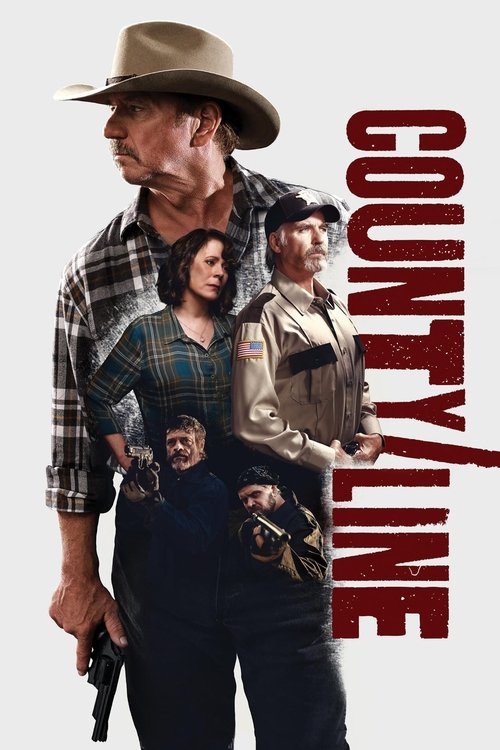









Popular
What motivates Sheriff Alden Rockwell to investigate the murder in County Line?
How does the relationship between Sheriff Rockwell and his deputy evolve throughout the film?
What role does the local community play in the investigation of the murder?
What are the key obstacles Sheriff Rockwell faces while solving the murder case?
How does the backstory of the victim influence the investigation?
Should I watch it?
Ask Your Own Question

What is the plot?
County Line opens in the aftermath of loss, and it wastes no time making Alden Rockwell's life feel like it has already been stripped down to almost nothing. He is a former sheriff in Maksville County, a man who has lost his bid for re-election, been pushed into retirement, and is still trying to function after the recent death of his wife. He now lives quietly on his farm, tending to chickens and pigs, trying to fill his days with routine because routine is all that is left to him. His daughter is away in service to her country, which leaves him even more alone, and the film frames him from the start as a man surrounded by absence rather than comfort.
That fragile stillness breaks when the other major anchor in his life, his best friend and neighboring sheriff Clint Thorne, is caught up in a violent attack. Clint is not just a colleague but Alden's longtime "brother in blue," the sheriff from the adjacent county and a man who, like Alden, understands the burdens of enforcing the law in a small town where everyone knows everyone else. The attack happens at a local dirt track, where Clint, who also races cars on the regional circuit, is letting off steam when a sniper takes a shot at him. The moment is sudden and ugly: a public place becomes a kill zone, and the ordinary noise of local life is shattered by gunfire. Clint is left gravely wounded and sent to the hospital, and the shooting immediately turns into the central mystery of the film.
The emotional blow hits Alden almost at once. Clint's wife, Jordan Thorne, refuses to let the case disappear into bureaucratic fog and pressures Alden to look into it himself. That demand matters because the official system is already failing. Sheriff Preston, Alden's replacement, opens an investigation after the shooting, but the inquiry goes nowhere and eventually turns cold, with the implication that Preston is either incompetent or deliberately looking away. Alden, who has already spent a year losing the people who define his life, cannot accept that the shooting of his best friend will be filed away as an unsolved incident. He moves from grief into resolve, and the film quietly transforms him from retired lawman into an unofficial investigator.
Alden begins where he always has: by reading the world around him, listening, noticing what does not fit. The sources describe "overlooked evidence," "shady goings on," and "enemies in disguise as allies," and those phrases fit the way the story unfolds. Alden is no longer protected by a badge, but he still has the instincts of a sheriff, and he starts pulling at threads others have ignored. What initially looks like a single shooting begins to feel like a symptom of something larger, uglier, and more coordinated. The film makes clear that this is not just a personal grudge or a random act of violence. It is part of a criminal conspiracy stretching across county lines, a hidden network of corruption linking people who should be separated by law, duty, and jurisdiction.
That title, County Line, takes on more meaning as Alden digs deeper. The boundary is not merely geographic; it becomes the place where responsibility is blurred and guilt can hide. The investigation forces Alden across the invisible and literal borders between counties, where alliances are uncertain and authority can be manipulated. As he probes further, he finds that the official investigation has stalled precisely because the truth is inconvenient to the people in power. Sheriff Preston's conduct becomes increasingly suspect, and the film uses that suspicion to sharpen Alden's isolation. He has no badge now, no office to lean on, and no institutional support. The law is supposed to protect the truth, but in this story the law itself may be part of the problem.
The emotional center remains Alden's relationship to Clint, whose shooting becomes both the catalyst and the emotional wound that drives every scene. Clint is not simply "shot"; the attack is framed as an assassination attempt, the sort of deliberate, planned violence that tells Alden someone wanted his friend silenced. In some accounts, Clint survives long enough to be hospitalized, while other summaries and later descriptions emphasize that he ultimately dies. The clearest reading of the film's ending is that Clint's condition worsens and he eventually dies, making the mystery even more personal for Alden and ensuring that the investigation is no longer just about justice but about grief, rage, and responsibility.
As Alden follows the trail, he is forced to navigate a town full of possible liars. The film presents a web of suspects rather than a clean lineup of villains. Local figures appear helpful while hiding something. The sources mention a mysterious teenager whom Alden encounters, someone who may or may not be connected to a graffiti-style calling card left behind by the perpetrators. That detail matters because it suggests the conspiracy is not only hidden but performative, with signs and symbols meant to intimidate, mislead, or mark territory. Alden's inquiry becomes more dangerous the more he learns, because every new conversation seems to open another door into a larger criminal structure.
One of the movie's strengths is the way it places Alden in spaces that feel ordinary until they become charged with threat. His farm is quiet and solitary, the kind of place where a man can hear his own grief. The dirt track is loud and communal, then instantly deadly. The town itself, including diners and other public spaces, becomes a place where information circulates in fragments and where the truth is always half-hidden behind side glances and evasive answers. The film keeps tension alive by making every social interaction feel like a test. Alden is no longer speaking as a sheriff with authority; he is asking questions as a private citizen, and that makes every answer harder to get.
The deeper he goes, the more the investigation confirms that the shooting is tied to corruption rather than chance. The sources consistently point to "shady dealings," "potential corruption," and a "deadly web of corruption" spreading through two counties. Alden realizes that the people who should have been helping him have every reason not to. Sheriff Preston's refusal to pursue the case properly leaves Alden with no choice but to become what he was never meant to be again: a lone truth-seeker working outside the system. The movie's tension comes from that contradiction. He is retired, but not finished. He is out of office, but not out of patience. He has lost nearly everything, but the loss of Clint is the one thing he cannot absorb and move past.
Jordan Thorne's role keeps the plot emotionally grounded. She is not a passive grieving widow; she is a force pushing the story forward, insisting that someone fight for the truth about her husband's shooting. Her urgency keeps Alden moving when despair might otherwise slow him down. She also embodies the film's practical outrage: if the authorities will not act, then someone must. Through her, the story frames justice not as a luxury but as a necessity for people left behind by a broken system.
As Alden gathers enough evidence to understand that the conspiracy reaches beyond one county, the stakes rise from personal vendetta to civic rot. The crimes are no longer random incidents but coordinated acts designed to protect a broader criminal enterprise. The sources do not identify every member of that enterprise, and the film seems to preserve some mystery around the exact hierarchy, but it is clear that the corruption is systemic enough to enlist both public officials and criminal actors. That ambiguity makes the final stretch more suspenseful, because Alden cannot simply arrest one man and assume the job is done. He has to force the entire structure into the open.
The confrontation toward the end is built around the dirt track and the same world where the attack on Clint begins. Alden's hunt drives him back into the orbit of the people responsible, and the film brings the hidden network into direct contact with the man who has been shadowing it alone. By this point, the investigation has transformed from procedural effort into open confrontation. Alden is no longer just asking questions; he is confronting the machinery behind the attack and refusing to let the matter remain buried.
The climax culminates in violence, and the last major turn belongs to Clint Thorne's widow, whose grief becomes action. In the version of the ending described by one of the available summaries, Clint is ultimately killed, Alden tracks the criminal group to the racing venue, and the decisive moment comes when Clint's widow shoots the culprit dead. That final act shifts the moral weight of the film. The law may have failed, the investigation may have stalled, and the system may have tried to bury the truth, but the wound at the center of the story is answered by someone who has lost too much to wait for process. The unnamed killer is stopped there, in the decisive confrontation, and the criminal group tied to the local authorities is broken apart and exposed publicly.
The ending also resolves Alden's personal arc. The retired sheriff, who began the film isolated on his farm and surrounded by loss, is pulled back into purpose. One account says that he is reinstated and later video-chats with his daughter, who is serving away from home, while smiling with renewed resolve. Whether the film presents that restoration as a formal return to duty or a symbolic reclamation of identity, the point is the same: Alden is no longer simply a grieving widower drifting through retirement. He has found a way to turn loss into action and to force a response from a town that had begun to accept silence as normal.
The most important deaths in the story are Alden's wife before the main plot and Clint Thorne during or after the shooting fallout, with Clint's fate serving as the central tragedy that drives the narrative. Alden survives, as does Jordan Thorne, who becomes crucial to the final reckoning by directly killing the man responsible in the climactic moment described in the available summary. Sheriff Preston does not emerge as a redeemed figure; instead, the investigation under his watch is depicted as ineffectual at best and compromised at worst, leaving him associated with the cover-up rather than the solution. The film closes on the sense that the corruption has been exposed, the immediate criminal network has been shattered, and Alden's long retreat from life has ended in a hard-earned return to purpose.
What lingers after the violence is not triumph in a clean sense, but a battered kind of closure. Alden has lost his wife, his job, and his friend, and the film never pretends those losses are reversible. Yet by refusing to let Clint's shooting be swallowed by official indifference, he restores a measure of meaning to a world that has spent much of the running time trying to take meaning away. The final image of him reconnecting with his daughter suggests that the story ends not with peace, but with enough truth and survival to begin again.




What is the ending?
In the ending of "County Line," Sheriff Tom Hatcher confronts the corrupt forces behind the drug trade in his community. After a tense showdown, he manages to bring justice to his town, but not without personal sacrifice. The film concludes with a sense of resolution as Tom reflects on the cost of his fight against crime, while the community begins to heal.
As the final act unfolds, the tension escalates. Sheriff Tom Hatcher, portrayed by the determined and rugged actor, finds himself at a critical juncture. The stakes are high as he has been investigating a drug operation that has infiltrated his small town, leading to violence and corruption. The emotional weight of his responsibility hangs heavily on him, as he grapples with the loss of his friend and the impact of crime on his community.
In a pivotal scene, Tom receives a tip-off about a meeting between the drug dealers and corrupt officials. He gathers his trusted deputy, who has been a loyal ally throughout the investigation. Together, they prepare for a confrontation that could either bring down the drug ring or put their lives in jeopardy. The atmosphere is thick with tension as they approach the location, a secluded warehouse on the outskirts of town.
As they arrive, the scene is set with dim lighting and the sounds of muffled voices. Tom and his deputy stealthily navigate through the shadows, their hearts racing with adrenaline. They overhear a conversation that reveals the extent of the corruption, implicating not only local criminals but also influential figures in the community. The weight of betrayal sinks in for Tom, who realizes that the fight is not just against the drug dealers but against a system that has failed the people.
The confrontation erupts into chaos when they are discovered. A fierce gunfight ensues, showcasing Tom's bravery and determination to protect his town. The camera captures the intensity of the moment, with bullets flying and the sound of gunfire echoing through the night. Tom's internal struggle is palpable; he is fighting not just for justice but for the memory of his fallen friend and the safety of his community.
In the climax, Tom faces off against the main antagonist, a ruthless drug lord who has been orchestrating the chaos. The showdown is intense, filled with emotional stakes as Tom confronts the man who has caused so much pain. In a moment of desperation, Tom manages to outsmart the drug lord, leading to his arrest. The relief is evident on Tom's face, but it is tempered by the realization of the toll this battle has taken on him and those he loves.
As the dust settles, the community begins to rally around Tom. The final scenes depict a town coming together, slowly healing from the scars of violence and corruption. Tom stands at the center, a symbol of resilience and hope. However, the emotional weight of his journey is clear; he has lost friends and faced unimaginable challenges. The film closes with Tom reflecting on the cost of his fight, hinting at the ongoing struggle against crime and the importance of community solidarity.
In the aftermath, Tom's deputy remains by his side, committed to rebuilding their town. The film leaves viewers with a sense of cautious optimism, as the characters begin to envision a future free from the shadows of crime, yet aware of the challenges that lie ahead. The fate of each character is intertwined with the community's journey toward healing, emphasizing the film's themes of sacrifice, justice, and the enduring strength of human connection.
Is there a post-credit scene?
In the movie "County Line," there is no post-credit scene. The film concludes without any additional scenes or content after the credits roll. The story wraps up with the resolution of the main conflict, focusing on the characters' emotional journeys and the consequences of their actions throughout the film. The absence of a post-credit scene allows the audience to reflect on the themes of justice, loyalty, and the personal struggles faced by the characters.
What motivates Sheriff Alden Rockwell to investigate the murder in County Line?
Sheriff Alden Rockwell is driven by a deep sense of duty and loyalty to his community, as well as a personal connection to the victim, which compels him to seek justice. His emotional state is marked by a mix of determination and frustration as he navigates the complexities of the case.
How does the relationship between Sheriff Rockwell and his deputy evolve throughout the film?
The relationship between Sheriff Rockwell and his deputy, who is initially portrayed as inexperienced, evolves as they face the challenges of the investigation together. Rockwell's mentorship and the deputy's growth create a dynamic of trust and camaraderie, highlighting their shared commitment to solving the case.
What role does the local community play in the investigation of the murder?
The local community plays a significant role in the investigation, as their reactions range from support to suspicion. The tension between the sheriff's office and the townspeople reflects the complexities of small-town dynamics, with some residents providing crucial information while others remain tight-lipped due to fear or loyalty.
What are the key obstacles Sheriff Rockwell faces while solving the murder case?
Sheriff Rockwell faces several key obstacles, including a lack of cooperation from certain community members, the presence of external threats, and the emotional toll of the investigation on himself and his family. These challenges test his resolve and force him to confront his own vulnerabilities.
How does the backstory of the victim influence the investigation?
The backstory of the victim reveals connections to both the sheriff and the community, adding layers of complexity to the investigation. As Rockwell uncovers details about the victim's life, it influences his approach to the case and deepens his emotional investment in seeking justice.
Is this family friendly?
"County Line," produced in 2017, is a crime drama that contains several elements that may not be suitable for children or sensitive viewers. Here are some potentially objectionable or upsetting aspects:
-
Violence: The film includes scenes of gun violence and confrontations that may be intense and graphic, depicting the harsh realities of crime and law enforcement.
-
Death: There are themes surrounding murder and loss, which can be emotionally heavy and distressing, particularly for younger audiences.
-
Drug-related content: The narrative involves drug trafficking and the associated dangers, which may be unsettling for some viewers.
-
Mature themes: The film explores themes of betrayal, corruption, and moral ambiguity, which may be complex and difficult for children to understand.
-
Emotional distress: Characters experience significant emotional turmoil, including grief and anger, which could be upsetting for sensitive viewers.
Overall, the film's mature themes and violent content suggest it may not be appropriate for a family-friendly viewing experience.







