





Popular
What motivates Etgar Keret to write stories throughout the film?
How does the relationship between Etgar and his father influence the narrative?
What role does the character of Shira play in Etgar's life?
How does the film depict the theme of storytelling through Etgar's interactions with other characters?
What specific events in Etgar's life inspire the stories he writes in the film?
Should I watch it?
Ask Your Own Question

What is the plot?
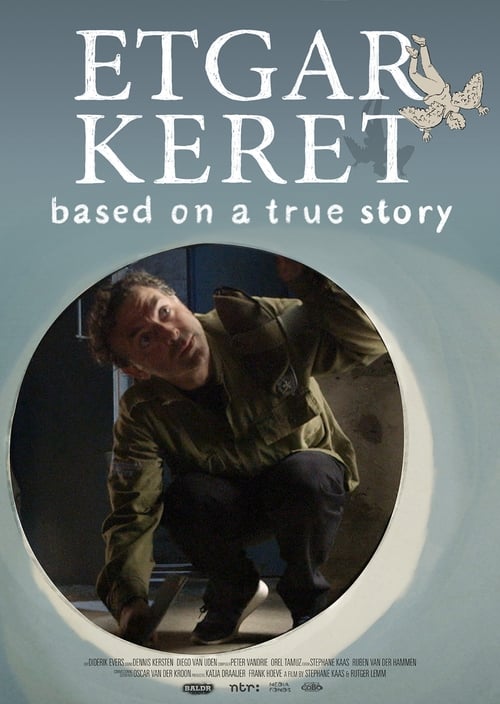
The film begins with a joke that is also a warning: Stephane Kaas and Rutger Lemm, the two Dutch filmmakers, arrive at an Israeli border checkpoint and are grilled by security about who they are, why they are there, and why they want to film Etgar Keret. The scene is staged, but it feels unnervingly real, and that is exactly the point. The officers' questions about purpose, identity, and loyalty immediately establish the film's central game: every answer can be doubted, every fact can be bent, and every truth must pass through suspicion before it can exist. Kaas and Lemm explain that they are making a documentary about Keret, but even this explanation is presented with a sly wink, as if the movie itself is testing whether it can survive its own premise.
Once they are allowed through, the film shifts into Tel Aviv and into Etgar Keret's world, where the everyday and the impossible coexist without apology. Keret is introduced not as a solemn literary figure but as a man whose mind seems permanently tilted toward the absurd. His stories are short, sharp, funny, and full of surreal turns, yet the film quickly reveals that this style is not decorative. It is an emotional strategy. Keret's life, the documentary suggests, has been shaped by shock, grief, guilt, and the constant pressure of living in a place where death and unpredictability are never far away. The filmmakers visit him at home, follow him through his domestic spaces, and sit with him as he speaks about writing, memory, and the way fiction can hold contradictions that real life cannot.
The first major story the film uses to unlock Keret's inner life is "Fatso," one of the tales that Kaas especially loves. As he recounts it, the film animates the story in stop-motion, making its bizarre emotional logic feel intimate and oddly tender. In "Fatso," a man discovers that his girlfriend transforms at night into a hairy, obese male figure named Fatso. Instead of recoiling forever, he gradually accepts this impossible double life, spending the daylight hours with the woman he loves and the nights with Fatso, who becomes a loyal companion. The story is funny, but the documentary turns it into something more revealing when Keret explains its origin. He wrote it around the time he first met his wife, Shira Geffen, and was dividing his emotional life between her and his best friend Uzi. The film makes clear that "Fatso" is not a random fantasy; it is Keret's way of translating emotional triangulation into myth. Shira Geffen is present as a creative, grounded, affectionate figure, while Uzi emerges as the friend whose bond with Keret is intense enough to become a source of loyalty, jealousy, and guilt. The story's absurd nighttime companion becomes a symbolic stand-in for the part of friendship that cannot be integrated neatly into romantic life.
That revelation gives the film its first real emotional hinge: behind every strange image is a personal pressure, and behind every joke is a wound. The documentary keeps circling back to this idea, deepening it through Keret's explanation of where he began as a writer. The central trauma is his army service and the suicide of his friend Oren, the event the film treats as the true beginning of his literary life. Oren dies by suicide during their time in the army, and the documentary frames this death as the moment Keret is forced into storytelling as survival. The loss is not presented as a neat origin myth; it lands like a rupture that permanently changes the shape of his imagination. In some accounts within the film, Oren's death is described as happening in the army setting they shared, and in every version the emotional meaning is the same: Keret is left with a grief so unbearable that fiction becomes the only available response.
From that trauma comes "Pipes," the first story Keret writes, and the film gives it a full animated treatment that turns metaphor into visible terrain. In the story, a man works in a pipeline factory and begins by making simple pipes for marbles. He grows fascinated by the system, then by what it means when the marbles stop coming out the other end. The pipe becomes a symbol for passage, transformation, and disappearance. The man keeps enlarging the structure until he can crawl inside it himself, and Keret's voice-over explains the desperate, liberating logic behind the act: "I decided to make myself a bigger pipe, in the same shape, and to crawl into it until I disappeared." The line is devastating precisely because it is so calm. It captures the yearning to vanish, but the film does not leave it there. As the man disappears into the pipe, the animated world opens into a strange afterlife where he finds the lost marbles and a host of figures who have slipped beyond ordinary existence--pilots who vanished into the Bermuda Triangle, unhappy housewives, mathematicians squeezed through spatial distortions. At the end of the sequence, the man is effectively in heaven, haloed and transformed, and the story's fantasy becomes a way of making death bearable without denying it. The film's emotional logic is that Keret writes not to escape pain but to reshape it into something survivable.
As the documentary moves between interviews, travel, and animated insertions, it repeatedly reminds the viewer that Keret's life itself feels constructed like one of his stories: full of unlikely coincidences, clipped exchanges, and sudden emotional reversals. The filmmakers move through Israel with him, but they also travel outward, to New York and other international settings, where Keret's reputation as a global literary figure is affirmed by admirers and colleagues. Writers and broadcasters such as Jonathan Franzen and Ira Glass appear to discuss him, and their presence does more than praise his work. It shows how far his blend of autobiography, invention, and absurdity travels across cultures. Yet even in these more polished interview moments, the film never lets go of its favorite tension: the question of what is real and what is performance.
That tension becomes explicit in the scenes involving Uzi, Keret's fiercely protective best friend. Uzi is not merely a supporting character; he functions almost like a guardian spirit with a temper. The film describes him as so loyal to Keret that when a New York Times fact-checker challenges Keret's claims, Uzi threatens the person. The moment is played with a mix of humor and menace, and it serves as one of the documentary's sharpest confrontations. It is not a physical fight, but it is a battle over narrative authority. The fact-checker wants precision, verification, and clean distinctions between truth and invention. Uzi responds as if he is defending a loved one from an attack. The outcome is clear: Keret's world is one in which emotional truth matters more than institutional certainty, and anyone who tries to flatten that world into simple fact risks becoming part of the absurdity themselves.
The border checkpoint frame returns in memory throughout the film because it perfectly mirrors all these later confrontations. The security officers' questions at the beginning are less about safety than about motive, identity, and legitimacy, and the filmmakers' answers always seem slightly inadequate in the face of the state's suspicion. The checkpoint is a kind of miniature version of the entire documentary: a place where storytelling is interrogated by power, and where one must explain oneself under pressure. By opening there, the film makes every later discussion about Keret's fiction feel like another customs inspection at the border between truth and imagination.
As the film goes deeper into Keret's past, the recurring revelation is that his stories are not invented in the ordinary sense; they are emotionally discovered. "Fatso" is tied to the conflict between wife and friend. "Pipes" is tied to suicide and the wish to disappear. Other anecdotes about Keret's life, his family, and his friends continue the pattern. He is portrayed as someone whose fiction does not hide reality but distills it into a form that can be felt more sharply. The documentary repeatedly emphasizes that his stories are rooted in lived experience, but the stories exaggerate, twist, and deform that experience so it can speak a larger emotional truth. This is why the film's title matters so much. "Based on a True Story" is both a promise and a joke. The movie insists that it is telling the truth about Keret by admitting, from the start, that truth here is slippery.
One of the strongest emotional currents in the film is the way it ties Keret's writing to the question of why he chooses life. After Oren's suicide, storytelling becomes, in the film's own phrasing, almost compulsive--an endless stream of answers to a question that can never be fully answered. That question is not just why Oren died, but why Keret did not. Why go on? Why make stories instead of surrendering to the same pull? The documentary does not reduce this to therapy or cliché. Instead, it shows how imagination can function as resistance. Keret's stories are absurd because absurdity is the only adequate form for some kinds of pain. They are funny because humor can create distance from horror without erasing it. They are fantastical because reality itself, in the shadow of loss, often feels unreal.
The film's structure mirrors this philosophy by refusing a clean line between documentary and fiction. The travel footage, the interviews, the staged opening, and the animated stories all bleed into each other. The directors are not invisible observers; they are characters in the film, and their presence constantly reminds the viewer that even a documentary is a constructed narrative. That awareness does not weaken the emotional effect. It strengthens it. By the time the movie reaches its later passages, the viewer understands that the real subject is not simply Etgar Keret the person, but the act of turning pain into form. Every playful shift in style becomes part of that argument.
As the climax approaches, the film does not build toward a single explosive revelation. Instead, it accumulates meaning until the pattern becomes undeniable. Oren's suicide remains the central death, the foundational wound, and everything else radiates from it. The animated afterlife of "Pipes" now feels less like whimsy than an attempt to imagine a world in which disappearance leads somewhere other than blankness. "Fatso" feels less like a comic conceit than a map of divided attachment. The border scene feels less like an opening prank than a thesis about the need to justify one's story to skeptical gatekeepers. The documentary's confrontations--between friends, between filmmakers and border agents, between Keret and fact-checkers, between memory and invention--resolve not by choosing one side but by acknowledging that the tension itself is the truth.
By the end, the film leaves no doubt about its emotional resolution. Etgar Keret's writing is shown as inseparable from survival. He is not merely someone who happened to become a writer after a tragedy; he is someone whose entire literary identity grows out of the need to answer trauma with invention. The final scenes do not offer a conventional ending with a single dramatic event. Instead, they gather the film's many threads--Oren's death, Shira Geffen's presence, Uzi's loyalty, the transfigured logic of "Pipes," the intimate weirdness of "Fatso," the border interrogation, the international interviews--into a single understanding: Keret lives in the space between fact and fantasy, and that space is where he remains alive.
The last impression is one of radical ambiguity made humane. The documentary finishes as it began, by insisting that identity can be tested but never fully contained. Etgar Keret is at once himself and the sum of the stories he tells about himself. The film's final effect is not to solve that contradiction but to honor it. What survives Oren's death is not clarity, but imagination. What survives the checkpoint is not certainty, but movement. What survives the pressure to choose between truth and invention is a body of work that turns grief into wonder and fear into narrative. The ending leaves the viewer with the sense that Keret's life, like his fiction, continues to hover between the real and the invented, and that this unstable border is exactly where his art lives.









What is the ending?
In the ending of "Etgar Keret: Based on a True Story," the film culminates in a poignant moment where Etgar reflects on his life and the stories he has told. He confronts the complexities of his relationships, particularly with his father and his wife, and ultimately finds a sense of acceptance and understanding. The film closes with a sense of hope, as Etgar embraces the power of storytelling as a means of connection and healing.
As the film approaches its conclusion, we find Etgar Keret in a state of introspection, grappling with the weight of his experiences and the narratives he has crafted throughout his life. The scenes unfold with a gentle yet profound rhythm, allowing the audience to witness the emotional landscape of his character.
In the first scene of the ending, Etgar sits alone in a dimly lit room, surrounded by scattered papers and books. The atmosphere is heavy with silence, punctuated only by the soft rustle of pages as he flips through his stories. His expression is one of contemplation, revealing a mixture of nostalgia and regret. He reflects on the stories that have shaped him, the characters he has created, and the real-life inspirations behind them.
Transitioning to the next scene, we see a flashback of Etgar's relationship with his father. The memories are vivid, filled with laughter and tension. They share moments of connection, but also instances of misunderstanding. This juxtaposition highlights the complexity of their bond. As Etgar recalls these moments, his face softens, indicating a growing acceptance of their relationship's imperfections.
The narrative then shifts to a scene with Etgar's wife, where they engage in a heartfelt conversation. The tension that has been building throughout the film comes to a head as they discuss their dreams, fears, and the stories they have yet to tell. Their dialogue is raw and honest, revealing the vulnerabilities that lie beneath the surface. Etgar's wife expresses her desire for him to embrace his creativity without fear, urging him to let go of the past and move forward.
In the final scene, Etgar stands before an audience, ready to share a new story. The stage is set, and the lights dim, creating an intimate atmosphere. As he begins to speak, his voice trembles with emotion, but there is a newfound confidence in his delivery. He weaves together the threads of his experiences, blending reality with fiction, and the audience is captivated. The story he tells is not just about his life but also about the universal themes of love, loss, and the power of storytelling.
As the film concludes, we see Etgar's face illuminated by the stage lights, a smile breaking through the earlier heaviness. The audience's applause fills the air, and in that moment, he realizes the importance of connection through stories. The film ends on a hopeful note, suggesting that while life is filled with complexities, the act of sharing our narratives can lead to understanding and healing.
In summary, the fates of the main characters are intertwined with the themes of acceptance and the transformative power of storytelling. Etgar finds peace with his past, his relationship with his father, and a deeper connection with his wife, ultimately embracing the stories that define him.
Is there a post-credit scene?
In the movie "Etgar Keret: Based on a True Story," there is no post-credit scene. The film concludes without any additional content after the credits roll. The focus remains on the narrative and themes explored throughout the film, centering on the life and work of the acclaimed Israeli author Etgar Keret, his unique storytelling style, and the interplay between reality and fiction in his life. The ending leaves viewers with a sense of reflection on the stories shared and the emotional journey experienced by both Keret and the audience.
What motivates Etgar Keret to write stories throughout the film?
Etgar Keret is driven by a deep need to express his thoughts and emotions through storytelling. His experiences, both personal and cultural, fuel his creativity, as he grapples with the complexities of life, love, and loss. The film showcases his internal struggles and the cathartic release he finds in writing.
How does the relationship between Etgar and his father influence the narrative?
The relationship between Etgar and his father is central to the narrative, highlighting themes of familial bonds and the impact of parental expectations. Etgar's father, a Holocaust survivor, instills in him a sense of resilience but also a burden of history. Their interactions reveal Etgar's desire for approval and understanding, which shapes his identity as a writer.
What role does the character of Shira play in Etgar's life?
Shira serves as a significant emotional anchor for Etgar, representing both love and the complexities of adult relationships. Her presence in the film illustrates the challenges of intimacy and communication, as Etgar navigates his feelings for her while also dealing with his own insecurities and fears about commitment.
How does the film depict the theme of storytelling through Etgar's interactions with other characters?
Throughout the film, Etgar's interactions with various characters, including friends and family, highlight the power of storytelling as a means of connection. Each character brings their own narrative, and through these exchanges, Etgar learns about different perspectives on life, which enriches his own storytelling and deepens his understanding of human experiences.
What specific events in Etgar's life inspire the stories he writes in the film?
The film illustrates several key events in Etgar's life that inspire his writing, including his childhood experiences in Israel, his relationship with his father, and his encounters with loss and love. These moments serve as the foundation for his stories, blending reality with fiction as he reflects on his past and the absurdities of life.
Is this family friendly?
"Etgar Keret: Based on a True Story" is a film that delves into the life and work of the Israeli author Etgar Keret, exploring themes of family, creativity, and the complexities of life. While the film is rich in storytelling and emotional depth, it does contain some elements that may not be suitable for children or sensitive viewers.
Potentially objectionable or upsetting aspects include:
-
Mature Themes: The film addresses themes of loss, existentialism, and the struggles of creativity, which may be difficult for younger audiences to fully grasp.
-
Emotional Turmoil: There are scenes depicting emotional distress, including moments of anxiety and sadness that reflect the characters' internal struggles.
-
Family Conflict: The film explores familial relationships that may involve tension or conflict, which could be unsettling for some viewers.
-
Dark Humor: Keret's storytelling often includes elements of dark humor that may not resonate well with all audiences, particularly younger viewers.
-
Surreal Imagery: Some scenes may contain surreal or abstract visuals that could be confusing or unsettling for children.
Overall, while the film is a poignant exploration of life and creativity, its themes and emotional depth may be more appropriate for older teens and adults.