





Popular
How does the Tokyo Dome performance open, and which song or visual sequence sets the tone for the concert film?
Which band member gets the most spotlight in the Tokyo Dome show, and how are the individual performers framed onstage?
What are the key song performances or standout stage moments in the middle of the concert?
How does the concert film show the crowd’s reaction during the biggest songs or transitions?
What visual or staging elements distinguish the Tokyo Dome show from smaller King Gnu performances?
Should I watch it?
Ask Your Own Question

What is the plot?
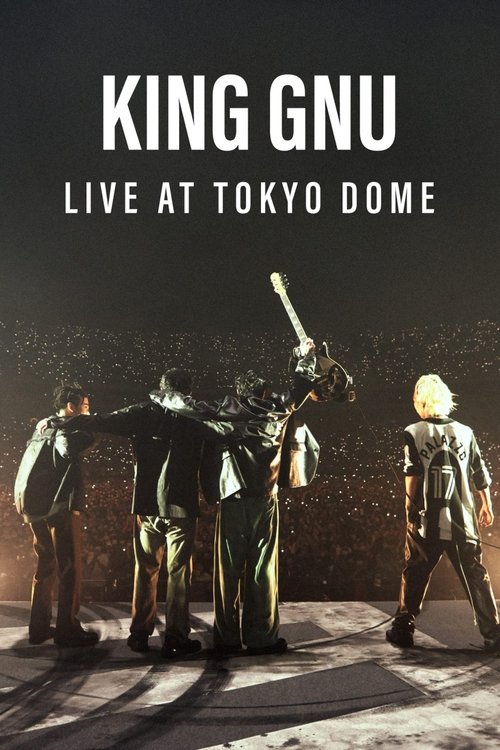
King Gnu Live at TOKYO DOME (2023) does not tell a fictional story with deaths, secrets, or plot twists; it is a concert film that documents King Gnu's first-ever performance at Tokyo Dome, the culmination of the band's first five years together, across a two-day run that draws nearly 100,000 fans and features 24 songs. Because the source material is a live music performance rather than a narrative drama, the "spoilers" are really the arc of the concert itself: arrival, anticipation, the eruption of the show, the emotional peaks, and the final release as the performance ends.
The film opens on the scale of the event itself. Tokyo Dome is not treated as a simple venue but as the destination the band has been building toward since their debut years, and the framing of the performance makes that clear from the start: this is King Gnu's first time on the Dome stage, a landmark moment that functions as a celebration of how far the band has come in five years. The crowd is enormous, the setting is electric, and the air around the venue carries the feeling of something historic rather than routine. The show is part of a two-day run, and the concert film preserves the sense that this is not just a gig but a summit, a public confirmation that King Gnu has reached the top tier of Japanese live music.
Before the music fully takes over, the film's emotional current is already apparent in the way the venue is presented. Tokyo Dome stands as an overwhelming physical space, and one source describing the Dome experience captures how huge and disorienting the environment feels, with fans navigating around the entire circumference of the building and through hidden passageways just to reach the entrance. That sense of scale matters because the concert film is built on contrast: the impersonal vastness of the Dome versus the tight, forceful intimacy of King Gnu's performance once the band starts playing. The audience is not merely watching a band on a big stage; they are witnessing a band occupying a space so large that it becomes a character in itself, amplifying every entrance, every chorus, and every surge of applause.
As the concert begins, King Gnu move into the show with the confidence of a group that understands the weight of the moment. The set is presented as a 24-song run that blends classic tracks with newer material, and the film's structure follows the natural rise and fall of a dome-scale performance rather than a scripted story. The opening numbers establish momentum immediately. Lights, sound, and crowd reaction lock together into a single atmosphere of anticipation being satisfied. The band does not need exposition; their presence is the revelation. The "plot," such as it is, is the culmination of a five-year ascent compressed into one stage and one night.
From there, the film builds its energy in waves. Songs are used as emotional chapters, each one changing the temperature inside the Dome. The performance alternates between explosive passages and moments where the crowd's roar becomes part of the arrangement. Because the available sources identify the concert as including both "classic and the latest hits," the film's journey works like a career-spanning statement: the audience is reminded of where the band started and shown how far they have come. That retrospective quality creates tension of a different kind from a narrative thriller. Instead of asking who will live or die, the concert asks whether the band can fill this space with enough force to justify the milestone. The answer, as the film presents it, is yes--again and again, song after song.
One of the concert's central pleasures is the way it turns collective memory into momentum. Every hit arriving in the setlist functions like a payoff, and each new track adds to the sense that the night is building toward something larger than any single song. The film's title makes the venue itself part of the drama: "Live at TOKYO DOME" is not a neutral location label but a declaration that the Dome performance is the event. The band's first appearance there is treated as a peak moment in its own right, and the audience's nearly 100,000 combined attendance across the two-day run underscores the scale of the achievement.
Visually, the concert film likely emphasizes the contrast between the band's precision and the arena's immensity, because that is the essence of a successful dome show. King Gnu are presented as commanding the room with sound, movement, and stagecraft, while the crowd responds in synchronized waves of enthusiasm. The film does not have the conventional beats of a story about conflict and resolution, but it does have escalation. Each song raises the stakes. Each chorus strengthens the emotional pitch. By the midpoint, the night no longer feels like a performance being watched from a distance; it feels like a shared event that the camera can barely contain.
If there are "confrontations" in this film, they are not between characters but between scale and intimacy, expectation and fulfillment, and the pressure of a first Tokyo Dome appearance versus the band's ability to dominate it. The outcome of each of those confrontations is visible in the audience response and in the sheer fact of the set continuing to intensify. King Gnu do not shrink under the size of the venue. They meet it head-on, song by song, and transform the Dome from a symbol of pressure into a stage of triumph. The tension does not come from danger; it comes from the possibility of transcendence, the question of whether a band can turn a milestone into a genuinely moving live experience. The film answers that question through performance rather than dialogue.
Because the available information does not describe a dramatic script, there are no character secrets to reveal and no hidden identities to expose. The important names here are the band itself, King Gnu, and the directors credited for the video release, Takuro Okubo and Takahiro Shimoyama. The documentary-style framing means the film's "revelations" are musical rather than narrative: the realization that the band has grown into a Dome-level act, that the repertoire can sustain a 24-song set, and that the audience's devotion is large enough to fill one of Japan's most famous venues. In other words, the reveal is not a plot twist but a confirmation of status.
As the show progresses into its later stretch, the atmosphere becomes increasingly celebratory. The film's momentum depends on the accumulation of sound and emotion: the early excitement of arriving, the mid-show confidence of familiarity, and then the late-set feeling that the band and audience are approaching a shared climax. The title song list is not fully broken down in the source materials, but the references to "classic and the latest hits" make clear that the performance is designed as both fan service and artistic statement. That balance is crucial. A Dome show can easily become impersonal if it is too large, but King Gnu's performance is framed as emotionally direct, with the music itself carrying the intimacy.
The most vivid emotional thread in the film is the sense of culmination. The concert is described explicitly as the "ultimate culmination" of the band's five years since starting out, and that language gives the closing section its weight. Every applause break, every singalong, every musical transition points back to that idea: this is the moment the band has been working toward. The audience is not just watching a setlist; they are witnessing a statement of arrival. The film's power lies in the feeling that all the earlier work, smaller stages, and growing recognition are compressed into this one great room.
As the concert approaches its end, the energy does not collapse; it concentrates. The closing stretch of a dome show like this is where release and satisfaction collide, and the film captures that sense of winding up the emotional arc without dissipating it. The crowd's reaction becomes part of the finale, turning the Dome into a massive echo chamber of applause and shared memory. There is no sudden betrayal, no death scene, no hidden villain waiting in the wings. Instead, the final movement is the celebration itself: the band finishing a milestone performance and the audience responding as if they have all been present for a defining chapter in the group's history.
The ending, accordingly, is not a story resolution in the usual sense but a concert resolution: the last song lands, the lights and noise subside, and the film leaves viewers with the completed image of King Gnu having conquered their first Tokyo Dome show. The emotional payoff is straightforward and strong. The band has reached the venue that symbolizes mainstream scale and endurance, and the film preserves that achievement as a finished artifact. The two-day run, the 24-song structure, the near-100,000 attendance, and the sense of five-year momentum all come together in the final impression: this is not an ending of conflict, but an ending of ascent, a pause at the top before whatever comes next.
Because this is a live performance film, the final scene is best understood as the moment the concert closes and the Dome's roar becomes the last emotional note. What remains is not a mystery to solve but the memory of a band fully inhabiting a landmark stage. King Gnu do not die, disappear, or uncover a secret; they finish the show as the victorious center of the room, and the film ends by preserving that victory in full.
More Movies Like This
Browse All Movies →





What is the ending?
The ending is the final stretch of King Gnu's Tokyo Dome concert, where the band closes the show after a full set of 24 songs and the crowd's energy reaches its peak. There is no fictional plot or character fate in the movie; it is a filmed live performance, so the "ending" is the concert's conclusion rather than a story resolution.
Presented as a short narrative: the band drives through the last songs, the audience responds as one massive wave of sound, and the performance reaches its finish at Tokyo Dome after the culmination of their first-ever dome show. The film ends with the sense of a completed milestone for the band rather than with a narrative twist or a character outcome.
In chronological, scene-by-scene form, the ending proceeds like this:
The concert has already been building through its set of songs, and the atmosphere is that of a major live event with nearly 100,000 fans across the two-day run. By the time the final portion arrives, the performance is framed as the culmination of the band's five years since forming, which gives the closing moments a sense of achievement and scale.
The band continues performing the last section of the set, moving through the closing songs in front of the dome audience. The film does not provide a scripted story conflict to resolve, because the focus is on the live music itself. Instead, the final moments emphasize the band completing its first performance at Tokyo Dome, which is presented as a landmark in their career.
As the show finishes, the event reaches its endpoint with the band having delivered the full 24-song performance. The "fate" of the main participants is simple and factual: the members of King Gnu complete the concert, and the audience remains part of a massive celebratory live experience that marks the end of the performance.
Is there a post-credit scene?
There is no information in the available sources indicating that King Gnu Live at TOKYO DOME has a post-credit scene. The accessible listings only confirm that it is a 2023 concert film documenting King Gnu's first Tokyo Dome performance and do not describe any post-credit content.
If you want, I can also help check whether the concert film has any encore-style final segment or hidden extra after the main performance based on setlist or fan reports.
How does the Tokyo Dome performance open, and which song or visual sequence sets the tone for the concert film?
The film presents King Gnu's first Tokyo Dome performance as a major milestone in the band's five-year rise, so viewers commonly ask how the opening moment establishes that scale and energy.
Which band member gets the most spotlight in the Tokyo Dome show, and how are the individual performers framed onstage?
Because the title documents a full live concert rather than a narrative drama, people often ask which members are most prominently featured and how the camera balances their individual performance moments.
What are the key song performances or standout stage moments in the middle of the concert?
A common specific question focuses on which songs or sequences become the most memorable parts of the show, especially since the film captures a two-day Tokyo Dome event and not a single-song performance.
How does the concert film show the crowd’s reaction during the biggest songs or transitions?
Viewers often want to know how the audience response is presented, including chants, applause, and the atmosphere inside Tokyo Dome during the most intense performance peaks.
What visual or staging elements distinguish the Tokyo Dome show from smaller King Gnu performances?
People frequently ask about the production details that make this concert feel larger than the band's earlier shows, since the film is framed as the culmination of their early years and first Tokyo Dome appearance.
Is this family friendly?
King Gnu Live at TOKYO DOME is generally not a family-friendly "kids' movie" in the usual sense, but it is also not described by the available sources as containing explicit story violence, sexual content, or other plot-based upsetting material. The most likely concerns for children or sensitive viewers are the concert environment, intense stage lighting, loud music, and crowd-heavy footage.
Potentially objectionable or upsetting aspects may include:
- Very loud performance audio and sustained concert energy, which may be overwhelming for young children or sound-sensitive viewers.
- Bright flashing lights, dramatic stage visuals, and rapid visual edits typical of large live shows, which can bother viewers sensitive to strobing or visual intensity.
- Large crowds and packed audience scenes, which may feel chaotic or overstimulating.
- No parental guide is currently available on IMDb, so there is no established public list of specific content concerns for this title.
Based on the available information, the film appears to be a concert recording, so any concerns are likely to come from the performance atmosphere rather than offensive plot content.








