





























Popular
How does Chloé first react when she learns her abusive step-brother Benjamin is back living in the same town?
What role do Judith and Mehdi play in Chloé’s decision to confront Benjamin?
Who are the main victims and offenders in the restorative justice sessions, and how are they grouped?
What specific kinds of crimes connect the two storylines in the film?
How does the film present the relationship between victims and offenders during the dialogue meetings?
Should I watch it?
Ask Your Own Question

What is the plot?
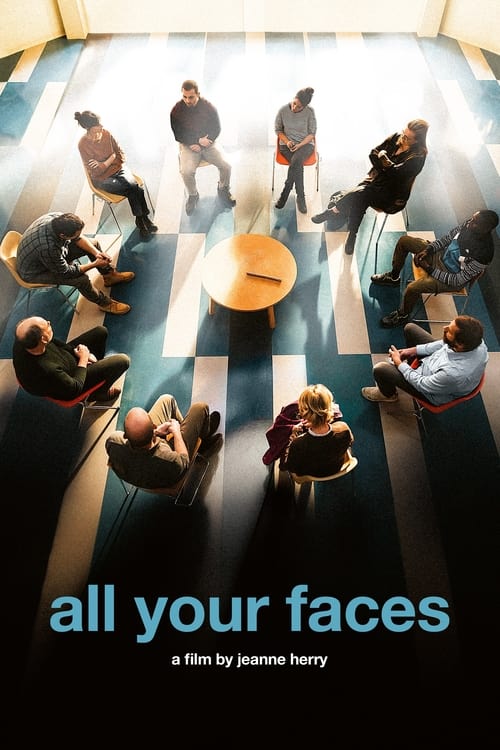
All Your Faces opens not with a burst of action but with a carefully staged rehearsal of empathy, a mock restorative-justice discussion in which facilitators are already "enacting a meeting," and the film immediately makes clear that this world runs on procedure, patience, and the fragile hope that words can do what punishment alone cannot. In the room, the speaking baton becomes more than a prop: it is the only thing that grants a person the right to speak, and the very fact that it must be passed around turns the conversation into something deliberate, restrained, and at times painfully slow. The program is voluntary and separate from sentencing, so no one is there because they have to be; they are there because they are trying to survive what happened to them, or trying to understand what they did.
The first thread introduces three victims of violent robbery and home invasion: Grégoire, Nawalle, and Sabine. Opposite them sit the perpetrators Nassim, Issa, and Thomas, men convicted of violent robberies, theft with violence, or similar offenses depending on the source's phrasing. The sessions are guided by professionals Fanny and Michel, with the supervision of their superior Paul, and the film treats this institutional layer as a crucial part of the drama rather than background detail. Paul pushes back against the facilitators' habits, telling them they cannot imagine what perpetrators feel and warning them against excessive commentary, judgment, and closed questions. He reminds them, in essence, that they are "not here as a lawyer or cop," but as people meant to create a space where everyone can listen. That line defines the film's ethic: no one is there to investigate, prosecute, or excuse; they are there to hear each other and hold the weight of what has been said.
The sessions begin with the awkwardness of strangers forced into a shared moral room. Grégoire, Nawalle, and Sabine come carrying the physical and emotional residue of being robbed in their own homes or on the street, and the film lets their fear, anger, and humiliation surface gradually rather than in tidy confessions. Nassim, Issa, and Thomas, meanwhile, are not framed as monsters but as men whose choices have caused real damage and who must now speak under watchful mediation. Their words do not erase their crimes; instead, they expose how differently each participant experiences the same event. The victims describe what it felt like to have safety torn away, while the offenders try to explain themselves without demanding forgiveness. The room becomes a place where resentment and curiosity can exist at the same time. No one is forced into reconciliation, and that refusal to simplify is one of the film's central tensions.
The structure of the film makes each session feel like a step deeper into emotional terrain. At first, the encounters are formal, almost ceremonial, because the participants are bound by the rules of the circle and by the baton-like speaking object that regulates who can speak and when. Yet the longer they meet, the less the room feels like an abstract exercise. Every silence grows heavy. Every interruption has consequences. Every admission arrives with the risk of reopening trauma or collapsing under shame. The offenders speak about accountability and the impact of prison or legal consequences, but the film does not let their perspective dominate; instead, it keeps returning to the victims' need to be fully heard, without being corrected, minimized, or hurried toward forgiveness.
Parallel to this group process runs the second storyline, which sharpens the film's emotional stakes by shifting from burglary and robbery to childhood sexual abuse. Chloé Delarme, played by Adèle Exarchopoulos, is introduced as a survivor preparing to confront her abusive step-brother Benjamin Delarme, played by Raphaël Quenard, after learning that he has moved back into town. The fact of his return functions like a disturbance in the air: even before he appears in the story's present, his presence threatens to collapse the fragile distance Chloé has managed to create around her past. Her life is no longer organized by what happened when she was a child, but by the awful possibility that the past is no longer past.
Chloé's preparation is carefully mediated by psychologist Judith, played by Élodie Bouchez, and supported by her partner Mehdi, played by Sébastien Houbani. Judith does not promise healing and does not claim to know what Chloé should do. Instead, she frames her role as helping create "good conditions" for dialogue. That phrase matters because it reveals the film's understanding of care: the goal is not to force a breakthrough, but to make a space in which truth can be spoken without immediately becoming another wound. Mehdi's presence gives Chloé a private counterpoint to the public, formal exchanges of the restorative-justice room. He is part witness, part anchor, part reminder that she still belongs to a life beyond the abuse.
As Chloé moves closer to the prospect of meeting Benjamin, the film reveals the emotional logic of delayed confrontation. She has not forgotten what he did; she has been living with it. His return into the same town makes the body remember before the mind can organize the memory into words. The film reportedly uses flashbacks, and those fragments do not function as exposition in the conventional sense so much as as pressure points, momentary ruptures that show how abuse can persist as sensation, dread, and bodily memory rather than as a neatly contained past event. The result is that Chloé's storyline is less about a single meeting than about the long approach toward one, with each counseling conversation and each moment of hesitation deepening the question of whether dialogue can ever be enough.
The film's dual structure slowly begins to echo itself. In the restorative-justice sessions, the robbery victims and offenders circle around the question of what it means to face another person after harm has been done. In Chloé's thread, the question becomes sharper and more personal: what does it mean to face the person who made your childhood impossible? The film never treats these as equivalent experiences, but it places them in the same moral architecture, suggesting that the work of naming harm, hearing testimony, and surviving contact with the past takes different forms but often produces the same mixture of rage, fear, relief, and exhaustion.
The group sessions continue to accumulate small revelations. A victim speaks, then an offender responds, then the room sits in silence long enough for the meaning of the exchange to settle. The film's drama lies in these pauses as much as in the speech itself. Some participants begin to show a kind of grudging recognition, not of innocence, but of each other's humanity. Others remain resistant, unable or unwilling to trust the process. The film does not pretend that every face-to-face meeting produces catharsis. Instead, it presents restorative justice as a work of proximity: difficult, imperfect, and vulnerable to collapse at any moment, yet still capable of opening a narrow path toward understanding.
A crucial revelation in the larger structure is that restorative justice is not a legal shortcut, nor a substitute for punishment, but a parallel emotional and moral process. The facilitators are careful, and their care is part of the film's argument. Their task is not to force confession or to extract information. It is to let speech emerge under conditions where it can be received. Paul's correction of the facilitators underscores this philosophy, making clear that the power of the setting comes from listening rather than interrogation. That distinction is essential because it keeps the film from becoming a procedural drama in the usual sense. The stakes are not whether a case is solved; the stakes are whether people can bear to tell the truth in each other's presence.
Chloé's storyline deepens this same idea by showing how prepared someone can be and still remain at the edge of collapse. Her fear is not only of Benjamin's denial or defensiveness, but of being returned, against her will, to the helplessness of the original abuse. Judith's therapeutic support is therefore not simply comforting; it is practical, a way of building a framework sturdy enough to hold terror without letting it dictate the outcome. Mehdi's support gives Chloé another form of grounding, but the film never suggests that love can solve trauma. It can only accompany it. When Benjamin's return becomes impossible to ignore, Chloé is forced to decide not whether the past matters, but how she wants to meet it.
Across the group storyline, the offenses are likewise reinterpreted through dialogue rather than through action. The perpetrators Nassim, Issa, and Thomas must confront not just the events of the robberies but the fact that they have become the kind of men whose names are now attached to other people's nightmares. The victims Grégoire, Nawalle, and Sabine do not offer easy absolution. Their pain remains intact, and the film respects that. What changes, if anything, is the texture of their relationship to the offenders and to their own memories. Hearing the other side does not make the crimes smaller; instead, it gives the victims a fuller field in which to understand what happened and what they have lost.
The emotional climax of the film, according to the available plot information, stays rooted in these dialogues rather than in violence, legal reversal, or a dramatic act of revenge. The ending does not resolve trauma as if it were a puzzle. It moves toward partial healing, regained confidence, and the possibility of reparation, all words that the film uses in the broad, human sense rather than as guarantees. The title itself, "I Will Always See Your Faces," suggests that what endures is not closure but memory, the continued presence of the others in the mind long after the meeting ends. That idea lingers over both storylines: the victims cannot simply erase the offenders, and Chloé cannot erase Benjamin. What they may gain is the ability to look directly at what happened without being destroyed by the act of looking.
The final movement of the film brings the two strands to their emotional end points. In the restorative-justice circle, some participants seem to arrive at a fragile understanding of one another, not because the harm is forgiven, but because it has finally been named aloud in a room where it can no longer be denied. In Chloé's thread, the confrontation with Benjamin Delarme is the culmination of an entire process of psychic preparation, but the sources emphasize preparation more than outcome, so the film's force lies in the fact that she reaches the threshold of speaking her truth under the protection of Judith's careful framework. The resolution is not clean victory. It is steadiness, the hard-won recognition that saying what happened can be its own form of survival.
No deaths are reported in the film's plot information or the cited summaries, and no fatal climax is described. Instead, the film ends by holding together discomfort and hope: the victims remain wounded, the offenders remain accountable, and Chloé remains changed by the necessity of facing Benjamin, but the act of meeting has created a space where the unspeakable is finally spoken. The last emotional note is not triumph but endurance, with the sense that everyone who enters these rooms leaves carrying the others' faces, unable to forget them, and perhaps unable to remain exactly as they were before.









What is the ending?
The ending of All Your Faces is a quiet but intense closing in which the restorative-justice process reaches its most personal point: Chloé finally comes face to face with the brother who abused her as a child, while the other participants' dialogue sessions have already shown that some measure of recognition and release is possible.
The film ends by bringing the different tracks of restorative justice to their emotional endpoint. In the group process, the victims and offenders have already spent time speaking in a circle, with anger, shame, and fear gradually giving way to direct human contact and a limited sense of understanding. In Chloé's separate process, she has first worked to set boundaries after learning that her brother is living nearby, and she asks for a face-to-face meeting even though the encounter is daunting. When that final meeting happens, the film presents it as the decisive moment of the story, the place where the hidden pain finally meets the person connected to it.
By the end, the film does not present a dramatic rescue or a neat cure; instead, it shows the participants reaching a point where speaking, listening, and being seen have become possible. The victims' fates are different but linked by that process: Grégoire, Nawelle, and Sabine have gone through the group sessions where they confront the people who harmed them and begin to move from raw injury toward some measure of trust. Chloé ends the story after her final confrontation with her brother, having forced the past into the open rather than letting it remain a shadow over her life.
The offenders' fates are also tied to the same process. Nassim, Issa, and Thomas remain defined by the violent robberies for which they were convicted, but the film shows them participating in the dialogue sessions as people who must hear the consequences of what they did and account for themselves directly to the victims. Their endpoint is not exoneration; it is participation in a system that requires them to face the human damage behind their crimes.
Scene by scene, the ending unfolds like this.
The group process reaches its late sessions first. The victims and offenders sit in a circle, taking turns speaking under the guidance of the facilitators and volunteers, and the atmosphere shifts from guarded tension to something more personal as each person listens to the others' experience of fear, rage, guilt, and aftermath. The film gives these exchanges the weight of ordinary speech and silence rather than spectacle.
Then Chloé's separate track becomes the emotional center of the ending. After learning her brother is back in the same town, she first seeks protection through boundaries, wanting to make sure they do not accidentally cross paths. She then chooses to go further and asks for a direct meeting, even though the request is difficult and the wounds are still raw. The final encounter is presented as the film's most charged moment, with Chloé forced to confront the person tied to her childhood abuse in a controlled, mediated setting.
From there, the story closes on the sense that restorative justice has not erased the past, but it has created a space where the truth can be spoken and endured. Chloé's fate is to carry that confrontation forward; the brother's fate is to be directly faced by the sister he harmed; and the other participants leave the process having been changed by the act of speaking and listening, even though the film does not turn that change into a simple happy ending.
Is there a post-credit scene?
There is no evidence in the available sources that All Your Faces (2023) has a postcredit scene, and the film is not described as having one in the synopsis or festival listings.
The sources instead focus on the film's main narrative: a restorative justice program where victims and offenders meet face to face, including Chloé confronting the brother who abused her, but none mention any scene after the credits.
If you want, I can also give you a spoiler-heavy ending summary of the film itself.
How does Chloé first react when she learns her abusive step-brother Benjamin is back living in the same town?
Chloé reacts by wanting to establish strict ground rules so that she never has to cross paths with Benjamin casually; the news immediately reopens her fear and anger, and she approaches the situation as something that must be controlled and contained rather than emotionally processed at first.
What role do Judith and Mehdi play in Chloé’s decision to confront Benjamin?
Judith, the psychologist, is the professional who helps create the conditions for dialogue, while Mehdi is part of Chloé's personal support system as she faces the possibility of meeting Benjamin. Together, they represent the structured emotional and practical support around her as she considers confrontation rather than avoiding him entirely.
Who are the main victims and offenders in the restorative justice sessions, and how are they grouped?
The film centers on three victims of violent robberies--Grégoire, Nawalle, and Sabine--and three offenders--Nassim, Issa, and Thomas--who meet in restorative justice sessions led by professionals and volunteers. In the separate storyline, Chloé, a sexual assault survivor, is paired in dialogue with her abusive step-brother Benjamin.
What specific kinds of crimes connect the two storylines in the film?
One storyline follows victims and perpetrators linked by robberies, home invasions, and snatching, while the other follows a sexual assault survivor confronting the family member who abused her. The film deliberately places these different forms of harm side by side inside the same restorative justice framework.
How does the film present the relationship between victims and offenders during the dialogue meetings?
The film shows the meetings as tense, vulnerable, and emotionally charged rather than neatly reconciliatory. Victims are allowed to doubt the sincerity of offenders, express anger, and challenge the way perpetrators understand the harm they caused, while the facilitators try to create safe conditions for the conversation.
Is this family friendly?
Probably not family friendly for young children. The film centers on restorative-justice meetings involving victims and offenders, and its content is rated by IMDb as having moderate violence, moderate frightening/intense scenes, and mild alcohol/drugs/smoking, with no sex/nudity and no profanity listed.
Potentially upsetting elements for children or sensitive viewers include:
- Discussion of violent crime and trauma, including victims facing the people connected to their harm.
- Emotional confrontation scenes that may be tense, distressing, or psychologically heavy rather than action-based.
- Reference to sexual assault in the story description, which may be upsetting even if not graphically shown.
- Scenes involving robbery, burglary, and violent offenses, which are central to the film's setup.
- Mild alcohol/drug/smoking content.
If you want, I can also give you a very short age-suitability recommendation by age group, still without spoilers.









