






















Popular
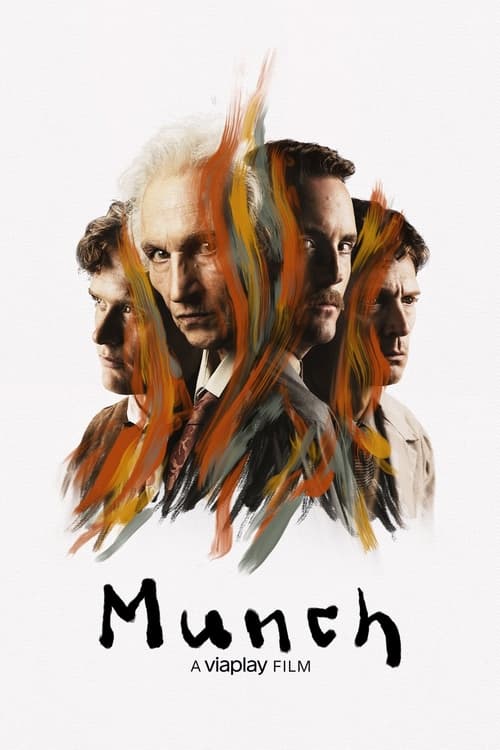
Why is Edvard Munch shown at four different ages in the 2023 film Munch?
What happens to Munch’s first solo exhibition in Berlin, and why is it canceled?
How does the film portray Munch’s relationship with alcohol and depression?
What role do Munch’s sister and mother play in his story?
What happens when the Nazis come for Munch’s paintings in the final chapter?
Should I watch it?
Ask Your Own Question

What is the plot?
Munch (2023) opens in 1884 in Kristiania, the old name for Oslo, and the city immediately feels divided by class, morality, and invisible pressure. The film introduces the social world that shapes the young Edvard Munch: a conservative capital where respectable people keep their distance from radicals, and where the Munch household itself is haunted by sickness, insanity, and death. Inside that home, Christian Munch, Edvard's pious father and a doctor by profession, stands as the stern embodiment of authority and religious disapproval. He rejects Edvard's growing friendship with the Kristiania Boheme, the loose circle of intellectuals that includes Hans Jaeger, Christian Krohg, and feminists such as Andrea Fredrikke Emilie. Their influence gives Edvard his first taste of rebellion, encouraging him to think of art not as polite decoration but as a form of confession, protest, and self-exposure.
At this early stage, Edvard is still a young man trying to define himself, but the film makes it clear that his emotional life is already marked by loneliness and sensitivity. He has been painting for years, and the work he makes in these opening scenes is still grounded in the world around him: landscapes near home, family portraits, the sort of subjects that look safe on the surface. Yet the household atmosphere and the cultural ferment around him are already steering him elsewhere. The film shows him listening, absorbing, and slowly understanding that his true subject is not the visible world alone, but the emotional damage beneath it. When his first completed painting, "Inger in Black," is attacked by the conservative press, the criticism lands like a public insult and a warning. His work is judged not just inadequate but offensive in its seriousness and tone, and the movie treats that rejection as the beginning of a long pattern. The assault on his art does not end there; it will continue for fifteen years, becoming one of the recurring pressures in his life.
Edvard's personal breakthrough comes with his first love, and the film presents it as both tender and destabilizing. In May 1885, he travels to Paris, where he first encounters classical art and the wider European tradition that will both inspire and overwhelm him. Returning to Scandinavia at age 21, he is still awkward in human company and prone to melancholy, but he is also in the process of becoming himself. The film centers this period on his attachment to a married woman, a relationship that carries the charge of desire, secrecy, and emotional impossibility. The details of the affair are less important than the feeling it creates: Edvard experiences love as something immediate and painful, a connection that deepens his isolation even as it briefly promises intimacy. He does not simply fall in love; he begins to understand that love, like art, can wound him and leave a permanent mark.
The romance unfolds in a world where feeling is always under pressure from convention. The married woman becomes the emotional center of this section, and Edvard's inability to fully possess or stabilize the relationship shapes his inner life. The film lingers on the intensity of their connection, and its closing quotation--"I felt as if there were invisible threads between us"--captures the way the relationship is remembered: not as a simple affair, but as a force that ties two people together across distance, time, and loss. That line becomes the emotional key to the whole film. The threads are invisible, but they are also unbreakable, and the pain of that bond will echo through the rest of Edvard's life and work.
As the story moves forward to age 29, the tone changes and the film drops Edvard into Berlin in the 1890s, a city of artistic energy, argument, and humiliation. Here he is moving among creative figures such as August Strindberg, and he is at the threshold of what should be a major professional success: his first solo gallery show. The anticipation builds around him, but it is crushed by a brutal act of institutional rejection. The local arts council decides to close the exhibition before it even opens, declaring the subject matter "too ordinary." The phrasing is almost absurdly dismissive, and the cruelty of it lies in the insult's banality. Edvard is not accused of obscenity or scandal; he is judged irrelevant. The world he is trying to enter refuses to recognize that the private, psychological, and emotionally raw is exactly where his art belongs.
This Berlin episode becomes one of the film's defining confrontations. Edvard stands against the conservative taste of the establishment, and the film makes the rejection feel like a public body blow. His work is not merely criticized; it is shut out before it can be seen. The humiliation is compounded by the fact that he has come to Berlin believing in the possibility of recognition. Instead, he is met by the rigid gatekeeping of the art world, and the scene turns that institutional power into a kind of violence. The film uses this moment to show how often Munch's career is shaped by misunderstanding. The people with authority over culture do not know what to do with his innerness, his unease, or his refusal to make art that behaves politely. The result is not just disappointment but a deeper alienation that hardens into artistic identity.
The film's next major movement jumps to age 45, and the mood darkens again as Edvard collapses inward. He is now in a sanitarium, deeply depressed and unstable, with the sense that his own mind has become an enemy. The treating physician is Dr. Daniel Jacobsen, who provides one of the film's most important interpretive counterpoints. Rather than treating Edvard's distress as something purely pathological, Jacobsen argues that what society calls mental illness in an artist may actually be the normal reaction of a genius mind to complexity. The line repositions Edvard's breakdown as part suffering, part insight: not an interruption of creativity, but one of the conditions that make it possible. The film does not romanticize this suffering, but it does insist that the boundary between illness and perception is unstable in Munch's case.
This middle section also depicts Edvard's nervous breakdown and his admission to a psychiatric clinic, where he is forced to confront the fragility that has been stalking him from childhood. By this point, the film has accumulated enough images of loss, rejection, and emotional deprivation that the breakdown feels less like a surprise than an inevitable rupture. The sources describe this stage as the one in which he becomes institutionalized after the collapse, and the drama of the scene lies in the tension between confinement and explanation: is he being treated, contained, rescued, or simply managed by people who do not truly understand him?
The film's structure keeps shifting, but its emotional logic remains consistent. Childhood illness, the death-haunted home, the failed social belonging, the first love that cannot be possessed, the public rejection in Berlin, and the collapse into psychiatric care all become part of the same story. Munch's art emerges from a life that repeatedly teaches him that closeness can be painful and that recognition comes with violence. The film's account of his creative development is therefore never separate from his suffering; instead, it presents art as the form that suffering takes when it becomes visible.
The final chapter moves to age 80, in 1944, with occupied Oslo casting a grim shadow over the end of Edvard's life. He is now surrounded by thousands of unsold paintings, a material burden as much as a legacy. The visual image is overwhelming: his work fills the space around him, a lifetime of production accumulated into a vulnerable stockpile. But the peace of old age is shattered when the Nazi government comes knocking. One of Hitler's ministers has developed a taste for Munch's work and wants to requisition some of it, perhaps all of it if the occupiers decide to take more. The threat is political and personal at once. The Nazis do not merely want paintings; they want ownership over the artistic memory of a man whose work they see as useful, collectible, and vulnerable.
This final confrontation carries the full weight of the film's themes. The same society that once dismissed Munch as "too ordinary" now becomes an occupying force that wants to claim his art for itself. In old age, Edvard is still resisting the conditions that have tried to define him all his life: authority, censorship, misunderstanding, and appropriation. The film presents him as irascible, stubborn, and unwilling to bow to the new occupiers. He is not fighting a glamorous battle; he is defending the physical existence of his own artistic life against a regime that reduces culture to property and prestige. The tension in these scenes comes from the fact that the stakes are both practical and symbolic. If the Nazis take the paintings, they also try to take control of what Munch has meant and what his work can still signify.
The narrative does not provide a violent death scene or a single grand heroic act, and that absence is itself telling. The film's power comes from accumulation rather than spectacle. The deaths that shape the story are mostly part of the background of the Munch household and its emotional inheritance: illness and death are the air he grows up breathing, even when no specific on-screen fatality is emphasized in the available material. What the film does show with certainty is that the entire life of Edvard Munch is organized around the pressure of loss. He loses the feeling of security in childhood, loses the possibility of uncomplicated love, loses public battles over his work, loses control to illness and breakdown, and finally faces the possibility that his art will be seized by fascist power.
The most important twists are therefore not plot twists in the conventional sense, but revelations about how his life is structured. The first revelation is that the family home is not simply strict or unhappy but fundamentally defined by disease, insanity, and death, creating the emotional conditions from which his art is born. The second is that his first love is not a side note but a formative wound, a relationship whose invisible bond continues to haunt him long after it passes. The third is that his rejection in Berlin is not a temporary setback but a decisive emblem of how the art world misunderstands him. The fourth is that his breakdown at 45 is interpreted not only as collapse but as an expression of a mind pushed to its limits by genius and sensitivity. The fifth is that his late-life confrontation with the Nazis turns art into a contested object of power, proving that even at the end of his life he must still defend the autonomy of his work.
In the end, the film closes not with a neat resolution but with memory, distance, and the lingering force of human attachment. After the struggle with the Nazis and the long backward glance across his life, the movie ends with Munch's quotation: "I felt as if there were invisible threads between us. I felt as if invisible threads from her hair still twisted themselves around me. And when she completely disappeared there, over the ocean, then I felt still how it hurt, where my heart bled, because the threads could not be broken." The words bring the whole film back to the first love that helped define his emotional world, but they also reach beyond romance. The invisible threads are the ties between grief and creativity, between memory and identity, between the people who leave and the work that remains. In the final scene's emotional register, Edvard Munch is not simply an artist looking back on his life; he is a man who has spent decades learning that connection can be invisible and still painfully real. The film ends by leaving that ache intact, with the art surviving as the one form strong enough to carry it forward.



What is the ending?
The film ends with old Munch in Nazi-occupied Norway trying to keep his paintings from being taken, while the story also closes by showing that his art outlasts the fear and chaos around him. In the last stretch, the movie returns to the modern-day Berlin framing chapter, connecting his life and work to the present.
In the final movement, the film moves back through Munch's last years and then lands on the wartime ending. The oldest version of Munch is shown surrounded by thousands of unsold paintings, while Nazi officials come to pressure him over his work and want to requisition some of it. He resists that intrusion and remains defiant rather than yielding to the occupying power. The film then closes on the idea that his paintings survive the conflicts of his life and career, with the final chapter shifting into modern-day Berlin to place his legacy in a contemporary setting.
For the main characters at the end: - Edvard Munch: he survives to old age, remains surrounded by his paintings, and faces the Nazis' attempt to take his art. - Dr. Jacobsen: his role belongs to the earlier sanitarium chapter, and he is not part of the wartime closing movement. - The Berlin artists such as August Strindberg: they belong to the earlier life chapter and are not shown in the final Nazi-occupation ending. - The modern-day Berlin figure: this closing chapter serves as a present-day frame rather than a separate character fate, linking Munch's legacy to today.
If you want, I can also give you the ending as a fully scene-by-scene narrated sequence in even more detail, still keeping it simple and factual.
Is there a post-credit scene?
There is no reliable evidence in the available sources that Munch (2023) has a post-credit scene, and the film's plot summaries and reviews do not mention one.
Based on the sources provided, the movie ends as a biographical account of Edvard Munch's life and legacy rather than with an additional tagged scene after the credits. If you were expecting a Marvel-style stinger, these sources do not indicate that Munch includes anything like that.
Why is Edvard Munch shown at four different ages in the 2023 film Munch?
The film tells Edvard Munch's story in four separate life periods, with different actors and screenwriters shaping each chapter, so viewers can follow distinct moments in his personal and artistic development rather than a single linear biography.
What happens to Munch’s first solo exhibition in Berlin, and why is it canceled?
In the 29-year-old chapter, Munch is in Berlin preparing for his first solo gallery show when he learns the local arts council has shut it down before it even opens because the subject matter is considered too ordinary.
How does the film portray Munch’s relationship with alcohol and depression?
The film presents Munch as unstable and deeply depressed in his mid-40s, receiving treatment in a sanitarium, and it also links the different periods of his life through arguments, passion, and heavy drinking.
What role do Munch’s sister and mother play in his story?
The film explicitly connects Munch's emotional pain to the loss of his younger sister and mother, treating those deaths as major scars that shape his life and creative identity.
What happens when the Nazis come for Munch’s paintings in the final chapter?
In the oldest chapter, Munch is surrounded by thousands of unsold paintings when Nazi officials arrive and try to requisition some of his work, with the film suggesting they may want to take all of it.
Is this family friendly?
Probably not ideal for young children. Munch (2023) is a biography/drama about Edvard Munch and includes adult themes such as grief, addiction, mental breakdown, and Nazi occupation, so it is more suited to older teens or adults.
Potentially upsetting or objectionable aspects may include: - Death and grief connected to family loss. - Addiction and related self-destructive behavior. - Mental health crisis / institutionalization, including a nervous breakdown. - Nazi occupation / wartime tension, with the threat of artwork being seized or hidden. - Emotional intensity and depressive themes throughout the film's portrayal of Munch's life.
The available summaries do not mention explicit sex, graphic violence, or strong language, but because this is a serious adult biopic, sensitive viewers may still find it heavy.









