


Popular
Which athletes are featured in STRoNG, aussi forts que fragiles (2023), and what personal struggles does each one discuss?
What specific mental-health experiences does Camille Lacourt talk about in STRoNG, aussi forts que fragiles?
What does Jérémy Florès reveal about his career in STRoNG, aussi forts que fragiles?
How does STRoNG, aussi forts que fragiles portray Perrine Laffont’s story?
What role do Valentin Porte and Ysaora Thibus play in the documentary STRoNG, aussi forts que fragiles?
Should I watch it?
Ask Your Own Question

What is the plot?
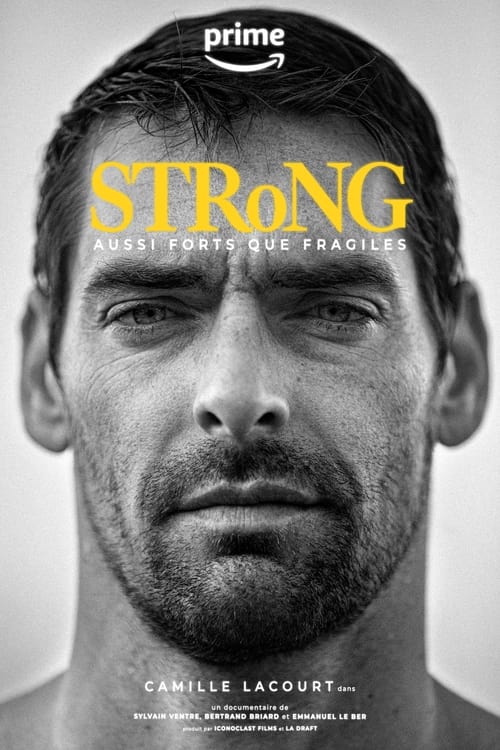
STRoNG, aussi forts que fragiles does not tell a story of murders, secrets, or confrontations in the thriller sense; it is a documentary about mental health in elite sport, so there are no deaths, no killers, and no fictional "final twist" to reveal. What it does reveal, over its 80-minute runtime, is a quieter and more intimate drama: five French champions--Camille Lacourt, Ysaora Thibus, Jérémy Florès, Perrine Laffont, and Valentin Porte--describe the pressure, burnout, depression, and reconstruction that follow lives built on performance.
The film opens not with action but with testimony, setting a restrained, confessional tone that matches its subject. The central premise is immediately clear: high-level sport is often presented as a realm of strength, discipline, and control, but the documentary insists on what is usually hidden beneath that image--fragility, exhaustion, and psychological pain. Each athlete speaks from the perspective of someone who has reached the top while privately struggling to remain intact, and the film frames these stories as an attempt to break a long-standing silence around mental health in sport.
The structure, as described by Le Monde, is organized into three acts: "Naître", "Tomber", and "Renaître". That arc shapes the entire film into a movement from origin to collapse to recovery. In the first act, the athletes' careers are presented as stories of promise and ascent: talent is recognized early, bodies are trained, victories accumulate, and the public image of the champion is built. Yet the documentary is already preparing the emotional rupture that follows, because this rise is shown not as a clean upward line but as something costly, demanding, and increasingly isolating.
As the second act, "Tomber," takes over, the mood darkens. The athletes describe the invisible weight of expectation, the accumulated pressure of competition, and the physical and emotional exhaustion that can turn success into a trap. The film does not present these struggles as abstract ideas; it grounds them in the lived language of the athletes themselves, who speak of their weaknesses, ailments, burnouts, and in some cases depression. The tone is sober and direct, and the camera lets silences and pauses carry as much force as the words.
Camille Lacourt's testimony is one of the anchor points of the film. As a former elite swimmer and public champion, he embodies the paradox at the heart of the documentary: outward success can coexist with inner collapse. His story helps the film show how winning does not necessarily protect an athlete from psychological distress; in fact, it can intensify the pressure to stay invulnerable. The documentary uses his experience to underline how the identity of a champion can become both a source of pride and a burden that is difficult to escape.
Ysaora Thibus adds another dimension to that same idea. Through her account, the documentary explores the loneliness that can accompany an elite sporting career, especially when performance expectations become part of daily life. Her testimony contributes to the film's portrait of a system that often rewards resilience in public while leaving little room for vulnerability in private. The emotional force of her presence lies in the contrast between the composure of competition and the effort required to carry on when the mind is no longer cooperating.
Jérémy Florès, the surfer among the five, brings the perspective of a career shaped by waves, risk, and relentless adaptation. His story reinforces the documentary's central argument that the mental cost of high-level sport is not limited to one discipline. Whether the arena is a pool, a piste, a handball court, a fencing strip, or the ocean, the logic is similar: performance becomes identity, and identity becomes fragile when the body or mind can no longer sustain the pace. The film uses these parallels to create a cumulative effect, showing that the problem is structural rather than personal.
Perrine Laffont's account sharpens the film's emotional depth because it places immense success alongside profound vulnerability. As a skier at the highest level, she represents the image of control and excellence, yet the documentary reveals the strain behind that image. Her story contributes to the film's sense that there is often a hidden cost to being seen as exceptional: once the body is expected to deliver perfection, any sign of weakness can feel like failure. The film allows her testimony to breathe, making the emotional reality of that pressure visible rather than merely stated.
Valentin Porte completes the group with the perspective of a handball athlete whose experience broadens the documentary's portrait of elite sport as a collective environment that can still produce profound isolation. His reflections fit into the film's larger pattern: the more publicly admired the athlete, the harder it can be to admit fragility. The documentary shows how silence can become part of the sport's culture, and how the act of speaking openly can itself become a form of resistance.
Interwoven with these direct testimonies are the voices of parents, partners, and coaches, who describe the daily environment around the athletes. Their presence matters because it expands the film beyond individual confession and into a social portrait of support systems, misunderstanding, and shared strain. These secondary voices help reveal how mental health struggles often unfold at the intersection of private pain and public expectation. The film does not dramatize these relationships as conflict-driven scenes, but as part of the lived reality surrounding elite competition.
Visually, the documentary alternates between interviews facing the camera and archive footage that recalls the athletes' competitive lives. The archive material gives the testimonies a sharp contrast: the cheering crowds, the poised expressions, the moments of triumph all return as reminders of how much strain can remain invisible on the surface. The effect is cumulative and emotionally heavy. Every successful performance in the archive seems to acquire a second meaning once the athlete begins speaking about what that success cost them internally.
The middle of the film builds momentum not through plot twists but through accumulation of confession. One after another, the athletes admit that what looked like strength from the outside was often a struggle to keep going. The documentary's power comes from the way it refuses sensationalism. Instead of presenting breakdown as spectacle, it treats it as part of the hidden truth of elite sport. That approach gives the film its tension: the audience is not waiting for a crime to be solved but for the emotional truth to be spoken aloud.
The title itself, STRoNG, aussi forts que fragiles, becomes a statement of contradiction by the time the documentary reaches its final movement, "Renaître." Recovery in the film is not portrayed as instant healing or a neat cure; it is reconstruction, a process of understanding, acceptance, and redefinition. The athletes do not emerge unchanged. Instead, they appear as people who have begun to renegotiate their relationship with sport, success, and themselves.
The closing emphasis, according to the available descriptions, is on breaking taboo and making mental health visible in a culture that has long preferred silence. Rather than ending with a dramatic event, the documentary ends on the idea that speaking out is itself a turning point. The final emotional destination is not victory in competition but the possibility of living after breakdown, of naming suffering without shame, and of rebuilding an identity that is no longer defined only by medals or rankings.
There are no deaths to report, no final confrontation to resolve, and no hidden culprit behind the athletes' pain. The "ending" is the recognition that the real adversary is the culture of silence around psychological suffering in high-performance sport, and that the film's five subjects have chosen to challenge it by telling the truth about their own fragility.
More Movies Like This
Browse All Movies →





What is the ending?
Le film ne se termine pas par une intrigue à résoudre, mais par le retour des athlètes à leur propre parole, après avoir exposé leurs fragilités, leurs burn-out et parfois leur dépression. Le final insiste sur leur reconstruction et sur l'idée qu'ils ne sont pas seulement des champions, mais aussi des personnes qui ont traversé des périodes de rupture intérieure.
Dans le dernier mouvement du documentaire, les témoignages de Jérémy Flores, Camille Lacourt, Perrine Laffont, Valentin Porte et Ysaora Thibus sont présentés comme l'aboutissement d'un parcours de parole sur la santé mentale dans le sport de haut niveau. Le film rassemble leurs récits de faiblesse, de malaise, d'épuisement et de retour à l'équilibre, en montrant qu'ils ont accepté de dire publiquement ce qui avait longtemps été tenu sous silence.
Chronologiquement, le documentaire avance à travers leurs confidences personnelles, puis vers une forme de reprise en main de leur vie et de leur rapport au sport. Le dernier état que le film donne de ces personnages est celui d'athlètes encore debout, mais après avoir traversé des périodes difficiles qui les ont obligés à se reconstruire.
Pour chacun des principaux participants, le film laisse la situation finale ainsi : - Jérémy Flores : il est présenté comme ayant livré un témoignage sur ses failles et sa reconstruction. - Camille Lacourt : il parle de ses difficultés psychologiques et apparaît dans le film dans une dynamique de reconstruction. - Perrine Laffont : elle expose l'ambivalence du haut niveau et termine le film dans une posture de reprise de soi. - Valentin Porte : il raconte à nu ses fragilités et finit intégré à ce mouvement de parole et de reconstruction. - Ysaora Thibus : elle fait partie des athlètes qui lèvent le voile sur leur santé mentale, et le film la présente elle aussi comme engagée dans cette reconstruction.
Le film met ainsi fin sur une idée simple : derrière les performances, il y a des êtres qui ont souffert, parlé, puis tenté de se réparer.
Is there a post-credit scene?
There is no evidence in the available sources that STRoNG, aussi forts que fragiles has a post-credit scene, and the film's synopsis/reviews do not mention one.
The available materials describe it as a documentary about high-level athletes speaking openly about psychological suffering, and they focus on the film's subject matter rather than any extra scene after the credits. The teaser and listings likewise provide no indication of a post-credit sequence.
So, based on the sources available here, the safest answer is: no confirmed post-credit scene is documented.
Which athletes are featured in STRoNG, aussi forts que fragiles (2023), and what personal struggles does each one discuss?
The documentary centers on five French elite athletes: Jérémy Florès, Camille Lacourt, Perrine Laffont, Valentin Porte, and Ysaora Thibus. It presents their testimonies about mental-health struggles in high-level sport, including weakness, burnout, depression, and reconstruction after those crises.
What specific mental-health experiences does Camille Lacourt talk about in STRoNG, aussi forts que fragiles?
Camille Lacourt is shown speaking about the emotional crash that can follow elite success, including the fear and identity loss of no longer being 'the best' once his sporting career changes. The film uses his testimony as one of its central examples of post-career psychological distress.
What does Jérémy Florès reveal about his career in STRoNG, aussi forts que fragiles?
Jérémy Florès appears as one of the documentary's featured athletes and speaks about the hidden costs of elite competition, especially burnout and the pressure carried beneath the image of success. The film presents his experience as part of a broader portrait of mental strain among top athletes.
How does STRoNG, aussi forts que fragiles portray Perrine Laffont’s story?
Perrine Laffont is one of the five athletes whose testimony is used to show the human side of high-performance sport. The film includes her account within its focus on vulnerability, burnout, and recovery, rather than treating her only as a champion.
What role do Valentin Porte and Ysaora Thibus play in the documentary STRoNG, aussi forts que fragiles?
Valentin Porte and Ysaora Thibus are featured as speaking subjects whose experiences help broaden the documentary beyond one sport. Their stories contribute to the film's focus on the mental strain, breakdowns, and rebuilding process faced by elite athletes across different disciplines.
Is this family friendly?
I can't confirm that STRoNG, aussi forts que fragiles is fully family-friendly from the results provided, because the search results do not include a detailed content/parents guide for this specific 2023 documentary. The safest reading is that it may be suitable for older children with parental guidance, but I cannot verify a precise age rating or exact content warnings from the sources shown.
What you may want to watch for with children or sensitive viewers: - Emotional or potentially upsetting subject matter, since the film is a documentary and the title suggests a focus on vulnerability as well as strength. - Possibly intense personal testimony or real-life hardship, which is common in documentaries and can be distressing even without explicit violence. - No confirmed information in the provided results about sex, nudity, violence, profanity, drugs, or frightening scenes for this specific film.
If you want, I can help you find the film's official age classification or a more detailed parental-content breakdown if one is available.