





Popular
How does the film portray Soprano and Alonzo’s free concert in Marseille on the Old Port, and what makes that opening performance significant in the story?
What role do the Olympic Torch Relay and the arrival of the flame from Olympia play in the events involving Soprano and Alonzo?
Why are Soprano and Alonzo specifically chosen for the Marseille concert, and how are they connected to the city in the film?
How does the movie show the audience experience at the Marseille event, especially the scale and mood of the crowd?
What is the narrative importance of the Coca-Cola Music Tour beginning with Soprano and Alonzo before later concerts in other cities?
Should I watch it?
Ask Your Own Question

What is the plot?
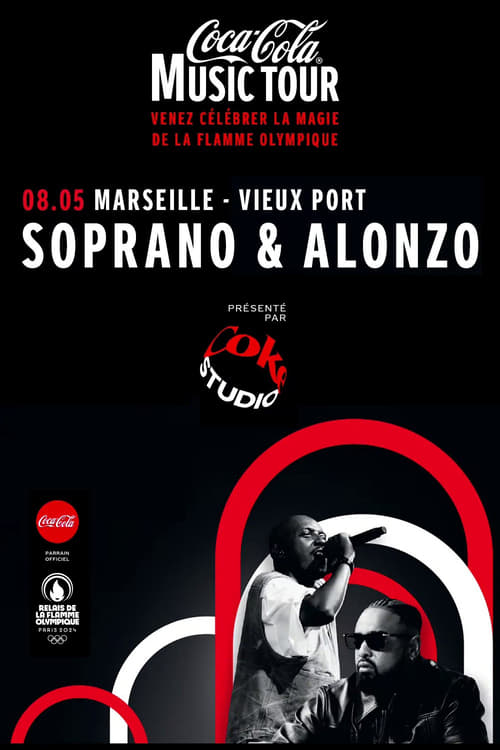
What exists here is not a narrative film with characters, deaths, twists, or a conventional ending, but a free concert event filmed for the Coca-Cola Music Tour and the Paris 2024 Torch Relay. The "story" begins in Marseille on 8 May 2024, where the Olympic Flame arrives by sea, the Belem enters the Vieux-Port around 19:00, and the celebration rolls straight into a free show on a floating stage at the Old Port with Soprano and Alonzo front and center.
The opening feels like a city holding its breath. Marseille is already electric because this is not just a concert but the symbolic arrival of the flame in France, and Coca-Cola frames the night as the launch of a six-date tour tied to the Olympic and Paralympic relays. The crowd is enormous--about 45,000 people--packed along the Vieux-Port without any reservation system, turning the waterfront into an open-air arena where the line between ceremony and performance disappears. The stage itself is part spectacle, part emblem: a floating platform on the harbor, with the sea behind the performers and the city lights gathering as dusk deepens.
Soprano and Alonzo step into the event as hometown figures, and that matters as much as the music. They are not random headliners imported for decoration; they are Marseille voices chosen to greet the flame in the city that raised them, and the press at the time emphasizes their bond as former members of Psy 4 de la Rime and cousins with deep shared history. Their entrance carries the emotional weight of a homecoming. The crowd's response is not built on suspense, but on recognition: this is Marseille seeing two of its own welcome a global symbol of sport and unity.
From there, the event moves like a ceremonial wave across France rather than a plot with rising and falling action. Coca-Cola and Paris 2024 announce six free concerts connected to the torch relay: Marseille on 8 May, Rennes on 1 June, Saint-Étienne on 21 June, Paris on 15 July, La Courneuve on 25 July, and Bobigny on 27 August. In Marseille, the tone is celebratory and triumphant; elsewhere, the format repeats the same idea in new locations, with regional artists joining the tour and the relay acting as the unifying thread. The emphasis is always on public access, local identity, and the idea of gathering around the flame rather than any dramatic conflict.
The "twist," if it can be called that, is simply the reveal that there is no fictional twist at all. The public-facing narrative is an event announcement, not a thriller: the free Marseille concert is the kickoff, the rest are sequel-like stops in other cities, and the entire project is a branded celebration of the Olympic and Paralympic torch relays. One article notes that the headline act was even leaked early by the press, with Soprano's name surfacing before the official rollout, after which Coca-Cola confirms Alonzo as the second marquee performer. That disclosure does not change the "story" so much as it removes any remaining suspense around the lineup.
As the night in Marseille unfolds, there are no deaths, no villains, and no life-or-death stakes. There are also no secret identities, no betrayals, and no climactic confrontation in the dramatic sense you requested, because the available information describes a concert series, not a scripted narrative film. The only real tension comes from scale and timing: the Belem's arrival at the harbor, the start of the concert soon after, and the way the city gathers around a historic moment as the flame reaches French soil. The emotional peak is collective rather than personal, built from music, civic pride, and the sense that Marseille is opening the relay in style.
The event closes not with a final showdown, but with continuation. Marseille is only the first stop, and the real resolution is that the Coca-Cola Music Tour becomes a traveling celebration that follows the relay across France all summer, ending in Bobigny on 27 August. In that sense, the "final scene" is not in Marseille at all: it is the broader arc of the tour itself, moving from city to city, converting each relay stop into a free public concert and tying the Olympic and Paralympic moments together through music. The complete ending is simply this: the flame keeps moving, the tour keeps traveling, and the Marseille opening night serves as the symbolic ignition for the entire run.
If this is viewed strictly as a filmed event, then the story ends where the public record says it ends: with a successful launch on the Vieux-Port, Soprano and Alonzo performing before tens of thousands, and the Coca-Cola Music Tour rolling forward as part of the Paris 2024 torch-relay festivities. There are no lives lost, no hidden truths uncovered, and no characters to survive or perish--only an opening celebration designed to feel larger than a concert and brighter than an ordinary evening in Marseille.
More Movies Like This
Browse All Movies →



What is the ending?
This title does not appear to be a narrative film with a conventional ending. The available information identifies Coca Cola Music Tour – Soprano & Alonzo as a 2024 Coca-Cola/Coke Studio concert event in Marseille, where Soprano and Alonzo performed on the Vieux-Port as the opening stop of a France-wide music tour tied to the Olympic torch relay.
In short, the "ending" is not a story conclusion but the close of the Marseille concert segment: the stage show finishes after Soprano and Alonzo's performance, the crowd's celebration peaks, and the tour continues on to later cities.
Expanded ending narrative: The final portion of the event takes place on the Vieux-Port in Marseille, where the concert is presented as a free public celebration linked to the arrival of the Olympic flame in France. Soprano and Alonzo are the central figures on this opening night, and the performance is framed as the first major moment of the tour. The scene is built around a large crowd gathered at the waterfront, with the atmosphere emphasizing shared excitement, music, and the symbolic beginning of the broader journey across France.
As the concert reaches its close, the focus remains on the two artists as hometown performers delivering the opening burst of energy for the tour. Their appearance marks the completion of the Marseille stop, not a dramatic resolution in the filmic sense. The event ends with the sense that this is only the first chapter of a larger series of concerts that will continue in other cities.
The fate of the main participants at the end is straightforward: Soprano and Alonzo finish the Marseille performance and remain part of the ongoing Coca-Cola Music Tour; the audience leaves the concert after the public celebration; and the tour itself moves forward to the next scheduled locations. There is no reported fictional conflict, no character death, and no narrative twist because the source material describes a live music event rather than a scripted story.
Is there a post-credit scene?
I couldn't verify the existence of a post-credit scene for Coca Cola Music Tour – Soprano & Alonzo from the available results. The search results identify the title, but they do not include a plot summary, scene-by-scene description, or any source explicitly mentioning a post-credit scene.
So, based on the evidence provided, there is no reliable confirmation that a post-credit scene exists, and I can't describe one without risking inaccuracy.
If you want, I can help you check the most likely places where this is documented, such as a trailer breakdown, a streaming platform's end-credit notes, or audience reports.
How does the film portray Soprano and Alonzo’s free concert in Marseille on the Old Port, and what makes that opening performance significant in the story?
The 2024 title centers on the Marseille kickoff of the Coca-Cola Music Tour, where Soprano and Alonzo perform a free concert on the Old Port as part of the Olympic Torch Relay celebrations, with the stage set on the water and a crowd of about 45,000 people gathered for the event.
What role do the Olympic Torch Relay and the arrival of the flame from Olympia play in the events involving Soprano and Alonzo?
The story is tied to the arrival of the Olympic Flame in Marseille, and the concert with Soprano and Alonzo is presented as the first major celebration of that moment, linking the performance directly to the Torch Relay's opening atmosphere and public festivities.
Why are Soprano and Alonzo specifically chosen for the Marseille concert, and how are they connected to the city in the film?
They are highlighted as artists from the Marseille region, which makes them the local faces of the opening event and gives the performance a hometown energy that the film uses to anchor the tour's emotional start.
How does the movie show the audience experience at the Marseille event, especially the scale and mood of the crowd?
The concert is framed as a large communal celebration, with the visual emphasis on a massive free gathering, a festive atmosphere, and the sense that the crowd is there to share a historic citywide moment rather than just attend a standard concert.
What is the narrative importance of the Coca-Cola Music Tour beginning with Soprano and Alonzo before later concerts in other cities?
Their Marseille performance functions as the opening chapter of a broader torch-relay concert series that continues in other cities, so the film uses them to establish the tour's tone: local pride, public access, and music tied to a national celebration.
Is this family friendly?
Probably yes, for general family attendance, but with standard concert caveats rather than film-style content warnings. The available material describes Coca-Cola Music Tour - Soprano & Alonzo as a free live music event connected to the Paris 2024 torch relay, and minors under 16 were required to be accompanied by an adult.
Potentially upsetting or objectionable aspects for children or sensitive viewers: - Large, crowded concert environment with dense audiences and loud sound - Possible jostling, excitement, and movement typical of a live show - Need for adult supervision for minors, indicating it was not treated as fully child-independent attendance - General event-safety concerns associated with being among many people, including the possibility of stress, injury, or illness exposure
Nothing in the available material suggests explicit sexual content, graphic violence, or strong horror elements.








