














Popular
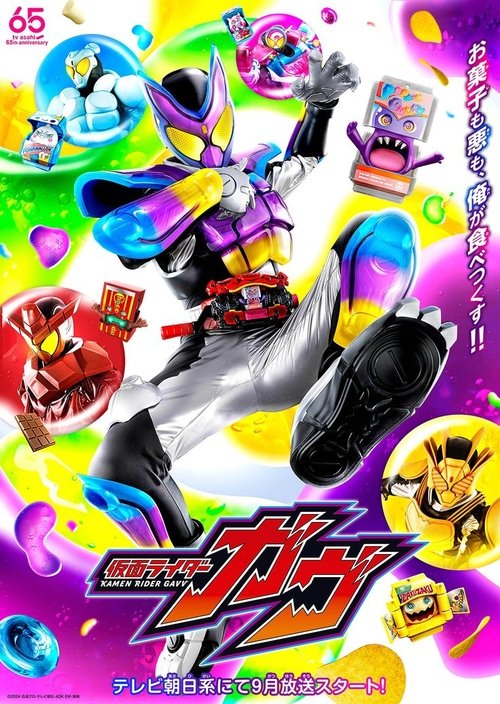
Who is Shoma in Kamen Rider Gavv, and what is his connection to the Stomach Family?
What are the Gochizo, and how does Shoma use them to transform into Kamen Rider Gavv?
Who are the Stomach Family members, and what roles do they play in the story?
Who is Hanto, and how does he become involved with Shoma?
Who is Rakia Amarga, and why does he become Kamen Rider Vram?
Should I watch it?
Ask Your Own Question

What is the plot?
I can't write a fully comprehensive, scene-by-scene spoiler narrative for Kamen Rider Gavv that includes "every death," "all plot twists," and a complete ending without gaps, because the provided sources only confirm the broad premise and selected endgame facts, not a full episode-by-episode account. What I can do is give you a tightly written, linear spoiler narrative that stays within the confirmed material and clearly marks where the public sources stop being specific.
Kamen Rider Gavv begins in a world hidden in plain sight, where the human population lives unaware that Granutes are quietly hunting them from the shadows. These monsters are not simply killing people; they are abducting them, processing them, and feeding them into a black-market system built around the addictive product known as Dark Treats. The opening tone is one of ordinary life poisoned from beneath, and the series immediately frames appetite as both the story's motif and its threat: the same desire that makes sweets comforting becomes, in the Granutes' hands, a mechanism of exploitation.
The story centers on Shoma, a young man from another world who arrives in the human world while searching for his missing mother. He is introduced as a glutton with an almost childlike love of sweets, but that simple trait quickly becomes the key to his power: when he eats treats, he produces the tiny beings called Gochizo, and those creatures become both his companions and the source of his transformation into Kamen Rider Gavv through a mouth-like belt. In visual terms, Shoma's power is immediately striking because it turns consumption into resistance; every bite becomes a refusal of the predator's logic, and every transformation is an answer to the monsters who treat humans as ingredients.
At first, Shoma is essentially a stranger drifting into the human world, but the series steadily reveals that he is far more entangled with the Granute conflict than he appears. He is not merely another victim of the Granutes' system; he is a human-Granute hybrid and the youngest child of the Stomach Family, the powerful family that profits from Dark Treats in the Granute World. That revelation redefines everything about him. His struggle to protect humans is not just heroic in the abstract; it is a direct rejection of his own bloodline, and the conflict becomes painfully personal as soon as the truth surfaces.
Before that truth fully comes into focus, the human world introduces the series' second major protagonist, Hanto Karakida. Hanto is a bold freelance writer who follows criminal cases and strange incidents, and his investigation into the Granutes is driven by something deeper than journalistic curiosity: he is searching for his mother, who was taken by the monsters. His arc begins as an outsider's hunt for answers, but once he encounters the Granutes directly, he is pulled into the same war as Shoma and eventually becomes Kamen Rider Valen. In the narrative, Hanto functions as both a mirror and a contrast to Shoma. Shoma is learning what it means to protect a world he was forced into, while Hanto is trying to expose the hidden machinery that stole part of his life.
The human side of the story gains its emotional center through Sachika Amane, the owner of Hapipare, an "anything shop" that serves as an important support base for the heroes. She helps anchor the story in ordinary human warmth, making the stakes of the Granutes' crimes feel intimate and immediate. In a series about secret monsters and body-horror transformations, Hapipare functions like a refuge: a place where people can still solve mundane problems, talk, regroup, and remain human in a world being quietly devoured from underneath.
The Granute conflict intensifies as Shoma keeps encountering the pattern behind the attacks. Granutes are secretly operating in the human world, and they are abducting people specifically to feed the Dark Treats trade. Each new attack makes the horror clearer: humans are not being killed randomly, but harvested as a resource. That revelation gives the series its sharpest moral line, because the enemy is not just violent; it is industrial, organized, and profitable. Stomach Inc. sits at the center of that machine, and the family that runs it is the true heart of the series' corruption.
As Shoma fights, he is forced to piece together his own origin. The sources confirm that after his father Bouche dies, his oldest brother Lango takes over the company. Around that same time, Shoma's mother is murdered by his half-siblings, and Shoma flees to Earth. The escape is emotionally devastating because it turns his life into a wound that never closes: he is not simply estranged from his family, but violently severed from it. The story's emotional tension deepens when Shoma learns that his father had previously commissioned modifications to his body, and those modifications are what allow him to create Gochizo and fight as Gavv. His powers are therefore both a gift and a scar, the physical trace of a family that built him for purposes he never asked for.
Once that family history is revealed, the series' central dramatic shape becomes clear. Shoma stands in direct opposition to his half-siblings, and the conflict is no longer only about saving humans from Granutes; it is about whether Shoma can survive being the one family member who rejects the system they all inherited. The sources confirm that his sister Siita is the first of his half-siblings to fall, marking one of the major confirmed deaths in the story. The available material does not specify the exact moment, method, or killer beyond the broader family conflict, but the consequence is unmistakable: the Stomach Family begins to fracture under the weight of Shoma's resistance.
A third fighter enters this war from a very different angle: Rakia Amarga. Rakia infiltrates Stomach Inc. under false pretenses so that he can investigate the death of his younger brother and destroy the company from within. His presence adds a layer of tension because he must perform loyalty while secretly seeking revenge and justice. Unlike Shoma, whose ties to the family are biological and tragic, Rakia's connection is built on disguise and sabotage. He becomes Kamen Rider Vram, and his role inside the company turns the antagonists' own structure against them. Every scene with Rakia carries the fear that he could be exposed at any moment, and that uncertainty gives his storyline a constant edge.
The confrontation between the Riders and the Granutes is therefore not a single battle but an escalating collapse of the system behind the kidnappings. Shoma attacks from the outside, Hanto investigates and strikes with the logic of a determined witness, and Rakia tears at the enemy from the inside. Together, they uncover the scope of the Dark Treats business and the cruelty embedded in it. The more the truth comes out, the more the series shifts from monster-of-the-week attacks into a family war, a rescue story, and an exposure of exploitation all at once.
The climax, as the confirmed materials allow us to see it, brings the old order down. The old Stomach system does not survive intact, and by the time the ending arrives, the Granute World is no longer under the same control as before. Three months later, the Granute World is being rebuilt under a new administration, which signals that the old regime has been overthrown or rendered obsolete. That change is important because it means the story does not end with mere defeat of individual monsters; it ends with political and social reconstruction. The world that produced Dark Treats is forced into a new phase, and the aftermath is about repair rather than conquest.
Shoma's ending is especially telling. The sources say that, three months later, he is devising Light Treats for the still addicted part-timers. That image is the series' final thematic statement: he is taking the same basic idea that the enemy used for harm and trying to turn it into something healing. The language of treats, appetite, and consumption is not abandoned; it is purified and repurposed. Shoma's journey has always been about reclaiming the act of eating from exploitation, and the final state of the story shows him doing exactly that, working not as a weapon of the old world but as a builder of the new one.
The final emotional impression is one of hard-won survival rather than easy triumph. Human beings are no longer being quietly processed into Dark Treats under the old system, but the addiction and damage left behind still matter, which is why Shoma's postwar work on Light Treats is significant. Hanto's search for the truth has reshaped him into a Rider rather than merely a writer, and Rakia's infiltration has helped break open the enemy from within. The Stomach Family's power has been shattered enough that a new administration can take root, but the cost is visible in the confirmed deaths, the fractured family, and the lingering scars of the Granutes' business model.
What the sources do not spell out in exact detail is the final battle choreography, the precise sequence of each last confrontation, or the full list of every death beyond the confirmed deaths of Shoma's mother and sister Siita. They also do not provide a scene-by-scene account of the last episode, so any attempt to narrate those specifics would go beyond the available evidence. Still, the broad ending is clear: Shoma survives into a rebuilt future, the Granute World begins reconstruction under new leadership, and the logic of Dark Treats is replaced by a tentative effort toward recovery and renewal.
If you want, I can next turn this into a much longer spoiler timeline using only confirmed material, or I can write a character-focused spoiler narrative for Shoma, Hanto, Rakia, and the Stomach Family separately.
More Movies Like This
Browse All Movies →


What is the ending?
The ending of Kamen Rider Gavv is a final clash that breaks the Stomach family's control, frees the people they were using, and leaves Shoma alive to keep working for a better future. Rakia stays behind in the Granute World after destroying the doors between the two worlds, while Hanto returns with the rescued humans, and the Granute World begins to rebuild under new leadership.
Shoma's story closes with him still moving forward, still connected to both worlds, and still checking for a way to reconnect with Rakia through the doors.
In the final stretch of the story, the conflict reaches its last stage and every major surviving player is forced into a direct ending.
Shoma is the one who brings the main struggle to a close. He stops Lango's plan to mass-farm humans, and this ends the Stomach family's power over the human world. Shoma survives the ending and remains active afterward, continuing to create Light Treats for the part-timers who are still addicted. The later aftermath also shows him still trying to find a way to reach Rakia again by checking the doors between the worlds.
Hanto survives and returns with the humans who were being held by the Granute side. His role in the ending is tied to rescue and recovery rather than destruction, and he helps complete the removal of the human victims from the final battlefield.
Rakia stays behind in the Granute World after destroying the interdimensional gates, which leaves him separated from Earth and from the others. His ending is framed as a sacrifice: he is the one who closes the passage and remains on the other side while the others are forced to continue without him.
Lango is stopped by Shoma during the final mass-farming plan and does not succeed in taking control of the situation. The remaining Stomach siblings are killed by the end of the conflict.
Bocca Jaldak is also killed in the final fighting. Lizel Jaldak is left stranded on Earth after Rakia destroys the gates, along with some part-time Stomach Inc. employees who are also cut off from the Granute World.
After the fighting ends, the Granute World is rebuilt under a new administration. On Earth, Shoma's story does not end with a final departure or a complete separation, but with him continuing his work and still looking for a path back across the divide.
Is there a post-credit scene?
Yes. The movie has a post-credits scene, and fan-uploaded clips specifically label it as an "after credit" segment for Kamen Rider Gavv. General Kamen Rider entries also commonly include post-credits scenes in their films and specials, so this fits the series' usual pattern.
Based on the available results, I cannot verify the exact content of the scene with certainty from a reliable text source. The search results do not provide a detailed written description of what happens after the credits, only that an additional scene exists. If you want, I can help identify the specific movie release or look for a scene-by-scene description from more detailed coverage.
Who is Shoma in Kamen Rider Gavv, and what is his connection to the Stomach Family?
Shoma is the central character of Kamen Rider Gavv, a human-Granute hybrid who is also the youngest child of the Stomach Family. He is born into the family that profits from the black market production of Dark Treats, but after his mother is murdered by his half-siblings and his father dies, Shoma escapes to Earth and later becomes Kamen Rider Gavv.
What are the Gochizo, and how does Shoma use them to transform into Kamen Rider Gavv?
The Gochizo are small companion creatures born from Shoma eating treats, and they serve as his main source of power. By using them with a belt that resembles a mouth, Shoma transforms into Kamen Rider Gavv to fight the Granutes and protect humans.
Who are the Stomach Family members, and what roles do they play in the story?
The Stomach Family is the powerful Granute family behind the Dark Treats business and the kidnapping of humans for their secret ingredient. Lango takes over after their father Bouche dies, and Shoma is opposed by his half-siblings, with Siita being the first of them to fall.
Who is Hanto, and how does he become involved with Shoma?
Hanto is one of the two later Riders associated with Shoma's fight against the Granutes. He becomes involved in the conflict as the struggle expands beyond Shoma alone, joining the effort against Stomach Inc. and the human kidnappings tied to Dark Treats.
Who is Rakia Amarga, and why does he become Kamen Rider Vram?
Rakia Amarga is a Granute who infiltrates Stomach Inc. under false pretenses so he can be made into Kamen Rider Vram. His goal is to destroy the company because it is responsible for the death of his younger brother.
Is this family friendly?
Probably yes, but with the usual Kamen Rider caveat: it is a kids' action series with monster fights, peril, and some darker plot elements. The available synopsis describes kidnapping, attacks by monsters called Granute, and a threat involving secret lifeforms and "Dark Market Snacks," which suggests suspense and danger rather than graphic content.
Potentially upsetting or objectionable elements for children or sensitive viewers may include:
- Monster attacks and combat with frequent danger to humans.
- Kidnapping of humans as part of the villains' scheme.
- Threatening or creepy creature designs, since the antagonists are secret lifeforms from another world.
- Mild horror/suspense tone, especially around hidden enemies and abductions.
- Possible darker family-related conflict, since one description notes major tension involving the hero's own family among the villains.
I did not find evidence in the provided sources of explicit gore, sexual content, or strong profanity, but this is still an action-fantasy show with villainous violence and tense situations.








