













Popular
What motivates the main character, Polymar, to become a hero?
How does the relationship between Polymar and his mentor evolve throughout the film?
What role does the antagonist play in Polymar's journey?
What are the key challenges Polymar faces in his battles against the villains?
How does the film depict the theme of sacrifice through Polymar's character?
Should I watch it?
Ask Your Own Question

What is the plot?
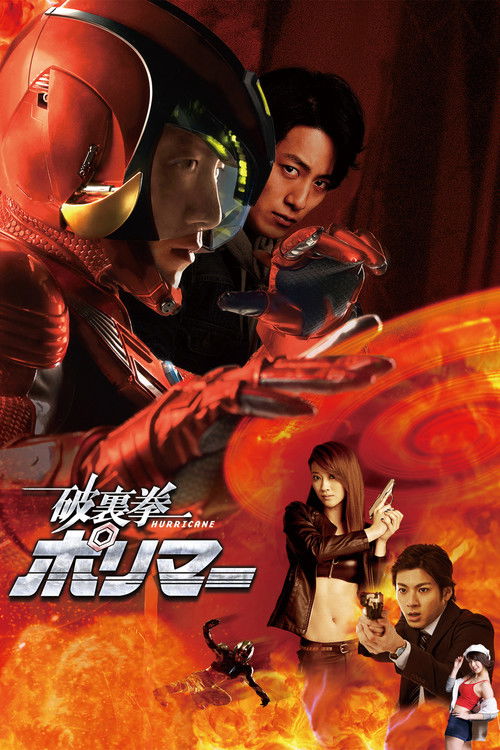
Hurricane Polymar opens on the familiar idea of a city trying to stay one step ahead of organized crime, but this time the fight is being waged in secret, through technology as much as through fists. The Metropolitan Police Department and the Ministry of Defense have quietly resumed development of the Polymar Suit, an advanced armored system meant to counter radicalized organized crime with heavy firepower resistance, solo combat capability, and exceptional mobility. In the middle of that hidden project stands Akihito Yashiro, the newly inaugurated police superintendent overseeing the revived program, while the investigators on the ground are forced to deal with the consequences when the first test suits disappear into criminal hands.
At the center of the story is Takeshi Yoroi, a former street fighter who now works as a private investigator. In the older Polymar mythology, Takeshi's life has always been defined by a tension between discipline and rebellion: he trains relentlessly, wants to be useful in crime-fighting, and yet cannot fit neatly into the expectations of authority. That history matters here because his abilities are not just a gift but a burden, something he has to learn to carry on the margins before he is trusted with anything official. In this version, he is drawn into the police operation only because the situation has become too dangerous to handle conventionally.
The inciting crisis is the theft of three test-version Polymar Suits. Their disappearance turns a covert government project into a public threat, because the stolen suits are then used in a wave of crimes and terrorist attacks. The police realize that whoever has them can now mimic the same advanced combat advantages the state intended to monopolize, and that means the enemy is no longer just organized crime in the abstract but criminals with access to the same power structure as the police themselves. Takeshi is asked to cooperate in the investigation, and in that process he learns that he is the one chosen to wield the strongest Polymar Suit ever.
That suit is not a simple costume or weapon; it is what transforms Takeshi Yoroi into Hurricane Polymar, a superhero with super strength, high-speed rotation, and the ability to transform into five different kinds of vehicles. The suit also comes with a strict limit: he can remain transformed for only 46 minutes and 1 second before reverting. That countdown hangs over the story like a visible clock, turning every battle into a race against time. Once he suits up, the film's basic shape becomes clear: the former street fighter is now the police's most powerful answer to the stolen-suit crisis, but every victory he earns comes with the danger of running out of time before he can finish the job.
The investigation pulls Takeshi deeper into the city's criminal underworld, where the stolen technology is not being treated as a one-off gimmick but as the foundation for a coordinated assault on public order. The plot sources consistently describe the antagonists as villains, terrorists, or the people behind a "wave of terrorism," but they also make clear that the central mystery is who is really behind it all. One review summarizes the narrative bluntly: the story follows Takeshi as he has to "learn who is behind this wave of terrorism and essentially who is the big boss." That is the engine of the movie. Every fight, chase, and suit-powered confrontation becomes part of a larger attempt to expose the mastermind orchestrating the chaos.
Takeshi begins taking on the stolen-suit criminals as Hurricane Polymar, using the new power to fight enemies who are no longer inferior to the police in raw technology. Because the criminals themselves use the same kind of suit-based advantage, each confrontation is also a mirror: the hero and the villains are both operating through artificially enhanced bodies, and the line between law enforcement and outlaw violence becomes less about what the suit can do and more about who controls it. The tension is heightened by the fact that Takeshi is not simply a soldier following orders; he is a detective by choice, someone who has to reason through the case even while throwing himself into combat.
As the story advances, the thefts and attacks stop looking like isolated incidents and start looking like an organized campaign. The police-side conspiracy behind the revived Polymar project is no longer enough to explain what is happening, because the stolen test suits are being used in the field with precision. Takeshi's role shifts from recovery to revelation. He is not just fighting the people using the suits; he is tracing the chain of responsibility upward, trying to find the person who turned a covert defense initiative into a weapon for terror. The suit's 46-minute limit gives every mission urgency, forcing him to enter confrontations knowing that if he misjudges the clock, he becomes vulnerable at the worst possible moment.
The movie's emotional core comes from Takeshi's transformation. He is still the same man who once lived as a street fighter and a private investigator, but now he stands between the city and the consequences of stolen state technology. In the older franchise background, Takeshi's journey into heroism begins with training, rejection, and the acquisition of a special polymer stronger than steel. That legacy echoes here as he moves from being a man on the fringe to the city's last line of defense. The suit does not erase his past; it weaponizes it. His martial-arts discipline, street instincts, and reluctance to submit to authority become exactly what the investigation needs.
The final act brings all of the story's pressures together. By this point, Takeshi has uncovered enough to understand that the suit thefts and the terrorist violence are the work of a hidden mastermind rather than opportunistic criminals. The climax is a direct confrontation with the figure behind the broader conspiracy, the person the summaries refer to as the "big boss." This is the movie's decisive showdown: Hurricane Polymar faces the architect of the stolen-suit campaign in a battle that resolves the mystery by force. The suit's mobility and transformation abilities become crucial here, because the villain's power comes from the same technological lineage, making the conflict less a traditional superhero fight than a collision between competing uses of the same invention.
Because the available sources do not give a full scene-by-scene breakdown, they do not allow a reliable, detailed inventory of every single confrontation, all exact locations, or every death with certainty. What they do establish is that the story's structure is built around the recovery of the stolen Polymar Suits, the exposure of the conspiracy using them, and a final battle in which Takeshi as Hurricane Polymar defeats the mastermind driving the terror campaign. The film ends with that central threat confronted and the stolen-suit crisis resolved through Takeshi's victory as the armored hero. In the final stretch, the tense countdown of the suit, the detective's persistence, and the government's secret project all converge into one answer: the man once rejected by the system becomes the only one capable of saving it.
More Movies Like This
Browse All Movies →




What is the ending?
In the ending of Hurricane Polymar, the protagonist, Polymar, faces off against the main antagonist, who has been wreaking havoc. After a fierce battle, Polymar manages to defeat the antagonist, restoring peace. The film concludes with a sense of hope and renewal, as the characters reflect on their experiences and the bonds they have formed.
As the climax of Hurricane Polymar unfolds, the scene is set in a devastated city, where chaos reigns due to the antagonist's destructive plans. The air is thick with tension, and the remnants of the once-bustling streets are now littered with debris. Polymar, determined and resolute, stands at the center of the chaos, his costume tattered but his spirit unbroken. He knows that the fate of the city rests on his shoulders.
The battle begins with a fierce confrontation between Polymar and the antagonist, who is revealed to be a powerful figure with a personal vendetta against the city. The antagonist, cloaked in darkness, taunts Polymar, revealing his intentions to bring about total destruction. Polymar, fueled by a mix of anger and determination, charges forward, his fists clenched and his heart racing. The two engage in a brutal exchange of blows, each strike echoing the stakes of their conflict.
As the fight intensifies, Polymar recalls the support of his friends and allies, which strengthens his resolve. Flashbacks of their shared moments--laughter, struggles, and victories--flood his mind, reminding him of the importance of fighting for those he loves. This emotional connection fuels his power, allowing him to push through the pain and exhaustion.
In a pivotal moment, Polymar taps into his full potential, unleashing a powerful attack that catches the antagonist off guard. The energy radiates from him, illuminating the darkened streets, symbolizing hope amidst despair. With a final, decisive blow, Polymar defeats the antagonist, who collapses in defeat, his plans thwarted. The city begins to recover, and the chaos slowly subsides.
As the dust settles, Polymar stands amidst the ruins, breathing heavily but victorious. His friends and allies gather around him, their expressions a mix of relief and admiration. They share a moment of silence, acknowledging the sacrifices made and the bonds forged through their struggles. Each character reflects on their journey, understanding that they have grown stronger together.
In the aftermath, the city begins to rebuild. Polymar, now a symbol of hope, is celebrated by the citizens. He realizes that his true strength lies not just in his powers but in the connections he has made. The film closes with a panoramic view of the city, now bathed in sunlight, signifying a new beginning. Polymar looks towards the horizon, a determined smile on his face, ready to face whatever challenges may come next.
The fates of the main characters are intertwined with this resolution. Polymar emerges as a hero, having learned the value of friendship and resilience. The antagonist, defeated, is left to contemplate his choices, hinting at the possibility of redemption. The supporting characters, having fought alongside Polymar, find renewed purpose in their lives, united by their shared experiences. The ending encapsulates the themes of hope, unity, and the enduring spirit of those who stand together against adversity.
Is there a post-credit scene?
Yes, "Hurricane Polymar" features a post-credit scene that adds an intriguing layer to the film's narrative.
As the credits roll, the screen fades to black before transitioning to a scene set in a dimly lit laboratory. The atmosphere is tense, filled with the hum of machinery and the flickering of monitors displaying various data. A shadowy figure is seen working diligently at a workstation, surrounded by blueprints and high-tech gadgets.
The camera zooms in on a close-up of the figure's hands, which are manipulating a small device that resembles a futuristic communicator. The figure, shrouded in mystery, speaks softly, revealing a sense of urgency and determination. They mention the need to prepare for the next phase of their plan, hinting at a larger threat looming on the horizon.
As the scene progresses, the figure turns slightly, and the audience catches a glimpse of their face, revealing a familiar character from the film who had been presumed defeated. This revelation sends a jolt of excitement, suggesting that the story of Hurricane Polymar is far from over and that new challenges await the heroes.
The scene concludes with a dramatic cut to black, leaving viewers with a sense of anticipation and curiosity about what lies ahead for Polymar and his allies. This post-credit moment effectively teases potential future developments, ensuring that fans are left eager for more adventures.
What motivates the main character, Polymar, to become a hero?
Polymar, whose real name is Kamen Rider, is driven by a strong sense of justice and a desire to protect the innocent. His transformation into Hurricane Polymar is fueled by his determination to fight against the evil organization that threatens his city, as well as his personal connections to those affected by the chaos.
How does the relationship between Polymar and his mentor evolve throughout the film?
Initially, Polymar looks up to his mentor, who embodies the ideals of heroism and strength. However, as the story progresses, Polymar begins to question his mentor's methods and motivations, leading to a rift that forces him to confront his own beliefs about what it means to be a hero.
What role does the antagonist play in Polymar's journey?
The antagonist, a powerful figure within the evil organization, serves as both a physical and ideological challenge for Polymar. Their confrontations push Polymar to his limits, forcing him to confront his fears and insecurities, ultimately shaping his growth as a hero.
What are the key challenges Polymar faces in his battles against the villains?
Polymar faces numerous challenges, including overwhelming odds, the betrayal of allies, and the emotional toll of fighting against those he once considered friends. Each battle tests not only his physical abilities but also his resolve and commitment to his ideals.
How does the film depict the theme of sacrifice through Polymar's character?
Throughout the film, Polymar is faced with choices that require him to sacrifice his personal desires and safety for the greater good. These moments highlight his internal struggle and the weight of his responsibilities as a hero, ultimately showcasing the depth of his character and the lengths he is willing to go to protect others.
Is this family friendly?
"Hurricane Polymar," produced in 2017, is a live-action adaptation of the classic anime and manga series. While it features superhero themes and action, there are several aspects that may be considered objectionable or upsetting for children or sensitive viewers.
-
Violence: The film contains scenes of combat and action that may be intense. Characters engage in fights, and there are moments of physical harm that could be distressing.
-
Dark Themes: The narrative explores themes of loss, betrayal, and the struggle against evil, which may be heavy for younger audiences to process.
-
Mature Language: There are instances of strong language that may not be suitable for children.
-
Emotional Turmoil: Characters experience significant emotional distress, including moments of fear, anger, and sadness, which could be unsettling for sensitive viewers.
-
Supernatural Elements: The presence of supernatural powers and transformations may be frightening for younger children who are sensitive to such themes.
Overall, while "Hurricane Polymar" has elements of adventure and heroism, its darker themes and intense action may not make it entirely family-friendly for all audiences.








