






Popular
What motivates Deborah Harry to avoid interviews throughout the film?
How does Deborah Harry's relationship with her bandmates influence her perspective on interviews?
What specific experiences from Deborah Harry's past contribute to her feelings about the media?
How does Deborah Harry express her emotions when confronted with interview requests?
What role does the documentary crew play in Deborah Harry's journey throughout the film?
Should I watch it?
Ask Your Own Question

What is the plot?
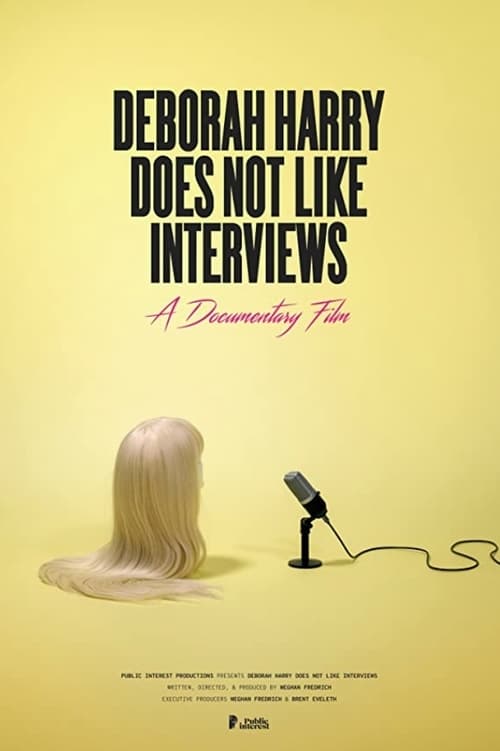
Deborah Harry sits inside a barrage of old interview footage, and the film opens by making the humiliation immediate: journalists keep greeting her not as a musician, but as a face, a fantasy, a blonde icon to be compared to Marilyn Monroe and measured against whatever shallow pop-image they can name next. The first moments do not bother with a traditional setting or date card. Instead, the movie plunges straight into a collage of press encounters from the early Blondie years, the image quality rough and timeworn, the cuts abrupt, the tone half-amused and half-cruel. Harry appears as herself, composed at first, coolly present, and already visibly aware that the people asking questions are not really listening to her answers.
The early interviews establish the pattern that drives the entire film. One interviewer leans into the same tired frame that dozens of others will repeat: Debbie Harry is treated like a reincarnation of Marilyn Monroe, a "sex symbol," a blank surface onto which a male interviewer can project his fantasy. Another keeps circling her looks, her body, her supposed allure, as if Blondie's frontwoman exists only to be visually consumed. Harry answers with restraint. She does not explode right away. Instead she offers the kind of measured politeness that comes from having learned, very quickly, that public composure is its own form of survival. Her expression tightens slightly, her eyes flick with irritation, but she keeps her voice level. The film's tension comes from that restraint; every bad question lands like a fresh slap, and every careful reply carries the weight of someone trying not to give the interviewer the satisfaction of seeing her crack.
As the montage continues, the interviews become more invasive and more absurd. The film does not settle into one location, because the real setting is the media machine itself: studio corners, backstage spaces, press junkets, microphone stands, televised sit-downs, all of them interchangeable arenas where the same lazy assumptions are repeated. Questions arrive about her beauty, her desirability, her place among other famous women, her relationship to trend-driven pop culture, and whether she is somehow supposed to explain herself through the lens of whoever the interviewer has decided she resembles. The comparisons to Madonna and other pop stars come up as if they are clever observations rather than reductions, and Harry's patience shortens each time. She refuses to accept those premises. When an interviewer tries to trap her in a banal comparison, she does not volunteer the expected sound bite. She pushes back with a look, a pause, a clipped answer, sometimes a dry joke, and sometimes just a stare that says the question itself is beneath response.
The film's rhythm is built on accumulation. A question is asked, Harry resists, another interviewer steps in with a nearly identical insult disguised as curiosity, and the cycle repeats. At first, her resistance is subtle. She seems surprised that the interviewers really mean to stay on this track. Then the surprise turns into expectancy, the sense that she now knows exactly what kind of nonsense is coming and is bracing herself for it. Her tactic shifts from earnest engagement to evasive humor. She answers just enough to keep the exchange moving, but not enough to let the interviewer control the narrative. A smile appears, but it is the smile of someone who has recognized a hostile game and intends to survive it by playing better than the people who invented it.
One of the film's recurring visual jokes comes in the form of a stuffed animal mascot, which appears amid the archival clips like a weird talisman from a more ridiculous era of celebrity media. It functions less like a story object and more like a reminder of how childish, theatrical, and demeaning the whole interview circus can be. The mascot's presence makes the surrounding questions feel even more surreal. Harry is being asked to perform intelligence, sex appeal, irony, and gratitude all at once, while the surrounding visual culture treats her as a novelty item. The effect is both comic and sad. The film makes clear that the laughter is often coming from embarrassment, from disbelief at how relentless and stupid the questions are.
The pressure keeps building. Harry's posture changes. She is still composed, but now the composure feels hard-earned, almost armored. She begins to show visible frustration. Her answers grow shorter. She gives off the air of someone who has heard every variation of the same degrading inquiry and no longer feels obliged to pretend each one is fresh. Her expressions tell the story as much as her words do. Sometimes she looks directly at the camera with a face that seems to ask the audience whether they can believe the nonsense she is being subjected to. Sometimes she looks away, as if deciding whether to even dignify the exchange. The film lets those reactions speak, and the result is that her silence becomes a rebuttal in itself.
The documentary's central revelation is not some hidden secret from Harry's private life. It is the way she learns, over years of repetition, to turn the interview dynamic back on the people interviewing her. That transformation is the film's real arc. The early interviews show a young star trying to maintain grace while being treated like an object. Later, the same woman appears more strategic, more willing to push back, more able to outlast and outmaneuver the men and women who approach her with a stale set of assumptions. She no longer accepts the frame. She answers on her own terms or not at all. The film treats this as the moment when the subject stops being passive material and becomes an active critic of the form itself.
As the montage presses onward, the questions get no better. The interviewers keep trying to pin Harry down as if she owes them a neat explanation of femininity, fame, or style. But the film keeps showing that she understands exactly what is happening. She knows the sexualized, sexist structure of the encounter. She knows the interviewer often wants not insight, but confirmation of their own fantasies. The emotional movement of the film is in watching her process this over time. At one point she seems merely annoyed; later she is openly skeptical; later still she is visibly tired, and then there are flashes of anger that break through the cool surface. Those flashes matter because they are earned. They are not random mood swings. They are the emotional residue of years of being pressed into a role she did not choose.
The interviewers' fixation on her image also links her to a broader media mythology. Blondie's frontwoman is framed as a pop-cultural object first and a person second. The film repeatedly exposes how journalists flatten her into "the blonde," "the beauty," "the sex symbol," "the Marilyn Monroe of punk," as if those labels are clever enough to replace actual conversation. Harry's responses, especially as the film goes on, refuse that flattening. When the questions become especially lazy, she meets them with irony so sharp it feels like a blade hidden inside a joke. When a question deserves no serious answer, she gives it none. The refusal is the point. The documentary turns every dead-end exchange into evidence of her intelligence and endurance.
There is no murder, no physical death, no conventional villain to defeat. The movie's conflict is verbal and cultural, and its casualties are dignity, patience, and time. What is "killed" here is the possibility of a real conversation, and that is why the film's confrontations feel so tense. Harry is constantly fighting for the right not to be reduced. Each interviewer tries to keep the conversation in the comfortable territory of cliché. Each time, Harry narrows the distance between herself and the viewer, so that the audience can see the strain behind the glamour and the calculation behind the smile. The more she resists, the more the film belongs to her rather than to the interviewers.
Near the end, the tone changes again. Harry's guarded politeness gives way to something more openly cutting. She no longer simply dodges; she punctures. She pushes the absurdity back toward the source. The movie gathers these late moments into a kind of cumulative declaration: enough. Enough with the reductive comparisons. Enough with the questions that pretend to be about music but are really about ownership, sexuality, and public consumption. Her refusal becomes exhilarating because it has been so carefully earned. The film does not invent a triumphant showdown. It finds triumph in persistence. She does not win by dazzling anyone with a big speech; she wins by outlasting the people who think they can wear her down.
The final stretch crystallizes the whole argument of the documentary. By then, the audience has seen the pattern clearly: interviewers arrive armed with banality, Harry absorbs the insult, then adapts. The archival footage itself becomes the proof. The degraded images, the clipped questions, the awkward pauses, the sarcastic glances, the small explosions of annoyance, all add up to a portrait of a woman repeatedly refusing the role assigned to her. The film's title becomes an explanation and a warning. Deborah Harry does not like interviews because interviews, in these clips, are often instruments of condescension. Her dislike is not petulance. It is a sane reaction to a demeaning ritual.
The ending does not resolve the problem in the sense of correcting the media culture that produced it. Instead, it closes by emphasizing the strategy Harry develops: she turns the interview on its head. The power dynamic shifts. The journalists no longer control the terms so easily, because Harry has learned how to deprive them of the easy answers they are fishing for. She outlasts them with wit, silence, irritation, and precise refusal. The film ends on that note of hard-won resistance, leaving the viewer with the sense that the real story was never the superficial questions at all. It was the accumulated intelligence and endurance required to survive them, and the quiet victory of a woman who refuses, again and again, to let other people define her.








What is the ending?
In the ending of "Deborah Harry Does Not Like Interviews," Deborah Harry finally confronts her feelings about fame and her relationship with the media. After a series of candid moments and reflections throughout the film, she decides to embrace her identity on her own terms, leading to a poignant moment of self-acceptance. The film concludes with her stepping away from the spotlight, choosing to focus on her personal life and artistic endeavors rather than the pressures of public scrutiny.
As the final scenes unfold, the camera captures Deborah sitting in a dimly lit room, surrounded by memorabilia from her career. The walls are adorned with posters and photographs that tell the story of her rise to fame. She gazes thoughtfully at a framed picture of her younger self, a mixture of nostalgia and contemplation washing over her face. The soft glow of the light casts shadows that dance across her features, emphasizing the weight of her experiences.
In this moment, Deborah reflects on the countless interviews she has given over the years, the questions that have often felt invasive, and the persona she has had to maintain. Her internal struggle is palpable; she has always been a public figure, yet she longs for the freedom to express herself without the constraints of public perception. The camera zooms in on her eyes, revealing a depth of emotion as she grapples with her identity beyond the stage.
The scene shifts to a montage of her past performances, interspersed with clips of her interacting with fans and the media. Each clip serves as a reminder of the duality of her existence--celebrated by many, yet often misunderstood. As the montage plays, the soundtrack swells with a haunting melody that underscores her journey, evoking a sense of both triumph and sorrow.
In the final moments, Deborah stands up, her posture straightening as she takes a deep breath. She walks towards a window, sunlight streaming in, illuminating her figure. This act symbolizes her decision to step into a new chapter of her life, one where she prioritizes her own happiness and creativity over the demands of fame. The camera captures her silhouette against the light, a powerful image of resilience and self-discovery.
As the credits begin to roll, the audience is left with a sense of closure. Deborah Harry, once a reluctant participant in the world of interviews, has found her voice and agency. The film ends on a note of hope, suggesting that true fulfillment comes from within, rather than from external validation. Each character, particularly Deborah, has undergone a transformation, learning to navigate the complexities of identity, fame, and personal truth.
Is there a post-credit scene?
In "Deborah Harry Does Not Like Interviews," there is indeed a post-credit scene that adds a whimsical touch to the film's exploration of the iconic musician's relationship with fame and media.
As the credits roll, the screen fades to black before transitioning to a dimly lit room filled with vintage memorabilia from Blondie's heyday. The camera pans slowly across the walls adorned with posters, gold records, and photographs, creating a nostalgic atmosphere.
Suddenly, the scene shifts to Deborah Harry herself, sitting comfortably in a cozy armchair, a playful smirk on her face. She looks directly into the camera, her eyes sparkling with mischief. "You thought I was done talking, didn't you?" she quips, her tone light and teasing.
She then leans forward, her expression shifting to one of sincerity. "But really, I just want to say thank you to everyone who has supported me and my music over the years. It's been a wild ride, and I wouldn't change a thing."
As she speaks, the camera captures her genuine warmth, revealing a side of her that contrasts with the guarded persona she maintained throughout the film. The scene closes with her laughing softly, a hint of vulnerability shining through, before the screen fades to black once more, leaving the audience with a sense of connection to the artist beyond her public image.
This post-credit moment encapsulates the film's themes of identity and the complexities of being in the spotlight, providing a heartfelt conclusion to Deborah Harry's narrative journey.
What motivates Deborah Harry to avoid interviews throughout the film?
Deborah Harry's aversion to interviews stems from her desire for privacy and her discomfort with the media's tendency to sensationalize her life and career. She feels that interviews often misrepresent her true self and reduce her artistic expression to mere soundbites.
How does Deborah Harry's relationship with her bandmates influence her perspective on interviews?
Deborah's relationship with her bandmates is complex; they share a deep bond forged through years of collaboration. However, she often feels that their perspectives on publicity and media differ, leading her to feel isolated in her decision to avoid interviews, as she values authenticity over commercial success.
What specific experiences from Deborah Harry's past contribute to her feelings about the media?
Throughout the film, flashbacks reveal pivotal moments in Deborah's past, including early experiences with fame that left her feeling objectified and misunderstood. These experiences shape her current stance, as she recalls instances where the media distorted her words or focused on her appearance rather than her music.
How does Deborah Harry express her emotions when confronted with interview requests?
When confronted with interview requests, Deborah often displays a mix of frustration and vulnerability. Her body language becomes tense, and her facial expressions reveal a deep-seated anxiety about being misrepresented, showcasing her internal struggle between her public persona and her private self.
What role does the documentary crew play in Deborah Harry's journey throughout the film?
The documentary crew serves as both a catalyst and a mirror for Deborah's journey. Their persistent questioning and filming force her to confront her feelings about fame and media, leading to moments of introspection where she grapples with her identity as an artist versus her desire for solitude.
Is this family friendly?
"Deborah Harry Does Not Like Interviews" is a documentary that explores the life and career of the iconic musician and actress Deborah Harry. While the film primarily focuses on her artistic journey, it does contain some elements that may not be considered family-friendly.
-
Mature Themes: The film touches on themes of fame, personal struggles, and the music industry, which may include discussions about substance use and the pressures of celebrity life.
-
Language: There may be instances of strong language or adult conversations that could be inappropriate for younger audiences.
-
Emotional Depth: The documentary delves into Harry's personal experiences, including moments of vulnerability and sadness, which might be upsetting for sensitive viewers.
-
Candid Reflections: Deborah Harry's candid reflections on her life and career may include discussions of relationships and experiences that are more suitable for an adult audience.
Overall, while the film is a celebration of Harry's contributions to music and culture, its mature themes and emotional content may not be ideal for children or those who are particularly sensitive to such topics.