
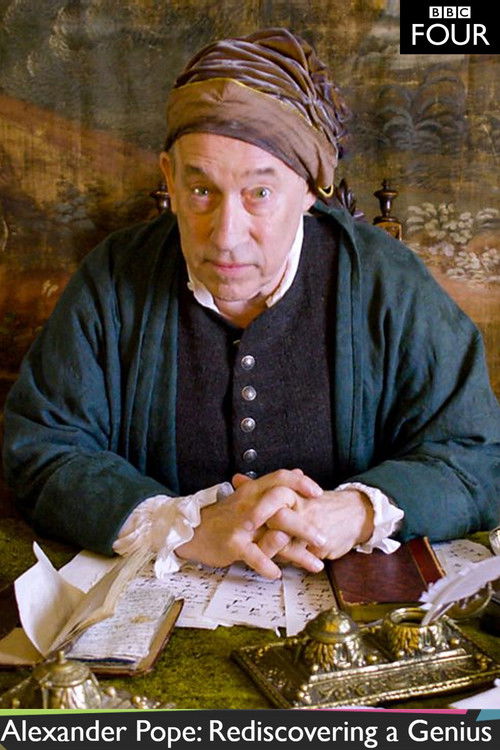








Popular
What are the key events that showcase Alexander Pope's struggles with his health and how do they impact his writing?
How does the relationship between Alexander Pope and his contemporaries, such as Jonathan Swift and John Gay, evolve throughout the film?
What role does Pope's family play in shaping his character and ambitions throughout the film?
How does the film depict the process of Pope's writing, particularly his approach to crafting 'The Rape of the Lock'?
What are the significant moments that highlight Pope's battles with critics and how do they affect his self-perception?
Should I watch it?
Ask Your Own Question

What is the plot?
Sorry, we aren't able to watch and write up a full detailed plot yet. Check back in a few days.
More Movies Like This
Browse All Movies →


What is the ending?
In the ending of "Alexander Pope: Rediscovering a Genius," the film culminates in a poignant reflection on the life and legacy of Alexander Pope. As the narrative unfolds, the characters come to terms with Pope's influence on literature and society, ultimately celebrating his genius and the enduring relevance of his work.
As the film draws to a close, we see a series of scenes that highlight the impact of Pope's writings on his contemporaries and future generations. The final moments are filled with a sense of reverence and appreciation for Pope's contributions, leaving the audience with a lasting impression of his brilliance.
Now, let's delve into the ending in a more detailed, chronological narrative.
The final act begins with a gathering of scholars and admirers in a grand hall, adorned with portraits of Alexander Pope. The atmosphere is charged with anticipation as they prepare to discuss his legacy. The camera pans across the room, capturing the faces of those who have been deeply influenced by Pope's work. Among them are literary critics, poets, and historians, each holding a copy of Pope's most famous works.
As the discussion commences, a prominent scholar stands to speak. He passionately recounts the struggles Pope faced due to his physical ailments and societal challenges. The audience listens intently, their expressions reflecting a mix of admiration and empathy. The scholar emphasizes how Pope's resilience and wit allowed him to transcend his limitations, crafting verses that resonate with universal themes of human experience.
Transitioning to a montage, the film intercuts scenes of Pope's life with the present-day gathering. We see young Pope, frail yet determined, scribbling furiously at his desk, surrounded by stacks of paper. His brow furrows in concentration, and his eyes gleam with the fire of creativity. The montage juxtaposes his struggles with the accolades he received, showcasing the stark contrast between his personal battles and the public's adoration.
As the montage fades, the scene shifts back to the hall, where a young poet stands to share her own work inspired by Pope. Her voice trembles with emotion as she reads her poem, drawing parallels between her experiences and the themes found in Pope's writings. The audience is visibly moved, some wiping away tears, as they recognize the timelessness of Pope's insights.
In the final moments, the camera focuses on a large portrait of Alexander Pope, illuminated by soft lighting. The narrator's voice echoes, reflecting on the enduring nature of Pope's genius. The film closes with a sweeping shot of the gathering, now united in a collective appreciation for the man who, despite his challenges, left an indelible mark on literature.
As the credits roll, we see brief glimpses of the characters from the gathering, each contemplating their own relationship with Pope's work. The prominent scholar, now deep in thought, realizes that Pope's legacy is not just in his words but in the inspiration he continues to provide to writers and thinkers alike. The young poet, filled with newfound confidence, vows to carry forward the spirit of creativity that Pope embodied.
In this way, the film concludes, leaving the audience with a profound sense of connection to Alexander Pope and a reminder of the power of literature to transcend time and circumstance.
Is there a post-credit scene?
The movie "Alexander Pope: Rediscovering a Genius" does not feature a post-credit scene. The film concludes with a reflective montage that encapsulates the essence of Alexander Pope's contributions to literature and his enduring legacy. As the credits roll, viewers are left with a sense of closure, having explored the complexities of Pope's life, his struggles with health, and his triumphs in the literary world. The final images serve to reinforce the impact of his work on subsequent generations, but there are no additional scenes or content after the credits.
What are the key events that showcase Alexander Pope's struggles with his health and how do they impact his writing?
The film illustrates Alexander Pope's ongoing battle with health issues, particularly his frail constitution due to tuberculosis. Key scenes depict him as a child, struggling with physical limitations, which instills in him a sense of determination to prove his worth through poetry. As he grows, his health continues to affect his social interactions and public perception, leading to moments of isolation that deepen his emotional connection to his work. These struggles are poignantly captured in scenes where he writes in pain, yet finds solace in the beauty of language, showcasing the duality of his suffering and creativity.
How does the relationship between Alexander Pope and his contemporaries, such as Jonathan Swift and John Gay, evolve throughout the film?
The film portrays a complex web of friendships and rivalries among Pope, Swift, and Gay. Initially, there are scenes of camaraderie, where they share ideas and critique each other's work, highlighting their mutual respect. However, as Pope's fame grows, tensions arise, particularly with Swift, who feels overshadowed. The film captures pivotal moments of conflict, such as heated discussions over literary styles and personal betrayals, ultimately leading to a poignant reconciliation that underscores the fragility of their relationships.
What role does Pope's family play in shaping his character and ambitions throughout the film?
Pope's family, particularly his father, is depicted as a significant influence on his early life. The film shows scenes of his father's encouragement in literature, which ignites Pope's passion for writing. However, the family's financial struggles also create a sense of urgency in Pope to succeed. As the narrative unfolds, the emotional weight of his family's expectations and sacrifices becomes evident, driving Pope to push the boundaries of his talent, even as he grapples with feelings of inadequacy.
How does the film depict the process of Pope's writing, particularly his approach to crafting 'The Rape of the Lock'?
The film intricately details Pope's creative process, especially in the scenes leading up to the writing of 'The Rape of the Lock.' Viewers witness his meticulous attention to detail as he drafts and revises, often reading aloud to friends for feedback. The emotional stakes are high, as the poem is inspired by a real-life incident involving a friend, which adds layers of personal investment. The film captures the joy and frustration of creation, illustrating how Pope's wit and satirical edge emerge through his struggles to balance humor with poignant social commentary.
What are the significant moments that highlight Pope's battles with critics and how do they affect his self-perception?
The film features several confrontational scenes where Pope faces criticism from literary rivals and societal elites. These moments are charged with tension, showcasing Pope's vulnerability as he grapples with harsh reviews and public mockery. The emotional turmoil is palpable as he reflects on his worth as a poet, leading to moments of self-doubt. However, these challenges also fuel his resolve to defend his work, culminating in a powerful scene where he confronts a critic, asserting his place in the literary world, which ultimately reinforces his identity as a genius.
Is this family friendly?
The movie "Alexander Pope: Rediscovering a Genius" is generally family-friendly, focusing on the life and works of the renowned poet Alexander Pope. However, there are a few aspects that might be considered potentially objectionable or upsetting for children or sensitive viewers:
-
Themes of Illness and Disability: The film touches on Pope's struggles with health issues, including his physical disabilities, which may evoke feelings of sadness or discomfort.
-
Historical Context: Some scenes depict the harsh realities of the time, including social injustices and conflicts, which might be challenging for younger audiences to fully understand.
-
Emotional Struggles: The film explores Pope's internal conflicts, including feelings of isolation and rejection, which could resonate deeply and may be upsetting for sensitive viewers.
-
Criticism and Controversy: There are moments where Pope faces criticism from his contemporaries, which may include harsh words or confrontational exchanges that could be intense for some viewers.
Overall, while the film is educational and insightful, these elements may require parental guidance for younger audiences.








