



Popular
How does Najma’s **iddaa** or mourning period shape her movements, routines, and choices after her husband’s death?
What exactly happens when **Surya** first comes to Najma’s house, and why is he there?
Why does Najma initially refuse to show her face to **Surya**, and how does that affect their interaction?
What do Najma and **Surya** talk about during the two days they are trapped together?
How does **Najma’s background as a nurse** and her recent marriage connect to her conflict with grief and isolation?
Should I watch it?
Ask Your Own Question

What is the plot?
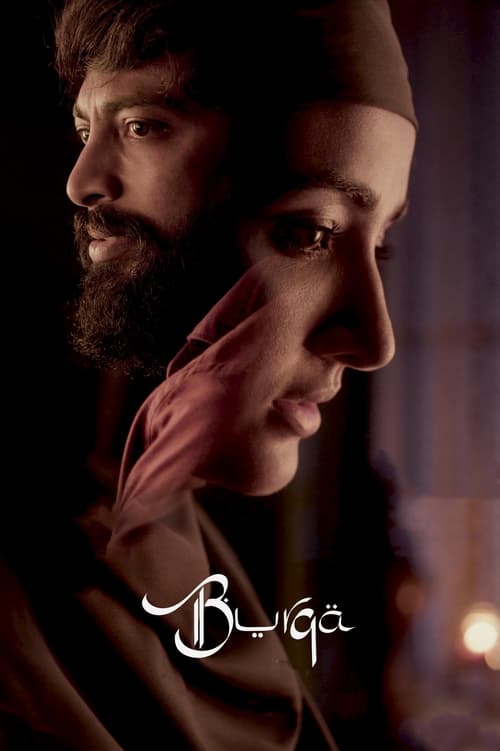
Sarjun KM's Burqa begins in Chennai on a night thick with communal unease, with a curfew already in force on the eve of a riot. The date is never firmly stated in the available descriptions, though one critic suggests it may be December 6, a detail that hangs over the film like a warning bell because it evokes the anniversary of the Babri Masjid demolition and the religious violence that shadows the story's world. The film immediately narrows its focus from the city's public tension to a single home, and that enclosed domestic space becomes both shelter and trap. Inside that house lives Najma, a 21-year-old Muslim woman who has recently become a widow, and the story opens around her solitude, grief, and the strict mourning rules now governing her life.
Najma is introduced not as a symbol but as a young woman with a profession and a history. She is a nurse by education, recently married through arranged marriage, and still close enough to the beginning of married life that the loss of her husband feels abrupt and devastating. Her husband, Anwar, is presented only through memory and conversation because he is already dead when the main action begins. Their marriage has only lasted about two months; he is described as kind and gentle, the sort of man who warms to her and with whom she begins to build the tenderness of a real relationship. The film makes this loss sting by revealing that the couple had been planning to go on their honeymoon and consummate the marriage, a future that is cut off before it can begin. Anwar's death in a road accident is the event that creates Najma's present condition: she is now in iddah, the required mourning period after widowhood, during which she must remain secluded and is not supposed to meet unrelated men.
That religious restriction is not just background; it is the first emotional and ideological pressure point in the film. Najma is alone in the house on a night when the outside world is dangerous, and her isolation is intensified by the expectation that she must hide herself from the gaze of others while she grieves. The burqa-like covering and the larger practice of veiling become visual markers of that condition, not simply as clothing but as a lived structure of modesty, control, and invisibility. The film lets this silence sit for a moment before it is interrupted. A wounded stranger knocks on her door.
That stranger is Surya, also rendered as Soorya in some descriptions, and his arrival transforms the closed household into a tense arena of exchange. He is injured, in need of immediate help, and his physical condition forces Najma to decide whether to shut the door on him or act on the nursing skills that define her in ordinary life. She chooses compassion, though reluctantly, and takes him in to treat his wounds. The decision matters because it places humanitarian instinct directly against social and religious caution. She sees a bleeding man at her threshold, and for a moment the film frames that encounter as a test of principle: whether she can respond to suffering before fear and custom harden into refusal.
Surya is not merely a random passerby. As Najma tends to him, she learns that he is a goon connected with a Hindu fanatic party, a revelation that immediately reshapes the emotional temperature inside the house. The stranger in need is also ideologically dangerous, a man linked to the same kind of communal politics that define the riot atmosphere outside. The film does not need violence in the room to generate danger; the knowledge of who Surya is becomes enough. His presence in Najma's home under curfew turns the house into a suspended battlefield where identity, faith, and power are discussed with no easy escape route.
From this point on, Burqa unfolds almost entirely through conversation. The film is structured as a chamber drama, and the long night inside Najma's home becomes a sustained argument about religion, gender, equality, patriarchy, and the social rules that govern women's bodies and behavior. The first major confrontation happens almost immediately when Surya questions why Najma must remain hidden and why her face should be shielded from him. Rather than accept the norm as natural, he challenges the logic of the restriction itself, pressing the issue with a bluntness that is both provocative and destabilizing. He effectively asks why he should be the one barred from seeing her face when she is the one offering hospitality and care in her own home. That question lands hard because it turns the rules of modesty into a debate over agency: who is protected, who is controlled, and who is supposed to look away.
Najma does not respond as a passive victim. She defends the framework she has inherited, but the film lets her defense emerge from pain rather than obedience. Her mourning is not abstract theology; it is the condition of a young widow who has lost her first marriage before it could begin. When she speaks of her husband, she reveals the private damage behind the public rule. Anwar was good to her, and she had started to like him, but their shared life is gone almost before it starts. The irony is sharp: a woman being instructed to hide from the world is also a woman whose own life has been violently interrupted. The iddah period, rather than feeling like a cold ceremony, becomes the visible form of that interruption.
The film's tension grows because Surya is trapped. The curfew outside means he cannot simply leave after being bandaged and fed; he must remain in the house for two days. The outside riot and police restriction become invisible walls that keep the two characters together, forcing the debate to continue long after ordinary courtesy would have ended it. The confinement sharpens every sentence. The house, which should be a place of mourning and safety, turns into a space of intense scrutiny where Surya's questions keep cutting through Najma's defensive calm.
Najma's practical care becomes a form of resistance in itself. She cleans and stitches Surya's wounds, cuts away his blood-soaked shirt, and gives him another one to wear. The image of her as a nurse matters because it complicates any simple reading of her as sheltered or powerless. She knows the body, knows how to stop bleeding, and knows how to keep a person alive. Yet the film keeps asking whether such knowledge can heal anything beyond flesh. The central emotional question is whether Najma can mend the deeper injuries produced by patriarchy and communal fear, or whether those wounds remain open no matter how carefully she tends them.
As the night wears on, the conversation deepens into the personal. Surya asks about her past, and Najma's answers gradually reveal the full contour of her loss. She describes how recently she married, how swiftly she entered the role of wife, and how rapidly that role was taken away. The revelation that her husband died only a short time after the wedding turns her mourning from routine into a tragic suspension of possibility. Her whole future has been compressed into a brief, unfinished span of domestic hope. The film's emotional power comes from this contrast: the public language of religious practice is set against the private fact of a woman who never got the marriage she imagined.
Surya's ideological role is equally important. Though injured and dependent, he is argumentative, unafraid to pry, and openly skeptical of the customs that shape Najma's behavior. He keeps pressing her on why women are made to bear the burden of modesty and separation, and the discussion broadens into a critique of patriarchy itself. The film's title becomes increasingly pointed in this context: the burqa is not treated simply as fabric, but as a social sign under which women are made visible and invisible at the same time. Surya challenges the fairness of that system, while Najma is forced to articulate why the system still holds force in her life. The result is not a neat conversion but a difficult, intimate collision of belief and lived experience.
The curfew outside keeps the story taut. Because the riot situation continues, the night never fully relaxes into ordinary domesticity. Every sound from beyond the walls threatens the fragile equilibrium inside the room, and every pause in their dialogue carries the possibility that the encounter might turn into something more dangerous. But the film's suspense is not built on physical attack. It is built on the possibility that one of them may finally say something that cannot be taken back, exposing a truth that the other cannot absorb without pain. Their long discussion, therefore, becomes the dramatic engine of the film. It is through speech that the characters push against each other, and through speech that the film reveals the social contradictions surrounding them.
Najma's revelations about Anwar soften the film without reducing its complexity. She does not describe him as cruel or oppressive. On the contrary, he is a "nice man" who treated her gently, and the tragedy is precisely that his goodness still could not protect their future. This is what makes her widowhood so devastating: the loss is not the escape from abuse but the destruction of a hoped-for ordinary life. The film makes room for tenderness in that memory, and that tenderness keeps Najma from becoming merely a mouthpiece for tradition. She is speaking from grief, not doctrine.
At the same time, Surya's position is complicated by who he is. His affiliation with a Hindu extremist or fanatic political group gives his questions a dangerous edge. He is not a neutral liberal voice from outside the conflict; he carries the communal politics of the city into the room with him. That detail complicates any simple reading of him as the enlightened challenger to religious patriarchy. The film makes him both an outsider and a provocateur, someone whose personal injury has temporarily suspended his public aggression but not erased the worldview behind it. His presence therefore intensifies the ideological ambiguity of the entire encounter. Najma is talking to a man whose ideological home is hostile to hers, and yet the film insists on the possibility of human exchange despite that hostility.
The second day of confinement passes in this charged atmosphere. The two-day duration matters because it turns the film into a kind of pressure chamber: enough time for argument to deepen, not enough time for the outside world to dissolve. The house remains the only setting that matters, and each room becomes an extension of the debate. Najma prepares breakfast for Surya, still wearing the burden of custom and grief, while he continues to probe the logic of the rules that govern her life. The gesture of feeding him is both practical and symbolic. She sustains the man who questions her world, even as his questions unsettle the fragile structure that has defined her mourning.
What the film does not do is offer a conventional resolution through action. There is no reported murder, no arrest, and no final external catastrophe in the available sources. Instead, the climax is intellectual and emotional: the collision of Najma's lived widowhood with Surya's aggressive questioning of gendered religious practice reaches a point where neither side can fully transform the other. Najma's inward struggle remains unresolved because the rules she lives under are not easily abolished by argument, while Surya's challenge remains morally compromised by his extremist affiliation. The film's power lies in refusing to flatten either character into pure victim or pure villain.
By the end, the curfew has served its purpose. The outside riot world is still there, but the real confrontation has already happened in the sealed space of Najma's home, where grief, doctrine, prejudice, and empathy have all been forced into the same room. Najma remains a widow within her mourning period, still bound by iddah and still carrying the loss of Anwar, the husband she barely had time to know. Surya remains the wounded ideological intruder whose arrival set the whole debate in motion. The available descriptions do not report any final twist that overturns their encounter, and they do not record a death beyond Anwar's accident earlier in the story. The final scene therefore rests in sustained tension rather than dramatic closure: a young woman still enclosed by custom, a stranger who has unsettled her silence, and a house that has briefly become the stage on which private mourning and public argument collide.
In that ending, Burqa leaves the viewer with the image of two people who have not resolved the world between them but have forced it to speak. Najma's grief is unchanged in its essentials, Surya's challenge remains unresolved, and the burden of the burqa as symbol--of concealment, duty, and contested identity--hangs over the film's closing moments without being neatly lifted away.





What is the ending?
Najma keeps caring for Surya while she remains inside during her mourning period, and their long conversation changes both of them. By the end, Surya leaves, Najma's world has been shaken by what she has learned, and the film closes on her moving toward a freer sense of herself.
Najma is first shown in a confined state after her husband's sudden death, because she is observing her iddah and is not meant to meet other men. One night, Surya arrives at her door wounded and in need of help. Najma, trained as a nurse, tends to his injuries, and he stays inside her home because of the curfew outside. During the hours they spend together, the two of them talk about religion, gender, and equality, and the relationship becomes more emotionally open as the night goes on.
As the ending approaches, the conversation reaches its strongest point: Surya and Najma speak with enough honesty that the encounter becomes a turning point rather than just an accident of shelter. The film's ending leaves Najma changed by that meeting, no longer feeling the same limits in the same way, while Surya's role in the story ends with his departure after the night they share. The sources do not describe a more detailed final action scene, but they do make clear that the ending centers on Najma's inner release and Surya's exit from her life.
Najma's fate at the end is that she remains alive, but transformed by the experience and the questions it raises about her confinement and identity. Surya's fate is that he survives the night encounter and leaves after being cared for, with the story using his arrival and departure as the catalyst for Najma's change.
Is there a post-credit scene?
There is no reliable evidence in the available results that Burqa (2023) has a post-credit scene, so I cannot confirm one from the sources provided.
The available sources only establish that Burqa is a 2023 Tamil-language film and provide cast/marketing material, but they do not document any end-credits or post-credits sequence. Since none of the results specifically mention a stinger, the safest answer is that no post-credit scene is documented in the supplied sources.
How does Najma’s **iddaa** or mourning period shape her movements, routines, and choices after her husband’s death?
Najma is a 21-year-old newly widowed woman who enters a three-month mourning period after her husband dies in a road accident, and that confinement defines the film's central situation. She is described as being unable to freely meet other men during this period, and the story places her alone inside the house, following a restricted daily routine until Surya arrives at her door.
What exactly happens when **Surya** first comes to Najma’s house, and why is he there?
Surya appears at Najma's door one night during the second week of her mourning period after he has been injured. Najma grudgingly tends to him, and it becomes clear that he is a goon associated with a Hindu fanatic party, which sets up their tense forced interaction inside the house.
Why does Najma initially refuse to show her face to **Surya**, and how does that affect their interaction?
Najma refuses to show her face to Surya because she is observing the strict mourning restrictions tied to her widowhood and is trying to maintain distance from any unrelated man. That refusal creates a physically and emotionally constrained dynamic, with Surya forced to remain inside for two days because of the curfew outside, so the two can only interact through conversation.
What do Najma and **Surya** talk about during the two days they are trapped together?
Their conversation turns into a prolonged discussion about religion, gender, equality, and discrimination. The plot summaries emphasize that the film is built around these exchanges, which gradually move the two strangers from tension toward mutual understanding and a growing liking for each other.
How does **Najma’s background as a nurse** and her recent marriage connect to her conflict with grief and isolation?
Najma is introduced as a nurse by education who was married only two months earlier through an arranged marriage, and she had begun to warm to her husband before his sudden death. That short-lived domestic happiness makes her grief sharper, because she is forced from an emerging married life into immediate confinement and emotional isolation before she has really settled into that relationship.
Is this family friendly?
No, Burqa (2023) is not especially family-friendly for young children, and it is more suitable for teens or adults because it centers on grief, confinement, religion, and gender-related discussion rather than light entertainment.
Potentially objectionable or upsetting elements include: - Recent death and mourning: the story begins after the heroine's husband dies, and her enforced mourning period is a major part of the setup. - Grief and emotional distress: the film is built around loneliness, isolation, and intense emotional conversation. - Religious and gender conflict: the dialogue explicitly discusses religion, equality, and gender discrimination, which may be challenging or uncomfortable for sensitive viewers. - A tense situation with a stranger under one roof: two strangers are forced to stay together during curfew, which may create unease even though the film is primarily conversational rather than action-heavy. - Possibly mature interpersonal themes: the premise includes a newly widowed young woman, arranged marriage, and the couple's plans to consummate the marriage before the husband's death, which may be awkward for younger viewers.
If you want, I can also give you a very short "parental guidance" verdict in one line.







