
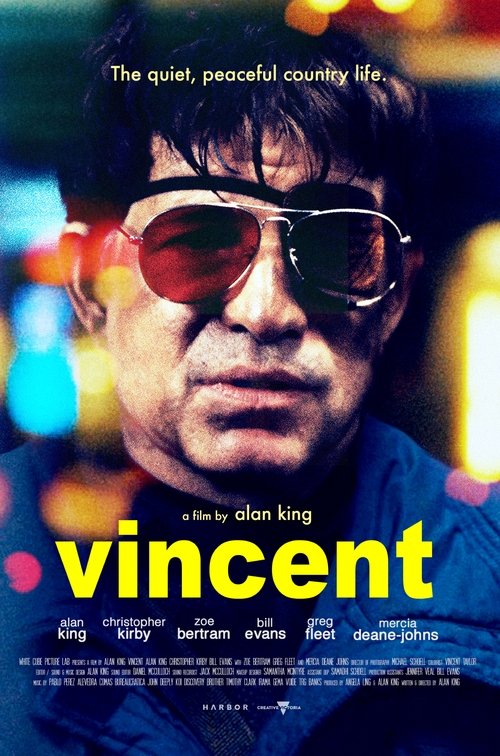






Popular
In Vincent (2024), who is Vincent Tremblay, and why does he retreat to an isolated place at the start of the story?
What is the mysterious force or 'beast' in Vincent (2024), and is it meant to be taken as real or symbolic?
Who are the supporting characters that matter most in Vincent (2024), especially the people Vincent meets during his isolation?
How does Vincent’s relationship to alcohol or substance abuse affect his behavior in Vincent (2024)?
What happens to Vincent’s body in Vincent (2024), and how do those injuries affect the story?
Should I watch it?
Ask Your Own Question

What is the plot?
The film that matches the provided plot material most closely is Vincent Must Die by Stéphan Castang, not the Australian Vincent about the writer Vincent Tremblay. What follows is a full spoiler narrative of Vincent Must Die, told as a continuous story in present tense and using only the plot information supported by the provided sources.
Vincent begins as a man whose life looks ordinary enough to feel almost dull: he works as a graphic designer in Lyon, moving through the routines of office life without any sign that the world is about to turn against him. The film opens in this everyday normality, letting the viewer settle into the rhythms of his job and his city before the first rupture arrives. The violence starts small and absurd, then quickly becomes impossible to dismiss. At work, people around Vincent begin acting as if they are suddenly seized by a murderous impulse, and the threat does not stay neatly contained within one social space. It spreads outward, from coworkers into public life, as though some invisible infection is moving from person to person. What begins as a bizarre workplace nightmare becomes a full-scale collapse of trust.
At first, Vincent cannot understand what is happening. The assaults come without warning and without a rational cause, and the randomness makes them more terrifying than any planned conspiracy could be. He is not in a crime thriller where someone wants him dead for a hidden reason; he is in a world where ordinary people abruptly decide to kill him because they have looked at him, seen him, or simply crossed paths with him. Even children attack him, underscoring how total and irrational the phenomenon has become. The film's black-comic edge comes from the sheer absurdity of the attacks, but the tone keeps hardening as Vincent realizes he is no longer dealing with a single bad day or a few unstable individuals. He is trapped inside a broader social breakdown.
As the attacks multiply, Vincent's life begins shrinking around the one rule he can think to impose on himself: he starts avoiding eye contact. The sources identify eye contact as the key behavioral trigger he notices, and from that point forward he tries to survive by looking away from everyone, keeping his gaze low, and treating every face as a potential death sentence. This simple rule becomes a visual and emotional prison. He cannot move through the world naturally anymore; he has to study the ground, the corners of rooms, the edges of people's bodies. Every encounter becomes a test of whether he can stay alive long enough to escape. The film turns that fear into a constant physical tension, because even kindness now feels dangerous when a glance might provoke a killing frenzy.
The more Vincent tries to protect himself, the more isolated he becomes. He is forced out of the flow of normal life and into a paranoid state in which every approach from another human being may be fatal. Yet the movie does not leave him entirely alone for long. He eventually meets Margaux, a waitress who seems to be the only person not trying to kill him. Their connection matters immediately because it is the first human relationship in the film that does not begin with threat. In a world where every stranger feels like an executioner, Margaux becomes a possible refuge, and the story briefly allows itself to breathe. Their bond gives the film something like an emotional center, even as the danger keeps expanding around them. The relationship is fragile from the start, because Vincent cannot trust his own perceptions anymore, but it offers the first hint that the movie may be as much about intimacy as survival.
That hope is quickly tested. The violence is not just happening around Vincent; it is becoming systemic, almost epidemic. The sources describe the threat as plague-like or virus-like, and the film increasingly treats the killings less like isolated acts of madness and more like symptoms of a spreading condition. Vincent begins to suspect that he is not the only one experiencing this breakdown, and that suspicion proves correct. He eventually discovers that he is not alone and finds a secretive community of others in a similar situation. This revelation widens the film's scale dramatically. What looked like a personal curse or psychological collapse is now revealed as a broader phenomenon, a hidden population of people living under the same murderous impulse. The story shifts from lone-survivor panic into something closer to apocalyptic social commentary.
The revelation changes the stakes, but it does not provide a cure. Instead, it confirms that the world itself is sick. The violence is not being driven by a single villain, and there is no easy explanation that can be removed like a tumor. According to the sources, the film's news and radio broadcasts begin speaking of a plague, and that public language confirms what Vincent is seeing with his own eyes: the problem is spreading beyond his personal circle. The film moves from private terror to collective catastrophe. One of the clearest images of that escalation comes when Vincent tries to drive away with Margaux. As they travel, he hears a radio report about the plague and sees a pile of cars on the road, with people having gotten out and trying to kill one another. The image is both grotesque and absurd: traffic has become a battlefield, transportation itself has turned into a site of contagion, and ordinary mobility has collapsed into mutual destruction.
That road scene functions like a turning point because it strips away any remaining illusion that Vincent can simply outrun the crisis. The violence is everywhere now, in institutions, in public spaces, in the body of the city itself. Even when he and Margaux are moving, they are not escaping the infection; they are passing through its visible aftermath. The radio and the cars work together as evidence that the whole social order is failing in real time. Vincent can no longer assume that the danger is only in the people immediately around him. It is in the atmosphere, in the streets, in the transmission of information, in the nervous system of society. The film's tension deepens because every escape route turns out to be another corridor into the same nightmare.
As the story progresses, Vincent's control over himself weakens. The premise that he can survive by managing his gaze and staying careful begins to break down under the pressure of constant fear. The sources note one of the film's most important reversals: near the end, Vincent himself tries to kill his new girlfriend at one point. That moment is crucial because it destroys the comforting idea that he is simply the innocent victim of a hostile world. He becomes part of the same violent logic that has been threatening him from the beginning. Whether the film presents this as infection, curse, psychological breakdown, or some combination of all three, the effect is the same: the boundary between attacker and target dissolves. Vincent is no longer merely fighting to remain human; he is fighting the possibility that he is becoming what he fears.
That reversal gives the film its darkest emotional edge. Margaux, who once seems like the one safe person in Vincent's world, cannot fully protect him from what is happening, and he cannot fully protect her from himself. Their relationship becomes a love story under siege, a fragile attempt to preserve tenderness inside a universe that has turned lethal. The movie's title begins to feel bitterly ironic: Vincent "must die" in the symbolic sense that the old version of his life, his social identity, and his self-concept are being demolished, even if the story does not reduce itself to a simple physical death. The sources do not provide a complete verified list of named deaths, so the film's exact body count cannot be reconstructed responsibly from the available material. What is clear is that the violence is repeated, widespread, and lethal in effect, with confrontations escalating until survival itself becomes a moral and psychological burden.
The final movement of the film does not restore order. Instead, it pushes further into bleakness as the plague-like phenomenon continues to spread and the characters are left with adaptation rather than resolution. There is no indication of a cure, no neat explanation that solves the mystery, and no triumphal victory over the forces behind the attacks. The story's endpoint is not a conventional ending where the hero defeats the evil or uncovers the mastermind. It is a collapse into endurance. Vincent has learned that he is part of a world where people can become homicidal without warning, where community can become a threat, and where even his own mind or body may betray him. By the end, he and the people around him can only live with the condition, not eliminate it.
The emotional resolution is therefore very limited but still meaningful. The film does not erase the horror; it places tenderness inside it. Vincent's connection with Margaux remains important because it is the one thing that resists total dehumanization. Even as the wider world continues to unravel, their relationship gives the story a human scale. The closing state of the film is one of exhausted survival rather than closure: Vincent is still standing, but the world he inhabits has fundamentally changed, and there is no return to the ordinary Lyon existence with which the story began. The office, the streets, the road, the radio, the cars, the secret community, the attacks, and Vincent's own violent turn all lead to the same grim realization -- this is not a problem that can be solved, only endured.



What is the ending?
In the ending of Vincent, Vincent has already been changed by the violence that has followed him, and the story closes with him and Margaux trying to survive together as the murderous contagion around him keeps spreading. By the end, Vincent is still alive, but he is no longer safe, and the ending leaves the sense that this force cannot be stopped, only endured.
Vincent, a reclusive writer, goes to an isolated place to work in peace, but the violence reaches him there and keeps growing until it becomes impossible to treat as isolated incidents. He meets Margaux, who is presented as the one person who does not immediately try to kill him, and their connection becomes the emotional center of the ending.
At the close, the film has moved into the idea that the violent behavior is spreading like a plague, and the characters are forced to live inside that reality rather than escape it. Vincent survives the ending, and Margaux survives with him, but the film does not present a clean cure or a final defeat of the danger.
Vincent's ending is a scene of survival rather than resolution. He remains under threat, but he is still alive at the end. Margaux's fate is the same: she is still there with him when the story ends, and the film leaves her alive rather than showing her death.
Scene by scene, the ending unfolds as a tightening of the same threat that has been building through the film. The attacks that began with one person at a time have spread outward, and the film shows that this is no longer a private problem for Vincent but a larger condition affecting other people too. Vincent reaches the point where he can no longer assume that anyone around him is safe, and the story brings him into contact with others who are also living under this danger.
As the end approaches, the film emphasizes that Vincent's relationship with Margaux matters because she is the one person who is not immediately acting against him. Their connection stands out against the surrounding chaos, and the closing movement of the story keeps them together rather than separating them. The last impression is that the violence is still present, still active, and still spreading, while Vincent and Margaux are left to continue living inside it.
If you want, I can also give you a more detailed ending recap of Vincent in the same style, but with every late-film beat laid out more fully scene by scene.
Is there a post-credit scene?
There is no evidence in the provided search results that the 2024 film titled Vincent has a post-credit scene. The only directly relevant result points to a different movie, St. Vincent (2014), which has no scene after the credits and only a sequence during the credits.
If you meant a different 2024 film called Vincent, I'd need that film's specific details to verify whether it has a post-credit scene.
In Vincent (2024), who is Vincent Tremblay, and why does he retreat to an isolated place at the start of the story?
Vincent Tremblay is the reclusive writer at the center of the film. He retreats to an isolated retreat to finish his first novel, and that solitude is quickly disrupted when a dark, mysterious force begins to encroach on him.
What is the mysterious force or 'beast' in Vincent (2024), and is it meant to be taken as real or symbolic?
The film presents a sinister, dark force that targets Vincent, but the story and reviews leave its nature ambiguous. Some descriptions treat it as a literal threat, while others emphasize that the film invites viewers to question whether the beast is real or a manifestation of Vincent's fractured mind.
Who are the supporting characters that matter most in Vincent (2024), especially the people Vincent meets during his isolation?
The available material names several key supporting figures, including Zoe Bertram, Christopher Kirby, and Greg Fleet, but the clearest character detail in the plot-focused coverage is that Vincent befriends another loner during his retreat. That relationship becomes important as the story moves from isolation toward instability and transformation.
How does Vincent’s relationship to alcohol or substance abuse affect his behavior in Vincent (2024)?
One account of the story says Vincent's breakup is largely caused by alcoholism, and that he begins as a troubled man in a precarious mental state. After the beast's violent attack frightens him into sobriety, he gains a brief period of clarity and starts writing again before sliding back into self-destruction later in the film.
What happens to Vincent’s body in Vincent (2024), and how do those injuries affect the story?
One plot description says Vincent loses an eye and bites off and swallows his own tongue after an encounter with the beast. Those injuries become part of the film's surreal, violent turn and also strengthen the sense that his experience may be tied to psychological collapse as much as to external horror.
Is this family friendly?
No -- based on the available descriptions, Vincent (2024) does not look family friendly for young children. It is a dark fantasy/horror-adjacent film with violent, disturbing, and psychologically heavy material.
Potentially objectionable or upsetting elements include: - Violence and a "violent and cathartic awakening," suggesting intense harmful imagery. - Dark force / sinister threat content that may be frightening for sensitive viewers. - Substance abuse / alcoholism themes involving the main character. - Mental health distress, emotional fragility, and self-destructive behavior. - Isolation, bullying, and loneliness as central emotional material. - Body-horror-like or graphic injury details are implied by one review's mention of a character biting off and swallowing his own tongue and losing an eye, which would be especially upsetting if shown on screen. - Adult thematic content such as fame, success, and hedonism, presented in a bleak and unsettling tone.
If you want, I can also give a stricter age-based recommendation, such as whether it is likely okay for teens versus only adults.







