
















Popular
Why does Pat decide to run the Sweet Peach Marathon in Office Race?
What is the relationship between Pat and Spencer, and why does it matter in the story?
Who is Rita, and what role does she play in Office Race?
Who is Harry, and how does he affect Pat’s marathon training?
What is Pat like as a character before he starts training for the marathon?
Should I watch it?
Ask Your Own Question

What is the plot?
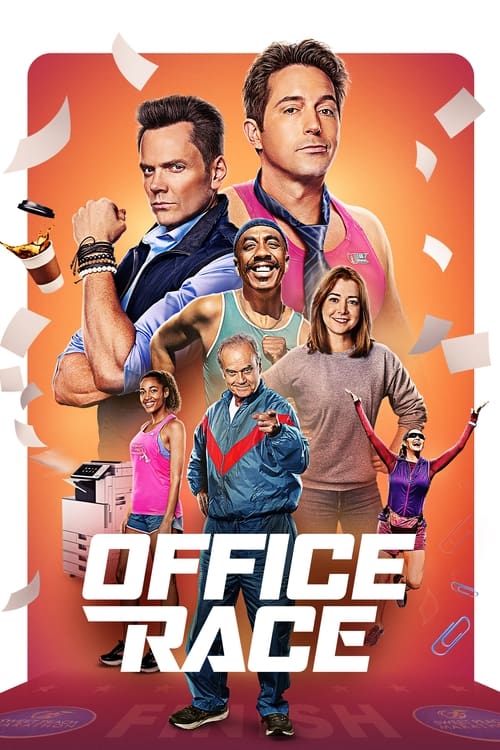
Pat Cassidy begins Office Race as a man stalled out in every direction: his job selling ads for a money transfer app is beneath him in the worst way, his home life is a mess, and his relationship with his girlfriend Pat feels so unsatisfying that it barely resembles a real partnership anymore. He drifts through his days as an unambitious office worker, the kind of man who has learned to survive by doing as little as possible, while his coworker Spencer--arrogant, exacting, and relentlessly successful--floats above him like a smirking reminder of everything Pat is not. Their office dynamic is built on humiliation from the start: Spencer is the sort of rival who does not merely compete with Pat, but enjoys making him feel small, and the tension between them is already well established before the marathon challenge ever appears.
The story does not begin with some grand life event so much as with Pat's ordinary defeat, the kind of shame that accumulates from repeated small failures until it becomes a personality. Pat's private escapes underline just how low his standards have sunk. When he is not working, he watches farting goat videos and Fast and Furious movies with his friend Dave, clinging to low-effort pleasures that perfectly fit the life he has resigned himself to living. Dave represents the version of adulthood Pat has settled for: comfortable, unserious, and completely detached from ambition. That matters because the film's comedy depends on Pat being forced out of a life of inertia and into something physically and emotionally demanding, something he would never choose on his own.
The pivot comes through Spencer, who is always looking for ways to assert dominance. During a lunch meeting after securing a promotion, Spencer chats up a client named Rita, and the conversation drifts toward running, the upcoming Sweet Peach Marathon, and the charity angle that makes the event socially respectable as well as competitive. Rita has a date tattoo on her arm, and Spencer notices it immediately; from that visual clue, he smoothly steers the conversation toward the marathon, implying that Rita is likely a cancer survivor and using that charitable context to make running sound meaningful rather than merely exhausting. The film's emotional machinery is set in motion here: Spencer is networking, charming, and controlling all at once, while Pat is still on the outside looking in.
For Pat, the marathon begins less as inspiration than as a trap. He is ultimately defeated by the pressure around him and no longer willing to be broken down, so he commits to running the Sweet Peach Marathon despite having never run one in his life. It is a ridiculous decision on its face, and the film knows it; that absurdity is the engine of the comedy. But the commitment also marks the first real act of agency Pat has taken in a long time. Once he says yes, the premise hardens into a wager with Spencer, turning the race into a public test of will, pride, and self-respect. From that moment on, every conversation between them carries the same underlying challenge: one of them will be proven right, and the other will be humiliated.
Pat's training is immediately messy, because he is not a natural athlete and does not even possess the emotional discipline to become one in a straightforward way. He has to learn how to relate to running culture, to other runners, and to the idea that effort itself can be meaningful. One of the key figures in this phase is Harry, an eccentric runner whose seriousness about the race is matched only by how strange he is, and Pat struggles to fit in with that world. Harry is important not because he is a villain or a mentor in a neat sense, but because he represents the uncompromising mindset Pat lacks. Every time Pat interacts with these runners, the film emphasizes how alien this new environment feels to him. He is not just out of shape; he is out of alignment with the kind of person who plans, trains, and commits.
That contrast becomes sharper as Spencer embraces the competition with almost manic intensity. Rather than simply enjoying the rivalry, he becomes obsessed with beating Pat and starts drinking a lot of Nitro Venom, a dubious energy drink that visibly changes how he looks. The film uses this exaggerated transformation as a comic mirror of Pat's own change: where Pat is awkwardly becoming more serious and capable, Spencer is physically and behaviorally warping under the pressure to dominate. The rivalry stops being merely professional and becomes existential. Pat is trying to prove he can do something difficult; Spencer is trying to make sure Pat cannot. Their bet turns the marathon into a moral contest as much as a physical one.
As the race approaches, the office conflict keeps leaking into every other part of life. Spencer does not simply outwork Pat; he publicly humiliates him, and at one point he berates Pat in front of others over Pat's relationship and performance, reinforcing the power imbalance between them. That public cruelty matters because it is the force that keeps Pat from retreating. The more Spencer humiliates him, the more Pat is pushed toward proving that he can finish something substantial. The film keeps returning to the same central irony: Pat is lazy, yes, but he is also finally being challenged in a way that forces him to confront how little he expects from himself. Each confrontation with Spencer becomes a test of whether he will fold or fight back.
The emotional complication deepens when Pat's personal life starts to unravel alongside the marathon plot. He is already in a hopeless relationship with his girlfriend Pat, and the film makes clear that this is not a relationship that supports him or gives him direction. His home life offers no refuge from the office, and the pressure of training only exposes how hollow everything else has become. Meanwhile, the group of runners and acquaintances around him slowly becomes a substitute community, giving him a sense--however fragile--that he might belong somewhere. The film's tone remains comic, but beneath the jokes there is a real shift happening: Pat is beginning to experience himself as someone whose actions matter.
That budding sense of progress collapses when Pat confesses his crimes to the group. The sources do not specify every detail of those crimes, but the revelation is framed as a serious betrayal, and the reaction is immediate and severe. The group feels deceived and cuts ties with him completely. This is the story's major emotional rupture, because it strips away the fragile new identity Pat has been building. He is no longer the man training for a race with a group of supportive people around him; he is alone again, lonelier than ever, and it feels as though all the effort he has poured into the marathon has been erased. The film does not soften the blow. Pat's sense of redemption is interrupted by the reality that self-improvement does not automatically repair trust.
For a stretch, that rejection kills his momentum. He loses his motivation to continue working toward the marathon and seems to return to the emptiness he started in. The narrative, however, refuses to let him stay there. The turning point comes through a small but decisive image: a photo of the group posted by Julia. That image functions like a reminder of the life Pat almost has, the one he nearly participates in but has now been cut off from. Seeing it reignites something in him. It is not just nostalgia or jealousy; it is the realization that redemption is still possible if he chooses to show up and run toward it. The movie uses that photograph as a quiet counterweight to the loudness of Spencer's humiliation and the sting of the group's rejection. Pat has one more chance to prove he belongs.
On the day of the marathon, Pat seeks out the group and explains himself. He tells them that before he met them, he had a fear of commitment, which gives his behavior a human explanation without fully excusing what he has done. The scene matters because it is the first time Pat articulates the deeper problem beneath his laziness. He has not merely been indifferent; he has been afraid. That revelation reframes his whole journey, making the marathon less about winning a physical contest and more about learning how to stay with something even when it becomes uncomfortable, embarrassing, or painful. His confession is awkward and imperfect, but it is also honest, and honesty is what the film treats as the beginning of redemption.
The final stretch of the race becomes the payoff for everything that has come before. Pat waits for the entire group, except Julia, who has already finished the race, and they move toward the finish together. That image carries the emotional resolution of the film: Pat is no longer racing only to beat Spencer, but to finish alongside the people who have, in their own chaotic way, become his community. The marathon course, which has been the arena of humiliation, obsession, and personal testing, now becomes a place of reconciliation. He finally does the unthinkable--not because he has become a different species of man, but because he has chosen to endure and remain present long enough to cross the line.
The final confrontation with Spencer is folded into this resolution. Pat walks into the office with confidence and berates Spencer publicly for cheating with his girlfriend, then challenges him again to beat him. That moment lands differently from the earlier humiliations. Pat is no longer passive, no longer waiting to be crushed. He is taking back the space Spencer has dominated all story long. The office, which had been a site of imbalance and mockery, becomes the place where Pat finally speaks with authority. The film's central rivalry thus closes not with a dramatic victory lap so much as with a reversal of emotional power: Pat has learned how to stand up for himself, and Spencer is forced to absorb the public challenge.
By the time Pat reaches the finish with the group, he wins the bet and earns their respect. That win is not presented as a hollow sports-movie triumph; it is tied directly to his personal growth. He has proved that he can do something hard, stay committed, and endure embarrassment without collapsing back into passivity. The race itself becomes the external proof of an internal shift. He has redeemed himself, in the film's terms, by doing what once seemed impossible. The satisfaction comes not from speed but from completion, from the fact that he keeps moving after every reason to quit has appeared.
The ending adds two final revelations that reframe the whole rivalry. It is hinted that Spencer dies due to a heart attack, a grim offscreen implication that arrives after all his obsessive competitiveness and self-destructive energy-drink consumption. The film does not stage the death as a dramatic scene, but the hint is enough to cast a shadow over his relentless drive, as if the same need to win that fueled him has finally consumed him. At the same time, the film hints that Pat and Julia get together, confirming that the connection formed through the race and the group has become something more than friendship. That final romantic implication gives Pat an ending that is both comic and warmly earned: he does not just become a better runner, he becomes someone capable of commitment, connection, and follow-through.
The last impression is of a man who has stumbled into adulthood by way of a charity marathon, an office wager, a public humiliation, and a hard-won act of honesty. Pat Cassidy starts out as an unserious drifter with no clear purpose, but by the end of Office Race he has endured enough embarrassment, conflict, and self-reckoning to stand in front of other people without shrinking. Spencer's pressure, Rita's role in setting the marathon in motion, Harry's eccentric seriousness, Dave's comfortable low ambition, Julia's photo, and the group's temporary rejection all feed into that transformation. The movie closes on the sense that Pat has finally learned how to keep going, even when the race is painful, even when the people around him are disappointed, and even when the finish line is the only thing that makes the effort feel real.








What is the ending?
Pat and the others finish the marathon together after he admits what he did and then makes things right by replacing the missing charity money. Spencer's fate is left in a grim final beat, with the film hinting that he dies after collapsing from a heart attack, and Pat ends up with Julia.
Pat starts the ending in a broken state after his confession to the group. He has told everyone that he lied and cheated them, and the group cuts him off. He is left alone, without their trust and without any sense that the race still matters to him.
Then Pat sees a photo Julia posted of the group. That image pushes him to act. He decides to fix what he damaged, and he sells his car and drains his savings to cover the charity money the group had lost. When the others see that he has fully given up what he owned to make the situation right, they allow him back in.
With the group restored, they go into the marathon together. Spencer is still racing, but the run has turned brutal. He looks physically ruined as the miles go on, and the film shows him pushing himself until he can barely continue. Pat stays in the race as the others struggle too, including Harry and Kiki, who finish with severe difficulty, and Rita, who also runs out of strength near the end. Julia has already crossed the finish line by this point.
Pat does not finish alone. He waits and lets the group come in together, and they reach the finish as a unit. That gives Pat the win in the bet, but more importantly it gives him back the respect of the people around him.
The final moments then suggest that Spencer dies from a heart attack. The ending also shows that Pat and Julia are together, closing the story with Pat having repaired both his place in the group and his personal life.
If you want, I can also give you a more detailed scene-by-scene version of just the final marathon sequence.
Is there a post-credit scene?
There is no reliable evidence in the available sources that Office Race (2023) includes a post-credit scene. The reviews and listings I found describe the film's plot and cast, but none mention an after-credits tag or bonus scene.
If you want the safest answer: no post-credit scene is documented in the sources I found. The film does end with credits, but a source noting that it "popped up at the end" refers to the Comedy Central branding, not to an additional story scene.
Why does Pat decide to run the Sweet Peach Marathon in Office Race?
Pat is pushed into the marathon after being humiliated by Spencer's success at work and after a client meeting ties the sale to marathon-obsessed Rita, so he treats the race as both a personal challenge and a way to prove himself.
What is the relationship between Pat and Spencer, and why does it matter in the story?
Pat and Spencer are coworkers with a bitter status imbalance: Spencer is more successful, gets promoted ahead of Pat, and becomes the person Pat most wants to beat, turning their office rivalry into the engine of the film's conflict.
Who is Rita, and what role does she play in Office Race?
Rita is the marathon-obsessed client whose interest in running connects directly to the sale Pat and Spencer need to make, and her enthusiasm for the Sweet Peach Marathon helps force Pat into the race storyline.
Who is Harry, and how does he affect Pat’s marathon training?
Harry is one of Pat's fellow runners, and the reviews describe him as unusually eccentric, making Pat's attempt to fit in with the running group awkward and uncomfortable as he trains for the marathon.
What is Pat like as a character before he starts training for the marathon?
Pat is portrayed as an unmotivated office worker and slacker salesman in a rut, stuck in an unhappy relationship and more interested in distractions like videos and action movies than in ambition or discipline.
Is this family friendly?
Mostly yes, but with caveats. Office Race is a comedy, but it is not especially child-targeted and some listings describe it as a "grossout comedy" with sexuality and drug abuse content.
Potentially objectionable or upsetting elements for children or sensitive viewers may include:
- Gross-out / toilet humor and slapstick-style crude jokes.
- Sexual references or sexual content described in the content advisory.
- Drug abuse references or related material noted in the advisory.
- Workplace cruelty / mean-spirited bullying, since the premise centers on an underachieving employee and an insufferable boss.
- Stressful marathon/race sequences that may include strain, embarrassment, or physical discomfort.
If you want a very cautious call: this is better for older teens and adults than for young children.