












Popular
What motivates the main character, Dr. Sarah, to embark on her journey of self-discovery?
How does the relationship between Dr. Sarah and her estranged father evolve throughout the film?
What role does the AI companion, Orion, play in Dr. Sarah's journey?
What significant event triggers Dr. Sarah's realization about the interconnectedness of all beings?
How does the visual representation of the cosmos reflect Dr. Sarah's internal struggles?
Should I watch it?
Ask Your Own Question

What is the plot?
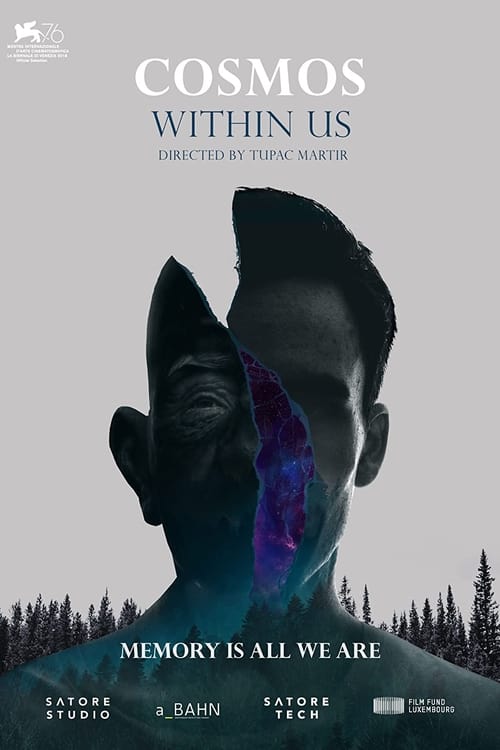
Cosmos Within Us begins by pulling the viewer out of ordinary reality and into the interior world of Aiken, a 60-year-old man living with Alzheimer's disease, and the opening feels less like a scene than a crossing into consciousness itself. The first images are dark and enclosed, almost backstage in their narrowness, as if the audience is stepping through a threshold before memory can begin to form; then the space opens into a drifting, unstable cosmos of domestic rooms, half-remembered surfaces, and fragments of childhood that seem to assemble themselves around Aiken's mind. Aiken's voice and presence anchor the experience as he tries to hold on to who he is, speaking his name into the void and clinging to the few memories that have not yet been washed away by his failing mind.
He is introduced as a man returning, in spirit if not in body, to his former family home, because this house is the center of what he is trying to preserve. Every room feels alive with emotional residue: walls shift, corridors reconfigure themselves, and furniture seems to appear and disappear as though the house is breathing with him. The domestic spaces are not stable flashbacks but reconstructive events, the kind of memory that is being built and damaged at the same time. The experience constantly reminds us that Aiken is not simply remembering; he is fighting to reconstruct an identity from fragments while the disease keeps tearing those fragments apart.
At first, what rises to the surface are the tender parts of his childhood. Aiken finds himself back in summer holidays spent with his beloved little sister Lily, and those recollections carry a warmth that seems almost unbearably fragile. He remembers family moments in ordinary interiors and in brighter outdoor spaces, where the light has the softness of old film and the emotional tone feels briefly safe. Lily is vivid in these passages, the one presence in his past that seems to move through the haze with special clarity, and her appearance suggests that she is tied to the most important emotional bond in his life. These scenes are not presented as neat flashbacks; instead they unfold like sensations being rediscovered, with each image seeming to arrive through fog, hesitation, and breath.
But the tenderness never lasts untouched. Even in the happiest memory spaces, something feels wrong, as though the past itself has been bruised. The summer scenes gradually become tainted, and the house begins to feel less like a refuge than a trap, a place where buried truth cannot remain buried forever. Aiken's struggle deepens because the disease is doing two things at once: it is erasing his past and simultaneously exposing the emotional fault line at the center of it. The story repeatedly returns to the idea that "memory is all we are," and that slogan becomes less like a comforting thesis than a warning: if memory is identity, then what happens when memory itself betrays you?
The visual world grows increasingly unstable as Aiken moves deeper into recollection. He passes through spaces that seem to collapse into darkness and then re-form into other spaces, including a forest and even outer-space imagery, as if his mind cannot decide whether it is trapped in a childhood home, a dream, or the void between thoughts. These transitions create a haunting momentum: each reconstructed room feels like a clue, each shift of scenery like a step closer to the center of a wound he has spent his life avoiding. The emotional texture tightens too, because the laughter and comfort of the early memories are slowly replaced by the uneasy sense that Aiken is approaching one single moment he has been trying to forget for decades.
That hidden memory becomes the story's gravitational center. Public descriptions never spell out the exact event in explicit scene-by-scene detail, but they are clear that deep in Aiken's consciousness lies one buried trauma, "concealed in oblivion," waiting to be relived and refelt. The structure of the experience makes that concealment feel active rather than passive: this is not just something forgotten by accident, but something his psyche has resisted, something his mind has tucked away behind layers of domestic nostalgia and sensory distortion. Each pleasant image of Lily, each shimmering reconstruction of the family home, appears to be carrying that secret inside it like a dark kernel.
As Aiken continues, the atmosphere becomes almost unbearably intimate. He is no longer simply wandering through old rooms; he is moving through the architecture of guilt, fear, and loss. The spaces seem to respond to his inner state, changing shape as his thoughts change, so that the environment itself becomes a visual expression of dementia's cruelty. The house is no longer fixed in time, because Aiken's brain will not allow it to remain whole. A hallway may feel comforting for an instant and then suddenly become oppressive, as though it is narrowing to shut him inside a recollection he cannot bear to face. The experience keeps building tension by letting the viewer feel that something terrible is being approached but not yet named.
Eventually, the pressure of avoidance gives way to confrontation. Aiken reaches the place in his memory where the tainted childhood scenes converge, and the long-suppressed truth begins to surface. The public material confirms only that this is the memory he has been trying to forget, not the exact factual content of it, but the dramatic shape of the reveal is unmistakable: the most painful thing in his life is not merely the disease, but whatever happened in the past that he has never fully allowed himself to remember. The emotional power of the piece comes from that delayed recognition, from watching a man try to protect himself from a truth his own mind is now forcing back into the light.
Because the available plot information does not identify the trauma itself in reliable, specific terms, the ending must be understood through its emotional resolution rather than through a conventional crime-or-mystery reveal. Aiken's journey is not about solving an external puzzle; it is about reaching a state where the hidden memory can finally be acknowledged. The climax therefore lands as a confrontation between Aiken and the deepest recesses of his own mind, a confrontation in which the enemy is time, Alzheimer's, and the long-buried pain of his childhood. The work's title becomes newly meaningful here: the "cosmos within us" is the interior universe of memory, and Aiken has been traveling through its black holes, fragments, and collapsing stars the entire time.
No confirmed deaths are publicly detailed in the available plot descriptions, and no source-supported account identifies a person being killed or even a specific death scene within the experience. The story's devastation comes instead from the slow death of continuity, the erosion of identity, and the emotional wound of a memory too painful to keep or lose cleanly. In that sense, the movie's horror is quieter and more tragic than physical violence: Aiken is watching his mind disappear while also being forced to face the part of his past that has defined the shape of his suffering.
The final movement resolves not with a dramatic external action but with recognition. Aiken's memories remain incomplete and unstable, yet he reaches the edge of the truth he has been circling, and that act of facing it becomes the closing emotional gesture. The experience ends with the idea that understanding, however painful, is a form of mercy, and that memory--however fractured--still contains the core of human identity. Rather than offering tidy closure, the ending leaves behind a fragile clarity: Aiken has not conquered Alzheimer's, and he has not restored the past, but he has moved through the darkness enough to meet the thing he was running from. The final impression is one of sorrow, tenderness, and hard-won acceptance, with the house, the childhood summers, Lily, and the shifting void all collapsing into the same truth: memory may fade, but its emotional weight never truly disappears.









What is the ending?
In the ending of "Cosmos Within Us," the main characters confront their inner struggles and the consequences of their choices. The film culminates in a moment of realization and acceptance, leading to a resolution of their conflicts and a sense of hope for the future.
As the film draws to a close, we find ourselves in a dimly lit room where the protagonist, Alex, sits alone, reflecting on the journey he has undertaken. The weight of his past decisions hangs heavily on him, and the emotional turmoil is palpable. He recalls the moments of connection with his friends, the struggles they faced, and the lessons learned along the way.
In a pivotal scene, Alex receives a message from his friend Maya, who has been a source of support throughout the film. She encourages him to embrace his true self and to let go of the fears that have held him back. This message resonates deeply with Alex, igniting a spark of determination within him.
The next scene shifts to a gathering of the main characters--Alex, Maya, and their friend Sam--who come together in a park, surrounded by the beauty of nature. The atmosphere is filled with a sense of renewal as they share their experiences and the growth they have achieved. Each character expresses their vulnerabilities, revealing the personal battles they have fought and the strength they have found in one another.
As they talk, the camera captures their expressions--smiles mixed with tears, laughter intertwined with moments of silence. The bond between them deepens, symbolizing the importance of friendship and support in overcoming life's challenges. They make a pact to continue supporting each other, no matter what the future holds.
In the final moments of the film, Alex stands at the edge of a cliff, overlooking a vast landscape. The sun begins to set, casting a warm glow over the scene. He takes a deep breath, feeling a sense of liberation as he embraces his identity and the choices he has made. The camera pans out, showing the beauty of the cosmos above him, a reminder of the infinite possibilities that lie ahead.
The film concludes with a sense of hope and renewal, as each character embarks on their individual journeys, armed with the knowledge that they are not alone. Alex, Maya, and Sam each find their paths, ready to face the future with courage and resilience.
In summary, the ending of "Cosmos Within Us" encapsulates the themes of self-discovery, friendship, and the power of acceptance, leaving the audience with a poignant message about the importance of connection and the journey of life.
Is there a post-credit scene?
In the movie "Cosmos Within Us," there is no post-credit scene. The film concludes its narrative without any additional scenes or content after the credits roll. The story wraps up with a sense of resolution, focusing on the characters' journeys and the themes explored throughout the film. The absence of a post-credit scene allows the audience to reflect on the emotional and philosophical messages presented in the main storyline.
What motivates the main character, Dr. Sarah, to embark on her journey of self-discovery?
Dr. Sarah is driven by a deep sense of loss and a desire to understand her place in the universe after the death of her mentor. This personal tragedy ignites her quest for knowledge and connection, pushing her to explore the cosmos and her own inner self.
How does the relationship between Dr. Sarah and her estranged father evolve throughout the film?
Initially, Dr. Sarah's relationship with her father is strained due to unresolved issues from her childhood. As the story progresses, they confront their past, leading to moments of vulnerability and reconciliation, ultimately allowing them to bond over shared experiences and a newfound understanding.
What role does the AI companion, Orion, play in Dr. Sarah's journey?
Orion serves as both a guide and a mirror for Dr. Sarah, challenging her perceptions and encouraging her to confront her fears. The AI's insights often lead her to pivotal realizations about herself and her relationships, making it a crucial element in her transformation.
What significant event triggers Dr. Sarah's realization about the interconnectedness of all beings?
During a pivotal scene in the film, Dr. Sarah experiences a near-death moment while exploring a remote planet. This encounter with the vastness of space and the fragility of life leads her to a profound epiphany about the interconnectedness of all beings, reshaping her understanding of existence.
How does the visual representation of the cosmos reflect Dr. Sarah's internal struggles?
The film uses stunning visuals of the cosmos, such as swirling galaxies and vibrant nebulae, to symbolize Dr. Sarah's internal chaos and her search for clarity. As she navigates her emotional turmoil, the visuals become increasingly abstract and chaotic, mirroring her journey towards self-acceptance and peace.
Is this family friendly?
"Cosmos Within Us," produced in 2019, is a thought-provoking film that explores deep themes of existence, consciousness, and the human experience. While it is not overtly graphic or violent, there are several aspects that may be considered potentially objectionable or upsetting for children or sensitive viewers.
-
Existential Themes: The film delves into complex philosophical questions about life, death, and the universe, which may be difficult for younger audiences to grasp and could evoke feelings of confusion or anxiety.
-
Emotional Turmoil: Characters experience significant emotional struggles, including grief, loss, and existential dread. These intense emotional moments may be distressing for sensitive viewers.
-
Visual Imagery: Some scenes may include abstract or surreal visual representations of concepts like consciousness and the universe, which could be unsettling or confusing for younger viewers.
-
Dialogue on Mortality: Conversations about death and the afterlife are present, which might be heavy for children or those who are sensitive to such topics.
-
Isolation and Loneliness: Themes of isolation and the search for connection are prevalent, which may resonate deeply and evoke sadness in some viewers.
Overall, while "Cosmos Within Us" is not explicitly inappropriate, its thematic depth and emotional weight may require parental guidance for younger audiences.