
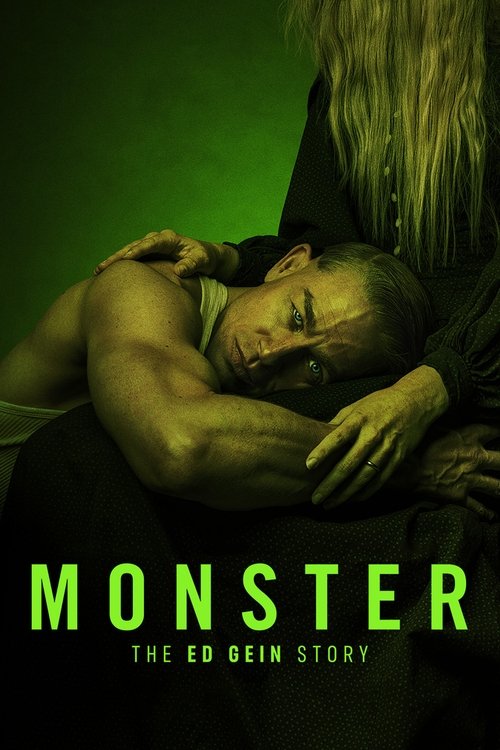












Popular
What happens with Ed Gein and his mother Augusta in the first episode, especially after her death?
Who is Adeline Watkins, and what role does she play in Ed Gein’s story?
What does the series show about Ed Gein’s brother Henry, and how is Henry’s death handled?
What does the show depict when the police discover Ed Gein’s farmhouse, and what specific things are found inside?
How does the series portray Ed Gein’s mental state and diagnosis in the hospital, and what happens to his visions later on?
Should I watch it?
Ask Your Own Question

What is the plot?
Ed Gein lives under the crushing control of his mother, Augusta, in rural Wisconsin, where she preaches that sex is sinful, women are corrupting, and the outside world is full of temptation. He does chores on the farm with his father mostly absent in the background, while Augusta dominates the household and fixes Ed's attention on fear, obedience, and shame. When Ed secretly spies on young women and then returns home to dress in his mother's undergarments and masturbate with a rope around his neck, Augusta catches him, punishes him, and forces him back under her religious control. She then warns him not to speak to "jezebels," especially Adeline, reinforcing his isolation and fixation on his mother's rules.
Ed's brother Henry returns to the farm and tells him he wants to leave that life behind. Henry reveals that he has fallen in love and wants to marry, but Augusta forbids it because she disapproves of the woman and condemns her divorce history. Ed hears this conflict between Henry's wish for a future and Augusta's control, and the situation escalates into a violent confrontation. In a sudden rage, Ed strikes Henry with a log, and Henry dies afterward from asphyxiation, while Ed is left confused and disturbed, at first seeming unable to fully grasp what has happened.
After Henry's death, the authorities suspect something is wrong because of bruising, but the morgue technician rules the cause of death as asphyxiation. The story then shifts back to Augusta, who suffers a stroke, and Ed returns home to care for her after the hospital. His role in the house changes from son to caretaker, but Augusta's authority remains intact even as her body weakens.
Augusta later dies of a heart attack while she is angrily shouting at a man who owes her money. After her funeral, Ed begins hearing her voice in his head, telling him they can still be together even though she is dead. He becomes consumed by that voice and goes to the cemetery, where he tries to dig up Augusta's body but cannot reach it. Then he hears her voice again, telling him to dig up the body of the person buried next to her instead.
Ed follows that command, exhumes the body of a woman from the neighboring grave, and brings the corpse back to his house. He washes and cleans the body carefully, then props it up in Augusta's old rocking chair as if restoring some version of domestic life. The episode ends with Ed staring at the body and smiling in a way that makes clear he has crossed into a grotesque new obsession, one tied directly to his grief, delusion, and fixation on his mother.
The story also briefly introduces Ilse, who is shown enslaving Jewish people from concentration camps, establishing a parallel thread of wartime depravity that intersects with the broader series.
Ed continues living alone in the aftermath of Augusta's death, with her voice still dominating his mind. He becomes increasingly detached from normal human connection and instead turns inward, building his life around imagined contact with his mother and the dead. In this period, the series shows his mental state collapsing further, with his loneliness and obsession taking over the direction of his life.
Seeking some kind of connection, Ed buys a ham radio, but he does not use it to talk to people. Instead, he becomes convinced that the static carries Augusta's voice, as if she can still communicate with him through the machine. This belief deepens his delusions and reinforces the idea that he is no longer living in the same reality as everyone around him.
The first major murder in the series is Mary Hogan, a tavern owner known for being loud and outspoken. She disappears during a brutal winter, and the audience later learns that Ed shot her and dragged her body through the snow back to his farm. Her disappearance marks the point at which his private fixation turns into outward killing.
As the series continues, Ed's house becomes a site of growing horror, as he begins collecting body parts and human skin to make objects and decorations from them. His crimes expand beyond murder into grave robbing and body-snatched remains, and the home becomes a macabre extension of his grief, obsession, and disordered fantasies.
The series also widens outward from Ed's crimes by showing how his story echoes into popular culture, with figures such as Alfred Hitchcock appearing in the narrative and the text drawing connections between Ed's life and the horror stories inspired by him. These sequences are presented as part of the show's structure, where Ed's real crimes and their fictional afterlives begin to overlap.
By the end of the series, Ed has been committed to an institution and is living under medical care, while his mind remains active in fantasy. In the final episode, his delusions have shifted away from violence and instead show him helping FBI agents catch Ted Bundy, a scenario the hospital nurses accept as one more product of his unstable imagination. The season closes with Ed in that institutional setting, still separated from reality but no longer directing his damage outward in the same way.









What is the ending?
Ed Gein spends his final days in a mental hospital, weakened by cancer and living inside a life of fading reality. In his last moments, he drifts into visions of his mother, of the killers he influenced, and of a calmer ending that brings him back to Augusta on the porch, where her words echo his whole life: "Only a mother could love you."
Ed is already confined in a psychiatric institution when the finale begins. He has been diagnosed with schizophrenia, and the series shows that medication has quieted the violent, chaotic fantasies that once drove him. In one hallucination, he imagines helping FBI agents catch Ted Bundy, and the nurses around him treat the delusion as just another part of his condition.
As Ed's health worsens, the story makes clear that he has cancer and is dying. At this point, Adeline comes to see him one last time. She tells him she will carry on his work, kill people, and embrace darkness, but Ed rejects that path and tells her not to do it. This is a sharp break from the earlier version of their dynamic, when his influence over her was more destructive.
Near the end of his life, Ed has another vision: the many killers and horror figures inspired by him appear and usher him down a hallway, praising him. After that, he imagines himself on his deathbed, moving through a surreal scene of dancing nurses and ascending a staircase where Augusta is waiting for him. In this final vision, she receives him as if he is returning home.
The story then returns to the porch memory: Ed sits beside Augusta while she knits and speaks the line, "Only a mother could love you." The ending holds on that image and then fades into the final visual echo of The Texas Chain Saw Massacre, with Leatherface and his chainsaw frozen in a twisted dance.
Ed's fate is death in the mental institution after years of confinement and illness. Augusta's fate is to remain a central force in his memory long after her death, appearing in his final visions and in the closing flashback. Adeline survives the meeting with Ed, but her final words suggest she intends to continue the pattern of violence he began. The ending also leaves the impression that the killers and horror icons linked to Ed's legacy now outlive him as part of the mythology built from his crimes.
Is there a post-credit scene?
There is no post-credits scene in Monster: The Ed Gein Story. The final moments happen before the credits, with the show ending on a flashback of Ed sitting beside Augusta as she says, "Only a mother could love you," after the graveyard sequence in which teens try to steal his headstone and are scared off by horror figures tied to his legacy.
If you mean the very last image before the credits, it is the porch flashback with Augusta, not an extra scene after the credits.
What happens with Ed Gein and his mother Augusta in the first episode, especially after her death?
In episode 1, the story centers on Ed's suffocating dependence on Augusta, whose controlling presence dominates his life and mind. After her funeral, he begins hearing her voice in his head, then goes to the cemetery and tries to exhume her body; when that fails, the voice directs him to dig up the grave of another woman buried nearby, which he takes home, cleans, and places in Augusta's rocking chair.
Who is Adeline Watkins, and what role does she play in Ed Gein’s story?
Adeline Watkins appears as a key character connected to Ed's private life and emotional isolation, with the series presenting her as a real-life suitor and an important figure in discussions of his queerness and personal relationships. Later in the story, she remains significant enough that Ed meets her one final time while hospitalized and dying of cancer, and she tells him she will carry on his work, a moment that underscores how deeply she is tied to his legacy and delusions.
What does the series show about Ed Gein’s brother Henry, and how is Henry’s death handled?
The series reveals that Henry is Ed's first victim, showing Ed strike him over the head and kill him accidentally. This event is positioned as an early rupture in Ed's life, tying the family's violence and secrecy directly to the path that later defines his crimes.
What does the show depict when the police discover Ed Gein’s farmhouse, and what specific things are found inside?
When authorities discover the farmhouse, the series presents it as a horrifying physical manifestation of Ed's hidden world, not just a messy house but a carefully assembled catalog of macabre objects made from human remains. The discovery includes evidence that he had methodically integrated body parts into the structure and contents of the house, turning the home itself into part of the horror.
How does the series portray Ed Gein’s mental state and diagnosis in the hospital, and what happens to his visions later on?
After his confinement in the mental hospital, the series shows Ed finally diagnosed with schizophrenia, which gives him a clearer explanation for his crimes and for his failure to remember committing them. In the final stretch, his fantasies shift away from violence toward a delusional scenario in which he helps FBI agents catch Ted Bundy, showing that his inner life has changed but remains profoundly detached from reality.
Is this family friendly?
No -- this is not family-friendly. It is rated for mature audiences and contains graphic violence, sexual violence, disturbing horror imagery, and strong language that would be upsetting for children and many sensitive viewers.
Potentially objectionable or upsetting material includes:
- Graphic killings and gore, including murder scenes with heavy blood and injury detail.
- Body mutilation and corpse-related imagery, including dismembered remains, human organs, and horror-focused depictions of skin and body parts.
- Sexual violence and explicit sexual content, including rape threats, sex with a dead body, nudity, and masturbation references.
- Disturbing psychological horror, with scenes meant to shock or unsettle rather than simply scare.
- Domestic violence and abuse, including hitting between adults and parents hitting children.
- Discriminatory and hateful language/themes, including Nazi-era dehumanizing treatment of Jewish people.
- Strong profanity throughout.
If you want, I can also give you a very brief "safe for what age?" recommendation based on the same sources.








