
















Popular
What is the significance of the mysterious notebook found by the main character?
How does Kaito's relationship with his grandfather evolve throughout the season?
What role does the character of Yuki play in Kaito's journey?
What are the key events that lead to Kaito discovering the truth about his family's past?
How does the setting of post-war Japan influence the characters' development?
Should I watch it?
Ask Your Own Question

What is the plot?
In the year 1945, a young boy named Kenta lives in a small Japanese village. The story begins with Kenta playing with his friends, enjoying the carefree days of childhood. However, the atmosphere is tense due to the ongoing war. Kenta's father is away fighting, and his mother is struggling to keep the family together. One day, while exploring the nearby woods, Kenta discovers a hidden cave. Inside, he finds a mysterious object that glows faintly. Intrigued, he takes it home, unaware of its significance.
As Kenta's family faces increasing hardships, including food shortages and air raids, he becomes more determined to protect his mother and younger sister, Yuki. The emotional weight of his father's absence begins to take a toll on him. Kenta's mother, worried about the future, often expresses her fears to Kenta, who tries to reassure her despite feeling helpless. The bond between Kenta and Yuki grows stronger as they rely on each other for comfort.
One night, during an air raid, Kenta and Yuki take shelter in the cave. While hiding, Kenta accidentally activates the mysterious object, which emits a bright light. Suddenly, they are transported to the year 2020, where they find themselves in a bustling city. Confused and frightened, they wander the streets, trying to understand their new surroundings. The stark contrast between their war-torn past and the modern world overwhelms them.
In 2020, Kenta and Yuki encounter a kind-hearted girl named Aiko, who notices their distress. Aiko takes them in, offering food and shelter. As they adjust to their new life, Kenta struggles with feelings of guilt for leaving his mother behind. He often dreams of his family and the life they had, which deepens his longing to return home. Yuki, on the other hand, is fascinated by the technology and culture of the present, which creates a rift between the siblings.
Kenta learns about the advancements in technology and society, but he remains fixated on finding a way back to 1945. Aiko, sensing Kenta's turmoil, encourages him to embrace the present while searching for a solution. Together, they explore the city, and Kenta begins to form a bond with Aiko, who becomes a source of support for him. However, he is haunted by memories of his past, especially the fear of what might have happened to his family.
As Kenta and Yuki continue their search for a way back, they discover that the mysterious object they found in the cave is a key to time travel. They learn that it can only be activated under specific conditions, which leads them on a quest to gather the necessary elements. Along the way, they face challenges that test their resolve and force them to confront their fears. Kenta's determination to return home intensifies, fueled by visions of his mother and sister.
During their journey, Kenta and Yuki encounter a group of individuals who are aware of the time-traveling object. This group, however, has their own agenda and seeks to use the object for personal gain. A confrontation ensues, where Kenta must protect Yuki and Aiko from these antagonists. The fight is intense, with Kenta showcasing his bravery and resourcefulness. He manages to outsmart the group, but not without sustaining injuries that leave him vulnerable.
After the confrontation, Kenta realizes that he cannot return to 1945 without making sacrifices. He grapples with the decision of whether to prioritize his own desires or the well-being of those he has come to care for in 2020. Aiko, sensing his internal struggle, encourages him to think about the impact of his choices. This moment of reflection leads Kenta to understand the importance of both his past and present.
As they gather the final elements needed to activate the object, Kenta faces a critical choice. He must decide whether to take Yuki back with him or leave her in the safety of 2020. The emotional weight of this decision weighs heavily on him, as he fears for her safety in the past. Ultimately, Kenta chooses to bring Yuki back, believing that they can find a way to protect their family together.
In the climactic scene, Kenta, Yuki, and Aiko activate the object, which creates a portal back to 1945. As they step through, Kenta feels a mix of hope and dread, knowing that they are returning to a world filled with uncertainty. The transition is jarring, and they find themselves back in the cave, but the world outside is different. The war is still raging, but Kenta is determined to change their fate.
The season concludes with Kenta and Yuki emerging from the cave, ready to face the challenges ahead. Kenta's resolve to protect his family is stronger than ever, and he carries the lessons learned from 2020 with him. The emotional journey has transformed him, and he is now prepared to confront the realities of their situation, armed with newfound courage and the support of his sister.









What is the ending?
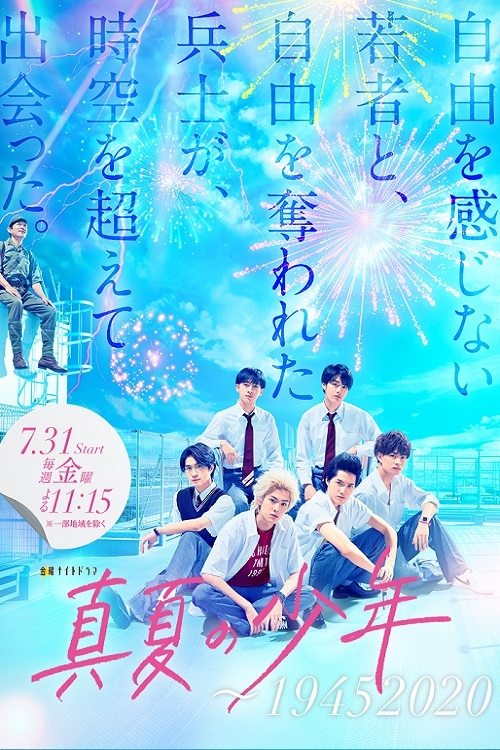
In the ending of "Manatsu no Shonen: 19452020," the story culminates in a poignant reunion and reflection on the passage of time. The main characters confront their pasts and the choices they made, leading to a bittersweet resolution that emphasizes the importance of memories and connections.
As the final scenes unfold, we see the protagonist, a young boy named Kenta, standing at the edge of a serene lake, reflecting on his journey. He is joined by his childhood friend, who has grown into a young woman, and they share a moment of understanding about their shared experiences. The series concludes with a sense of hope and the acknowledgment that while time changes everything, the bonds formed in youth remain significant.
As the final episode begins, the sun sets over the tranquil landscape, casting a warm golden hue across the lake where Kenta often played as a child. The camera pans slowly, capturing the gentle ripples of the water, a metaphor for the passage of time. Kenta, now a young man, stands at the water's edge, his expression a mix of nostalgia and contemplation. He recalls the carefree days of his youth, the laughter shared with friends, and the dreams that once felt so vivid.
In a flashback, we see Kenta as a boy, running through the fields with his friends, their laughter echoing in the air. The scene shifts back to the present, where Kenta's childhood friend, Aiko, approaches him. She has matured into a thoughtful young woman, her eyes reflecting the wisdom gained from their shared experiences. The two exchange a knowing glance, a silent acknowledgment of the years that have passed and the trials they have faced.
As they sit by the lake, Aiko shares her own reflections on the choices they made and the paths they took. Kenta listens intently, his heart heavy with the weight of their shared history. He reveals his own struggles, the dreams that faded, and the moments of joy that still linger in his memory. Their conversation is filled with a mix of laughter and tears, as they reminisce about their childhood adventures and the innocence they once had.
The scene transitions to a montage of their lives, showing the impact of time on their families and friends. We see glimpses of their loved ones, some who have moved away, others who have passed on, and the bittersweet nature of growing up. The montage is accompanied by a hauntingly beautiful score that underscores the emotional weight of their journey.
As the sun dips below the horizon, Kenta and Aiko stand up, ready to face the future. They make a promise to each other to cherish their memories and to keep the spirit of their childhood alive, no matter where life takes them. The camera captures their silhouettes against the vibrant sky, symbolizing hope and the enduring nature of their bond.
In the final moments, Kenta takes one last look at the lake, a place that holds so many memories. He turns to Aiko, and they walk away together, side by side, ready to embrace whatever comes next. The screen fades to black, leaving the audience with a sense of closure and the understanding that while time may change them, the essence of their friendship will remain forever etched in their hearts.
The fate of Kenta and Aiko is one of growth and resilience. They have faced the challenges of life, but their connection remains strong, a testament to the power of shared experiences and the importance of holding onto the past while looking forward to the future.
Is there a post-credit scene?
In "Manatsu no Shonen: 19452020," Season 1, there is indeed a post-credit scene that adds a poignant layer to the narrative. After the final episode concludes, the screen fades to black, and a soft, nostalgic melody begins to play.
The scene opens with a serene view of a sunlit beach, reminiscent of the summer days depicted throughout the series. The camera pans slowly across the shoreline, where gentle waves lap against the sand, evoking a sense of peace and reflection.
As the music swells, the focus shifts to a solitary figure standing at the water's edge. It is the protagonist, a young boy who has journeyed through the trials of his past and the complexities of his present. He gazes out at the horizon, his expression a mix of hope and longing. The sunlight glints off the water, creating a shimmering effect that symbolizes the dreams and memories he carries with him.
In this moment, the boy reflects on the friendships he has forged and the lessons he has learned throughout the series. His internal monologue reveals his desire to hold onto the fleeting moments of youth while also embracing the inevitable changes that life brings. The scene captures his emotional state--an amalgamation of nostalgia, determination, and a hint of sadness as he acknowledges the passage of time.
As the camera zooms in on his face, a small smile breaks through, suggesting a newfound resolve. He turns away from the ocean, taking a deep breath, and begins to walk back along the beach, leaving footprints in the sand that are soon washed away by the tide. This imagery serves as a metaphor for the transient nature of childhood and the importance of cherishing memories while moving forward.
The screen fades to black once more, leaving viewers with a lingering sense of hope and the understanding that while the past shapes us, the future is still unwritten. This post-credit scene encapsulates the essence of the series, emphasizing themes of growth, memory, and the bittersweet nature of time.
What is the significance of the mysterious notebook found by the main character?
The mysterious notebook serves as a crucial plot device that connects the protagonist, a young boy named Kaito, to the past events of 1945. It contains entries that reveal hidden truths about his family's history and the impact of war on their lives. As Kaito deciphers the notebook, he experiences a range of emotions, from confusion to determination, driving him to uncover the secrets of his lineage.
How does Kaito's relationship with his grandfather evolve throughout the season?
Kaito's relationship with his grandfather, who is initially distant and secretive about their family's past, undergoes significant transformation. At first, Kaito feels resentment and frustration due to his grandfather's reluctance to share stories. However, as Kaito learns more about the war and its effects on his family through the notebook, he begins to empathize with his grandfather's pain. This culminates in heartfelt conversations where they bond over shared memories, leading to a deeper understanding and reconciliation.
What role does the character of Yuki play in Kaito's journey?
Yuki, Kaito's childhood friend, plays a pivotal role in his emotional journey. She represents innocence and hope amidst the backdrop of historical trauma. As Kaito becomes increasingly absorbed in the mysteries of the past, Yuki serves as a grounding force, encouraging him to balance his quest for truth with the joys of their present friendship. Her unwavering support and gentle nudges help Kaito navigate his internal struggles, ultimately leading him to a more holistic understanding of his identity.
What are the key events that lead to Kaito discovering the truth about his family's past?
Key events leading to Kaito's discovery include his initial encounter with the notebook, a series of flashbacks that reveal his family's experiences during the war, and conversations with elderly neighbors who share their own stories. Each revelation builds upon the last, creating a tapestry of interconnected histories. The emotional weight of these discoveries forces Kaito to confront his own feelings about loss, legacy, and the importance of remembering the past.
How does the setting of post-war Japan influence the characters' development?
The setting of post-war Japan is integral to the characters' development, as it reflects the societal struggles and emotional scars left by the war. The desolate landscapes and remnants of destruction serve as a constant reminder of the past, influencing Kaito's and his grandfather's actions and motivations. The characters grapple with their memories and the desire to move forward, which shapes their interactions and growth throughout the season, highlighting the tension between remembrance and healing.
Is this family friendly?
"Manatsu no Shonen: 19452020" is a series that explores deep and often heavy themes, which may not be suitable for all children or sensitive viewers. Here are some potentially objectionable or upsetting aspects:
-
Historical Context: The show is set against the backdrop of post-war Japan, which includes references to war trauma, loss, and the impact of historical events on families and communities.
-
Emotional Struggles: Characters experience significant emotional turmoil, including grief, loneliness, and existential crises, which may be intense for younger viewers.
-
Family Dynamics: There are scenes depicting strained family relationships, including conflict and misunderstandings, which could be distressing for some.
-
Social Issues: The series touches on themes of poverty, societal change, and the struggles of adapting to a new world, which may be heavy for sensitive audiences.
-
Visual Imagery: Some scenes may contain visual representations of hardship or despair that could be unsettling.
Overall, while the show has artistic merit and depth, its themes and emotional weight may require parental guidance for younger viewers.