
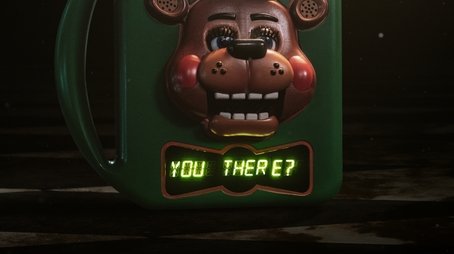


Popular
What are the main differences between the animatronics in Five Nights at Freddy's 2 compared to the first movie?
How does the character of the night guard evolve throughout the film?
What role does the mysterious phone calls play in the narrative?
What is the significance of the 'Bite of '87' mentioned in the film?
How do the various mini-games contribute to the overall story?
Should I watch it?
Ask Your Own Question

What is the plot?
In 1982 the flagship Freddy Fazbear's Pizza stages a weekday matinee. A young girl named Charlotte Emily waits alone in front of the raised stage until the animatronic show finishes and the cast collapses into their offstage positions. From a backstage corridor she sees William Afton guiding a little boy toward the restaurant's service doors. Charlotte runs to the adults at a nearby table, shouting that someone is taking the child, but the grown-ups assume she is playing and ignore her. She slips behind the curtains, follows William into the dim back region and finds him bent over the boy. Charlotte moves the boy away, screaming for help. William turns and stabs her repeatedly; she staggers, cries out, and collapses through a trapdoor beneath the stage. As her body drops, a puppet-like animatronic called the Marionette rises and holds Charlotte's corpse in its arms.
The restaurant closes to the public after the incident, the official record sanitized, and the Freddy Fazbear franchise spreads to other locations. William Afton continues life outwardly as the chain's public figure; the crime is buried and the Marionette is removed from active rotation. Henry Emily, Charlotte's father, protests for years. He keeps a carved music box that used to soothe Charlotte and never stops telling anyone who will listen what happened to his daughter.
Two decades later Mike, who used to work security at a mall and lost a brother to a disappearance years before, lives in a suburban house with his younger sister Abby. Mike copes by keeping a steady job and building a semblance of normal life; he and Vanessa, who was William Afton's daughter and who survived the events that dismantled one Freddy location, see each other socially. Abby latches onto the story of the animatronics and calls them her friends; she misses them and wants to fix them. The town, riding on a resurfacing fascination with the franchise, plans FazFest, a public celebration of the now-mythic restaurants. At school Abby enrolls in a robotics class taught by Mr. Berg, a bullying instructor who belittles her work and dismisses her as obsessed.
A trio of paranormal content creators--Lisa, Alex, and Rob--book an overnight exploration of the original 1982 building. A young security-man who calls himself Michael escorts them inside, showing them the derelict animatronics, the stage, and the water-ride moat that once carried small boats. Lisa wanders alone toward the stage and, looking into the dark opening beneath, discovers and deactivates a music box mechanism welded inside a dusty toy chest. When she winds the box, the Marionette animatronic awakens. The Marionette, animated by Charlotte's furious spirit, lashes out through its strings and organs. It rips Alex apart in the room where prototype animatronics are stored, tearing flesh and bone as its mechanical appendages crush and pull him. Rob is pulled into the water channel of the river-moat ride; the Marionette or one of the smaller animatronics forces him under the surface, and his body is left twisted against the ride's infrastructure. Lisa falls under Marionette control; the puppet uses her body to move, and when it no longer needs her as a vessel it discards her limp form and hides the corpse among the ruined props.
The Marionette reestablishes the old system that once allowed it to manipulate other machines: it reaches into the factory network and reconnects wirelessly to the Toy-era animatronics stored in the building--Toy Freddy, Toy Bonnie, Toy Chica, and the dismantled, snarled remains of Toy Foxy now called Mangle. It also awakens smaller puppet-like copies and Balloon Boy units. The Marionette uses a voice that imitates children to lure Abby through a FazTalker -- a talking fanstore toy Mike gave her -- to the pizzeria, instructing her that her friends need fixing. Abby obeys and returns to the building with a homemade robotic doll based on Chica, intending to make it her school project. When Abby appears in the lot, Toy Chica recognizes her as the child she once loved and initiates a protocol that requires a security code to allow the toys to leave the property. Marionette demands that Vanessa, who knows Charlotte better than anyone, give up the perimeter override code or Marionette will kill Abby.
Vanessa goes to the site, seeking Charlotte's spirit and arguing with it, but Marionette ambushes her in the dark of the theater and forces her to reveal the security code. Under threat of Abby's imminent death, Vanessa inputs the code and breaches the perimeter lock that Henry had helped install to keep the animatronics contained. The Toy animatronics stream out of the building as Marionette commands them, flowing outward into the town.
At Abby's school Mr. Berg intercepts her and humiliates her publicly, grabbing and dropping the Chica doll to force her to retrieve it. Toy Chica tracks Berg to the classroom. She appears as Abby's project, but when Berg insults Abby and threatens to ruin her chances at the science fair, Toy Chica squeezes his skull between two metal hands and crushes it, snapping his neck and spilling blood on the linoleum.
Vanessa, tormented by the past, pleads with Mike for help when the town calls in reports of wandering animatronics. Mike splits his attention between Abby and tracking the Toy units. He follows the signal from the original restaurant, where Henry tells him Charlotte's history and slips Mike a music box used to calm Charlotte as proof of the young girl's existence. At the derelict site Mike breaks into the back rooms to rig a tracking program on the antiquated systems and to find anything that can stop the toys. In the storage pits he encounters damaged prototype suits--the withered, decommissioned shells that once supplied spare parts to the main cast. Marionette animates some of those prototypes and sends them forward as withered proxies to attack.
Back in the neighborhood the Toy animatronics spread outward, targeting adults in response to Charlotte's grievance that grown-ups ignored her when she begged for help. Toy Freddy approaches a suburban couple and lunges; Toy Bonnie chases householders; Mangle crawls through vents and chews at wiring. Vanessa charges into several confrontations and uses improvised maneuvers to protect bystanders--shoving a couple clear of an advancing Toy Freddy and using the restaurant's own mechanical equipment to cause two of the toys to collide and damage each other. Mike sits in the maintenance office and dons a battered Freddy head to hide from cameras while he uses the restaurant's console to identify the toys' movements.
While Mike monitors, Marionette hides inside Toy Chica's torso to move more freely without drawing attention. Toy Chica carries the Marionette across town until she arrives at Mike's house. There Marionette frees itself and assaults Abby, sliding puppet-strings into the child until Abby begins to move under the Marionette's control. Mike returns to find his living room invaded: Toy Bonnie's head clicks in a corner, Toy Freddy stands in the doorway, and the prototype Foxy lunges from the shadows. Vanessa arrives moments later, out of breath and holding the music box that Henry gave Mike, and Jeremiah--Mike's friend--brings reinforcements and medical attention where needed.
Marionette's possession buries itself in Abby's body. She stares blankly, her voice no longer her own. Vanessa steps forward and meets Marionette with pleading and old memories: she remembers Charlotte as a child she once tried to help, and Charlotte's cries flash in Vanessa's eyes. Mike pulls the tiny music box from his pocket, winds it, and plays the lullaby Henry entrusted to him. The tinkling melody resonates through the room, and Marionette's hold on Abby falters. The puppet withdraws, screaming soundlessly; Abby collapses to the floor, breathing hard and shedding the last of the possession. Marionette, hit by the song, becomes disoriented and retreats.
The man who guided the YouTubers through the original building reveals himself then: he unmasks as Michael Afton, William's son and Vanessa's estranged brother. He steps into the light and declares that he intends to continue their father's experiments and twisted legacy. He controls the Toy animatronics via the same wireless link Marionette exploited and coldly commands them to kill Mike, Vanessa, Abby, and anyone who stands in his way. The toys obey, pivoting back toward the house in a coordinated attack.
At the threshold, the classic animatronics--the older, battered Freddy, Chica, Bonnie, and Foxy from the location Mike worked at in the prior year--arrive in a staggered procession as if called by Mike's desperate plea. They engage the Toy-era machines in brutal, mechanized combat. Metal claws tear into vinyl, springs snap under torque, servos short and scream; Freddy slams Toy Bonnie into the fireplace mantle, Bonnie rips off Mangle's rogue appendages, and Foxy disables Toy Chica's jaw servos. The Toy animatronics fall apart under the assault: Toy Freddy's chest cavity is torn open; Toy Bonnie's jaw disengages and flops; Toy Chica's torso is split; Prototype Foxy is disassembled and collapses in a heap. Michael realizes his control is failing as the toys he commands are incapacitated. Jeremiah tackles Michael and knocks him unconscious; in the scuffle Michael gasps and then disappears into a narrow alley as the buildings latch closed around him. Mike and Vanessa bind him briefly, but he wriggles free and slips away in the confusion.
As the classic animatronics finish dismantling the Toys, they show signs of wear beyond their functions--pistons seize and servos stutter from prolonged movement outside the restaurant environment. Their power drains; one by one their eyes go dim. Before they slouch into permanent stillness, the ghostly children who long inhabited them step forward in a brief, visible procession: they stand at the threshold of the living room in the form of faint apparitions and speak to Mike. Among them is a boy Mike recognizes by memory and accident--his missing brother Garrett. Garrett tells Mike that the children have been keeping something bound within the hidden infrastructure of the pizzerias: William Afton's spirit is restrained by their presence inside the animatronics. By freeing themselves, Garrett warns, they will no longer hold the thing back. "He'll be free," a child says. The children fade out of the room toward the afterlife; the animatronic bodies that housed them go lifeless.
Mike looks at Vanessa with a new, hard expression. He tells her she must stay away from him and Abby; he blames her for not telling him the whole story about Charlotte's connection and for keeping Michael's existence secret. Vanessa pleads, but Mike lowers his eyes and walks away with Abby and Jeremiah. As the three of them leave the house and step onto the curb, Marionette's influence reappears: inside Vanessa's body the puppet stirs and takes hold. Vanessa's face goes blank, the muscle of her jaw spasms, and the Marionette's lifeless head tilts. Marionette possesses Vanessa, sliding its influence inward without physical struggle now that the children's spirits have crossed over and diminished the warding forces.
In the hours that follow, demolition crews prepare the newer Freddy Fazbear's location for a teardown. A group of teenagers with flashlights and a dolly force their way into a sealed back room, searching for props and relics they can sell. They find, wrapped and roped in a dusty corner, a costume that looks like a yellow rabbit. They assume they have discovered a vintage suit and grin as they heave it onto the dolly. As they walk past a door the camera pans to reveal a skeletal shape curled in the suit's skin--the desiccated corpse of William Afton trapped inside its spring-lock mechanisms. One boy jokes about bringing it home; another takes a video on his phone. The boys lift the suit, and as they cross the lot, the camera lingers on the suit's empty eye sockets. The sockets glow briefly; a labored mechanical whine begins in the background. The corpse in the suit begins to twitch. In the film's end-credits scene the spring-lock rabbit's eyes flare into life: William Afton's body, having died in the suit when its internal locks pinned him into metal, reactivates and becomes something else--Springtrap--animated by the malevolence that never truly dies.
As the credits run, a closing voicemail from Henry plays: he calls Mike, says he was William's business partner and helped build the animatronics, and then a scuffle and a noise abruptly cut the message short.
In the final, quiet tableau before the credits, Mike and Abby leave town in a taxi. Abby sleeps against her brother's shoulder clutching a faded toy she rescued from the pizzeria, and in the back seat beside her a small Balloon Boy statue sits, its painted eyes seeming to blink in the passing streetlights. Mike stares at the road, his jaw set, knowing what Garrett's warning implies and with Marionette's presence now in Vanessa lingering at large. He does not speak about the future; he only grips the edge of Abby's coat. The camera pulls back from the car as it turns a corner into the night, the FazFest banners sagging in the wind behind them. The narrative closes on the image of the dormant pizzeria, the back room with its hidden secrets, and the inevitability of Springtrap's awakening as a promise that the past's violence has not yet finished unfolding.




What is the ending?
In the ending of Five Nights at Freddy's 2, the protagonist, Mike Schmidt, faces the ultimate confrontation with the haunted animatronics. After surviving the harrowing nights, he discovers the truth about the tragic events that transpired at Freddy Fazbear's Pizza. The film culminates in a tense showdown where Mike must confront the spirits of the children who were wronged, leading to a climactic resolution that reveals the fate of the animatronics and the lingering curse that haunts the establishment.
As the final night approaches, Mike Schmidt, the night guard, is filled with a mix of dread and determination. The flickering lights of the pizzeria cast eerie shadows as he prepares for what he knows will be his most challenging shift yet. The animatronics, now fully aware of his presence, begin their relentless pursuit. Each character--Freddy, Bonnie, Chica, and Foxy--exudes a menacing aura, their eyes glowing with a haunting intensity.
Scene by scene, the tension escalates. Mike checks the security cameras, his heart racing as he sees Bonnie lurking in the hallway. He quickly shuts the door, the metallic clang echoing in the silence. The weight of his responsibility presses down on him; he knows that he must survive until 6 AM, but the animatronics are relentless. As the clock ticks, he feels the weight of the past--the children who were lost, the tragedy that unfolded within these walls.
In a pivotal moment, Mike encounters the puppet, a spectral figure that seems to guide him toward the truth. The puppet reveals flashes of memories--children laughing, then screaming, and the dark secrets hidden within the pizzeria. Mike's resolve strengthens; he understands that he must confront not only the animatronics but also the pain of the past.
As the final hours of his shift unfold, the animatronics become increasingly aggressive. Mike's fear transforms into a fierce determination. He uses every tool at his disposal, flicking lights and shutting doors, but the animatronics are cunning. They find ways to outsmart him, and the tension reaches a breaking point. The audience can feel Mike's desperation as he fights to keep the doors closed, sweat beading on his forehead.
In the climax, as the clock strikes 6 AM, Mike faces Freddy in a final showdown. The animatronic looms over him, its eyes glowing with a sinister light. In this moment, Mike confronts the spirits of the children, pleading for their forgiveness. The animatronics pause, their movements slowing as if they are processing his words. The air is thick with emotion, and the audience can sense the weight of the unresolved tragedy.
As dawn breaks, the animatronics begin to retreat, their forms flickering as if they are being released from their torment. Mike watches, a mix of relief and sorrow washing over him. He realizes that while he has survived the night, the scars of the past will linger. The spirits of the children find peace, and the animatronics, once filled with rage, fade into the shadows of the pizzeria.
In the aftermath, Mike is left standing alone in the dimly lit pizzeria, the echoes of laughter and sorrow intertwining in the air. He knows that he has faced the darkness and emerged, but the haunting memories will forever be a part of him. The film closes with a lingering shot of the pizzeria, now silent, a testament to the battles fought within its walls. The fate of Mike is one of survival, but the emotional toll is evident; he has become a guardian of the memories, a keeper of the stories that must never be forgotten.
Who dies?
In the movie "Five Nights at Freddy's 2," produced in 2025, several characters face dire fates as the tension escalates throughout the narrative. The film is set in a haunted pizzeria filled with animatronic characters that come to life at night, creating a terrifying atmosphere for the night guard.
-
Jeremy Fitzgerald: The main character, Jeremy, is a night guard who takes the job at Freddy Fazbear's Pizza. As the nights progress, he becomes increasingly aware of the sinister nature of the animatronics. On the fifth night, Jeremy is overwhelmed by the relentless attacks of the animatronics. In a climactic scene, he is cornered by the animatronic Foxy, who lunges at him. The screen fades to black, leaving his fate ambiguous, but it is heavily implied that he meets a gruesome end.
-
The Puppet (Marionette): The Puppet, a key animatronic in the story, is revealed to have a tragic backstory tied to the spirits of the children who were murdered in the pizzeria. While the Puppet does not die in the traditional sense, it is shown to be a vessel for the souls of the children. In a pivotal moment, the Puppet sacrifices itself to protect Jeremy from the other animatronics, leading to a moment of emotional resonance as it tries to save him from their wrath. This act of sacrifice highlights the Puppet's internal conflict and desire for redemption.
-
Toy Bonnie: One of the new animatronics introduced in this sequel, Toy Bonnie, is particularly aggressive. During the fourth night, Jeremy encounters Toy Bonnie in the security office. In a frantic attempt to escape, he inadvertently causes a malfunction in the security system, which leads to Toy Bonnie's temporary shutdown. However, the animatronic is later reactivated, and in a terrifying chase sequence, it corners Jeremy, leading to a moment where it appears to attack him. The scene is left ambiguous, but the implication is that Toy Bonnie is relentless in its pursuit, symbolizing the inescapable horror of the pizzeria.
-
Old Freddy: The original Freddy Fazbear animatronic, known as Old Freddy, plays a significant role in the haunting atmosphere of the pizzeria. During the climax, Old Freddy confronts Jeremy in a darkened hallway. In a moment of desperation, Jeremy uses a flashlight to fend off Old Freddy, causing a malfunction that leads to the animatronic collapsing. While Old Freddy does not die in a traditional sense, this moment signifies the end of its reign of terror, as it is rendered inoperative, leaving the audience with a sense of temporary relief amidst the chaos.
Throughout the film, the deaths and sacrifices of these characters serve to heighten the emotional stakes, illustrating the themes of fear, survival, and the haunting legacy of the pizzeria. The tension builds as Jeremy grapples with his own mortality, the tragic past of the animatronics, and the relentless pursuit of the spirits seeking vengeance. Each character's fate is intricately tied to the overarching narrative, creating a chilling and immersive experience for the audience.
Is there a post-credit scene?
In the movie "Five Nights at Freddy's 2," produced in 2025, there is indeed a post-credit scene that adds a chilling layer to the narrative.
As the credits roll, the screen fades to black before transitioning to a dimly lit room filled with old, dusty animatronics. The camera slowly pans across the room, revealing the remnants of the previous Freddy Fazbear's Pizza, now abandoned and overrun with shadows. The atmosphere is thick with tension, and the faint sound of mechanical whirring can be heard in the background.
Suddenly, the camera focuses on a flickering monitor displaying static. As the static clears, a distorted image of a familiar animatronic, the Puppet, appears on the screen. Its eyes glow ominously, and it seems to be watching the viewer intently. The Puppet's voice, soft yet haunting, echoes through the room, whispering cryptic phrases about "the past never truly being buried" and "the cycle of fear continuing."
The scene then cuts to a close-up of a child's drawing pinned to the wall, depicting the animatronics in a playful manner, but with a dark twist--each character has a sinister smile. The camera lingers on the drawing, and as it zooms in, the sound of children's laughter fades into a chilling silence.
Finally, the screen cuts to black once more, and the words "They will return" flash briefly before the credits conclude. This post-credit scene leaves the audience with a sense of dread and anticipation, hinting at the unresolved mysteries and the potential for further horrors lurking in the shadows of Freddy Fazbear's legacy.
What are the main differences between the animatronics in Five Nights at Freddy's 2 compared to the first movie?
In Five Nights at Freddy's 2, the animatronics are more advanced and menacing than in the first movie. New characters like Toy Freddy, Toy Bonnie, and Toy Chica are introduced, featuring updated designs and more aggressive behaviors. The original animatronics, including Freddy Fazbear, Bonnie, and Chica, also return but with a more haunting presence, showcasing their deteriorated states. The contrast between the old and new animatronics heightens the tension as they each have unique attack patterns and methods of evasion.
How does the character of the night guard evolve throughout the film?
The night guard, Mike Schmidt, begins as a somewhat reluctant employee, driven by financial necessity. As the nights progress, he becomes increasingly aware of the animatronics' sinister nature and the dark history of Freddy Fazbear's Pizza. His emotional state shifts from fear to determination as he fights to survive each night, ultimately revealing a deeper motivation tied to the tragic events surrounding the establishment. His character arc reflects a transformation from a passive observer to an active participant in uncovering the truth.
What role does the mysterious phone calls play in the narrative?
The phone calls in Five Nights at Freddy's 2 serve as a crucial narrative device, providing exposition and context for the events unfolding in the pizzeria. The voice on the other end, presumably a previous employee, offers warnings and insights about the animatronics and the dangers they pose. These calls create a sense of urgency and tension, as they foreshadow the escalating threats Mike faces each night. They also deepen the lore of the franchise, hinting at the tragic backstory of the animatronics and the haunted history of the location.
What is the significance of the 'Bite of '87' mentioned in the film?
The 'Bite of '87' is a pivotal event referenced in Five Nights at Freddy's 2, alluding to a tragic incident where a child was severely injured by one of the animatronics. This incident is crucial to understanding the fear and distrust surrounding the pizzeria. It serves as a backdrop for the animatronics' aggressive behavior and the subsequent closure of the establishment. The mention of this event adds layers to the narrative, as it connects the animatronics' actions to a history of violence and tragedy, heightening the stakes for Mike as he navigates the dangers of his job.
How do the various mini-games contribute to the overall story?
The mini-games in Five Nights at Freddy's 2 are integral to unraveling the story's deeper mysteries. They provide players with glimpses into the past, showcasing key events such as the tragic fate of the children associated with the animatronics. Each mini-game serves as a puzzle piece, revealing the motivations behind the animatronics' haunting behavior and the dark history of Freddy Fazbear's Pizza. These sequences evoke a sense of nostalgia and horror, allowing viewers to piece together the narrative while experiencing the emotional weight of the characters' fates.
Is this family friendly?
Five Nights at Freddy's 2 is rated PG-13 for violent content, terror and some language, making it moderately family-friendly but with notable considerations for younger or sensitive viewers.
Potentially objectionable elements include:
-
Violence: The film contains increased scenes of violence compared to the first movie, though presented without graphic gore due to the PG-13 rating.
-
Terror and jump scares: Multiple jump scares occur throughout, and the animatronic characters are designed to be unsettling and creepy rather than comforting.
-
Eerie atmosphere: Disturbing audio elements, such as an eerie Speak & Spell toy delivering menacing messages, contribute to an unsettling tone.
-
Thematic darkness: The film deals with themes of obsession and ambition driving people to do unthinkable things, touching on serious subject matter including a pizzeria massacre referenced from the previous film.
-
Language: Some profanity is present, though not extensively detailed in available reviews.
The film is designed as "gateway horror" for younger audiences interested in the Five Nights at Freddy's franchise, meaning it aims to introduce horror elements in a PG-13 context. Children under 13 should ideally have parental guidance, and very young children or those sensitive to suspenseful atmospheres and creepy imagery may find it distressing despite the lack of graphic content.









