

Popular
What motivates Hiroshi to pursue his dream despite the obstacles he faces?
How does Saito's relationship with his mentor influence his decisions throughout the series?
What pivotal event causes a rift between Hiroshi and Saito?
How does the setting of the city influence the characters' development?
What role does the theme of friendship play in the evolution of Hiroshi and Saito's characters?
Should I watch it?
Ask Your Own Question

What is the plot?
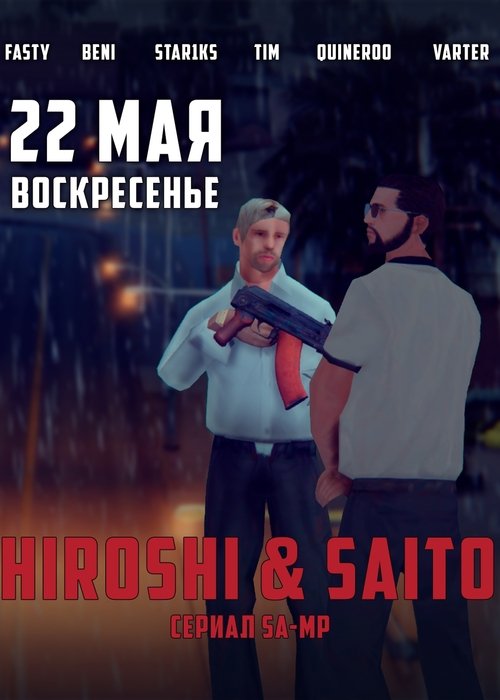
In the opening scene of "Hiroshi & Saito," we are introduced to Hiroshi, a skilled but disillusioned detective in a bustling metropolis. He is seen in his cluttered office, surrounded by case files and photographs of unsolved crimes. The camera pans to a framed picture of his late partner, Saito, which serves as a constant reminder of his unresolved guilt over Saito's death during a botched operation. Hiroshi receives a call about a new case involving a series of mysterious disappearances linked to a powerful crime syndicate.
As Hiroshi investigates, he visits the last known location of one of the missing persons, a rundown bar frequented by lowlifes. There, he encounters a young woman named Mei, who claims to have seen something suspicious the night the victim vanished. Her nervous demeanor and reluctance to speak raise Hiroshi's suspicions. He decides to take her under his wing, believing she may hold the key to unraveling the case.
The narrative shifts to the crime syndicate's headquarters, where the ruthless leader, known only as "The Broker," discusses the disappearances with his enforcers. Tension rises as they argue about the increasing attention from law enforcement. The Broker orders them to tighten security and eliminate any loose ends, hinting at a deeper conspiracy that connects the missing persons to a larger scheme involving human trafficking.
Hiroshi and Mei delve deeper into the investigation, leading them to an underground fight club where they suspect the syndicate operates. Disguised as participants, they infiltrate the club. The atmosphere is charged with adrenaline as fighters clash in brutal matches. Hiroshi's heart races as he spots one of the missing persons, barely conscious and being coerced into fighting. He and Mei devise a plan to rescue the victim, but their cover is blown when one of the enforcers recognizes Hiroshi.
A chaotic fight ensues. Hiroshi engages in hand-to-hand combat with several enforcers, showcasing his detective training. He dodges punches and counters with swift kicks, but he is outnumbered. Mei, using her agility, helps him by distracting the enforcers, allowing Hiroshi to reach the victim. They manage to escape, but not without sustaining injuries. The scene ends with them narrowly avoiding capture, adrenaline pumping as they flee into the night.
Back at Hiroshi's office, he tends to their wounds while Mei reveals her own tragic backstory--she was once part of the syndicate but escaped after witnessing the horrors of their operations. This revelation deepens their bond, and Hiroshi feels a renewed sense of purpose. They decide to go public with their findings, but Hiroshi is conflicted about exposing the syndicate, fearing for Mei's safety.
The next day, they present their evidence to the police, but the response is lukewarm. A corrupt officer, in league with The Broker, dismisses their claims, warning Hiroshi to back off. Frustrated but undeterred, Hiroshi and Mei take matters into their own hands, planning to gather more evidence by infiltrating the syndicate's main operation site.
They prepare for a high-stakes mission, gathering tools and disguises. As they approach the site, tension mounts. They sneak past guards and navigate through dark corridors, their hearts racing with fear and determination. They discover a room filled with captives, including several of the missing persons. The sight is harrowing, and Hiroshi's resolve strengthens as he vows to save them.
Just as they begin to free the captives, they are ambushed by The Broker's enforcers. A fierce confrontation breaks out. Hiroshi fights valiantly, using his surroundings to his advantage, while Mei helps the captives escape. The fight is brutal, with Hiroshi taking several hits but refusing to back down. In a climactic moment, he faces off against The Broker, who reveals his connection to Saito's death, claiming it was all part of a larger game.
Fueled by rage and grief, Hiroshi overpowers The Broker in a final showdown, delivering a series of powerful blows that culminate in a dramatic takedown. The enforcers, seeing their leader defeated, begin to retreat. Hiroshi and Mei manage to free the captives, leading them to safety as the police finally arrive, tipped off by Mei's earlier contact.
In the aftermath, Hiroshi stands at Saito's grave, reflecting on the events that transpired. He feels a sense of closure, having avenged his partner's death and dismantled the syndicate. Mei, now free from her past, stands beside him, and they share a moment of understanding and hope for the future. The series ends with Hiroshi looking determinedly towards the horizon, ready to face whatever challenges lie ahead.
More TV Shows Like This
Browse All TV Shows →


What is the ending?
In the ending of "Hiroshi & Saito," the two main characters confront their pasts and the choices that have led them to this moment. Hiroshi, having reconciled with his estranged family, finds a sense of closure and purpose. Saito, on the other hand, faces the consequences of his actions, leading to a bittersweet resolution. The series concludes with both characters standing at a crossroads, symbolizing their growth and the uncertain future ahead.
As the final episode unfolds, the scene opens in a dimly lit room where Hiroshi sits at a table, a letter from his family in hand. The camera zooms in on his face, revealing a mix of relief and sadness. He reflects on the years lost due to misunderstandings and pride. The weight of his past decisions hangs heavily on him, but there is a newfound determination in his eyes. He stands up, takes a deep breath, and walks out of the room, ready to face his family.
The next scene shifts to Saito, who is in a stark, sterile environment, a police station. He sits alone, his hands clasped tightly together, a look of regret etched on his face. Flashbacks of his past decisions play in his mind, showing moments of betrayal and loss. The tension in the air is palpable as he awaits his fate. A police officer approaches him, and Saito's expression hardens, knowing that he must confront the consequences of his actions. The officer informs him of the charges, and Saito's shoulders slump, accepting his reality.
The narrative then transitions back to Hiroshi, who arrives at his family home. The door creaks open, and he steps inside, greeted by the familiar yet distant scent of his childhood. His family members are gathered, their expressions a mix of surprise and apprehension. Hiroshi's heart races as he takes in the scene, the emotional weight of the moment crashing over him. He speaks softly, apologizing for the years of silence, and the room fills with a tense silence before his mother steps forward, tears in her eyes. They embrace, a moment of healing that signifies the beginning of a new chapter.
Meanwhile, Saito is led away in handcuffs, his expression a blend of resignation and acceptance. He glances back one last time, a fleeting moment of longing for the life he could have had. As he is escorted out, he catches sight of a young boy in the waiting area, a reflection of his own lost innocence. The boy looks up at him with wide eyes, and Saito's heart aches with the realization of what he has sacrificed.
The final scenes intertwine the fates of both characters. Hiroshi is seen at a family gathering, laughter and warmth surrounding him as he shares stories with his loved ones. The camera captures the joy in his eyes, a stark contrast to the earlier scenes of isolation. He has found his place, a sense of belonging that had eluded him for so long.
In contrast, Saito is shown in a prison cell, the starkness of his surroundings a harsh reminder of his choices. He sits on the edge of his bed, staring out the small window, contemplating his future. The weight of his past actions looms over him, but there is a flicker of hope as he begins to write in a journal, documenting his thoughts and feelings. It is a small step towards redemption, a sign that he is willing to confront his demons.
The series concludes with a split-screen of both characters. Hiroshi smiles, surrounded by family, while Saito writes, a solitary figure in a dark room. The juxtaposition of their lives serves as a poignant reminder of the paths they have chosen. The screen fades to black, leaving the audience with a sense of closure for Hiroshi and a glimmer of hope for Saito, encapsulating the themes of redemption, family, and the consequences of one's choices.
Is there a post-credit scene?
In the 2022 TV show "Hiroshi & Saito," there is indeed a post-credit scene that adds an intriguing layer to the narrative.
As the credits roll, the screen fades to black before transitioning to a dimly lit room filled with various artifacts and old photographs. The camera slowly pans across the room, revealing a large map pinned to the wall, marked with several locations that are significant to the story. Each location is connected by red string, hinting at a larger conspiracy that has yet to be uncovered.
Suddenly, the door creaks open, and a shadowy figure enters the room. The figure is dressed in a long coat, their face obscured by a wide-brimmed hat. They approach the map, running their fingers along the strings connecting the locations. A low, gravelly voice breaks the silence, muttering about the "next phase" of their plan.
The camera zooms in on a photograph pinned to the map, showing Hiroshi and Saito in a moment of triumph from earlier in the series. The figure leans closer, a smirk forming on their lips, suggesting a personal vendetta against the protagonists.
As the scene fades to black, the sound of a clock ticking grows louder, emphasizing the urgency of the impending threat. This post-credit scene leaves viewers with a sense of foreboding and anticipation, hinting at future conflicts and deepening the mystery surrounding the characters' journey.
What motivates Hiroshi to pursue his dream despite the obstacles he faces?
Hiroshi is driven by a deep-seated desire to prove himself, stemming from a childhood marked by self-doubt and familial expectations. His journey is fueled by the need for validation, both from his estranged father and from himself, as he grapples with the fear of failure.
How does Saito's relationship with his mentor influence his decisions throughout the series?
Saito's relationship with his mentor is complex; he admires him but also feels the weight of his expectations. This dynamic creates internal conflict for Saito, as he struggles between following his mentor's traditional path and forging his own identity, leading to pivotal moments of rebellion and growth.
What pivotal event causes a rift between Hiroshi and Saito?
The rift occurs during a critical competition where Hiroshi, in a moment of desperation, betrays Saito's trust by using an underhanded tactic to win. This act not only strains their friendship but also forces both characters to confront their values and the lengths they are willing to go to achieve their goals.
How does the setting of the city influence the characters' development?
The bustling city serves as a backdrop that mirrors the characters' internal struggles. Its vibrant energy contrasts with Hiroshi's isolation and Saito's pressure to conform, pushing them to confront their fears and aspirations. The city's diverse culture also introduces them to new perspectives that challenge their beliefs.
What role does the theme of friendship play in the evolution of Hiroshi and Saito's characters?
Friendship is central to both characters' arcs; it is a source of strength and vulnerability. As they navigate their ambitions, their bond is tested by jealousy and misunderstandings, ultimately leading to moments of reconciliation that highlight their growth and the importance of support in overcoming personal challenges.
Is this family friendly?
"Hiroshi & Saito," produced in 2022, is generally considered family-friendly, but it does contain some scenes and themes that may be potentially objectionable or upsetting for children or sensitive viewers.
-
Emotional Conflict: The show explores themes of family dynamics and personal struggles, which may include arguments or emotional breakdowns that could be intense for younger viewers.
-
Mild Violence: There are moments of physical altercations that, while not graphic, may be unsettling for some. These scenes are often tied to character development and conflict resolution.
-
Loss and Grief: Characters experience loss, which is portrayed with emotional depth. Scenes depicting grief may resonate strongly and could be upsetting for sensitive viewers.
-
Social Issues: The show addresses social issues such as bullying and discrimination, which may be challenging for younger audiences to process.
-
Tense Situations: There are moments of suspense and tension that could be anxiety-inducing, particularly for younger children.
Overall, while "Hiroshi & Saito" is crafted with a family audience in mind, parents may want to preview certain episodes to gauge their appropriateness for their children.