
















Popular
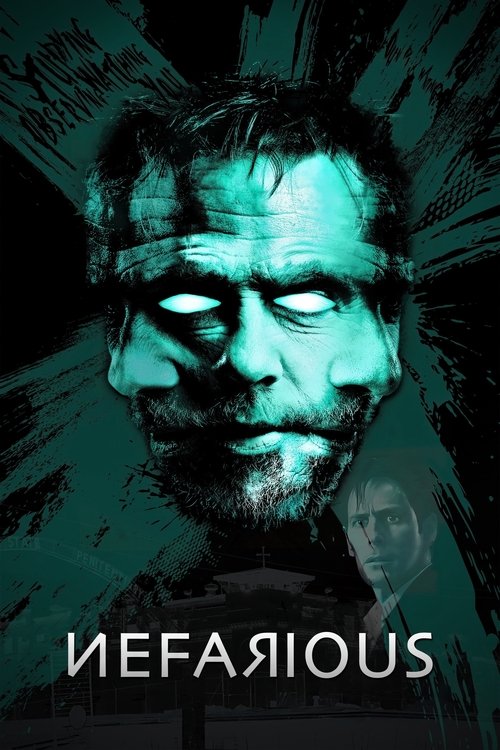
Who is Edward Wayne Brady, and why is he on death row in Nefarious?
Who is Dr. James Martin, and why is he interviewing Edward Brady?
Why does Edward Brady claim to be a demon named Nefarious?
What does Edward/Nefarious say will happen to Dr. James Martin before the day is over?
What is Dr. Alan Fischer’s role in the story, and what happened to him?
Should I watch it?
Ask Your Own Question

What is the plot?
Dr. James Martin arrives at a maximum security state prison late in the afternoon to carry out a competency evaluation of Edward Wayne Brady, a notorious death-row inmate scheduled for electrocution at 11:00 that night. Warden Tom Moss briefs Martin in the visitation corridor, reminding him that he replaces Dr. Alan Fischer, who killed himself after his own interrogation of the prisoner. Moss stresses that Brady is a cunning psychological operator who can worm into the minds of those who question him, and he emphasizes that Martin must determine whether Brady is legally sane and fit to face execution.
In the first private meeting inside the interview room, Edward speaks with unnerving precision about details of Martin's life and career that Martin has not shared. The inmate interrupts and corrects the doctor's assumptions: he does not merely go by Edward Wayne Brady; he identifies himself as a demonic intelligence calling itself Nefariamus, shortened to Nefarious, claiming to inhabit Brady's body. Nefarious explains that he attached to Brady because the young Edward was never baptized and accumulated sin in childhood, citing petty thefts among those sins. When Martin presses for motive and sanity, the entity calmly insists that it is not seeking escape from punishment; on the contrary, it wants its host to be executed. Nefarious tells Martin that, before the night ends, the doctor will himself be responsible for three deaths -- a declaration that Martin rejects as impossible.
The demon levels an accusation at Martin: Nefarious asserts that the psychiatrist euthanized his own terminally ill mother to secure her estate. Martin reacts angrily and defends the medical decisions he made in the past as careful and clinical, threatening to terminate the interview when provoked. When Martin hypothesizes that the defendant is suffering from a dissociative identity disorder with an alter that calls itself Nefarious, the inmate's manner shifts -- Edward, the subdued, beaten-down man behind the alter, appears briefly and answers in a hushed, submissive voice while Nefarious interjects at will. Martin, an avowed atheist, frames the inmate's proclamations as delusional and, after the session, tells Moss he intends to certify Brady as mentally incompetent and unfit for execution.
As Martin leaves the interview area, the entity in the cell continues to unsettle him. During a defensive monologue about spiritual matters, Nefarious tells Martin that his pregnant girlfriend is at that very moment at an abortion clinic, which the demon likens to ancient child sacrifice. Alarmed, Martin rushes to place a frantic call; the line goes through to his girlfriend and he learns the abortion has already been performed. The revelation shatters him, and he returns to the prison under a new strain of doubt and emotional turmoil.
When Martin resumes his assessment, the prisoner alternates between voices and even speaks passages of Latin with fluidity. Nefarious reveals that a manuscript titled The Dark Gospel already exists and that he wants Martin to be the one to produce and endorse it -- an inversion of the Biblical Gospel, promised as a means to deceive humanity. He offers Martin the same sort of worldly and spiritual bargains that, in Nefarious's telling, were once offered to a carpenter in ancient times and were refused. The inmate tells Martin that he has known him since childhood, an assertion that unnerves the doctor. At that moment Warden Moss informs Martin and the guards that prison staff have discovered a scrapbook detailing Martin's life and a completed manuscript for The Dark Gospel hidden in Edward's cell.
Confronted with physical evidence that seems tailored to Martin, the team returns to the interview room and questions Edward about the items. Under observation and restraints, the prisoner suddenly contorts his left hand and uses raw force to dislocate several fingers, slipping cuffs and evading restraints in a violent burst of strength. Edward lunges at Martin and wraps his hands around the doctor's throat, applying crushing pressure as he demands that Martin beg for his life. Martin gasps and, under duress, tells Edward that he does not want to die; Edward releases him and the guards rush in, subduing and shackling the killer.
After he regains his composure, Martin signs the formal certification that attests to Edward Wayne Brady's sanity and his capacity to understand and face execution, reversing his earlier intent to declare him incompetent. As Martin signs, Nefarious taunts him: by authorizing the execution and with the past deaths the demon has alleged, Nefarious proclaims the doctor will be guilty of three murders -- Martin's mother, the unborn child his girlfriend carried, and the man in the electric chair. The charge hangs in the air as the prison staff prepare the condemned for the evening's proceedings.
On the night of the execution, prison officials move Edward into the death chamber. He pleads for his life at several points, crying that the violent acts attributed to him were not his own and that a darker intelligence compelled him. As they strap him into the electric chair and place the electrodes, Nefarious resurfaces with clinical calm and again addresses Martin through the bars, renewing the earlier bargain: if Martin accepts the offer to author and spread The Dark Gospel, great power and reward will follow. Martin shakes his head in refusal. The technicians activate the chair and electricity courses through Edward's body. The execution is protracted and intense; Edward convulses and the attendants shout for the switches to be cycled again. The man dies by electrocution after a drawn-out series of jolts, and the witnesses watch as the body goes limp.
After the physical death of Edward Brady, the watching personnel are unnerved by a change in Martin's demeanor. A disembodied voice, intoning words that do not belong to any mortal mouth, speaks to the doctor. The voice claims its opportunity to move on and, in an instant, the presence shifts into Martin's frame. The doctor's posture stiffens; witnesses watch the formerly rational psychiatrist seize a handgun and level it at the assembled officials and family members in the chamber. Under the demon's control, Martin raises the weapon to his own temple and attempts suicide. He pulls the trigger and the gun does not fire. He tries again; the weapon fails again. In the struggle he cries out spontaneously to God for help -- a raw invocation from a man who had publicly claimed no faith. On the third attempt while the demon uses his fingers, the gun once more misfires. The attendants physically wrestle Martin away, restrain him, and remove the firearm. Later forensic testing demonstrates that the firearm functions correctly and would have discharged had it been operated normally; the officials register the misfires as inexplicable.
A year passes. Dr. James Martin, visibly changed and bearing the marks of trauma, sits in a television studio to promote a book titled A Nefarious Plot. He explains to the interviewer that he wrote the book as a warning about malevolent influences he once denied; during the segment he recounts the episode in the execution chamber and repeats that the handgun he was forced to use misfired three separate times while he was under possession. Martin says that forensic tests confirmed the weapon's proper operation, and he concedes that something unexplainable occurred in that room. He does not claim a return to faith; instead he frames himself as agnostic and expresses a cautious interest in exploring Christianity and spiritual questions he formerly dismissed.
When Martin leaves the studio and steps out onto the street, he encounters a disheveled homeless woman sitting on the curb. She lifts her head, looks directly at him by name, and asks in a tone that carries both familiarity and menace whether he has missed her. Martin freezes; recognition crosses his face. The woman's eyes and the cadence of her voice identify her, to Martin and to the audience, as the new vessel of the intelligence that once called itself Nefarious. The exchange is brief, charged, and leaves Martin and the viewers with the knowledge that the presence inhabiting Edward Wayne Brady has not been destroyed by electrocution but has moved on into another human host.
After the credits, a voice in ancient tongues -- part Aramaic, part Latin -- issues a final pronouncement. The voice declares that those judged by its scales have been found lacking, and it ends with a promise that the events will continue, signaling that the confrontation between Martin and the intelligence called Nefarious is not finished.







What is the ending?
Edward Wayne Brady is executed after Dr. James Martin declares him sane, and the demonic presence that calls itself Nefarious uses the aftermath to possess James briefly, force him toward suicide, and then lose that final attempt when the gun misfires. One year later, James is alive, changed, and publicly presents the story as a warning rather than as the demon's message.
James finishes the case at the prison and signs the paperwork that sends Edward to the electric chair. Edward dies in the execution chamber, and the film treats that death as the final moment of the three deaths Nefarious had predicted. As soon as the execution is over, the demon speaks again through Edward's dead body, telling James that he should have accepted the offer earlier. Then the demon moves into James himself.
James, now under the demon's control, is made to point a gun at the people nearby and then turn it on himself. He tries to pull the trigger three times, but the gun does not fire. In that moment, he cries out to God for help, and the weapon misfires instead of killing him. The demon's immediate attempt to claim him fails, and James survives.
A year later, James is seen at a public appearance promoting the book he has made from Edward's manuscript. He has rewritten it as a warning about evil rather than as the demon's text. As he explains what happened, he now presents the experience as something real and dangerous, not as a hoax. After the appearance, Nefarious returns in another person's body and confronts him again, showing that the conflict is not over.
Scene by scene, the ending moves like this:
James is still in the prison setting, finishing his evaluation of Edward and making the decision that Edward is legally sane. Edward is then taken away to be executed.
The execution is carried out by electric chair. Edward dies in a prolonged and painful way.
Right after the death, the demon speaks through the dead or dying body and addresses James directly, accusing him and speaking as if the final outcome was expected.
Then the demon takes over James. James becomes physically controlled, raises a gun, and turns it toward the others in the room. The possession drives him to try to shoot himself.
He pulls the trigger three times. The gun does not fire.
James then calls for God's help. The gun misfires, and the immediate suicide attempt fails. James remains alive, and the demon does not complete the possession in the way it intended.
Afterward, the story jumps ahead one year. James has written a book based on the manuscript Edward produced. He has altered it into a cautionary work meant to warn people about evil and demonic influence.
James appears in public to discuss the book. He explains what happened to him and what he believes it meant.
When he leaves, Nefarious appears again in another body and confronts him one more time. The final image makes clear that the demon remains active.
The fates of the main characters at the end are these:
Edward Wayne Brady: executed by electric chair and dead.
Dr. James Martin: survives the possession, lives one year later, and publicly rewrites the manuscript as a warning.
Nefarious: fails to kill James in the final scene, but remains present and active by inhabiting another person.
The surrounding conflict ends with the prison execution completed, but the larger struggle between James and the demon is left ongoing.
Is there a post-credit scene?
Yes. Nefarious (2023) has a short post-credits audio scene, not a visual scene, and it consists of the demon's voice speaking in Latin/Aramaic after the credits end.
What is heard is essentially a taunting message along the lines of: "You have been weighed in the balance and found wanting," followed by "It is to be continued!"
So, the scene does not add a new plot event or character appearance; it functions as a chilling coda that reinforces the supernatural threat and teases that the evil in the story is not over.
Who is Edward Wayne Brady, and why is he on death row in Nefarious?
Edward Wayne Brady is the convicted serial killer at the center of the film. He is awaiting execution in an Oklahoma state penitentiary, and Dr. James Martin is brought in to determine whether he is legally sane enough to be executed or mentally incompetent. The film frames Edward as a notorious murderer who has already spent years on death row and is now facing electrocution at 11:00 p.m.
Who is Dr. James Martin, and why is he interviewing Edward Brady?
Dr. James Martin is the psychiatrist assigned to evaluate Edward Brady shortly before the execution. He replaces Dr. Alan Fischer, who died by suicide after his own interview with Edward, and Martin's job is to decide whether Edward is sane or mentally ill, because that diagnosis determines whether the execution goes forward.
Why does Edward Brady claim to be a demon named Nefarious?
During the evaluation, Edward insists that he is not simply a human prisoner but a demon inhabiting Edward's body, and he gives his true name as Nefariamus, while answering to Nefarious. This claim is the key twist of the film's prison-room scenes, because it forces Martin to decide whether he is facing delusion, manipulation, or something supernatural.
What does Edward/Nefarious say will happen to Dr. James Martin before the day is over?
Edward claims that before their time is finished, Dr. Martin will commit three murders of his own. That prediction becomes one of the most important plot-specific threads in the story, since it hangs over the evaluation and raises the stakes of every exchange between the two men.
What is Dr. Alan Fischer’s role in the story, and what happened to him?
Dr. Alan Fischer is the psychiatrist who interviewed Edward before Dr. Martin arrived. He is already dead by suicide when the film begins, and the other characters treat his death as a warning sign that Edward is dangerously manipulative and capable of getting inside a doctor's head.
Is this family friendly?
No, Nefarious (2023) is generally not family-friendly. It is rated R for some disturbing violent content, and multiple family-oriented review sources describe it as intense, unsettling, and better suited to adults or older teens.
Potentially objectionable or upsetting elements for children or sensitive viewers include:
- A graphic execution scene that is described as gruesome and disturbing, with visible suffering and intense death imagery.
- Violence and self-harm-related moments, including finger-breaking, assault, choking threats, and other physical aggression.
- Dark, psychologically intense conversations that may feel disturbing or oppressive even without constant action.
- Dialogue about abortion, suicide, and other heavy adult themes, presented in a serious and emotionally charged way.
- Mild profanity and some smoking.
- Frightening supernatural/demonic content and an overall ominous tone that several reviewers say can unsettle viewers.
If you want, I can also give a parental guide by age range like "okay for 12+ / 14+ / 16+" based on these sources.







