




























Popular
Should I watch it?
Ask Your Own Question

What is the plot?
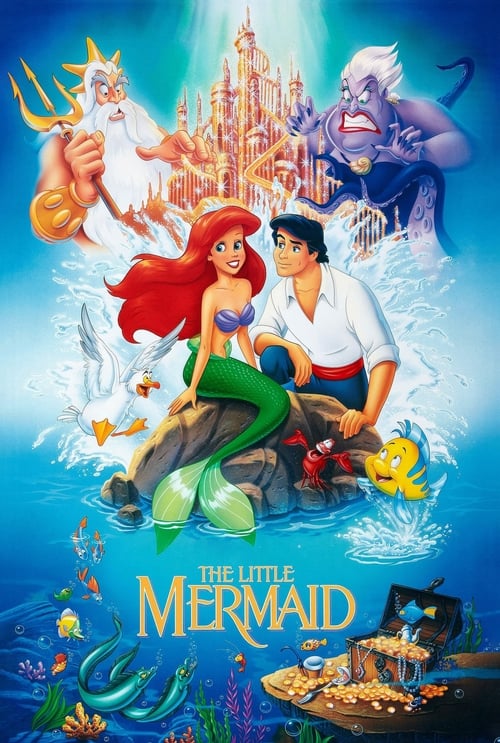
The Little Mermaid (1989): Complete Plot Narrative
The ocean stretches endlessly beneath a sailing ship cutting through the waves, its crew singing sea shanties as they work the deck. Among them stands Prince Eric, a young man of noble bearing, standing with his faithful sheepdog Max at his side. His advisor Grimsby, dignified and somewhat fussy, encourages Eric to think about marriage and royal responsibilities. As a birthday gift, Grimsby presents Eric with a colossal stone statue--a heroic rendering of Eric himself in dramatic pose with sword raised. Eric accepts it with good-natured embarrassment, unaware that this very statue will soon become the centerpiece of an underwater obsession.
Below the surface, in the glittering kingdom of Atlantica, King Triton arrives in triumphant procession, his golden trident gleaming with magical power as dolphins pull his shell chariot through cheering crowds of merfolk. The occasion is a grand concert, and Sebastian, the royal court composer and conductor, nervously prepares to present a musical performance in Triton's honor. The piece is meant to showcase Triton's seven daughters, each singing in turn, culminating in the debut of the youngest princess. But when Sebastian announces the final performer--Ariel--the stage remains empty. The youngest daughter is absent, causing Sebastian's composure to crack and Triton's expression to darken with displeasure.
At that very moment, far from the concert hall, Ariel explores the wreckage of a sunken human ship with her loyal fish companion Flounder, a small, timid creature who follows her into danger despite his fear. Ariel moves through the skeletal remains with wonder, collecting human artifacts--a fork, a pipe, and countless other mysterious objects. Her curiosity is insatiable, her movements graceful and fearless. But their exploration is interrupted when a massive shark emerges from the darkness, its jaws snapping at the intruders. Ariel's quick thinking saves them; she leads the predator into a collision with debris, and Flounder accidentally lodges the shark's head in a porthole using a cannon, allowing them to escape into open water.
Surfacing near the shore, Ariel and Flounder encounter Scuttle, a seagull perched on a rock, who presents himself as an expert on human culture. His "expertise," however, is hilariously inaccurate. He identifies the fork as a "dinglehopper" used for combing hair and the pipe as a "snarfblat," confidently dispensing misinformation that Ariel accepts as gospel truth. This becomes her primary source of knowledge about the human world--unreliable, whimsical, and utterly wrong.
Meanwhile, in a dark lair far beneath the sea, Ursula, a sea witch with an octopus-like lower body and hypnotic eyes, watches through a magical crystal ball as Ariel moves through the underwater kingdom. Coiled around her are her moray eel henchmen, Flotsam and Jetsam, sinister and obsequious. Ursula speaks of her exile from the palace, of Triton's betrayal, and of her plan for revenge. She has been watching Ariel, recognizing in the young mermaid a vulnerability she can exploit. Triton's love for his daughter is his weakness, and Ursula intends to use it to seize the throne and the trident that symbolizes his power.
Back in Atlantica, Triton confronts Sebastian about Ariel's absence. The crab admits reluctantly that the princess is fascinated with the human world, a revelation that troubles the king deeply. He sends Sebastian to keep watch over Ariel, to ensure she stays away from the surface and the dangers that lurk there. But Sebastian's supervision will prove insufficient to contain the rebellious spirit of the youngest princess.
Days pass, and Ariel's infatuation with the human world grows. She sings alone in her secret grotto--a hidden underwater cavern filled with her collection of human treasures. Among the trinkets and artifacts stands the massive stone statue of Prince Eric, salvaged from the wreck of his ship. As she sings "Part of Your World," her voice carries the yearning of a soul trapped between two worlds, dreaming of legs and a life on land, of being "where the people walk, where they run, where they stay all day in the sun."
On the surface, Eric's ship encounters a violent storm. Lightning tears through the sky, waves crash over the deck, and the vessel pitches dangerously. Eric stands firm, commanding his crew, but a lightning strike ignites the ship's rigging. In the chaos, Eric is thrown overboard, knocked unconscious as he sinks into the dark water.
Ariel, drawn to the surface by some inexplicable pull, witnesses the disaster. She sees Eric's limp body sinking and dives without hesitation, pulling him toward the shore. She drags him onto the beach and sings to him as he lies unconscious, her voice the last thing he hears before darkness claims him fully. When he awakens, Eric finds himself alone on the sand, with no memory of who saved him--only the haunting echo of a beautiful voice that he cannot forget.
Obsessed with finding the girl with the enchanting voice, Eric searches the kingdom, but no maiden matches the voice he remembers. He becomes melancholy, withdrawn, causing Grimsby and Max concern. Meanwhile, Ariel's behavior has become increasingly erratic. She surfaces constantly, asking Scuttle endless questions about humans, collecting more artifacts, and singing about her desire to join that world. When Triton learns of her continued obsession with the surface, he storms into her grotto in a fury.
The confrontation is devastating. Triton, seeing the statue of Eric and understanding the depth of his daughter's infatuation, unleashes his rage. With his trident, he systematically destroys her collection, blasting the artifacts to pieces, shattering her dreams in physical form. The statue of Eric is obliterated. Ariel watches in horror as everything she treasures is reduced to rubble, and her father's words cut deeper than any magic: humans are barbarians, dangerous and beneath her station, and she will have nothing more to do with them.
Heartbroken and desperate, Ariel flees into the darkness. Flotsam and Jetsam find her weeping and whisper seductively of a solution to her problems. They guide her to Ursula's lair, a sinister cavern decorated with bones and bioluminescent plants. The walls seem to pulse with a sickly glow, and Ariel notices, with growing horror, that the space is filled with shriveled, polyp-like creatures--the remnants of previous "deals" Ursula has made. These are merpeople who failed to meet Ursula's terms and were transformed into her slaves.
But Ariel is too desperate to heed the warning. Ursula greets her with false sympathy, singing "Poor Unfortunate Souls," a seductive melody that downplays the importance of Ariel's voice and promises her everything she desires. The sea witch explains her offer: she will transform Ariel into a human for three days. During that time, Ariel must receive a kiss of true love from Eric. If she succeeds, she will remain human forever. If she fails, she will transform back into a mermaid and become Ursula's property--her slave for eternity.
Ariel hesitates only briefly. The price is her voice--Ursula will extract it and seal it within a magical nautilus shell amulet that she will wear. Without her voice, Ariel will be mute, unable to speak or sing. But Ariel, blinded by love and desperation, agrees. She signs the glowing contract with a magical quill, and Ursula's magic erupts around her. Ariel feels her voice being pulled from her throat--a sensation of loss and violation--and watches as it swirls into the nautilus shell, which Ursula fastens around her neck.
The transformation begins. Ariel's tail splits and reforms into human legs. Her scales fade to skin. She rises through the water, propelled by Flounder and guided by her friends toward the surface. When she breaks through into the air, she is fully human--beautiful, vulnerable, and utterly mute.
Eric finds her on the beach, washed up and confused, still adjusting to her new body. He is immediately struck by her beauty and by something familiar in her eyes, though he cannot place it. He takes her to his castle, where she is given clothes and introduced to human customs. She learns to walk, though her movements are still fluid and graceful in a way that marks her as different. At dinner, she uses the fork in her hair--following Scuttle's misinformation--before learning the proper way to eat.
Over the next two days, Eric spends time with Ariel, showing her his world. They explore the kingdom's markets, dance with villagers, and ride through the countryside in a carriage. Ariel experiences human joy and wonder at every turn--music, laughter, food, and the simple pleasure of walking on solid ground. Eric finds himself drawn to her despite her inability to speak. Her expressive eyes and genuine reactions to everything around her captivate him in ways that words never could.
But time is running out. On the evening of the second day, Eric takes Ariel out on a rowboat in a moonlit lagoon. The setting is romantic, orchestrated by Sebastian and other sea creatures who have come to help Ariel. They sing "Kiss the Girl," creating an atmosphere of magic and possibility. Eric leans toward Ariel, and for a moment, it seems the kiss will happen--that Ariel will succeed in her quest.
Then, suddenly, the boat capsizes. Flotsam and Jetsam, acting on Ursula's orders, have deliberately overturned it, thwarting the kiss and ensuring Ariel's failure. Eric and Ariel are thrown into the water, and the moment is lost. Ariel surfaces, desperate and heartbroken, realizing that her three days are nearly over and she has failed.
The next morning, Ariel learns that Eric has announced his engagement. He is to marry a mysterious woman named Vanessa who arrived at the castle the previous evening. Ariel's heart shatters. She does not know that Vanessa is Ursula in disguise, that the sea witch has come to ensure Ariel's failure by winning Eric's heart herself.
Vanessa wears the nautilus shell around her neck, and when she sings, it is with Ariel's voice--the voice Eric heard on the beach, the voice that has haunted him since his rescue. Under the spell of that familiar voice and Ursula's hypnotic magic, Eric becomes entranced. He sees Vanessa as the girl who saved him, and he agrees to marry her immediately on a ship in the harbor.
Scuttle, the seagull, becomes an unlikely hero. Spying on Vanessa in her cabin, he witnesses her reflection in a mirror--the reflection of the sea witch, not the beautiful woman. He races to find Ariel and Sebastian, frantically communicating what he has discovered. Sebastian immediately dives toward the sea to inform King Triton, while Scuttle organizes a chaotic animal assault on the wedding ship.
As the ceremony begins, birds descend on Vanessa, pecking and harassing her. Sea creatures cause disruptions--octopi tangle the rigging, fish leap onto the deck. In the chaos, the nautilus shell is knocked loose and shatters on the wooden planks. Ariel's voice streams out of the broken shell and returns to her, restoring her ability to speak and sing.
Eric's eyes clear instantly. The hypnotic spell breaks, and he realizes the truth: the girl before him--mute, expressive, with those familiar eyes--is the one who saved him. He reaches for Ariel, and they move to kiss. But at that precise moment, the sun touches the horizon. The three-day deadline expires.
Ariel transforms back into a mermaid in front of everyone, her human legs becoming a shimmering tail. Ursula, no longer disguised, reveals her true form and her true nature. She seizes Ariel and drags her back into the sea, laughing with triumph. The contract is fulfilled--Ariel has failed to receive the kiss of true love before sunset, and now she belongs to Ursula.
Eric dives after them, but he cannot follow them into the depths. He surfaces, gasping and desperate, watching helplessly as Ariel disappears into the darkness below.
In the underwater realm, Triton confronts Ursula, demanding his daughter's release. But Ursula presents the magical contract--binding, inviolable, signed in Ariel's own hand. The law of the sea cannot be broken, even by the king. Ursula's power is absolute.
Triton, faced with the loss of his daughter, makes a choice born of love. He offers himself in Ariel's place. He signs away his power, his trident, and his crown. The moment the contract is sealed, Triton transforms into a shriveled polyp, joining the other victims in Ursula's garden of enslaved souls. Ursula seizes the trident and the crown, and her power explodes outward. She grows to colossal size, her form expanding until she towers above the ocean itself.
The sea erupts into chaos. Dark clouds swirl overhead, lightning tears through the sky, and waves become mountainous. Ursula creates a massive whirlpool that pulls wrecked ships up from the seabed, drawing them into a vortex of destruction. She intends to destroy Ariel and Eric as a demonstration of her power, to rule the ocean through fear and domination.
But Eric, clinging to floating debris, sees Ariel in danger. He climbs aboard one of the wrecked ships caught in the whirlpool and fights his way to the wheel, struggling against the storm and the pull of the vortex. With strength born of desperation, he aligns the ship so that its broken, jagged bowsprit points directly at the towering sea witch. A massive wave lifts the ship and propels it forward.
The splintered prow impales Ursula through the torso. She screams, a sound of rage and agony that echoes across the sea. Dark magic erupts from her body in violent bursts of energy, and then she explodes in a massive blast of shadow and light. Her form disintegrates, sinking beneath the waves, and the storm dissipates as suddenly as it began.
With Ursula's death, her magic collapses. The whirlpool subsides, the waves calm, and the polyp merpeople in her lair--including King Triton--transform back into their original forms. The ocean is freed from her tyranny.
Ariel surfaces, alive but devastated. She is a mermaid again, separated from Eric by the fundamental difference of their natures. She sits on a rock, gazing toward the shore where Eric stands, both of them trapped on opposite sides of an impossible divide.
But Triton, watching his daughter's anguish and recognizing the depth of her love, makes a decision that changes everything. He rises from the water and approaches Ariel. In a moment of profound acceptance, he raises his trident and casts a gentle spell. Ariel's tail shimmers and transforms into human legs. She is no longer a mermaid--she is permanently human, given the gift of her father's blessing.
Ariel rises from the water, fully human, and Eric rushes to meet her. They embrace on the shore, their love no longer impossible, their union no longer forbidden. The two worlds have been bridged by sacrifice, courage, and the power of love to transform even the most rigid boundaries.
A royal wedding takes place on a ship near the shore. Ariel, dressed in a white wedding gown, stands beside Eric as they are married before human guests and sea creatures watching from the water. King Triton rises from the depths to witness his daughter's happiness. Ariel swims to him--or leans from the ship's side--to share a final embrace and farewell. Triton smiles, no longer resistant, no longer controlling, but proud and accepting of his daughter's choice.
As the ship departs into the horizon, Triton raises his trident and sends a rainbow arcing over the sea as a blessing. Ariel and Eric stand together on the deck, waving goodbye to their underwater friends--Sebastian, Flounder, and the creatures of the sea--as the film ends on a note of hope and union, two worlds finally at peace, two hearts finally at home.





What is the ending?
In the ending of The Little Mermaid, Ariel defeats Ursula with the help of Prince Eric, who ultimately kills the sea witch. Ariel's father, King Triton, sees her bravery and sacrifices his trident to transform her into a human permanently. Ariel and Eric get married, and they live happily ever after.
Now, let's delve into the ending in a detailed, chronological narrative.
As the climax unfolds, Ariel finds herself in a fierce battle against Ursula, who has taken on a monstrous form. The ocean roils with dark waves as Ursula, now a giant, looms over Ariel and Prince Eric. With her powerful magic, she commands the sea, creating a tempest that threatens to engulf them. Ariel, filled with determination and fear, realizes that she must confront Ursula to save her friends and her new life on land.
In a moment of desperation, Eric seizes a chance to help Ariel. He commandeers a ship, steering it toward Ursula. The tension escalates as he navigates the treacherous waters, his heart racing with the urgency to save Ariel. With a fierce resolve, he uses the ship's prow to stab Ursula, who lets out a terrifying scream as she is defeated. The dark magic that had enveloped the sea begins to dissipate, and the ocean calms.
As Ursula's body sinks into the depths, the sea creatures cheer for Ariel and Eric, celebrating their victory. However, the aftermath of the battle leaves Ariel in a precarious position. King Triton, witnessing his daughter's bravery and the love she shares with Eric, realizes the depth of her commitment to her new life. He approaches Ariel, who is still reeling from the confrontation, and with a heavy heart, he understands that he must let her go.
In a poignant moment, Triton raises his trident, and with a wave of magic, he transforms Ariel into a human permanently. Ariel's eyes widen with joy and disbelief as she feels the warmth of her legs beneath her. She embraces her father, tears of gratitude streaming down her face, knowing that she can now fully embrace her love for Eric.
The scene shifts to a beautiful, sunlit day on the shore, where Ariel and Eric prepare for their wedding. The atmosphere is filled with joy and celebration as friends from both land and sea gather to witness their union. Flounder, Sebastian, and other sea creatures swim close to the surface, peeking out to catch a glimpse of the ceremony. The vibrant colors of the decorations and the sound of music fill the air, creating a magical ambiance.
As Ariel walks down the aisle, her heart swells with happiness. Eric stands at the altar, his eyes filled with love and admiration. The two exchange vows, promising to love and cherish one another. The moment is filled with warmth and hope, symbolizing the merging of two worlds--land and sea.
Finally, as they share their first kiss as a married couple, the scene fades to a beautiful sunset over the ocean. The camera pans out, revealing the vastness of the sea and the sky, signifying the endless possibilities that lie ahead for Ariel and Eric. The film concludes with a sense of fulfillment and joy, leaving the audience with the image of a couple united in love, ready to face whatever challenges may come their way.
In the end, Ariel has found her place in the world, having made sacrifices for love and having gained her father's acceptance. Eric, too, has embraced his role as Ariel's partner, standing by her side as they embark on their new life together. King Triton, though initially resistant to Ariel's desires, ultimately recognizes her strength and independence, allowing her to pursue her dreams. The story closes on a note of hope, love, and the promise of a bright future.
Is there a post-credit scene?
The Little Mermaid, produced in 1989, does not have a post-credit scene. The film concludes with a celebratory scene where Ariel and Prince Eric are married, surrounded by their friends and family. The final moments feature a joyful atmosphere, with music and laughter as they sail away together, symbolizing their new life and love. The film ends on a high note, emphasizing themes of love, acceptance, and the triumph of following one's heart.
What motivates Ariel to trade her voice for legs?
Ariel, the youngest daughter of King Triton, is deeply fascinated by the human world and longs to be part of it. Her desire to explore the surface is intensified when she saves Prince Eric from drowning and falls in love with him. This infatuation drives her to seek out Ursula, the sea witch, to trade her voice for legs, believing that this sacrifice will allow her to win Eric's heart.
How does Ursula manipulate Ariel in the story?
Ursula, the sea witch, uses Ariel's longing for freedom and love to her advantage. She presents herself as a helpful figure, offering Ariel a deal that seems beneficial. By taking Ariel's voice, Ursula not only gains power over her but also plans to use Ariel's silence to keep Prince Eric from recognizing her as the one who saved him. Ursula's manipulation is rooted in her desire for revenge against King Triton and control over the ocean.
What role does Flounder play in Ariel's journey?
Flounder, Ariel's loyal fish friend, serves as her confidant and moral support throughout her journey. He is often worried about Ariel's reckless pursuits and tries to dissuade her from venturing to the surface or making deals with Ursula. Despite his fears, Flounder ultimately supports Ariel, showcasing his loyalty and friendship, especially when he helps her navigate the challenges she faces after trading her voice.
How does King Triton react to Ariel's actions?
King Triton is initially portrayed as a protective and authoritative figure who disapproves of Ariel's fascination with the human world. When he discovers that Ariel has traded her voice to Ursula, he is furious and heartbroken, feeling betrayed by his daughter. His emotional turmoil is evident as he confronts Ariel and later realizes the depth of her love for Eric, leading him to ultimately support her in the climax of the story.
What is the significance of the sea witch Ursula's transformation into Vanessa?
Ursula's transformation into Vanessa is a pivotal moment in the story, showcasing her cunning and deceit. By disguising herself as a beautiful human woman, she uses Ariel's stolen voice to enchant Prince Eric, furthering her plan to take over the ocean. This transformation highlights Ursula's manipulative nature and the theme of appearances versus reality, as she attempts to undermine Ariel's chances of true love and freedom.
Is this family friendly?
The Little Mermaid (1989) is generally considered family-friendly, but there are a few scenes and aspects that might be potentially objectionable or upsetting for children or sensitive viewers:
-
Ursula's Transformation: The sea witch Ursula transforms into a beautiful woman, which can be visually striking and may evoke feelings of unease due to her sinister nature.
-
Ariel's Sacrifice: Ariel gives up her voice to Ursula, which can be interpreted as a troubling message about sacrificing one's identity for love.
-
Conflict and Danger: There are scenes of conflict, including a shipwreck and a battle between Prince Eric and Ursula, which may be intense for younger viewers.
-
Ursula's Threats: Ursula uses intimidation and manipulation, which could be frightening, especially when she reveals her true form and intentions.
-
Emotional Turmoil: Ariel experiences deep feelings of longing, sadness, and frustration throughout the film, particularly in her struggles with her father, King Triton, and her desire to be part of the human world.
-
Parental Disapproval: The relationship between Ariel and her father is strained, leading to moments of anger and disappointment that may resonate with children who have experienced similar feelings.
While these elements contribute to the film's emotional depth and narrative tension, they may be sensitive for some viewers.








