
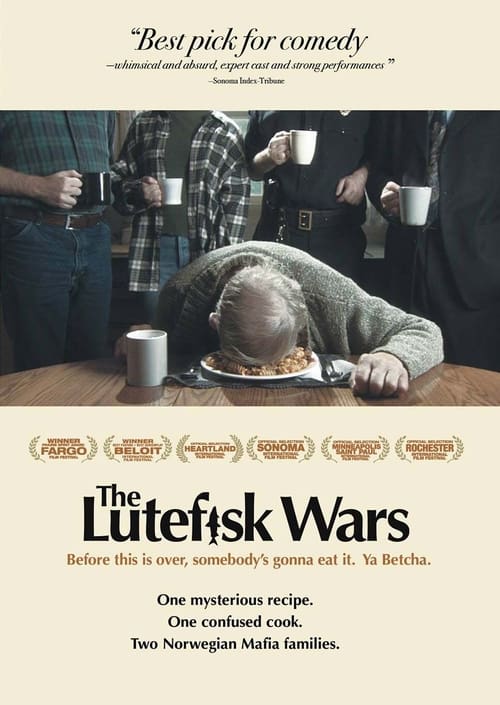











Popular
What motivates the main character, Lars, to enter the lutefisk competition?
How does the rivalry between Lars and his childhood friend, Bjorn, escalate throughout the film?
What role does the lutefisk recipe play in the story?
How does the community react to the lutefisk competition?
What is the significance of the final lutefisk dish presented by Lars?
Should I watch it?
Ask Your Own Question

What is the plot?
Sorry, we aren't able to watch and write up a full detailed plot yet. Check back in a few days.








What is the ending?
In the ending of "The Lutefisk Wars," the long-standing feud between the two rival families, the Johnsons and the Andersons, reaches a climax during the annual lutefisk festival. After a series of comedic and dramatic confrontations, the families come to a realization about the futility of their rivalry. They ultimately decide to unite and celebrate their shared heritage, leading to a heartwarming resolution.
As the festival unfolds, the tension between the families escalates. The Johnsons and the Andersons prepare their lutefisk dishes, each determined to outdo the other. The festival is filled with colorful decorations, the aroma of cooking fish, and the sounds of laughter and music. However, the atmosphere is thick with rivalry as both families set up their booths, glaring at one another.
During the cooking competition, a mishap occurs when a large pot of lutefisk from the Johnsons spills over, causing chaos. In the midst of the commotion, a young child from each family accidentally collides, causing both families to momentarily pause and reflect on the absurdity of their feud. This moment of innocence serves as a catalyst for change.
As the festival progresses, the families begin to share stories and memories of their ancestors, realizing that their shared history is more significant than their petty disputes. The emotional weight of their past grievances begins to lift, and laughter replaces hostility. The festival culminates in a joint celebration where both families come together to create a massive lutefisk dish, symbolizing their newfound unity.
In the final scenes, the Johnsons and the Andersons embrace, their animosity dissolved. The festival ends with a communal feast, where everyone, including the townspeople, joins in to enjoy the lutefisk together. The camera pans out, capturing the joyous atmosphere, as the families dance and celebrate, marking the end of their feud and the beginning of a new chapter in their relationship.
The fate of the main characters reflects this transformation. The patriarchs of both families, Mr. Johnson and Mr. Anderson, who were once bitter rivals, find common ground and shake hands, signaling their reconciliation. Their children, who had been caught in the crossfire of their parents' feud, share a moment of friendship, symbolizing hope for future generations. The film concludes on a high note, emphasizing themes of community, understanding, and the importance of family ties over rivalry.
Is there a post-credit scene?
In "The Lutefisk Wars," there is indeed a post-credit scene that adds a humorous twist to the film's conclusion. After the credits roll, the scene opens in a small, dimly lit kitchen where a group of townsfolk is gathered around a table, still buzzing with the excitement and tension from the lutefisk competition.
As the camera zooms in, we see a few of the main characters, including the competitive chefs, nervously eyeing a large pot simmering on the stove. The air is thick with the smell of lutefisk, and the tension is palpable as they prepare for an impromptu taste test.
One character, clearly the most competitive of the group, dramatically lifts the lid off the pot, revealing a bubbling concoction that looks both enticing and slightly terrifying. The others lean in, their expressions a mix of anticipation and dread.
Suddenly, as they each take a spoonful, their faces contort in surprise. Instead of the expected flavor of lutefisk, they are met with an unexpected burst of sweetness--it's a dessert version of lutefisk, made with candy and fruit. The scene shifts to laughter and playful banter as they realize they've been tricked by one of the chefs, who had secretly been working on a sweet variation all along.
The scene ends with the group playfully arguing over who will take credit for this new creation, setting the stage for future culinary battles and reinforcing the film's themes of community, rivalry, and the joy of food. The lightheartedness of the moment contrasts with the earlier tensions of the film, leaving the audience with a sense of warmth and camaraderie.
What motivates the main character, Lars, to enter the lutefisk competition?
Lars, a passionate lutefisk chef, is driven by a deep-seated desire to honor his family's culinary legacy. He feels the pressure of his family's expectations and the need to prove himself in a community that values tradition. His internal conflict revolves around balancing his love for cooking with the fear of failure, which intensifies as the competition approaches.
How does the rivalry between Lars and his childhood friend, Bjorn, escalate throughout the film?
The rivalry between Lars and Bjorn begins with playful banter but quickly escalates as both men become increasingly competitive. Bjorn, who has always been the more successful chef, taunts Lars, pushing him to prove his worth. As the competition nears, their interactions become more heated, culminating in a series of sabotages and confrontations that reveal their deep-seated insecurities and unresolved issues from their past.
What role does the lutefisk recipe play in the story?
The lutefisk recipe serves as a symbol of tradition and family heritage. It is a closely guarded secret passed down through generations in Lars's family. As Lars prepares for the competition, he struggles with whether to stick to the traditional recipe or innovate and create something new. This decision reflects his internal battle between honoring his roots and forging his own identity as a chef.
How does the community react to the lutefisk competition?
The community is deeply invested in the lutefisk competition, treating it as a cultural event that brings everyone together. The townspeople display a mix of excitement and anxiety, as they have strong opinions about the competitors and their culinary skills. The atmosphere is charged with anticipation, and the stakes feel high, as the winner is not just celebrated but also seen as a representative of the town's culinary pride.
What is the significance of the final lutefisk dish presented by Lars?
Lars's final lutefisk dish is significant as it represents his journey of self-discovery and acceptance. He combines elements of his family's traditional recipe with his own creative flair, symbolizing his growth as a chef. The dish not only showcases his culinary skills but also embodies his reconciliation with his past and his willingness to embrace both tradition and innovation, ultimately earning him respect from the judges and the community.
Is this family friendly?
"The Lutefisk Wars" is a comedic film that revolves around the cultural clash between two rival communities over the traditional dish of lutefisk. While the movie is generally light-hearted and family-friendly, there are a few aspects that might be considered objectionable or upsetting for children or sensitive viewers:
-
Cultural Conflict: The film portrays a rivalry that can lead to misunderstandings and comedic confrontations, which may include exaggerated stereotypes that some viewers might find uncomfortable.
-
Mild Violence: There are scenes of slapstick humor that involve mild physical comedy, such as food fights and pranks, which could be seen as chaotic or disruptive.
-
Language: There may be occasional use of mild language or humorous insults that could be inappropriate for younger audiences.
-
Themes of Rivalry: The central theme of competition and conflict between the two communities might be intense for some viewers, as it explores the lengths to which people will go to defend their traditions.
Overall, while the film is intended to be humorous and entertaining, these elements could be sensitive for some children or viewers.