








Popular
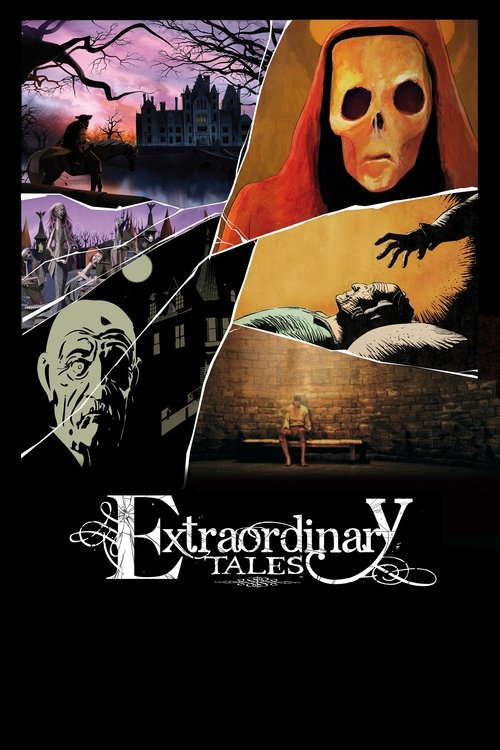
What are the main stories featured in Extraordinary Tales?
How does the character of the narrator influence the stories in Extraordinary Tales?
What is the significance of the visual style in the adaptation of 'The Tell-Tale Heart'?
What themes are explored in 'The Fall of the House of Usher' segment?
How does 'The Masque of the Red Death' depict the character of Prince Prospero?
Should I watch it?
Ask Your Own Question

What is the plot?
Sorry, we aren't able to watch and write up a full detailed plot yet. Check back in a few days.
More Movies Like This
Browse All Movies →
What is the ending?
In the ending of "Extraordinary Tales," the film concludes with the final story, "The Tell-Tale Heart," where the narrator's guilt leads to his confession of murder. The film wraps up with a reflection on the themes of death and the human condition, leaving the audience with a haunting sense of the inevitability of fate.
As the final tale unfolds, the scene opens in a dimly lit room, where the narrator, a man consumed by paranoia and guilt, recounts the events leading to his crime. The atmosphere is thick with tension, and the flickering candlelight casts eerie shadows on the walls, enhancing the sense of dread. The narrator's voice trembles as he describes his obsession with the old man's eye, which he perceives as a "vulture eye." This fixation drives him to madness, and he ultimately decides to murder the old man to rid himself of the eye's torment.
In a chilling sequence, the narrator meticulously plans the murder, showcasing his meticulous nature. He sneaks into the old man's room each night, waiting for the perfect moment. The audience can feel the weight of his internal conflict; he is both repulsed and fascinated by the old man. The tension escalates as he finally commits the act, suffocating the old man and hiding his dismembered body beneath the floorboards.
As the story progresses, the narrator's initial sense of triumph quickly deteriorates into paranoia. He believes he can hear the old man's heart still beating beneath the floor, a sound that grows louder and more insistent. This auditory hallucination symbolizes his overwhelming guilt and the inescapable nature of his conscience. The scene is filled with a palpable sense of dread as he becomes increasingly frantic, his mind unraveling under the weight of his actions.
In the climax of the tale, the narrator, unable to bear the sound any longer, confesses to the murder in a fit of hysteria. He tears up the floorboards, revealing the body to the police officers who had come to investigate. His confession is a powerful moment, illustrating the theme of guilt and the idea that one cannot escape the consequences of their actions.
As the film concludes, the narrator's fate is sealed; he is left to grapple with the reality of his crime and the torment of his conscience. The final images linger on the narrator's face, a mixture of horror and relief, as he realizes that he cannot escape the truth of what he has done. The film fades to black, leaving the audience with a haunting reminder of the fragility of the human mind and the darkness that can reside within.
The other characters, such as the old man and the police officers, serve as catalysts for the narrator's descent into madness, but their fates are intertwined with his, as they represent the external forces that ultimately lead to his downfall. The film closes with a sense of inevitability, emphasizing the themes of guilt, madness, and the inescapable nature of one's actions.
Is there a post-credit scene?
Extraordinary Tales, produced in 2013, does not have a post-credit scene. The film is an anthology that presents five animated adaptations of Edgar Allan Poe's stories, each narrated by a different voice actor. The film concludes after the final story, "The Tell-Tale Heart," without any additional scenes or content following the credits. The focus remains on the rich storytelling and the haunting visuals throughout the film, leaving the audience with the lingering impact of Poe's themes rather than a continuation of the narrative.
What are the main stories featured in Extraordinary Tales?
Extraordinary Tales features five animated adaptations of Edgar Allan Poe's works: 'The Tell-Tale Heart,' 'The Fall of the House of Usher,' 'The Masque of the Red Death,' 'The Cask of Amontillado,' and 'The Pit and the Pendulum.' Each story is narrated by a different voice, including notable figures like Guillermo del Toro and Christopher Lee.
How does the character of the narrator influence the stories in Extraordinary Tales?
The narrators in Extraordinary Tales, each bringing their unique style and emotional depth, significantly influence the tone and atmosphere of the stories. For instance, Christopher Lee's deep, resonant voice adds a gravitas to 'The Fall of the House of Usher,' while Guillermo del Toro's narration in 'The Tell-Tale Heart' infuses a sense of urgency and madness, enhancing the psychological tension.
What is the significance of the visual style in the adaptation of 'The Tell-Tale Heart'?
In 'The Tell-Tale Heart,' the visual style is characterized by stark contrasts and surreal imagery that reflect the protagonist's descent into madness. The use of dark colors and distorted shapes creates an unsettling atmosphere, mirroring the internal chaos of the narrator as he becomes increasingly obsessed with the old man's eye and ultimately succumbs to guilt.
What themes are explored in 'The Fall of the House of Usher' segment?
In 'The Fall of the House of Usher,' themes of decay, madness, and the supernatural are explored through the relationship between Roderick Usher and his sister Madeline. The oppressive atmosphere of the Usher mansion, coupled with Roderick's deteriorating mental state and the eerie presence of his sister, creates a haunting narrative about the inescapable nature of familial ties and the consequences of isolation.
How does 'The Masque of the Red Death' depict the character of Prince Prospero?
In 'The Masque of the Red Death,' Prince Prospero is depicted as a hedonistic and arrogant ruler who believes he can escape the plague ravaging his kingdom by isolating himself and his courtiers in a lavish abbey. His character embodies the themes of denial and hubris, as he throws a grand masquerade ball, ultimately leading to his downfall when the Red Death infiltrates his sanctuary, symbolizing the inevitability of death.
Is this family friendly?
"Extraordinary Tales," produced in 2013, is an animated anthology film that adapts several of Edgar Allan Poe's classic stories. While the film is visually striking and artistically crafted, it contains themes and imagery that may not be suitable for all audiences, particularly children or sensitive viewers.
Potentially objectionable or upsetting aspects include:
-
Death and Mortality: Many of Poe's stories revolve around themes of death, loss, and the macabre, which may be unsettling for younger viewers.
-
Horror Elements: The film features dark and eerie visuals, including ghostly apparitions and unsettling atmospheres that could provoke fear or anxiety.
-
Violence: Some stories include depictions of violence or the consequences of violent actions, which may be disturbing.
-
Psychological Themes: The exploration of madness and guilt in certain narratives can be intense and may not be appropriate for all children.
-
Supernatural Themes: The presence of supernatural elements, such as spirits and curses, may be frightening for sensitive viewers.
Overall, while "Extraordinary Tales" is a unique artistic interpretation of Poe's work, its themes and visuals may be more suitable for older teens and adults rather than a family-friendly audience.








