








Popular
What role does Robert Reich play in the documentary Inequality for All?
How does the film illustrate the concept of the '1%'?
What personal stories does Robert Reich share to emphasize his points about inequality?
What specific economic policies does Reich advocate for in the film?
How does the film address the impact of globalization on American workers?
Should I watch it?
Ask Your Own Question

What is the plot?
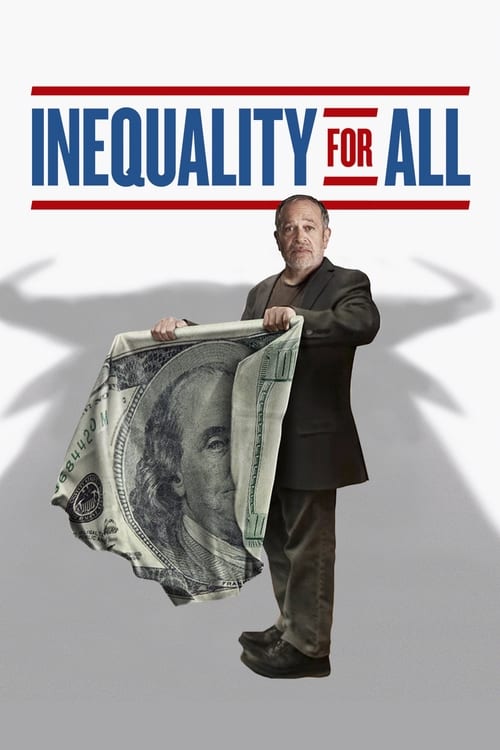
Inequality for All opens not like a thriller with a mystery to solve, but like a public argument that is already underway, with Robert Reich stepping into view as both teacher and witness, ready to explain why the American economy is narrowing around him and why that narrowing matters to everyone watching. The film's first movement is anchored in Reich's Wealth and Poverty class at U.C. Berkeley, and the camera treats the classroom almost like a stage where history, policy, and personal urgency collide in real time; the spring 2012 setting gives the film a concrete frame, even though the crisis it describes reaches back decades. Reich, former U.S. Labor Secretary, professor, author, and public-policy explainer, speaks with a mix of wit and alarm, building the documentary around a simple but devastating thesis: the growing gap between rich and poor is hollowing out the middle class, and without a healthy middle class, the whole economy becomes unstable.
He begins by laying out the scale of the imbalance in blunt, unforgettable terms. The film immediately emphasizes that the richest 400 Americans now hold more wealth than the bottom half of the population, a fact repeated in multiple reviews as one of the documentary's most startling statistics. Reich uses graphs, animated charts, archival footage, and his Berkeley lectures to show that this is not simply a recent glitch or a temporary downturn; rather, it is the result of economic and policy shifts stretching back more than 30 years, especially from the 1970s onward. The documentary frames inequality as a long, structural process rather than a single event, and Reich's narration keeps returning to that idea: the system is not broken by accident, it is functioning exactly as designed by the incentives and policy choices that shaped it.
From the outset, the film's emotional engine is Reich's effort to make abstract economics feel human. He talks directly to students, and by extension to the audience, with a teacher's clarity and a reformer's impatience, connecting statistics to everyday life. He explains that the middle class produces roughly 70% of U.S. consumer spending, which means the entire economy depends on ordinary families having enough money to buy homes, cars, food, and services. That point becomes the film's central tension: if wages stagnate while costs rise, then the middle class is forced deeper into debt just to maintain a normal life, and when households can no longer spend, businesses lose demand, jobs disappear, and growth slows. The documentary keeps tightening that logic until it feels almost unavoidable, as though Reich is methodically leading the viewer toward the conclusion that inequality is not just unfair but economically self-defeating.
As the film widens its scope, it repeatedly looks backward to the Great Depression and then forward to the 2008 financial crisis, drawing a parallel between the pre-1928 economy and the pre-2008 economy. The comparison is presented as one of the documentary's major revelations: both eras feature rising inequality, a fragile middle class, and an economy increasingly dependent on speculation and debt. Reich traces the line from postwar shared prosperity to the later unraveling, explaining that after the 1970s the gains from economic growth stop flowing broadly and instead concentrate upward. He points to a combination of anti-union legislation, market deregulation, and tax and policy changes that favor capital over labor, all of which allow wealth to accumulate at the top while the middle class loses purchasing power. The film presents these shifts not as abstract policy debates but as the hidden architecture of everyday insecurity.
The transitions between classroom explanation and lived experience are smooth and deliberate, and one of the film's strengths is the way it moves from national data to individual faces. Reich's students and audience members function as stand-ins for the broader public, listening, questioning, and reacting as the economic lesson unfolds. The camera lingers on Reich's body language as he leans into a point, smiles at a joke, or grows more serious when the evidence turns grim. He is not a detached academic; he is visibly invested in the argument, and that investment gives the film momentum. When he describes the widening gulf between rich and poor as a threat not only to the economy but to democracy itself, the stakes suddenly feel larger than income alone.
One of the documentary's most memorable human threads comes through Erika Vaclav and Robert Vaclav, whose story translates national anxiety into household pressure. Erika works at Costco, and Robert loses his job as a manager at Circuit City before becoming a student in Reich's class. Their inclusion gives the film a quietly devastating intimacy: this is not an abstract debate about percentages, but a story about rent, wages, insecurity, and the emotional strain of trying to remain stable in an unstable economy. Their situation embodies the film's central claim that even when people are employed, they can remain economically precarious if wages do not keep up with living costs. Circuit City and Costco, as workplaces, become symbolic markers of two different kinds of middle-class reality: one where a former salaried manager falls through the cracks, and one where service-sector labor provides work without full security.
As Reich explains the larger system, the documentary introduces another striking figure: Nick Hanauer, a wealthy entrepreneur whose presence complicates the usual ideological line between rich and poor. He becomes important because he does not behave like a stereotypical defender of elite wealth; instead, his comments support Reich's core argument that even the very rich do not spend in a way that sustains broad-based growth. The film uses Hanauer to challenge the conventional idea that the wealthy are the economy's main drivers. Reich insists that the rich may invest, save, or buy expensive goods, but they do not consume enough in the mass-market sense to keep the system expanding the way a spending middle class does. That contrast gives the documentary one of its most effective rhetorical turns: wealth concentration is not only unjust, it is inefficient.
The film's visual language deepens that argument. Charts rise and fall across the screen, showing income stagnation, wealth concentration, and the narrowing share of economic gains reaching ordinary workers. Archival footage links past and present, reminding viewers that today's crisis has precedents, while new interview footage and classroom scenes anchor the story in the present tense. At points, the documentary uses symbolic graphics, including suspension-bridge imagery, to suggest the precariousness of economic support and the way inequality stretches the social structure until it becomes brittle. These visuals are not decorative; they function like another form of narration, turning numbers into something the viewer can see and feel. The result is a steady accumulation of pressure, as each new chart confirms what the last one already implied: the distribution of prosperity is becoming radically skewed.
Reich's rhetorical strategy is to disarm before he alarms. He is frequently described as charismatic, humorous, and persuasive, and the film leans into that personality so that the argument never becomes flat or academic. He breaks down complex subjects with a teacher's patience, but he never hides his frustration. When he discusses the erosion of the middle class, he frames it as a national emergency disguised as a technical issue. The audience hears about the decline in real wages, the burden of debt, and the way policy has stacked the deck toward those already at the top. He cites the reality that in 2010 the median income for the average male worker is around $33,000, which is far below what it had been in 1978 when adjusted for inflation. That comparison lands like a punch because it reveals that the economy has not merely slowed; for many people, it has gone backward.
The documentary's major revelations unfold gradually, but they all point toward the same moral architecture. Inequality, Reich argues, is not the inevitable reward for genius or effort; it is a system produced by institutions, laws, and power. The film insists that when the rules change, the distribution of gains changes too. That is why the story keeps circling back to policy choices from the past 30-plus years, especially the erosion of organized labor and the loosening of financial constraints. The documentary makes the case that the rise of the top 1%, who by one cited estimate capture more than 20% of all income, is not a natural law but the result of an economy whose rewards are increasingly detached from most people's labor. The stronger the concentration at the top becomes, the more the system depends on debt-driven consumption below, creating an unstable loop that looks prosperous on the surface and fragile underneath.
As the film moves toward its later sections, the tone darkens without ever abandoning Reich's clarity. The middle class is no longer just shrinking; it is being structurally weakened by a combination of falling relative wages and rising costs. The film stresses that this is not merely a private problem for individual households. The decline in middle-class purchasing power affects tax revenues, business growth, hiring, and political legitimacy. Reich repeatedly frames the issue as one of national survival: if ordinary people cannot participate meaningfully in the economy, then the economic system loses both its engine and its social contract. The viewer is left with the impression that the documentary is building not toward a plot twist, but toward a diagnosis so broad and severe that it becomes its own climax.
The emotional center of the film remains Reich himself. He appears not as a distant lecturer but as a man who has spent a lifetime trying to protect people who are unable to protect themselves. That framing gives his classroom scenes a deeply personal resonance. His concern for the middle class is not abstract; it is the throughline of his political identity and academic work. When he speaks about the American Dream, the film positions that dream as something that can still exist, but only if the country reverses the concentration of wealth and opportunity that has defined the recent past. The documentary's title, Inequality for All, lands as both a warning and a challenge: the crisis is collective, and so must be the response.
There are no conventional deaths in this documentary, no murders, no fatal confrontations, and no hidden secrets waiting to be unmasked. The film's "conflict" is ideological and systemic rather than personal. Its main confrontation is between Reich's argument and the familiar belief that market outcomes alone should determine social reward. In that sense, the film stages a quiet but persistent intellectual battle: Reich argues that the economy is not a meritocracy if the rules are written to advantage wealth, and the film keeps supplying evidence in support of that claim. The closest thing to a dramatic turn is the cumulative realization that the patterns Reich describes are not temporary setbacks but long-term design features.
The closing movement returns to the classroom framing device, bringing the film full circle to U.C. Berkeley and Reich's role as guide. This structural choice matters because it turns the documentary into an educational loop: we begin in a classroom, travel through history, statistics, and personal stories, and end back where explanation becomes action. Reviewers describe the ending as having the spirit of An Inconvenient Truth, with Reich effectively asking viewers to take the information and do something with it. The film does not resolve inequality; it does not pretend to. Instead, it ends with urgency, insisting that the widening gap between rich and poor is still active, still dangerous, and still reversible if the public understands it clearly enough. The final emotional note is not triumph but resolve, with Reich's face and voice carrying the documentary's final charge: the American economy can only be healthy if it serves the many rather than the few.
In that final scene, the film's argument is complete without ever becoming closed. Reich has moved the audience from historical comparison to present-day crisis, from policy to lived experience, from charts to human stories, and from diagnosis to civic appeal. The class, the statistics, the interviews, and the visual evidence all converge on the same conclusion: the middle class is not a side character in the economy, but its foundation. The documentary ends by leaving that truth hanging in the air, not as a solved puzzle but as a demand.







What is the ending?
In the ending of "Inequality for All," Robert Reich concludes his lecture by emphasizing the importance of addressing economic inequality. He expresses hope for the future, urging the audience to take action and become advocates for change. The film closes with a montage of various individuals and families, illustrating the impact of economic disparity on their lives, while Reich's voiceover reinforces the urgency of the issue.
As the film approaches its conclusion, we find Robert Reich standing in front of a large audience, delivering a powerful lecture that encapsulates the core themes of the documentary. The atmosphere is charged with anticipation as he prepares to summarize the critical points he has made throughout the film. Reich, with his characteristic passion and clarity, begins to articulate the dire consequences of economic inequality in America. He emphasizes that the widening gap between the rich and the poor is not just an economic issue but a moral one that affects the very fabric of society.
Scene by scene, the camera captures the faces of the audience, reflecting a mix of concern, contemplation, and determination. As Reich speaks, he recounts personal stories and statistics that illustrate the struggles faced by the middle and lower classes. He highlights the stories of families who have been adversely affected by the economic policies that favor the wealthy, painting a vivid picture of their hardships. The audience is visibly moved, some nodding in agreement, while others appear deep in thought.
Reich's voice grows more impassioned as he urges the audience to recognize their power as citizens. He calls for collective action, encouraging individuals to advocate for policies that promote economic fairness and to hold their representatives accountable. The urgency in his tone resonates deeply, and the audience begins to respond with applause, signaling their agreement and commitment to the cause.
As the lecture concludes, the film transitions into a montage that showcases various individuals and families across the country. We see scenes of workers in factories, families struggling to make ends meet, and children in underfunded schools. Each vignette serves as a poignant reminder of the real-life implications of economic inequality. The visuals are accompanied by Reich's voiceover, which reiterates the importance of fighting for a more equitable society. He speaks of hope and the possibility of change, emphasizing that while the challenges are significant, they are not insurmountable.
The film ends on a note of optimism, with Reich encouraging viewers to take action in their own communities. The final images depict people coming together, participating in rallies, and engaging in discussions about economic justice. The screen fades to black, leaving the audience with a sense of urgency and empowerment to address the issues of inequality that have been so vividly portrayed throughout the documentary.
In summary, the ending of "Inequality for All" encapsulates Robert Reich's message about the critical need for awareness and action regarding economic inequality. The film closes with a call to arms, urging viewers to recognize their role in shaping a more just and equitable society.
Is there a post-credit scene?
The movie "Inequality for All," produced in 2013, does not have a post-credit scene. The film concludes with Robert Reich, the former U.S. Secretary of Labor, summarizing the key themes of economic inequality and the importance of addressing this issue for the health of the economy and democracy. The focus remains on the content of the documentary, which explores the widening wealth gap in America and its implications, rather than including any additional scenes or content after the credits.
What role does Robert Reich play in the documentary Inequality for All?
Robert Reich serves as the central figure and narrator of the documentary. He is a former U.S. Secretary of Labor and a prominent economist who passionately discusses the growing income inequality in America. Throughout the film, he shares personal anecdotes, historical context, and economic data to illustrate the impact of inequality on the middle class and the economy as a whole.
How does the film illustrate the concept of the '1%'?
The film uses various visual aids, including graphs and charts, to depict the wealth distribution in the United States, highlighting the stark contrast between the top 1% and the rest of the population. Reich explains how this concentration of wealth affects economic mobility and the overall health of the economy, emphasizing the dangers of a shrinking middle class.
What personal stories does Robert Reich share to emphasize his points about inequality?
Reich shares several personal stories, including his own experiences growing up in a middle-class family and the struggles faced by his parents. He also recounts the challenges faced by workers in various industries, illustrating how wage stagnation and job insecurity have affected families across the nation. These anecdotes serve to humanize the statistics and make the issue of inequality more relatable.
What specific economic policies does Reich advocate for in the film?
In the film, Reich advocates for several economic policies aimed at reducing inequality, including raising the minimum wage, increasing taxes on the wealthy, and investing in education and infrastructure. He argues that these measures would help create a more equitable economy and provide opportunities for the middle class to thrive.
How does the film address the impact of globalization on American workers?
The film discusses globalization as a significant factor contributing to income inequality. Reich explains how outsourcing jobs to countries with lower labor costs has led to job losses and wage stagnation for American workers. He uses specific examples of industries affected by globalization, illustrating the broader implications for the economy and the workforce.
Is this family friendly?
"Inequality for All," produced in 2013, is a documentary featuring former U.S. Labor Secretary Robert Reich as he discusses the growing economic inequality in the United States. While the film is primarily educational and focuses on economic issues, there are a few aspects that might be considered objectionable or upsetting for children or sensitive viewers:
-
Discussion of Poverty: The film includes statistics and personal stories that highlight the struggles of families living in poverty, which may be distressing for younger viewers.
-
Emotional Testimonials: Some segments feature individuals discussing their hardships and the impact of economic inequality on their lives, which can evoke strong emotions and may be upsetting.
-
Visuals of Economic Disparity: The documentary presents visuals that illustrate the stark contrast between wealth and poverty, which may be jarring for some viewers.
-
Political and Economic Commentary: The film delves into complex political and economic concepts that may be difficult for children to fully understand, potentially leading to confusion or frustration.
Overall, while the film is not explicitly inappropriate, its themes and content may require parental guidance for younger audiences.