










Popular
What role do the supporting characters play in the protagonist's journey?
How does the setting influence the mood of the film?
How does the relationship between the main character and their parent evolve throughout the film?
What is the significance of the rabbit in the story?
What challenges does the protagonist face in their quest to protect the rabbit?
Should I watch it?
Ask Your Own Question

What is the plot?
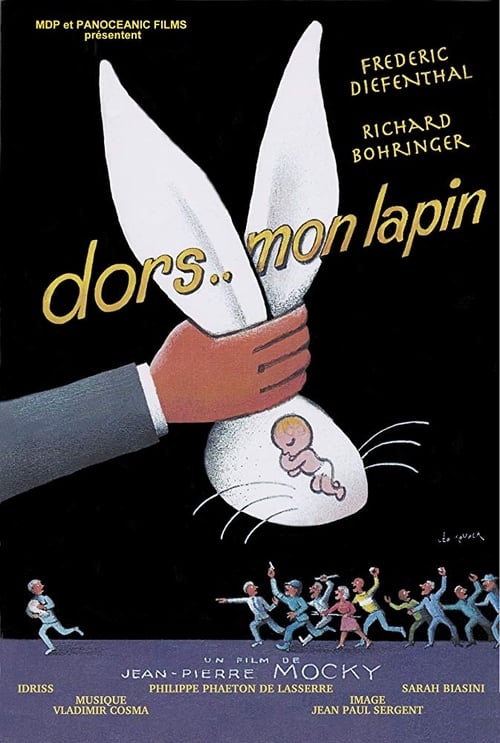
Lionel begins Dors mon lapin as a man already cornered by life: he is buried under colossal debts, his wife is heavily pregnant, and the future of the family seems to be collapsing before the child is even born. In the more detailed account, he has only one week to produce 60,000 euros or face eviction, and that deadline turns every scene into a race against time. He is not introduced as a hardened criminal but as a frightened, indecisive husband whose panic keeps building until it curdles into a plan so reckless that it feels almost absurd: he decides to kidnap the twelve-month-old baby of his wealthy neighbors, a rich couple identified in the fuller summaries as Mr. Ratkin and his wife, and demand a ransom.
The film establishes Lionel's desperation before the kidnapping even begins. He cannot pay the installments on his apartment, and neither his boss nor his notary, Maître Coloquinte, will help him. His pregnant wife worries, and the home becomes less a refuge than a pressure cooker, every conversation thick with fear of what is coming next. Lionel keeps looking outward at the rich life he resents and envies, especially the household next door, where the Ratkins' baby is watched by a nanny who falls into a predictable routine. Lionel studies that routine day after day, waiting near a nearby newspaper seller while the nanny goes out to buy papers, and the repetition gives him the rhythm of the household he intends to violate. The plan forms not from confidence but from the pathetic logic of a man who has run out of other options.
When Lionel's wife leaves for the maternity hospital, the crime crosses from fantasy into action. He buys a doll, and the next day he uses it to replace the real child, stealing the Ratkins' twelve-month-old son and leaving behind a fake infant as a crude decoy. The swap is eerie and almost childlike in its improvisation, as if he is playing at fatherhood and kidnapping at the same time, using a toy to stand in for a human life he now holds in his hands. He carries the baby to his father's fishing hut, a remote cabane de pêche that becomes the film's central hideout. In that isolated cabin, with water, weather, and silence pressing around him, Lionel is suddenly left alone with the child he has stolen. The setting makes the crime feel both secret and fragile, as if it could collapse at any moment.
The kidnapping is quickly discovered. Mr. Ratkin realizes his child is missing and contacts Commissioner Bolzer, bringing the police into the story and turning Lionel's private extortion into a public manhunt. Lionel makes his first ransom call, demanding 60,000 euros to be delivered at a supermarket. The exchange fails catastrophically. Bolzer intervenes, but in the confusion he arrests an innocent person instead, which only deepens the sense that every institution in the story is either useless or grotesquely misdirected. Lionel's attempt at criminal control evaporates almost immediately; he has the child, but he has no real power over the situation. He is playing a role he cannot sustain.
A second ransom attempt is staged at a construction site, and the scene again becomes a chase rather than a clean transaction. Lionel is pursued and forced to abandon the money, so even when the ransom is physically present, he cannot complete the exchange. The film keeps pushing him into improvised movements through public spaces, each one more chaotic than the last, until the kidnapping feels less like a plan than a chain reaction of bad timing and worse judgment. He is always a few seconds behind events, and those seconds matter more and more as the pressure mounts.
After those failures, Lionel goes looking for advice from a bookseller, a small but telling detail that underlines how disoriented he has become. Instead of finding a solution, he returns to the cabin and encounters Vera, a young runaway. Their connection is immediate and reckless, and they sleep together in the very place where the stolen baby is hidden. Vera's arrival shifts the emotional temperature of the story. For a moment, the cabin is not just a criminal hideout but a temporary refuge for two lost people, each trying to escape their own life. Yet Vera is also a threat to Lionel's secrecy, even before she realizes why.
Meanwhile, Ratkin responds to the kidnapping by going public. He appears on television and multiplies messages, broadcasting his anguish in a way that makes the private crime feel larger and more humiliating. The media attention increases the pressure on Lionel and also gives the story its moralistic edge: the rich father is transformed into a frantic public figure, and the kidnapper is squeezed between the family he has endangered and the authorities closing in on him. But the public appeal does not solve anything. It only intensifies the noise around the missing child.
The third ransom attempt finally succeeds, at least in the short term. The handoff takes place by a river, in a setting that feels both open and unstable, as if the water itself might carry away whatever certainty remains in the story. This time Lionel manages to recover the money. It is the first genuine victory he has achieved, but it arrives too late to produce relief, because the film has already made clear that every success in Lionel's life comes laced with ruin. The ransom money is not liberation; it is only another object to be carried, hidden, and accounted for.
Lionel then pays Maître Coloquinte, reversing the earlier refusal in a cruel, ironic way. The notary, who would not help him when he was in need, now receives money that comes from the kidnapping itself. This transaction exposes one of the film's recurring themes: respectable institutions remain entangled with the crime even when they pretend to stand outside it. The payment does not cleanse Lionel's actions; it only moves the money one step further into the machinery of consequence.
When Lionel returns to the fishing cabin, the baby is gone. The disappearance is not caused by police work, nor by Ratkin, nor by some dramatic rescue. A passerby heard the infant crying and simply took him away. The kidnapping, which Lionel imagined as the center of a ransom scheme, is abruptly undone by an ordinary human impulse. This is one of the film's most striking reversals: the child vanishes from Lionel's control not because the plan has been triumphantly broken by force, but because the world intrudes in a different, almost accidental way. The cabin, once the secret core of the plot, is suddenly empty.
The passerby's role is then revealed to have a deeper emotional dimension. She keeps the baby because she is grieving the death of her own child, and the lost infant becomes a substitute through which she can survive her loss. The film turns what first appears to be theft into a bleak act of emotional salvage. Lionel has kidnapped one child, only for another bereaved woman to take him in and use him as a bridge across her own grief. The story's moral logic grows increasingly twisted: each character is not simply doing right or wrong, but responding to pain in ways that are desperate, damaged, and morally compromised.
Vera then becomes the agent of Lionel's destruction. She realizes that Lionel is the kidnapper and tells Bolzer. This revelation is the decisive break in the story's fragile temporary alliance between the two of them. What had seemed like an intimate connection in the cabin becomes betrayal as soon as the truth is spoken. Vera's choice is not merely informational; it is the moment when Lionel's private world collapses into the public one he has been trying to avoid. The police now know what he is, and the story is no longer about whether he can keep the baby hidden. It is about how he will be punished.
The punishment is brutal and final. Lionel is lynched to death in the street. The sources do not identify a single named killer; instead, the death is described as mob violence, a collective act rather than a duel. That matters because the film's ending is not a tidy crime-thriller resolution in which one antagonist defeats another. It is a communal, almost ritual destruction of a man whose failure has become public knowledge. Lionel dies outside, exposed, stripped of whatever weak dignity he had left, his body destroyed by the anger and panic he has unleashed. The scene completes the film's descent from domestic pressure to social catastrophe.
Even after Lionel's death, the consequences continue to spread outward. Ratkin keeps sending messages, his panic multiplying even after the baby has disappeared from Lionel's hands. The precise wording of those messages is not preserved in the available summaries, but their existence shows that the father's distress does not stop simply because the kidnapper is gone. He is left in a state of unresolved fear, communicating across a situation that has slipped far beyond anyone's control. The film refuses the comfort of closure for the family whose child was taken, even though the immediate crisis is over.
Maître Coloquinte is also trapped by the crime in a different way. He deposits the ransom money at the bank, but the bills are marked, and he is arrested. This is the final institutional humiliation in the story: the notary, who began as a cold bureaucratic refusal, ends as a captured intermediary caught holding contaminated cash. The marked bills make the money itself into evidence, and the legal order that Coloquinte once represented now consumes him. The irony is sharp: the man who would not help Lionel legally becomes part of the criminal aftermath and is punished for it.
The film's locations matter because they map the emotional and moral collapse of Lionel's life. His home is a place of financial suffocation, not comfort; the wealthy neighbors' residence is the target of his envy; the maternity setting is tied to anxiety over the approaching birth; the fishing cabin is the hidden stage of the kidnapping; the supermarket and construction site are public spaces where the ransom attempts fail; the bookseller's shop is where Lionel briefly seeks wisdom; the river is where the plan finally seems to work; the street is where he is destroyed; and the bank is where the money's trace finally catches another man. Each place feels like a station in a downward spiral, and the film uses them to move Lionel from desperation to delusion to catastrophe.
The objects in the story carry the same kind of grim symbolism. The doll stands in for the stolen baby and exposes Lionel's amateurish, almost infantile criminality. The baby itself becomes the emotional center around which every character's choices orbit. The ransom money represents the promise of escape from debt, while the marked bills turn that promise into a trap. The television appeal and the repeated messages show how public communication amplifies private misery rather than resolving it. Nothing in the story functions cleanly. Every object is both practical and symbolic, and every symbol is contaminated by failure.
By the end, the film's structure is brutally clear: Lionel gets the money, pays Coloquinte, returns to find the child gone, is exposed by Vera, and is killed in the street. The passerby keeps the baby and begins to recover from the death of her own child. Coloquinte is arrested because the money he deposits is marked. Ratkin remains in a state of frantic communication, and the baby survives, but not in the hands of the man who stole him. The ending is not triumphant or restorative. It is a chain of consequences in which the most vulnerable figures are briefly damaged, the supposedly respectable ones are exposed, and the central antihero is annihilated. The final image of the story is not of justice neatly served but of a world in which one desperate act multiplies into several more, leaving behind a baby, a grieving woman, a jailed notary, and a dead father-to-be who never finds a way out.







What is the ending?
In the ending of "Dors mon lapin," the story culminates in a poignant confrontation between the main characters, leading to a resolution that reflects their emotional journeys and the complexities of their relationships. The film concludes with a sense of bittersweet acceptance and the characters moving forward in their lives, albeit changed by their experiences.
As the final scenes unfold, we find ourselves in a dimly lit room, where the atmosphere is thick with tension. The protagonist, a young woman named Lila, stands at the center, grappling with her feelings of loss and longing. She has just come to terms with the reality of her situation, having faced the consequences of her choices throughout the film. The weight of her decisions hangs heavily in the air, and her internal struggle is palpable.
In the next scene, Lila confronts her estranged partner, a man named Thomas, who has been a source of both comfort and pain for her. Their dialogue is charged with emotion, as they navigate the remnants of their relationship. Lila expresses her regrets and the pain of their separation, while Thomas reveals his own vulnerabilities, showcasing the depth of their connection despite the distance that has grown between them. The scene is filled with close-ups of their faces, capturing the raw emotions that flicker across their expressions--sadness, anger, and a flicker of hope.
As the conversation progresses, Lila and Thomas begin to understand each other's perspectives. They reflect on the moments that brought them together and the misunderstandings that drove them apart. The cinematography shifts to softer lighting, symbolizing a gradual thawing of their emotional barriers. This moment of vulnerability leads to a tentative reconciliation, as they both acknowledge the love that still exists between them, even if it is complicated.
In the final moments of the film, Lila makes a decision to embrace her independence. She steps away from Thomas, not out of rejection, but as a declaration of self-acceptance. The camera follows her as she walks out into the world, the sunlight breaking through the clouds, illuminating her path. This scene is filled with a sense of liberation, as Lila takes her first steps toward a new beginning, leaving behind the shadows of her past.
Meanwhile, Thomas watches her go, a mixture of pride and sorrow etched on his face. He understands that this is a necessary step for both of them, and while he feels the sting of loss, there is also a sense of hope for the future. The film closes with a lingering shot of Thomas, standing alone in the room, reflecting on their shared journey and the lessons learned.
In summary, the ending of "Dors mon lapin" encapsulates the themes of love, loss, and personal growth. Lila and Thomas, while parting ways, carry with them the memories of their time together, forever changed by their experiences. The film leaves the audience with a sense of closure, highlighting the importance of self-discovery and the complexities of human relationships.
Is there a post-credit scene?
"Dors mon lapin," a 2014 film, does not feature a post-credit scene. The film concludes its narrative without any additional scenes after the credits roll, focusing instead on the emotional resolution of its characters and the themes explored throughout the story. The ending leaves viewers with a sense of closure, emphasizing the journey of the main characters rather than teasing future developments or additional content.
What role do the supporting characters play in the protagonist's journey?
Supporting characters, such as friends and family members, serve as both obstacles and sources of support for the protagonist. Their varying reactions to the rabbit and the protagonist's attachment highlight the themes of acceptance and the struggle for connection.
How does the setting influence the mood of the film?
The setting, a small, often bleak town, amplifies the film's mood of isolation and longing. The stark landscapes and dimly lit interiors reflect the protagonist's internal turmoil and the sense of entrapment they feel in their circumstances.
How does the relationship between the main character and their parent evolve throughout the film?
The relationship between the main character and their parent is strained at the beginning, marked by misunderstandings and emotional distance. As the story progresses, they confront their fears and vulnerabilities, leading to moments of reconciliation and deeper understanding.
What is the significance of the rabbit in the story?
The rabbit in 'Dors mon lapin' serves as a symbol of innocence and the fragility of childhood. It represents the protagonist's longing for comfort and safety in a world that feels increasingly threatening.
What challenges does the protagonist face in their quest to protect the rabbit?
The protagonist faces numerous challenges, including external threats from peers who do not understand their attachment to the rabbit, as well as internal struggles with their own fears of abandonment and loss. These challenges force them to confront their own emotional resilience.
Is this family friendly?
"Dors mon lapin," produced in 2014, is a poignant film that explores themes of loss, family dynamics, and the complexities of childhood. While it is generally suitable for family viewing, there are some elements that may be considered potentially objectionable or upsetting for children or sensitive viewers.
-
Themes of Grief and Loss: The film delves into the emotional struggles of characters dealing with the death of a loved one, which may be heavy for younger audiences.
-
Emotional Turmoil: Characters experience moments of deep sadness, frustration, and conflict, which could be intense for sensitive viewers.
-
Family Conflict: There are scenes depicting arguments and misunderstandings among family members, which may be distressing for children who are sensitive to familial discord.
-
Imagery of Illness: The film includes visual representations of illness and its impact on family life, which could be unsettling for some viewers.
-
Isolation and Loneliness: The protagonist experiences feelings of isolation, which may resonate deeply and evoke sadness.
Overall, while "Dors mon lapin" offers valuable life lessons and emotional depth, its exploration of serious themes may require parental guidance for younger viewers.