






Popular
What personal struggles does Beyoncé reveal in the documentary?
How does Beyoncé portray her relationship with Jay-Z in the film?
What insights does Beyoncé provide about her childhood and upbringing?
How does Beyoncé address her experiences with fame and public scrutiny?
What role does music play in Beyoncé's self-expression in the film?
Should I watch it?
Ask Your Own Question

What is the plot?
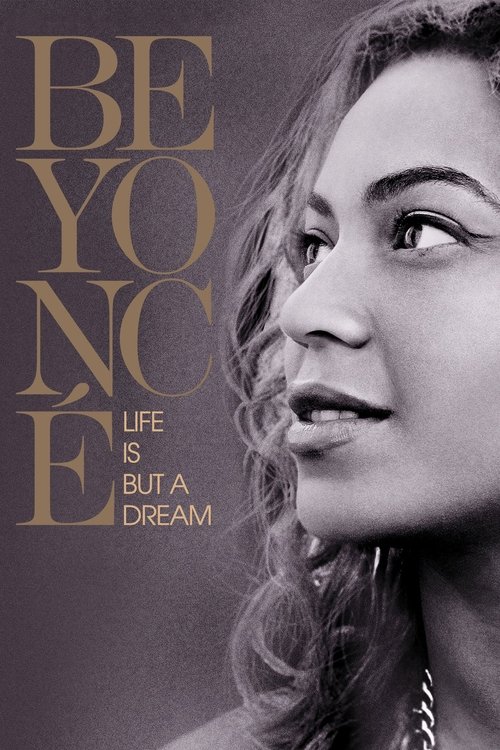
The screen is black before a soft, distant hum comes in, like a crowd that hasn't yet risen to a roar. A single white title appears: Beyoncé: Life Is But a Dream. There is no date stamped on the image, but the world outside this frame knows this film will first be shown on HBO on February 16, 2013, as Beyoncé Knowles-Carter's own curated window into her life.
Her voice comes before her face. It is calm, controlled, slightly echoing, as if it is already a memory of itself.
"I'm a human being," Beyoncé Knowles-Carter says in voice‑over. "I cry, I get scared. I have to remind myself to just be honest. To be free."
The first image is light and spectacle: she is onstage, flooded in beams of white and gold, sequins catching the light like shards of a mirror. The camera tracks her from behind as she walks toward the blinding brightness of a stadium crowd, the rumble of thousands swelling to a roar. The sense is that this is now, this moment, yet the film is already telling us that time will not be linear. We are in a thematic loop, a life that will be replayed in fragments.
She lifts the microphone, and the concert sound slams into place: drums, synths, the tight snap of choreography. Her body is precise, every move rehearsed, every breath counted. The audience screams her name. There is no narrative problem here, no villain, no immediate conflict--only scale, pressure, expectation.
The film cuts sharply to a grainier, intimate image: Beyoncé sitting alone in front of a laptop, lit by the cold glow of the screen. Her hair is pulled back simply. The background is anonymous, maybe a hotel room, maybe a quiet corner of home. This is her private confessional mode. She looks at the tiny camera at the top of the screen, studying herself, then begins.
"I always battle with how much I reveal about myself," she says, echoing the thought she will later summarize in an interview with GQ. "But if I don't tell my story, someone else will."
This is our first sense of the central tension: control versus vulnerability. The film is built around that tension rather than around a plot. She will never give up control, but she will show us how close she comes.
The image shifts again. We are in a rehearsal studio, walls lined with mirrors, dancers scattered across a wooden floor. The soundtrack is muffled, like hearing music through a wall. Beyoncé, now in workout clothes, stands in the center, explaining a piece of choreography. "Again," she insists, clapping the beat. "I need to feel your intention. Not just the steps." Sweat darkens her shirt. Her face is serious, not unfriendly, but uncompromising.
Backstage corridors, quick cuts. A handheld camera follows her through narrow hallways draped in cables and rigging. The sound of the crowd seeps through concrete. She is flanked by staff, stylists, security, but the camera keeps pulling in tight to her face: eyeliner sharp, expression composed. Her voice overlays this movement.
"People see the glitz," she says. "They don't see the hours. The sacrifices. The pressure to be perfect. I don't know if I ever feel like I've done enough."
The film now begins interweaving the public image and the private voice. Clips from television interviews flash by: Beyoncé on talk‑show sofas, laughing about tour dates, albums, fashion. Snatches of hosts' voices--"global superstar," "Queen Bey"--are cut off before they finish. Each time, the documentary pulls us back to her own lens, her own framing.
In a quiet hotel room, curtains half‑drawn over a city she never names, she films herself again. She talks about success as a cage.
"I built this," she says softly into the laptop camera. "This career, this image. But sometimes I ask myself, 'Who am I if I'm not Beyoncé?'"
The narrative tension increases not through event, but through accumulation: the more she shows, the more we feel the weight of what remains unsaid.
We move back in time without warning. Home‑video footage appears, slightly washed out, the picture less polished. Beyoncé is younger here, though the film does not stamp the year. We see Shawn "Jay‑Z" Carter beside her, relaxed, amused, the two of them sharing a private joke on a boat, or in a kitchen, or at some quiet gathering. Their romance is not introduced as a plot twist; it is a given. The world already knows they are married. But here we see the texture: the way she leans into him, the way he lifts a phone to record her singing to him, both of them grinning like conspirators.
In a voice‑over, she says, "I was so happy. So in love. And I wanted a child more than anything."
The mood darkens almost imperceptibly. The lighting in the webcam footage is dimmer now. She is bare‑faced, vulnerable. She hesitates before speaking, looking down and away from the camera.
"I was pregnant," she says. "And I heard the heartbeat. It was the most beautiful music I ever heard in my life."
Then, a pause. The film does not dramatize this moment with reenactments or hospital footage. It stays on her face, on the small movements around her eyes.
"And then… later, there was no heartbeat."
She does not say the word "death," but this is the only death in the film: the loss of her unborn child in a miscarriage before the birth of her daughter Blue Ivy Carter. No character causes it. There is no villain. It happens inside her body, unexplained. The camera holds as she blinks back tears.
"I went into the studio afterward," she continues. "And I wrote the saddest song I've ever written. I sang to the baby I lost. To the pain."
We cut to a studio, cables coiled around microphone stands, dim colored lights casting everything in a warm blur. She is in front of a mic, one hand pressing the headphones to her ear. We don't hear the full song--that would belong to her albums--but we see her eyes close, her shoulders tighten as she sings. The grief is present, but the film keeps it at a crafted distance. This is a revelation, but it is also a performance of revelation.
The narrative moves forward. We see her traveling: private jets, black SUVs, hotel lobbies. Each transit space looks both anonymous and expensive. She walks surrounded by her team, yet isolated, separated by fame. Occasionally she pauses to smile at fans, to pose for photos, but the camera is more interested in the moments when she is quiet, between interactions.
Her voice‑over speaks about another turning point: her professional relationship with her father, Mathew Knowles. There is no explosive confrontation on screen, no raised voices.
"My father has been my manager my whole life," she says. "He believed in me when I was a little girl, when nobody knew my name. But there comes a time when you have to make your own decisions. When you have to separate."
It is an emotional confrontation, not a physical one. The film does not show the conversation where she tells Mathew Knowles that she will no longer have him as her manager, but it frames the decision as painful and necessary. We see brief glimpses of her childhood--Destiny's Child era costumes, early performances--and her voice is tinged with both gratitude and resolve.
"I had to say, 'I love you, but I need to do this on my own.'"
This is one of the film's major revelations: that she ended the professional arrangement with her father, a man who had been central to her career, to assert her independence as an artist and businesswoman. It is presented not as betrayal, but as self‑definition. The conflict is internal: can she be a daughter and yet not be managed?
Rehearsal footage follows, now with a different energy. She is not just a performer; she is a director, a producer. She gives notes on lighting cues, on camera angles. "The cut needs to be tighter here," she says to an unseen editor. "I want to feel it more." The implication is that this film, too, is something she is controlling at that level. Critics later will call it a "vanity project and calculated act of image control," but from inside the narrative, it feels like authorship.
The film continues to braid together threads: work, love, loss, control. Concert sequences slam in between the quiet scenes. Large arenas are named more by context than by title; we are in cities across the world, though the film rarely stops to tell us exactly where. The camera sweeps over thousands of faces, then dives back to the one face that matters: Beyoncé's, under a halo of stage lights.
She speaks about fear in another confessional clip.
"I am terrified before I go onstage," she admits, looking into the laptop. "I'm always asking, 'Will they still love me? Will I be good enough tonight?' And then I remember why I started: because I love music. Because I love performing. That's when I breathe."
This thought leads into one of the film's emotional climaxes: the birth of Blue Ivy Carter. Here, the film again refuses dramatized detail. We do not see a delivery room, clocks on walls, medical staff hurrying around. Instead, we see the before and after: Beyoncé's pregnant belly in soft, gauzy light, her hands tracing circles over her skin; Shawn "Jay‑Z" Carter kissing her stomach, both of them photographed in gentle home‑video close‑ups. The tone is reverent, almost sacred.
Her voice cracks with joy now.
"After losing my first child, I didn't know if I would ever be able to carry again," she says. "When Blue came… it was like God gave me my life back."
The camera captures a small hand, a baby's fingers curling around Beyoncé's thumb. We see Blue Ivy's face only briefly, in partial angles, as if even here Beyoncé is negotiating how much of her daughter to reveal. The music under these images is subdued, strings and piano, more like a lullaby than a pop track.
This is not a twist--anyone watching the film in 2013 knows Blue Ivy exists--but it is an emotional resolution of the earlier grief. The death of the first pregnancy finds its counterpoint in this birth. The narrative arc of loss‑and‑renewal becomes one of the central emotional structures in a film that otherwise resists conventional plotting.
The film's tension now moves toward another conflict: how to be a mother, a wife, and still the global superstar we see in the concert footage. The scenes shift rapidly between Beyoncé cradling Blue Ivy in a softly lit room and Beyoncé stepping out of cars into a wall of flashes and screams. The contrast builds momentum.
In one home video, she holds Blue Ivy and leans against Jay‑Z. "I just want to protect her," she whispers. "From everything." It is the most nakedly maternal line in the film.
In another scene, perhaps shot months later--time is never pinned down with on‑screen dates--she is back in a rehearsal space, body no longer visibly pregnant, pushing herself and her dancers through a high‑impact routine. She pauses, hands on her knees, catching her breath, then looks up and grins.
"I'm a mother now," she says to someone off‑camera. "I gotta work twice as hard."
The story of Mathew Knowles returns here, in subtext. Now, as a mother, as an artist free from her father's management, she is redefining her identity again. The film gives us no specific scene where she talks to him, no reconciliation or argument. The conflict thereby remains slightly abstract, but we feel the emotional residue when she speaks about independence.
"Being in control of my career means I'm also in control of my time," she says in voice‑over over footage of her playing with Blue Ivy. "I can choose to be home. I can choose to be onstage. That choice is everything."
Television clips interject again: commentators speculating about her pregnancy when she first announced it, images of her revealing her baby bump during a performance at an awards show, media chatter about whether the bump was real or "fake." Although the documentary does not dwell on specific dates or program names, the viewer recognizes the media circus that surrounded her. Beyoncé's own film answers not with a direct rebuttal, but with empirical images of her pregnancy and her child.
The documentary now turns inward to her philosophy, making the narrative more reflective than event‑driven. In several monologues, she muses about feminism, power, and equality. At one point she says, "It's not about equal rights; it's about how we think." The line passes quickly, part of a larger flow, but it hints at how she positions herself as a woman navigating immense success in a male‑dominated industry.
Critics will later interpret the film as showing "a delicate mix of the calculated and confessional," and this mix is apparent in how these philosophical passages are framed: soft lighting, close‑ups, an intimate tone. She is both speaking genuinely and aware of how she appears.
Tension subtly builds as reviewers' comments (though not quoted in the film) align with what we see: moments of rawness that are always beautifully lit, always aesthetically pleasing. The conflict between authenticity and image remains unresolved, and that unresolved quality becomes one of the film's quiet engines.
The film moves through more performance highlights--large stages, intricate costumes, explosive pyrotechnics--intercut with tiny domestic moments. Beyoncé rehearses with her band, working out arrangements, arguing gently over tempo or emphasis. "No, no, no, right there," she insists, tapping out a rhythm on a table. "That's where it needs to hit."
We see her backstage seconds before a performance, eyes closed, lips moving in a private prayer. "Thank you for this opportunity," she murmurs, voice low, almost inaudible under the distant roar of the crowd. "Let me give everything, and let me be protected."
There are no villains in this film, no direct antagonists. The forces she confronts are abstract: public scrutiny, loss, inherited expectations, her own perfectionism. Confrontations are often her with herself, in quiet, half‑lit rooms, with a camera as the confidant.
In one of those rooms, she speaks candidly about needing to be "real" and "imperfect," even as the shot itself is flawless--good angle, soft focus, her skin luminous. "I want to show that I'm not perfect," she says. "That I make mistakes, that I doubt, that I hurt." The tension lies in the slight dissonance between the words and the visual perfection. She is trying to pull aside the curtain while still controlling the drape.
As the film moves toward its closing movements, the pace slows slightly, letting the emotional threads settle. We see more of Blue Ivy, now slightly older: her hand reaching out toward a camera, her tiny feet on a carpet, the back of her head as she leans against her mother's chest. Beyoncé's voice in these scenes is softer, less performative.
"One day," she says, "she'll see this. And I want her to know that I was brave. That I loved her before she was here. That I loved the child I lost, too. That I kept going."
There is no time stamp like "2012" or "2013" on the screen, but the viewer understands we are near the present of the film's release. The themes have been established and revisited: her marriage to Jay‑Z, the miscarriage, the birth of Blue Ivy, the split from Mathew Knowles, her insistence on privacy versus the demands of publicity. The story is less about what happens than about how she tells what has happened.
Toward the end, the film leans into an inspirational tone. Clips of young fans, of girls dancing to her music, are intercut with her onstage, arms outstretched, receiving the roar of the crowd. Her narration becomes more didactic, like advice.
"If there's one thing I want young people to take from my story," she says, "it's that passion and determination can help you overcome anything."
The film visualizes this sentiment by replaying the contrasts we've seen: the exhausted woman in rehearsal and the triumphant performer onstage, the grieving would‑be mother writing a sad song and the joyful mother cradling Blue Ivy, the daughter guided--perhaps controlled--by her father and the woman steering her own company, Parkwood Entertainment.
There are no surprise deaths. No one collapses. No secret crime is revealed. The "secrets" are of a more ordinary human kind: a miscarriage kept private until now, the emotional cost of ending a professional relationship with a parent, the doubts that haunt someone who from the outside looks invincible. Each revelation arrives not as a shock twist, but as a deepening of the persona we already know.
In the penultimate stretch, we return once more to her laptop confessional. By now, the viewer recognizes the format: dim room, computer glow, her voice lower, words slower.
"Sometimes I watch myself on TV," she confesses, "and I don't even recognize that girl. It's like… she's Beyoncé, and I'm just me. And then I realize--they're both me. I'm a mother. I'm a wife. I'm a performer. I'm a businesswoman. I'm a daughter. I'm all of it."
She smiles, just a little, at her own reflection. "And that's okay."
This idea--that she can be many selves and still claim authenticity--is one of the film's final resolutions. The earlier conflicts are not neatly solved--they're integrated.
The visual style in the closing scenes becomes even more "gauzy" and "pretty," as one critic described the film overall. Sunlight pours through windows, catching dust motes. An anonymous coastline appears in a slow pan--perhaps a vacation spot, perhaps a metaphor for openness. Beyoncé walks along the sand, hair loose, no obvious makeup, the ocean loud behind her. Jay‑Z appears at her side for a moment, holding her hand, then the image cuts away. We do not linger long enough to make this a climax of romance; it is merely a piece of the mosaic.
We end, fittingly, onstage. One last concert sequence, though the film does not identify where. The camera starts far back, capturing the whole arena: a tiny figure at the end of a long catwalk, a storm of light and sound around her. The crowd is a living organism, arms raised, phones held up like thousands of tiny stars.
The music surges. We see close‑ups of her face--sweat at her temples, eyes shining, mouth open as she sings into the microphone. She is in complete command, the embodiment of the "everything we want her to be" that a reviewer noted. There is no visible trace of the vulnerability we saw in the confessional clips, yet we, having seen them, carry that knowledge into this image. The tension between the private and public selves resolves not by one defeating the other, but by coexisting.
Her voice‑over returns one last time, layered over the live vocal so that for a moment we hear two Beyoncés at once.
"Life is but a dream," she says, echoing the film's title. "You can't control everything. But you can control how you tell your story."
Onstage, she holds the final note, arm raised. The lights flare to white. The crowd screams. The image freezes for a fraction of a second at the height of that gesture.
Then the screen fades to black.
There is no epilogue text telling us what happens next, no "where are they now" captions. We know, outside the film, that Beyoncé Knowles-Carter continues to release albums, perform tours, and evolve her public image. Inside this carefully constructed documentary, the story ends with her exactly where we began: in the bright, blinding space between the woman and the icon, owning the frame, authoring the dream.
More Movies Like This
Browse All Movies →




What is the ending?
In the ending of "Beyoncé: Life Is But a Dream," Beyoncé reflects on her journey, her struggles, and her triumphs. The film concludes with her performing at the Super Bowl halftime show, showcasing her strength and resilience as an artist and a person. The final scenes emphasize her connection to her family and her commitment to her craft, leaving viewers with a sense of empowerment and hope.
As the film approaches its conclusion, we see a series of intimate and powerful moments that encapsulate Beyoncé's life and career. The scene transitions to her preparing for the Super Bowl halftime show, a significant event that symbolizes her return to the stage after a brief hiatus. The atmosphere is charged with anticipation, and Beyoncé is seen in her dressing room, surrounded by her team. She takes a moment to breathe deeply, reflecting on the weight of the performance ahead.
The camera captures her focused expression, revealing her internal motivation to prove herself once again to her fans and to herself. As she dons her iconic outfit, the audience can sense her determination and the pressure she feels to deliver a flawless performance. The film intercuts between her preparation and flashbacks of her earlier struggles, including her experiences with fame, personal loss, and the challenges of motherhood.
As the performance begins, the scene shifts to the stadium filled with thousands of fans, their energy palpable. Beyoncé steps onto the stage, and the crowd erupts in cheers. The lights flash, and the music begins, showcasing her powerful vocals and dynamic choreography. Each movement is infused with emotion, reflecting her journey and the resilience she has cultivated over the years. The performance serves as a cathartic release, a celebration of her artistry and her ability to overcome obstacles.
Throughout the performance, the film intersperses clips of her family, particularly her daughter Blue Ivy, who watches proudly from the sidelines. This connection to her family underscores the importance of love and support in her life. As Beyoncé sings, her expressions convey a mix of joy, vulnerability, and strength, embodying the essence of her journey.
The climax of the performance culminates in a powerful moment where she stands center stage, arms raised, embracing the energy of the crowd. The camera captures her radiant smile, a testament to her triumph over adversity. As the final notes echo, the scene transitions to her backstage, where she is met with hugs and congratulations from her team. The sense of accomplishment is palpable, and Beyoncé's eyes reflect a deep sense of fulfillment.
In the closing moments of the film, Beyoncé is seen with her family, sharing a quiet moment of reflection. The film emphasizes her commitment to balancing her career with her role as a mother and partner. The final shot lingers on her face, a blend of contentment and determination, as she looks toward the future with hope and ambition.
The film concludes with a message of empowerment, highlighting Beyoncé's journey as an artist and a woman. Each character, particularly Beyoncé, emerges from the narrative with a renewed sense of purpose, illustrating the themes of resilience, love, and the pursuit of dreams. The audience is left with a powerful reminder of the strength found in vulnerability and the importance of family and self-acceptance.
Is there a post-credit scene?
"Beyoncé: Life Is But a Dream" does not have a post-credit scene. The film concludes with a powerful reflection on Beyoncé's life, her career, and her personal struggles, leaving viewers with a sense of closure as she shares her journey through music, motherhood, and self-discovery. The documentary-style film focuses on her experiences and emotions, culminating in a heartfelt message rather than an additional scene after the credits.
What personal struggles does Beyoncé reveal in the documentary?
In 'Beyoncé: Life Is But a Dream,' Beyoncé opens up about her personal struggles, including her battle with self-doubt and the pressure of fame. She shares her feelings of vulnerability, particularly after the birth of her daughter, Blue Ivy, and how motherhood changed her perspective on life and her career. The documentary captures her emotional journey, showcasing her fears and insecurities, especially regarding her public image and the expectations placed upon her.
How does Beyoncé portray her relationship with Jay-Z in the film?
Beyoncé's relationship with Jay-Z is depicted with a mix of intimacy and complexity. The film includes candid moments that highlight their deep connection, such as their shared experiences in the music industry and their support for each other. However, it also touches on the challenges they faced, including infidelity rumors and the strain of their high-profile lives. Beyoncé expresses her love and admiration for Jay-Z, emphasizing their partnership and the strength they find in each other.
What insights does Beyoncé provide about her childhood and upbringing?
Beyoncé reflects on her childhood and upbringing, sharing memories of her early years in Houston, Texas. She discusses the influence of her parents, particularly her mother, Tina Knowles, who played a significant role in her artistic development. The film features home videos and photographs that illustrate her journey from a young girl with dreams of stardom to a successful artist. Beyoncé's nostalgia is palpable as she recounts the support and sacrifices her family made for her career.
How does Beyoncé address her experiences with fame and public scrutiny?
Throughout the documentary, Beyoncé candidly addresses her experiences with fame and the intense public scrutiny that comes with it. She shares her feelings of being constantly watched and judged, which often leads to anxiety and a desire for privacy. The film captures her struggle to maintain authenticity while navigating the pressures of celebrity life, revealing her determination to stay true to herself despite external expectations.
What role does music play in Beyoncé's self-expression in the film?
Music serves as a vital form of self-expression for Beyoncé in 'Life Is But a Dream.' The documentary showcases her creative process, including behind-the-scenes footage of her songwriting and recording sessions. Beyoncé discusses how her music reflects her personal experiences, emotions, and growth. The film features performances of her songs, illustrating how they convey her journey and serve as an outlet for her feelings, allowing her to connect with her audience on a deeper level.
Is this family friendly?
"Beyoncé: Life Is But a Dream" is a documentary that provides an intimate look into the life of the artist, showcasing her personal and professional journey. While it is not explicitly designed for children, it does contain themes and scenes that may be sensitive for younger audiences or those who are particularly sensitive.
-
Emotional Vulnerability: The film delves into Beyoncé's struggles with self-identity, fame, and the pressures of being in the public eye. These themes may be heavy for younger viewers.
-
Personal Relationships: There are candid discussions about her relationships, including her marriage and the challenges that come with it. Some scenes may touch on emotional conflicts or tensions.
-
Career Challenges: Beyoncé reflects on the difficulties she faced in her career, including moments of doubt and anxiety, which may be intense for some viewers.
-
Mature Themes: The documentary includes references to personal and professional challenges that may not be suitable for all children, such as discussions about betrayal and heartbreak.
-
Visual Imagery: There are performance scenes that may include provocative costumes or choreography that some parents might find inappropriate for younger audiences.
Overall, while the film is a celebration of Beyoncé's artistry and resilience, its emotional depth and mature themes may not be suitable for all children or sensitive viewers.







