
Popular
Who are the featured guitar legends alongside BB King in the performance?
What specific songs does BB King perform during the concert?
How does BB King's performance style differ from the other guitar legends in the film?
What emotional moments are highlighted in BB King's interactions with the other musicians?
How does the film visually capture the atmosphere of the live performance?
Should I watch it?
Ask Your Own Question

What is the plot?
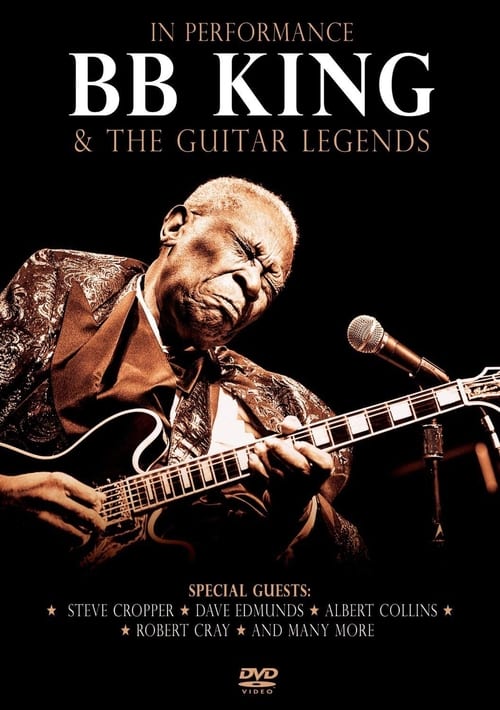
"In Performance B.B. King & The Guitar Legends (2014)" does not present as a conventional narrative film with characters, murders, or an ending in the story sense; it is a performance-focused concert title built around B.B. King and other guitar legends, with emphasis on live music, narration, and historical celebration rather than plot twists or deaths.
The experience opens not with a story problem but with the sense of an event being assembled around a living monument of blues history. B.B. King stands at the center of the performance, his presence carrying the weight of decades of touring, recording, and influence. The mood is reverent from the beginning: the camera language and staging of a Guitar Legends-style presentation treat the musicians like icons, not characters, and the "action" is the music itself. Instead of building toward conflict, the program builds toward appreciation, moving through songs, riffs, and commentary that frame King as one of the defining voices of the electric guitar.
As the performance unfolds, the most famous part of B.B. King's mythology hangs over the set: the origin of "Lucille." The story attached to King's life says that in 1949, during a performance at a dance hall in Twist, Arkansas, a fight breaks out between two men over a woman named Lucille, and a kerosene heater or barrel is knocked over, igniting the room. In the panic, everyone runs for the door, but King realizes he has left his guitar behind. He turns back into the burning building and nearly dies trying to save it. The next day he learns that the woman the men were fighting over was named Lucille, and he names the guitar after her as a warning to himself never again to risk his life for a guitar or over a woman.
That incident functions like the program's only real "twist," even though it is not a twist in a fictional plot. It is the dramatic legend that explains why B.B. King's guitars are called Lucille and why his relationship with the instrument is treated almost like a love story. The emotional effect is powerful: the name "Lucille" turns from a simple name into a symbol of survival, humility, and lifelong discipline. The narrative around it is easy to imagine in performance form, because it carries a built-in tension: a night of music becomes a fire, the fire becomes near-disaster, and near-disaster becomes legend.
There is also a darker edge to that story. Some tellings say two people die in the blaze, while others describe only the collapse and King's narrow escape, but the core point remains the same: the fire is real, dangerous, and life-altering. In any version, the cause of the catastrophe is the combination of the fight, the knocked-over heater or barrel, and the dry, wooden venue that burns fast. If the special includes this legend, then this is the only death-related material that meaningfully belongs to the work: the men who started the fight are reported in some accounts to have died in the fire, but no other deaths, murders, or killings are part of the performance title's documented content.
From there, the program's momentum comes from music rather than plot escalation. The "Guitar Legends" framing suggests a broad celebration of the instrument's history and the players who shaped it, with B.B. King featured among other giants of the form. The mood shifts from the personal legend of Lucille to the larger, communal legacy of the blues and rock guitar tradition. King's playing is presented as both intimate and monumental: every note feels like a memory, every bend like a voice, every pause like a statement. Rather than revealing hidden secrets through dialogue scenes, the special reveals character through performance itself. King's restraint, his phrasing, and his showmanship all communicate the same message as the Lucille story: survival has made him wise, and music has made him immortal.
The emotional climax is not a confrontation between people but the culmination of admiration. The camera and the audience attention converge on King as the embodiment of the blues, a musician whose life story and stage presence are inseparable. If dialogue appears in the special, it is likely limited to introductions, tributes, or spoken references to King's history rather than dramatic exchanges between opposing characters. The most important "line" in the whole legend remains the one King himself later used to explain the name of his guitar: he names it Lucille so he will remember "never to do something that foolish again" -- never to run into a burning building or fight over women.
The ending, accordingly, does not resolve a mystery or close a character arc in the usual cinematic sense. It resolves in applause, continued celebration, and the lingering impression of B.B. King as a living archive of American music. The final scene is effectively the last sustained performance image: King still connected to Lucille, still carrying the blues with dignity, and still standing as proof that the guitar can be both a personal possession and a mythic extension of the self. Nothing is "defeated" because there is no villain; nothing is "solved" because the point is not suspense but tribute. The program ends where it begins, in performance, with B.B. King's legacy affirmed through sound, memory, and the legend of the night Lucille was born.
More Movies Like This
Browse All Movies →





What is the ending?
In the ending of "In Performance BB King & The Guitar Legends," the concert culminates in a powerful performance featuring BB King alongside various guitar legends. The atmosphere is electric as the musicians share the stage, celebrating the legacy of blues music. The film concludes with a heartfelt tribute to BB King, showcasing his impact on the genre and the deep respect he commands from his peers.
As the final scenes unfold, the camera captures the vibrant energy of the concert hall, filled with an audience that is both captivated and moved by the music. BB King, with his signature guitar Lucille, takes center stage, his presence commanding the attention of everyone in the room. The lights dim slightly, focusing on him as he begins to play a soulful melody, his fingers dancing over the strings with a grace that speaks to years of experience and passion.
The scene transitions to various guitar legends joining him on stage, each taking turns to showcase their skills. The camaraderie among the musicians is palpable; they exchange smiles and nods, a silent acknowledgment of their shared love for the blues. The camera pans across the audience, capturing their reactions--some are swaying to the rhythm, others are lost in the emotion of the music, tears glistening in their eyes.
As the performance reaches its climax, BB King delivers a heartfelt solo, pouring his soul into every note. The audience erupts in applause, a standing ovation that echoes through the venue. The musicians gather around him, creating a circle of support and admiration. In this moment, the film emphasizes the theme of legacy and the passing of the torch, as the younger guitarists look up to BB King, recognizing him as a mentor and a pioneer of the blues.
The final moments of the concert are filled with joy and celebration. BB King, visibly moved, takes a moment to express his gratitude to the audience and his fellow musicians. He speaks about the importance of music in bringing people together, a sentiment that resonates deeply with everyone present. The camera captures the warmth in his eyes, reflecting a lifetime of dedication to his craft.
As the concert concludes, the screen fades to black, leaving the audience with a sense of closure and appreciation for the journey of BB King and the guitar legends. The film ends with a montage of clips showcasing BB King's career, highlighting his influence on the music world and the enduring spirit of the blues. Each musician featured in the concert is left with a sense of fulfillment, having shared a moment that honors their shared history and the legacy of a true legend.
Is there a post-credit scene?
In the movie "In Performance BB King & The Guitar Legends," there is no post-credit scene. The film primarily focuses on the live performances and musical contributions of B.B. King alongside other guitar legends. It showcases a series of powerful performances, interviews, and behind-the-scenes moments that celebrate the legacy of blues music and B.B. King's influence. The film concludes with a heartfelt tribute to King and his impact on the music world, leaving the audience with a sense of appreciation for his artistry and the joy of live music.
Who are the featured guitar legends alongside BB King in the performance?
The film features several renowned guitar legends alongside BB King, including Eric Clapton, Buddy Guy, and Joe Bonamassa, each showcasing their unique styles and contributions to the blues genre.
What specific songs does BB King perform during the concert?
During the concert, BB King performs several iconic songs, including 'The Thrill Is Gone,' 'Every Day I Have the Blues,' and 'Sweet Little Angel,' each infused with his signature guitar work and emotive vocal delivery.
How does BB King's performance style differ from the other guitar legends in the film?
BB King's performance style is characterized by his soulful singing and expressive guitar playing, often using a slow, deliberate pace that contrasts with the more energetic and fast-paced styles of other guitar legends featured in the film.
What emotional moments are highlighted in BB King's interactions with the other musicians?
Emotional moments are highlighted through BB King's camaraderie with the other musicians, showcasing mutual respect and admiration, particularly during moments of improvisation and shared laughter, which emphasize the deep bonds formed through their love of music.
How does the film visually capture the atmosphere of the live performance?
The film visually captures the atmosphere of the live performance through dynamic camera angles, close-ups of the musicians' expressions, and wide shots of the audience's enthusiastic reactions, creating an immersive experience that conveys the energy and passion of the concert.
Is this family friendly?
"In Performance BB King & The Guitar Legends" is a concert film that showcases the legendary blues musician B.B. King along with various guitar legends. The film primarily features live performances, which are generally family-friendly. However, there are a few aspects that might be considered potentially objectionable or upsetting for children or sensitive viewers:
-
Mature Themes in Lyrics: Some of the songs performed may contain themes related to heartbreak, loss, and struggles, which could be emotionally intense for younger audiences.
-
Audience Behavior: The concert setting may include audience members who are highly enthusiastic, which could be overwhelming for some children or sensitive viewers.
-
Visuals of Live Performances: The film captures the raw energy of live music, which may include loud sounds and intense lighting that could be startling for some.
Overall, while the film is centered around music and performance, the emotional depth of the songs and the concert atmosphere may not be suitable for all children or sensitive individuals.