
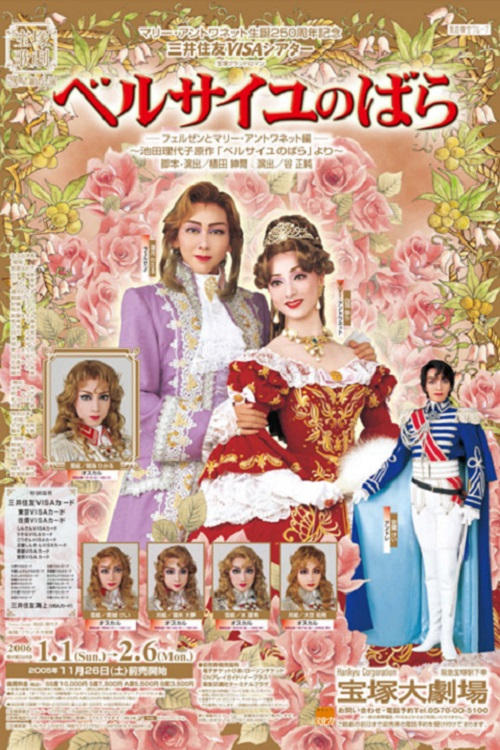











Popular
What role does the French Revolution play in the story?
What is the relationship between Fersen and Marie-Antoinette in the film?
How does Marie-Antoinette's character evolve throughout the film?
What are some key moments that define Fersen's character in the film?
How does the film portray the court life of Versailles?
Should I watch it?
Ask Your Own Question

What is the plot?
Sorry, we aren't able to watch and write up a full detailed plot yet. Check back in a few days.









What is the ending?
In the ending of "The Rose of Versailles - Fersen and Marie-Antoinette," the story culminates in a tragic and poignant conclusion. Marie Antoinette faces the consequences of the French Revolution, leading to her arrest and eventual execution. Fersen, deeply in love with her, is heartbroken and struggles with the loss of their dreams together. The film closes with a sense of despair and the inevitability of change, as the world they knew crumbles around them.
As the final act unfolds, the atmosphere in France grows increasingly tense. The revolutionaries are gaining momentum, and the once opulent palace of Versailles is now a symbol of the monarchy's excesses. The scene opens with Marie Antoinette, dressed in her elegant gowns, standing by a window, gazing out at the chaos that has engulfed her beloved France. Her expression is a mix of fear and defiance, reflecting her internal struggle as she grapples with the reality of her situation. She is aware that her lavish lifestyle has made her a target, yet she clings to the hope that her husband, King Louis XVI, can restore order.
In the next scene, we see Fersen, who has returned to France, desperately trying to find a way to help Marie. His love for her is palpable, and he is determined to protect her at all costs. He meets with other nobles, discussing potential escape plans, but the atmosphere is fraught with danger. Fersen's frustration grows as he realizes that the revolution is not just a fleeting moment but a powerful force that cannot be ignored. His internal conflict deepens as he weighs his loyalty to the crown against his love for Marie.
As the revolutionaries storm the palace, the tension escalates. Marie Antoinette is forced to flee with her family, and the once-grand halls of Versailles are filled with chaos. The camera captures the frantic energy of the crowd, the shouts of the revolutionaries echoing through the air. Marie's face reflects her desperation as she clutches her children, trying to shield them from the violence surrounding them. Fersen arrives just in time to help them escape, but the weight of the situation hangs heavily on him. He knows that their time together is limited.
In a heart-wrenching moment, Marie and Fersen share a final embrace, filled with unspoken words and emotions. Their love, once vibrant and full of promise, is now overshadowed by the grim reality of their circumstances. Fersen promises to find a way to reunite with her, but both know that the chances are slim. As they part, tears fill Marie's eyes, and Fersen's heart breaks, knowing that he may never see her again.
The film then shifts to the aftermath of the revolution. Marie Antoinette is captured and imprisoned, her once-majestic life reduced to a mere shadow of its former self. The scenes of her trial are stark and unforgiving, showcasing the harsh judgment of the people who once adored her. She stands before the tribunal, her dignity intact despite the humiliation she faces. The audience can feel her despair as she realizes the depth of her isolation, her dreams of a future with Fersen slipping away.
In the final moments, the film depicts Marie's execution. The scene is somber, with a haunting score underscoring the gravity of the moment. As she walks to the guillotine, her expression is one of resignation, yet there is a flicker of defiance in her eyes. She faces her fate with a quiet strength, embodying the tragic heroism of her character. The camera lingers on her face, capturing the complexity of her emotions--fear, sadness, and an unwavering spirit.
Fersen, meanwhile, is shown in the aftermath of her death, grappling with his grief. He stands alone in a desolate landscape, the weight of his loss palpable. The film closes with a poignant image of him looking out over the horizon, a symbol of the love that was lost and the world that has irrevocably changed. The final shot fades to black, leaving the audience with a sense of sorrow and reflection on the fleeting nature of love and the harsh realities of history.
Is there a post-credit scene?
In the movie "The Rose of Versailles - Fersen and Marie-Antoinette," produced in 2006, there is no post-credit scene. The film concludes with a poignant and emotional ending that encapsulates the tragic fate of its characters, particularly focusing on the relationship between Fersen and Marie-Antoinette amidst the turmoil of the French Revolution. The final moments leave the audience reflecting on the themes of love, sacrifice, and the harsh realities of history, without any additional scenes or content after the credits.
What role does the French Revolution play in the story?
The French Revolution plays a pivotal role in 'The Rose of Versailles -Fersen and Marie-Antoinette-'. The film depicts the escalating tensions between the monarchy and the common people, highlighting the stark contrast between the opulence of the royal court and the poverty of the populace. As the revolution gains momentum, Marie-Antoinette's life becomes increasingly precarious, and her attempts to navigate the political landscape become fraught with danger. The revolution serves as a backdrop that intensifies the personal struggles of the characters, particularly Fersen and Marie-Antoinette.
What is the relationship between Fersen and Marie-Antoinette in the film?
In 'The Rose of Versailles -Fersen and Marie-Antoinette-', the relationship between Fersen and Marie-Antoinette is central to the narrative. Fersen, a Swedish nobleman, becomes infatuated with Marie-Antoinette, the Queen of France. Their bond is characterized by deep emotional connection and unspoken love, as Fersen admires her beauty and spirit, while Marie-Antoinette finds solace in his presence amidst the political turmoil of her reign. Their relationship is complicated by the constraints of their social standings and the expectations placed upon them.
How does Marie-Antoinette's character evolve throughout the film?
Marie-Antoinette's character evolves significantly throughout 'The Rose of Versailles -Fersen and Marie-Antoinette-'. Initially portrayed as a carefree and extravagant queen, she gradually becomes more aware of the suffering of her people and the political unrest surrounding her. As the story progresses, she experiences moments of despair and isolation, particularly as her lavish lifestyle is scrutinized. This transformation is marked by her growing sense of responsibility and her struggle to maintain her identity amidst the chaos of the French Revolution.
What are some key moments that define Fersen's character in the film?
Key moments that define Fersen's character in 'The Rose of Versailles -Fersen and Marie-Antoinette-' include his unwavering loyalty to Marie-Antoinette and his internal conflict regarding his feelings for her. One poignant scene shows him risking his safety to protect her during a public outcry against the monarchy. Another significant moment occurs when he grapples with the reality of their social divide, realizing that his love for her may never be fully realized. These moments highlight his noble spirit, dedication, and the heartache of unrequited love.
How does the film portray the court life of Versailles?
The film vividly portrays the court life of Versailles, showcasing its opulence and the intricate social dynamics at play. Lavish balls, extravagant costumes, and elaborate feasts are depicted, emphasizing the excesses of the monarchy. However, beneath the surface glamour lies a world of intrigue, gossip, and political maneuvering. The interactions among courtiers reveal the tension and rivalry that permeate the court, as characters vie for favor and influence. This portrayal serves to contrast the superficiality of court life with the genuine struggles faced by the common people outside its walls.
Is this family friendly?
The movie "The Rose of Versailles - Fersen and Marie-Antoinette" produced in 2006 contains several elements that may be considered objectionable or upsetting for children or sensitive viewers. Here are some aspects to be aware of:
-
Political Intrigue and Betrayal: The film delves into themes of political manipulation, betrayal, and the consequences of power struggles, which may be complex and distressing for younger audiences.
-
Emotional Turmoil: Characters experience intense emotional states, including despair, longing, and heartbreak, which may be heavy for sensitive viewers.
-
Historical Violence: While not graphic, the film references the violent upheaval of the French Revolution, which may include scenes of unrest and the implications of violence against the monarchy.
-
Romantic Tension: The relationship between Fersen and Marie-Antoinette is fraught with tension, longing, and unfulfilled desires, which may be mature themes for younger viewers.
-
Depictions of Class Struggle: The stark contrast between the opulence of the royal court and the suffering of the common people may evoke feelings of sadness or discomfort.
-
Death and Loss: Themes of mortality and the impact of loss are present, which could be upsetting for children or those sensitive to such topics.
These elements contribute to a narrative that, while rich in historical context and emotional depth, may not be suitable for all audiences, particularly younger children.