
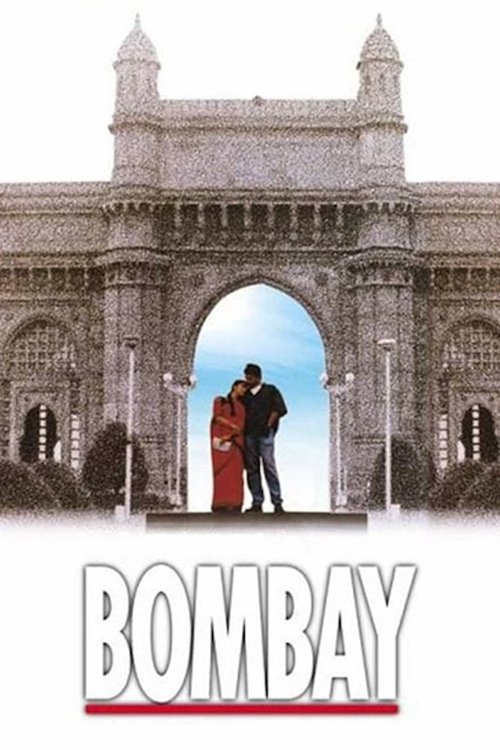











No Image
Popular
What challenges do Shekhar and Shaila face in their inter-religious marriage?
How does the Bombay riots impact the lives of Shekhar and Shaila?
What role does the character of Shekhar's father play in the story?
What is the significance of the character of Shaila's brother in the film?
How does the film depict the theme of love amidst communal violence?
Should I watch it?
Ask Your Own Question

What is the plot?
Shekhar Pillai begins as a young journalism student from an orthodox Tamil Hindu family, and when he returns from Bombay to his village in Mangudi, Tirunelveli, in 1985, his life changes the moment he sees Shaila Banu near the jetty, walking in a burqa or, in some versions of the plot, as a shy Muslim schoolgirl who immediately captures his attention. The encounter is quiet but electric: the sea, the jetty, and the village's narrow social boundaries frame a love story that is already doomed by the world around them. Shekhar is the son of Narayana Pillai, a stern and deeply conservative Hindu father, and Shaila is the daughter of Basheer, a Muslim father who is equally unwilling to accept a marriage across religious lines. What begins as fascination becomes pursuit, then mutual recognition, and then love. Shaila initially resists him, trying to keep distance, but repeated encounters erode her caution until she finally returns his feelings.
Their romance grows in secret against the hard walls of family duty. Shekhar eventually gathers enough courage to approach Basheer directly and asks for Shaila's hand in marriage, but Basheer refuses flatly because they belong to different religions. Shekhar then brings the same request to his own father, and Narayana Pillai reacts with anger and humiliation, treating the relationship as an insult to tradition and family honor. The confrontation between the fathers becomes the first real explosion in the story, because each man sees the other not as a fellow parent but as an obstacle to be resisted. One summary describes Shekhar's meeting with Basheer as nearly violent, and the later argument between Narayana Pillai and Basheer only deepens the hostility. The village, which had first seemed like a place of innocence and open sky, now feels claustrophobic, a social trap where every glance is watched and every choice is policed.
Heartbroken but not defeated, Shekhar leaves for Bombay again, carrying both his ambition and his unresolved love with him. He does not sever the bond, however. Instead, he keeps writing to Shaila, and one account notes that he sends her a letter and a one-way ticket to Bombay through a friend, turning a simple piece of paper into a promise of escape. The ticket is both romantic and practical: it offers a route out of the village's religious rigidity and into the anonymous freedom of the city. Shaila receives the letters and the ticket, but at first she hesitates, trapped between desire and obedience. Basheer learns of the correspondence and prepares to force her into marriage to end the affair. That pressure becomes unbearable, and Shaila finally makes her decision. She leaves home, slips away from the village, and travels to Bombay to marry Shekhar, choosing love over the life her family has planned for her.
Bombay initially functions like a refuge. The city gives the lovers distance from their families, distance from the village's judgment, and distance from the immediate violence of religious opposition. They marry and begin a modest domestic life together. In some accounts they are described as living happily, in others as building a secure life, but all versions agree that they create a stable home against the odds. Their union is openly inter-religious and therefore socially charged, yet within the privacy of marriage it seems to survive through mutual devotion and shared routine. Their happiness expands when Shaila becomes pregnant and gives birth to twin sons, named Kamal and Kabir in most summaries, though the precise order and family-name variants differ slightly across sources. The children become the symbolic center of the film's middle section. They are raised without rigid religious boundaries or, in some descriptions, with both Hindu and Muslim influences, so that the family itself becomes an attempted bridge between communities rather than a battlefield.
For a while, this is enough. The couple's life in Bombay has ordinary rhythms: home, work, children, affection, and the quiet courage of a mixed-faith family trying to live beyond ideology. But the film is always moving toward the larger historical catastrophe waiting in the background. That catastrophe begins to gather force with the demolition of the Babri Masjid on 6 December 1992, the event explicitly identified in multiple sources as the spark that sets off the Bombay riots. The city that had sheltered Shekhar and Shaila now becomes the stage for religious rage, misinformation, retaliation, and terror. The private history of one family collides with national history, and the film's emotional scale widens violently. A further escalation follows on 5 January 1993, when two murders are propagated as communal killings, triggering another round of riots and further sharpening Hindu-Muslim tensions in the city. Bombay, once the city of escape, turns into a city under siege.
The riots do not remain abstract background noise. They move directly into the family's life, and the tension that had once lived in parental disapproval now becomes physical danger. The most painful turn comes when the two fathers, Narayana Pillai and Basheer, who once opposed the marriage, are brought into the same orbit again under far more desperate circumstances. One summary notes that the parents come to Bombay after six years and finally accept the relationship between their children across religious boundaries. Another says they set aside their differences in order to save their children and grandchildren. This is one of the film's major emotional reversals: the men who began as antagonists are transformed by crisis into protectors. Their acceptance is not framed as a neat ideological conversion but as the result of seeing the family as real, vulnerable human beings rather than symbols of doctrinal conflict. The city's violence forces them to confront what their prejudice almost destroyed.
As the riots intensify, the apartment where Shekhar and Shaila live becomes a trapped interior space, a domestic sanctuary under attack. The home has always carried symbolic weight because it is the product of love against social hostility, but now it is also a potential tomb. Arsonists set the apartment on fire during the riots. The danger closes in fast, smoke and panic swallowing the room. Shekhar tries to evacuate everyone, and the scene becomes the film's central survival struggle. The effort is frantic, full of shouted instructions, fear, and the raw chaos of a family trying to keep itself alive while history burns around it. But the rescue fails for the elders. Narayana Pillai, Basheer, and Basheer's wife are unable to escape in time and die in the explosion caused by the fire. Their deaths are not random accidents; they are the direct result of the arsonists who ignite the apartment during the riots. The film makes the loss devastating precisely because these are the same parents who first resisted the marriage and later, through suffering and proximity, came to understand and protect it. Their deaths feel like both punishment and tragic witness.
The fire is the climax in every sense: visually, emotionally, and thematically. Flames consume the private home, but they also symbolize the larger communal hatred consuming the city. The explosive destruction ends the possibility of easy resolution. Yet the film still has one more wound to deliver. In the confusion and crowd panic, Kamal and Kabir are separated from their parents. This separation is one of the story's most heartbreaking turns because it fractures not just the household but the future the couple had tried so hard to build. The children, who were once meant to embody unity across faiths, are now lost in the same public violence that has killed their grandparents. The riot does what prejudice alone could not: it tears the family apart physically, not just ideologically.
The final movement of the story is defined by aftermath, grief, and the sense that survival itself has become uncertain. The available summaries agree that many people die in the riots, but only the family deaths are specifically named with certainty. The narrative therefore ends not with triumph but with devastation carried by the surviving generation. Shekhar and Shaila are left to face the ruin of both city and household, while the children's separation adds an unresolved ache that lingers beyond the frame. The film's larger meaning is made painfully clear here: the inter-religious family that once seemed like a personal rebellion against social prejudice is now caught inside a national tragedy, and ordinary love has been forced to endure the full weight of communal hatred.
What gives the ending its power is the way the story has carefully transformed each space it uses. The village jetty is where love first appears, the village homes are where parental authority first blocks it, the ticket to Bombay carries the lovers into chosen exile, and Bombay itself--initially the city of possibility--becomes the site of destruction. Even the apartment changes meaning over time: first a home, then a symbol of coexistence, then a burning trap. The final image, as preserved in the plot summaries, is not of reconciliation but of loss under fire, with Narayana Pillai, Basheer, and Basheer's wife dead, the children scattered, and the family's fragile bridge between religions crushed beneath riot violence.
The movie ends by leaving the emotional aftermath open rather than neatly resolved. The interfaith marriage survives long enough to produce children and to force the older generation into a late and tragic acceptance, but the riots exact a brutal price. Shekhar and Shaila's love is not undone by lack of devotion; it is attacked by the social world around them, then nearly erased by fire and chaos. Their parents, once enemies, die in the very household that their opposition helped make vulnerable, and the children they hoped to protect are lost in the confusion. The story closes in the shadow of that destruction, with the family's future uncertain and the city still convulsed by communal violence.







What is the ending?
In the ending of the movie "Bombay," the communal riots escalate, leading to a tragic climax where the main characters face devastating losses. The film concludes with a poignant scene that emphasizes the futility of violence and the hope for peace amidst chaos.
As the film approaches its climax, the communal tensions in Bombay reach a boiling point. The streets are filled with chaos as riots break out, and the atmosphere is charged with fear and anger. Arjun, a Hindu man, and his wife, a Muslim woman named Sheela, find themselves caught in the crossfire of the violence that erupts around them. Their love, which once symbolized unity between two communities, is now threatened by the very divisions that surround them.
In a heart-wrenching sequence, Arjun and Sheela attempt to escape the violence, desperately trying to protect their children. The couple's determination to keep their family safe is palpable, and their fear is mirrored in the eyes of their children. As they navigate through the chaos, they witness the brutality of the riots, with people from both communities attacking each other, driven by hatred and fear.
Tragically, the couple's efforts to shield their family from harm are in vain. In a moment of sheer horror, their children are caught in the violence, leading to a devastating loss that shatters Arjun and Sheela's world. The emotional weight of this moment is profound, as the couple is left to grapple with their grief and the senselessness of the violence that has torn their family apart.
In the aftermath of the riots, the film shifts to a somber tone. Arjun and Sheela, now bereaved, are seen standing amidst the ruins of their lives. The once vibrant love story that symbolized hope and unity has been marred by tragedy. The couple's pain is palpable, and their expressions reflect a deep sense of loss and despair.
The film concludes with a powerful visual metaphor. As Arjun and Sheela stand together, they are surrounded by the remnants of destruction, yet they hold onto each other, symbolizing the enduring strength of love even in the face of overwhelming adversity. The final scenes emphasize the need for reconciliation and understanding between communities, leaving the audience with a poignant reminder of the consequences of hatred and the importance of unity.
In summary, the ending of "Bombay" encapsulates the tragic consequences of communal violence, highlighting the personal losses experienced by Arjun and Sheela while also conveying a message of hope for peace and understanding amidst chaos.
Is there a post-credit scene?
The movie "Bombay," produced in 1995, does not have a post-credit scene. The film concludes with a powerful and emotional climax that encapsulates the themes of love, communal harmony, and the devastating impact of violence. After the intense events that unfold, the story wraps up without any additional scenes during or after the credits. The focus remains on the resolution of the main characters' arcs and the poignant message of unity amidst chaos.
What challenges do Shekhar and Shaila face in their inter-religious marriage?
Shekhar, a Hindu, and Shaila, a Muslim, face significant societal and familial opposition to their inter-religious marriage. Their families are deeply rooted in their respective religious beliefs, leading to intense conflict and emotional turmoil. Shekhar's father is particularly adamant against the union, while Shaila's family also disapproves, fearing the repercussions of their daughter's choice. This societal pressure manifests in various forms, including threats and violence, highlighting the deep-seated communal tensions in Bombay.
How does the Bombay riots impact the lives of Shekhar and Shaila?
The Bombay riots serve as a catalyst for tragedy in Shekhar and Shaila's lives. As communal violence erupts, their love is tested in unimaginable ways. The riots lead to the destruction of their home and the loss of their loved ones, forcing them to confront the harsh realities of their society. The chaos and brutality of the riots create a backdrop of fear and despair, ultimately leading to a heartbreaking separation and loss that profoundly affects their emotional states and future.
What role does the character of Shekhar's father play in the story?
Shekhar's father is a pivotal character who embodies the traditional Hindu values that oppose his son's marriage to Shaila. Initially, he is portrayed as a strict and unyielding figure, representing the societal norms that dictate religious boundaries. His disapproval creates a rift between him and Shekhar, leading to intense emotional conflict. As the story progresses, his character experiences moments of vulnerability and reflection, particularly as the consequences of the riots unfold, forcing him to confront his prejudices and the impact of his beliefs on his family.
What is the significance of the character of Shaila's brother in the film?
Shaila's brother plays a crucial role in illustrating the familial loyalty and the extreme lengths to which individuals will go to protect their loved ones. Initially, he is protective of Shaila, but as the communal tensions escalate, he becomes increasingly radicalized, reflecting the societal pressures and the impact of the riots on personal relationships. His actions ultimately lead to tragic consequences, showcasing the destructive nature of communal hatred and the loss of familial bonds in the face of violence.
How does the film depict the theme of love amidst communal violence?
The film poignantly depicts love as a powerful force that transcends religious boundaries, embodied in the relationship between Shekhar and Shaila. Their love is portrayed as pure and genuine, yet it is constantly threatened by the external forces of communal violence. The film contrasts their intimate moments of connection with the harsh realities of the riots, emphasizing the fragility of their love in a society torn apart by hatred. This juxtaposition highlights the emotional stakes for both characters as they navigate their relationship amidst chaos.
Is this family friendly?
"Bombay," produced in 1995, is a film that deals with heavy themes and contains several scenes that may be considered objectionable or upsetting for children or sensitive viewers. Here are some aspects to consider:
-
Communal Violence: The film depicts intense communal riots, showcasing violence and chaos that can be distressing. There are scenes of people being attacked, which may be disturbing.
-
Death and Grief: Characters experience significant loss, including the death of loved ones. The portrayal of grief and mourning can be emotionally heavy.
-
Displacement: The film addresses themes of displacement and the impact of violence on families, which may be upsetting for younger viewers.
-
Emotional Turmoil: Characters undergo significant emotional struggles, including fear, anger, and despair, which may be intense for sensitive audiences.
-
Social Issues: The film tackles complex social issues, including religious intolerance and societal division, which may require a mature understanding to fully grasp.
Overall, while "Bombay" is a powerful narrative, its themes and scenes may not be suitable for younger audiences or those who are sensitive to violence and emotional distress.







